Exercise-Induced Leg Pain | Bone Stress Continuum | Training Errors | Activity Modification
- Clinical diagnosis - diffuse posteromedial tenderness exceeding 5cm length
- Continuum with stress fractures - same pathophysiology, different severity
- Training load errors are the most common modifiable risk factor
- MRI gold standard if imaging needed - shows periosteal/marrow oedema
- Activity modification, not complete rest - evidence-based approach
- “MTSS pain improves with warm-up; stress fracture pain worsens with activity
- “Female athlete triad/RED-S must be screened in recurrent cases
- “Bone scan has high sensitivity but poor specificity for MTSS
- “Shock-wave therapy emerging as promising treatment modality
Overview and Epidemiology
Medial tibial stress syndrome (MTSS), "shin splints" to the patient, is the most common cause of exercise-induced leg pain and the most common overuse injury of the leg, accounting for 13-17% of running injuries. It is a stress reaction of the tibial cortex along the posteromedial border: the mild end of a bone stress continuum whose severe end is tibial stress fracture. The diagnosis is clinical, and understanding its relationship to stress fracture is what the examiners test.
How common. The headline figure is up to 35% of athletes at some point, and it needs a caveat. Moen's review reports an incidence of 4-35% across military personnel and athletes, and the 35% ceiling is Yates and White's prospective cohort of naval recruits driven through 10 weeks of basic training, close to a worst-case loading experiment. Quote it as the top of the range, not as a recreational runner's risk.
Who. Peak incidence is at 18-25 years. Female runners carry a threefold higher risk in the figure usually quoted; in the naval-recruit cohort 53% of women were affected against 28% of men, a relative risk of 2.03. The remaining risk factors:
- Training errors - a sudden increase in load, and the most common modifiable risk factor
- Female sex - with its lower bone density
- Overpronation of the foot
- Low BMI and relative energy deficiency
- Previous MTSS
Pathophysiology and Mechanisms
The border. The posteromedial tibial border is the junction of the posterior and medial surfaces of the bone. It lies directly under the skin with minimal soft-tissue cover, which is why it is so easy to palpate, and the deep crural fascia attaches along it. The distal two-thirds is the segment most commonly affected.
The muscles. The deep posterior compartment muscles attach to the posterior tibia along this border:
- Soleus - via the soleal line and the middle third of the tibia
- Flexor digitorum longus (FDL) - the posterior tibia
- Tibialis posterior - the interosseous membrane and posterior tibia
The classic teaching is that repetitive traction from these muscles, combined with tibial bending stress, causes periosteal reaction and bone stress injury at the border: "traction periostitis".
Why traction periostitis is the wrong model. Histology does not support it (Moen et al., 2009). MTSS is a localised failure of bone remodelling, osteoclastic resorption outpacing osteoblastic formation in the posteromedial cortex under repetitive bending load; the periosteal oedema seen on MRI is the surface marker of that bony overload, not a primary tendinopathy. The muscle-attachment story is debated as well. Cadaveric work shows the tibialis posterior frequently does not attach at the distal posteromedial site where the pain occurs, and the soleus and the deep crural fascia are more consistent contributors, so which muscle pulls matters less than the bending-overload concept.
Why the model matters. Bone overload is what puts MTSS on a single continuum with tibial stress fracture (same bone, same load mechanism, increasing severity), and it is why management targets load, bone health and energy availability rather than stretching a muscle. If asked the mechanism, say bone-stress injury, resorption outpacing formation under repetitive tibial bending, on a continuum with stress fracture; "traction periostitis" is an older label the histology does not support.
The continuum. The ladder below runs from normal bone to complete fracture, and it is the one summarised at the top of the page. It is not the Fredericson MRI classification of the next section, which numbers its grades differently: a fracture line is continuum grade 3 but Fredericson grade 4b.
Classification Systems
Fredericson. The Fredericson classification grades tibial stress injury on MRI and is the framework everyone uses to structure a return-to-play conversation. Two things to say before quoting it. Fredericson's 1995 paper describes grades 1 to 4; the 4a/4b subdivision is a later modification and should not be credited to him. And the system that now sets return-to-running timelines worldwide was derived from 14 runners with 18 symptomatic legs, with no inter-rater reliability testing and no follow-up to healing, so the grades are a well-reasoned descriptive ladder whose prognostic use is an inference the original study never tested. Use them to organise a conversation and to communicate severity; do not present a grade-specific week count to a patient as though it were measured.
- MRI Findings
- Periosteal oedema only on T2; no marrow involvement
- Recovery Time
- 2-3 weeks
- Management
- Activity modification
- MRI Findings
- Periosteal and marrow oedema on T2/STIR; no T1 marrow signal change
- Recovery Time
- 4-6 weeks
- Management
- Reduce training load 50%
- MRI Findings
- More extensive marrow oedema, visible on T1 and T2
- Recovery Time
- 6-9 weeks
- Management
- Non-impact activity only
- MRI Findings
- Multiple focal intracortical signal abnormalities; no discrete fracture line
- Recovery Time
- 9-12 weeks
- Management
- Complete rest from running
- MRI Findings
- Linear cortical fracture line; highest risk of progression
- Recovery Time
- 12-16+ weeks
- Management
- Protected weight bearing, possible surgery
Grading without a scan. For a typical presentation the grading is clinical, on symptoms and examination: diffuse tenderness is likely MTSS, focal tenderness is likely a stress fracture, and the progression of the pain guides management. Imaging is reserved for the indications set out under Investigations, and clinical judgement decides when they are met.
Clinical Assessment
History. Shin pain is not always shin splints, and the history is where the mimics declare themselves. Ask about:
- Sport and activity - type, frequency, recent changes
- Pain pattern - onset, timing, progression with activity
- Location - diffuse or focal, and which border of the tibia
- Impact - running surface and footwear
- Nutrition, energy availability and menstrual history
- Training load changes - volume, intensity, surface
- Systemic symptoms - fever and night sweats, which mean tumour and infection must be excluded
Examination. The diagnosis rests on the length of the tenderness. MTSS gives diffuse tenderness over more than 5 cm of the posteromedial tibial border, along the distal two-thirds of the bone, and there may be slight palpable periosteal thickening. Resisted ankle plantarflexion or toe flexion loads the deep compartment and reproduces the pain, and the single-leg hop is the provocative test.
What should be absent. The negatives carry as much weight as the positives, because each one points to a different diagnosis:
- Focal point tenderness under 5 cm - stress fracture
- Compartment swelling - chronic exertional compartment syndrome or DVT
- Compartment fullness or pain on passive stretch - chronic exertional compartment syndrome
- Neurological deficit - radiculopathy or nerve entrapment
- Diminished pulses or claudication - a vascular cause
- Night pain or systemic symptoms - exclude tumour
If the symptoms are unilateral, focal, or include neurological or vascular features, investigate further before diagnosing MTSS.
MTSS or stress fracture. The two ends of the continuum are separated at the bedside by where it hurts, over what length, and what the pain does as the athlete runs.
- MTSS
- Diffuse (greater than 5cm)
- Tibial Stress Fracture
- Focal (less than 5cm)
- MTSS
- Posteromedial tibial border
- Tibial Stress Fracture
- Any cortex (anterior higher risk)
- MTSS
- Typically improves
- Tibial Stress Fracture
- Worsens with activity
- MTSS
- Uncommon
- Tibial Stress Fracture
- Common
- MTSS
- Periosteal reaction
- Tibial Stress Fracture
- Cortical stress reaction/fracture
- MTSS
- Usually normal
- Tibial Stress Fracture
- May show fracture line/periosteal reaction
- MTSS
- Periosteal oedema only
- Tibial Stress Fracture
- Marrow oedema + cortical involvement
- MTSS
- 6-8 weeks
- Tibial Stress Fracture
- 12-16+ weeks (depends on grade)
- MTSS
- Activity modification
- Tibial Stress Fracture
- Complete rest from impact
- MTSS
- Progression to stress fracture
- Tibial Stress Fracture
- Complete fracture
The wider differential. Exercise-induced leg pain has several serious mimics, and the table gives the investigation that settles each.
- Key Features
- Diffuse posteromedial tenderness, improves with warm-up
- Investigation
- Clinical diagnosis, MRI if needed
- Key Features
- Focal tenderness, worsens with activity, night pain, risk of complete fracture
- Investigation
- MRI or bone scan
- Key Features
- Cramping/burning with exercise, resolves with rest
- Investigation
- Compartment pressure testing
- Key Features
- Vascular claudication, diminished pulses with exercise
- Investigation
- ABI, duplex, angiography
- Key Features
- Swelling, warmth, calf tenderness, Homans sign
- Investigation
- D-dimer, duplex ultrasound
- Key Features
- Dermatomal symptoms, neural tension signs
- Investigation
- MRI lumbar spine
Investigations
When to image. MTSS is a clinical diagnosis and a typical presentation needs no imaging. Moen's review adds the reason: abnormal findings on bone scan, CT and MRI are prevalent in asymptomatic subjects, so a positive scan in a symptom-free leg means little, which is the argument against imaging a typical presentation. Image when there is:
- Diagnostic uncertainty - focal tenderness, atypical features or red flags
- Failure to improve with 4-6 weeks of appropriate management
- A high-level athlete who needs an accurate prognosis and timeline
- Concern for progression to stress fracture
Radiographs. Usually normal in MTSS. Chronic cases may show periosteal reaction, and a stress fracture may show cortical irregularity or a fracture line as a late finding, but sensitivity for stress injury is under 50% and a film cannot separate MTSS from an early stress fracture. Its role is primarily to exclude other pathology such as tumour and infection.
MRI is the gold standard when imaging is needed. It has high sensitivity and specificity, grades severity on the Fredericson ladder, excludes stress fracture and soft-tissue pathology, and guides the return-to-play timeline; cost and availability are the constraints. In MTSS it shows:
- Periosteal oedema along the posteromedial tibia on T2/STIR
- Linear signal along the tibial border over more than 5 cm
- No discrete fracture line
- No focal marrow oedema
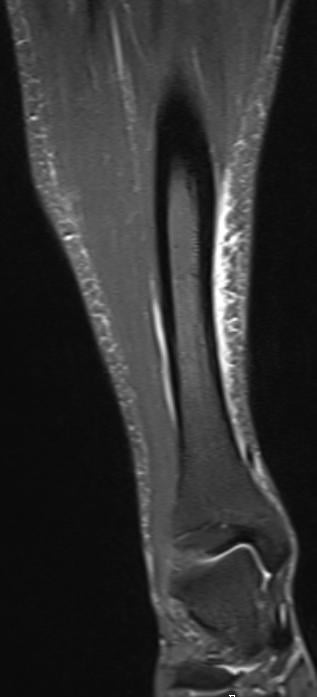
Bone scan. Historically the test, now largely replaced by MRI. MTSS gives linear uptake along the posteromedial cortex, the "railroad track" pattern, whereas a stress fracture gives focal, fusiform uptake. It is highly sensitive but has low specificity and a high false-positive rate, cannot grade severity accurately, and carries a radiation dose.
CT has a limited role in MTSS and is poor for early stress reaction. Use it to characterise an established stress fracture, to assess fracture healing, or when MRI is contraindicated.
Blood tests. Not routinely indicated for typical MTSS. Consider them for recurrent stress injuries, suspected metabolic bone disease, the female athlete triad or RED-S, or systemic symptoms:
- 25-OH vitamin D
- Calcium - serum and 24-hour urine
- PTH if the calcium is abnormal
- TSH for thyroid dysfunction
- DEXA bone density if there is concern
Management
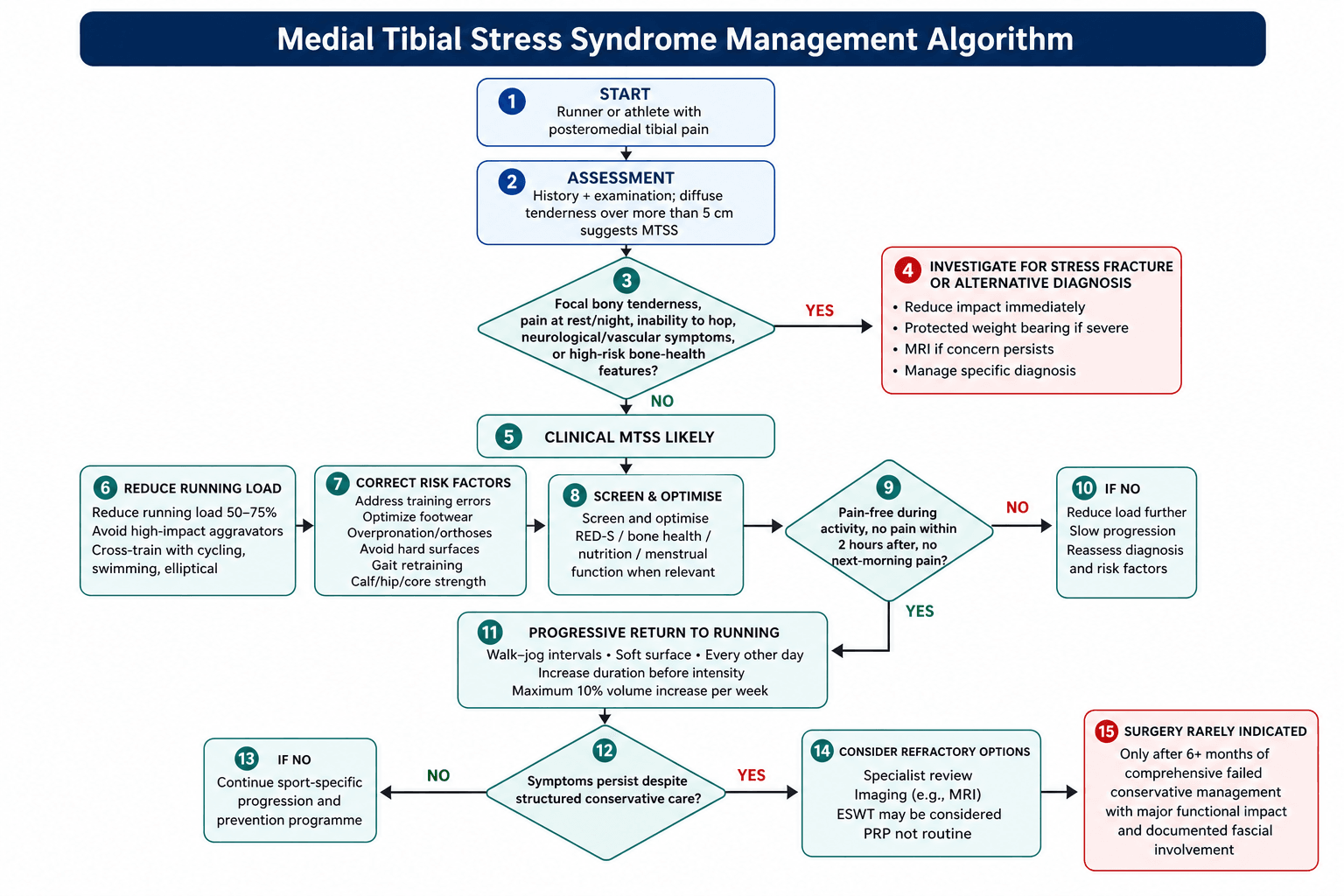
The principle. Activity is modified, not stopped. Complete rest is generally not recommended: it deconditions the athlete without addressing the factors that caused the injury. The plan is to reduce load, address the risk factors (training errors, biomechanics, footwear), let pain guide the return, screen for RED-S (energy availability, bone health, menstrual function) and reintroduce impact gradually. Ice and anti-inflammatories are for symptom relief.
Load. Cut running volume by 50-75% at the outset, avoid high-impact activity, and cross-train (swimming, cycling, elliptical) to hold fitness. The pain rules that govern every step up are:
- No pain during exercise
- No pain within 2 hours afterwards
- No pain the next morning
If pain appears, reduce the load and progress more slowly.
Biomechanics. Choose a shoe appropriate to the foot type, replace worn shoes (over 500 km), and consider a motion-control shoe for overpronation. Semi-rigid or custom orthoses are used for overpronation, and the support for them on this page is Moen's finding that neoprene or semi-rigid orthoses may aid prevention. Gait retraining raises cadence by 5-10% and reduces overstriding; consider specialist referral.
Rehabilitation. Stretch gastrocnemius and soleus, 30 seconds, three times daily, and strengthen with eccentric calf raises, hip and core stability work, and balance and proprioception training. Be candid about the evidence: Winters's systematic review found stretching and strengthening among the interventions not proven effective. Soft-tissue massage has limited evidence and dry needling emerging evidence.
Adjuncts for the refractory case. Extracorporeal shockwave therapy (ESWT) has emerging evidence for refractory MTSS and may stimulate a healing response; Winters rated it the most promising of the interventions reviewed, and the ESWT trials behind that verdict include Rompe's non-randomised cohort in the Evidence Base. Periosteal pecking, ultrasound-guided needling of the periosteum, has a theoretical benefit and limited evidence. PRP injection has insufficient evidence and is not routinely recommended.
Return to running. The protocol below is the graded return that the pain rules police at every step.
Surgical Technique
Surgical intervention for MTSS is rarely needed and reserved for refractory symptoms despite comprehensive conservative management. Most cases resolve with activity modification and addressing underlying risk factors.
Be explicit with the patient about the evidence, because there is very little. Not one of the studies carded on this page examined surgery for MTSS: Winters's systematic review assessed eleven trials of non-operative interventions and concluded that none of them was free enough of bias to be recommended, and the only operative-adjacent technique it looked at — periosteal pecking — reached just Level 3 to 4. So the surgical pathway rests on case series and surgical reasoning rather than on comparative data, and it sits below extracorporeal shockwave in the evidence hierarchy, not above it. That is the argument for exhausting load management and completing a shockwave trial first, and for consenting any operation as an option of last resort with genuinely uncertain benefit.
Indications. Consider surgery only if:
- Symptoms persist despite 6 or more months of appropriate conservative treatment
- There is a significant impact on an athletic or military career
- Imaging documents fascial involvement (a thickened deep posterior fascia)
- Every non-operative option, including biomechanical correction, has been tried and failed
- The patient understands the variable success rates and the rehabilitation required
Contraindications. Do not operate when:
- Active training errors have not been addressed
- Underlying RED-S or bone health has not been optimised
- Expectations are unrealistic
- Conservative management has run for less than 6 months
Deep posterior fasciotomy. The operation releases the deep fascia overlying tibialis posterior and FDL to reduce traction on the tibial periosteum, and can be done open or endoscopically. The steps:
- Longitudinal incision over the posteromedial tibia
- Identify the deep crural fascia
- Release the fascia covering tibialis posterior and FDL
- Ensure complete release over the symptomatic area
- Inspect the periosteum, which may be cauterised if inflamed
Success rates are variable, 60-90% in small series.
Periosteal pecking. Multiple perforations of the inflamed periosteum to stimulate a healing response, alone or combined with fasciotomy. Expose the posteromedial tibial periosteum and use a drill or needle to make multiple perforations about 1 cm apart across the symptomatic area, which promotes bleeding and a healing response. The studies are few and the benefit theoretical.
Complications and Prevention
Progression to stress fracture. The primary concern with inadequately managed MTSS is progression to a tibial stress fracture. The risk rises with:
- Continued training through pain
- Failure to address training load errors
- Underlying low energy availability (RED-S)
- Low bone density
- Female sex
Pain-guided activity modification and addressing the modifiable risk factors prevents progression in the vast majority of cases.
The posteromedial tibia is the compression side of the bending tibia and is well vascularised, so the stress fractures on the MTSS continuum are low risk and heal reliably with load modification. The anterior mid-diaphyseal cortex is the tension side and relatively hypovascular, so a fracture there is high risk: prone to delayed union, non-union, progression to complete (sometimes displaced) fracture, and recurrence. Its radiographic hallmark is the "dreaded black line", a transverse anterior cortical lucency, often with cortical hypertrophy around it.
Management differs accordingly. A true anterior-cortex stress fracture often does not reliably respond to rest alone and may require prolonged protected loading, bone stimulation or optimisation, or surgical intramedullary nailing, quite unlike the conservative pathway for posteromedial MTSS. When shin pain progresses to a stress fracture, localise the cortex before choosing the pathway.
Prevention. The modifiable risk factors are the targets:
- Training errors - sudden increases in volume or intensity; progress by no more than 10% a week and monitor volume and intensity
- Footwear - worn shoes, or shoes inappropriate for the foot type; replace worn shoes
- Surface - excessive hard-surface running; vary the running surface
- Biomechanics - overpronation and muscle imbalance; neuromuscular training for strength and flexibility
- Energy availability - inadequate nutrition; track menstrual function in female athletes
The non-modifiable factors are female sex, previous MTSS, bone density (which has a genetic component), tibial anatomy (a narrow diaphysis) and age, with the peak in young adults.
The prevention evidence. The strongest on this page is Sharma's randomised trial in at-risk British Army recruits: supervised gait retraining plus neuromuscular exercise reduced MTSS with an adjusted hazard ratio of 0.25 and a number needed to treat of 14 at 20 weeks. The intervention was a supervised bundle delivered to a screened subgroup, so the effect cannot be attributed to gait retraining specifically or generalised to unscreened trainees or to athletes.
Postoperative Care and Rehabilitation
The aim. After fasciotomy for refractory MTSS, rehabilitation is a gradual return to loading while the fascia heals, with the biomechanical factors that caused the problem addressed alongside. Return to sport is typically at 3-6 months.
Phase 1, protection (0-2 weeks). The goals are wound healing, control of swelling, maintained ankle range and no complications:
- Protected weight bearing with crutches
- Elevation when resting; ice 3-4 times daily
- Ankle pumps and circles, and gentle active range of movement within pain limits
- No impact activity; keep the wound clean and dry and watch it for infection
Phase 2, early rehabilitation (2-6 weeks). Restore full weight bearing, progress range and flexibility, begin strengthening and keep the cardiovascular base:
- Progress to full weight bearing as tolerated, by week 4
- Gastrocnemius and soleus stretching
- Isometric calf strengthening
- Pool running or swimming, and the stationary bike
- Balance exercises; no impact
Progress to the next phase once gait is pain-free and there is no swelling.
Phase 3, advanced rehabilitation (6-12 weeks). Progressive strengthening, a gradual return to impact, and the biomechanics addressed:
- Eccentric calf strengthening
- Walk-jog progression on a soft surface, with cross-training to hold fitness
- Plyometric exercises at weeks 10-12
- Gait retraining if indicated
- Running volume increased by no more than 10% per week
Monitor pain during and after activity, and swelling.
Return to sport (12 weeks and beyond). The criteria:
- Pain-free daily activities
- Full, painless range of movement
- Calf strength 90% of the contralateral side
- Sport-specific drills completed without pain
- No pain on the single-leg hop test
- Psychological readiness
Maintenance afterwards is what prevents recurrence: continue the strengthening programme, monitor training load by the 10% rule, keep appropriate footwear, address any biomechanical issue, and screen regularly for recurrence.
Outcomes and Prognosis
Natural history. With appropriate management MTSS has an excellent prognosis:
- 85-90% resolve with conservative management
- Average recovery 6-8 weeks with activity modification
- Recurrence 20-30% if the underlying factors are not addressed
- Progression to stress fracture under 10% with appropriate load management
- Surgery needed in under 5% of cases
What predicts the outcome. The favourable factors are early recognition and management, good compliance with activity modification, training errors addressed, biomechanical issues corrected, adequate energy availability, no previous stress fracture, and male sex. The poor prognostic factors:
- Continued training through pain
- Multiple recurrences
- Underlying RED-S or low bone density
- Anterior tibial location, with its higher fracture risk
- Failure to address biomechanics or manage training load
- A concomitant stress fracture
Recovery by severity. The table gives the expected course. Read the third row against the Fredericson table: a Fredericson grade 2 (marrow oedema on T2) is quoted at 4-6 weeks there, while severe MTSS with marrow oedema is quoted at 8-12 weeks here, and the gap is a reminder that the grade-specific week counts are inference rather than measurement.
- Conservative Management
- Activity modification 25-50%
- Expected Recovery
- 3-4 weeks
- Return to Sport
- 4-6 weeks
- Conservative Management
- Activity modification 50-75%
- Expected Recovery
- 6-8 weeks
- Return to Sport
- 8-10 weeks
- Conservative Management
- Significant load reduction
- Expected Recovery
- 8-12 weeks
- Return to Sport
- 12-16 weeks
- Conservative Management
- Complete rest from impact
- Expected Recovery
- 12-16+ weeks
- Return to Sport
- 16-20+ weeks
- Conservative Management
- Comprehensive management ± surgery
- Expected Recovery
- Variable, 3-6 months
- Return to Sport
- 6-9 months
Incidence and Risk Factors in Naval Recruits
- Prospective cohort of 124 naval recruits over a 10-week basic training period
- MTSS incidence 35% (40 of 124 recruits affected)
- Female recruits affected 53% versus 28% in males (relative risk 2.03)
- Pronated foot type associated with MTSS (relative risk 1.70)
- Identifying pronation pre-training may enable preventive intervention
Guidelines, Registries & Global Practice
Global Epidemiology
MTSS is consistently the most common exercise-induced leg injury worldwide, but reported frequency varies with population and case definition.
- Reported figure
- 4-35%
- Source
- Moen 2009 critical review (PMID 19530750)
- Reported figure
- 35% overall incidence
- Source
- Yates & White 2004 (PMID 15090396)
- Reported figure
- 53% vs 28% (RR 2.03)
- Source
- Yates & White 2004 (PMID 15090396)
- Reported figure
- RR 1.70 for MTSS
- Source
- Yates & White 2004 (PMID 15090396)
The female predominance and the role of foot pronation are reproducible across prospective military cohorts (Yates & White 2004, PMID 15090396, DOI; Moen 2009, PMID 19530750, DOI).
Guideline & Consensus Positions
There is no single dedicated AAOS/NICE/BOA clinical practice guideline for MTSS; practice is shaped by sports-medicine consensus statements and systematic reviews. The table below summarises authoritative positions and their evidence strength.
- Position on MTSS
- No active treatment proven; ESWT most promising; manage load/risk factors
- Evidence basis
- Level I review of Level 3-4 trials
- Position on MTSS
- Rest equals other interventions; orthoses may prevent; clinical diagnosis primary
- Evidence basis
- Level II review
- Position on MTSS
- Screen recurrent bone stress injury for the Female Athlete Triad / low energy availability
- Evidence basis
- Expert position stand (Level V)
- Position on MTSS
- Clinical algorithm; positive hop test plus focal tenderness signals stress fracture; image only if no response to rest
- Evidence basis
- Prospective validation cohort
Registry & Prospective-Cohort Evidence
MTSS is not captured by joint-replacement registries (AOANJRR/NJR/AJRR); the equivalent population-level evidence comes from military training cohorts, which provide the most robust incidence and prevention data.
Gait Retraining Reduces MTSS Incidence (RCT)
- RCT in 166 at-risk British Army recruits during 26-week basic training
- Supervised gait retraining plus neuromuscular exercise versus usual training
- Adjusted hazard ratio for MTSS 0.25 (95% CI 0.05-0.53)
- Number needed to treat 14 to prevent one additional injured recruit at 20 weeks
Clinical Differentiation of Stress Fracture from MTSS (IDF Protocol)
- Prospective validation of the Israel Defense Forces medial tibial stress fracture protocol in 429 elite infantry recruits
- A positive hop test alongside tibial pain and tenderness predicted stress fracture with an odds ratio of 52.04 - but the 95% confidence limits run from 2.80 to 967.74, so read it as a strong signal of direction and NOT as a usable magnitude
- Stress fracture occurred when the band of tenderness was 10cm or less; diffuse tenderness favoured MTSS, and tibial pain SCORES were not predictive at all
- Over 14 weeks of basic training, an initial imaging-free protocol of 10 to 14 days rest resolved more than two-thirds of suspected cases, with bone scan reserved for non-responders
Practice Variation Across Health Systems
- Common international practice
- Clinical across all systems; imaging reserved for atypical or non-responding cases
- Common international practice
- MRI preferred globally where accessible; bone scan still used where MRI access is limited
- Common international practice
- Load modification and risk-factor correction universal; ESWT used in better-resourced settings for refractory cases
- Common international practice
- A leading driver of training time-loss and medical downgrading in military recruits; UK, Israeli and Australian programmes use gait retraining and graduated loading to reduce incidence
MCQ Practice Points
Q: What is the characteristic clinical finding that distinguishes MTSS from tibial stress fracture? A: Diffuse tenderness over greater than 5cm of the posteromedial tibial border. Point tenderness less than 5cm suggests stress fracture.
Q: What is the gold standard imaging modality for suspected MTSS? A: MRI - demonstrates periosteal edema on T2/STIR sequences. X-rays are usually normal in MTSS.
Q: What is the underlying mechanism of MTSS? A: Traction periostitis from soleus, FDL, and tibialis posterior muscles combined with repetitive tibial bending loads causing periosteal reaction at the posteromedial border.
Q: What is the key management principle for MTSS? A: Activity modification (not complete rest) with pain-guided return to activity. The 10% rule limits weekly training increase.
Q: What is the most common modifiable risk factor for MTSS? A: Training errors (sudden increase in volume, intensity, or change in running surface). Female sex increases risk 3-fold but is non-modifiable.
- MTSS is a clinical diagnosis - imaging not required
- Diffuse tenderness over greater than 5cm posteromedial tibial border
- Pain improves with warm-up (vs stress fracture worsens)
- Distal 2/3 of tibia most commonly affected
- Single-leg hop test provocative
- Must exclude stress fracture if focal tenderness
- Traction periostitis from soleus, FDL, tibialis posterior
- Bone stress continuum with stress fractures
- Repetitive tibial bending loads
- Periosteal reaction on histology
- NOT purely muscular origin
- Same risk factors as stress fractures
- MRI is gold standard for imaging
- Periosteal edema on T2/STIR sequences
- X-ray usually normal in MTSS
- Bone scan: sensitive but NOT specific
- Fredericson classification grades severity
- CT has limited role in MTSS
- Female sex increases risk 3-fold
- Training errors most common modifiable factor
- Previous MTSS history
- Overpronation of foot
- Low BMI and RED-S
- Hard running surfaces
- Activity MODIFICATION not complete rest
- Pain-guided return to activity
- 10% rule for weekly training increase
- Address biomechanics and footwear
- Screen for RED-S in recurrent cases
- Surgery rarely indicated (under 5%)
- 85-90% resolve conservatively
- Average recovery 6-8 weeks
- Recurrence 20-30% if factors not addressed
- Progression to fracture under 10%
- Excellent long-term prognosis
- Return to pre-injury level in 87%
Common MCQ Scenarios
- Most Likely Diagnosis
- MTSS
- Next Best Investigation
- None - clinical diagnosis
- Definitive Management
- Activity modification 50%, biomechanics
- Most Likely Diagnosis
- Tibial stress fracture
- Next Best Investigation
- MRI tibia
- Definitive Management
- Complete rest from impact, protected WB
- Most Likely Diagnosis
- MTSS with RED-S
- Next Best Investigation
- DEXA scan, vitamin D, menstrual workup
- Definitive Management
- Increase energy availability, MDT approach
- Most Likely Diagnosis
- Refractory MTSS
- Next Best Investigation
- MRI to exclude stress fracture
- Definitive Management
- Consider ESWT or surgical fasciotomy
- Most Likely Diagnosis
- Fredericson Grade 1
- Next Best Investigation
- None - confirms MTSS
- Definitive Management
- Activity modification 2-3 weeks
Key Numbers for MCQs
- What it belongs to
- Length of tenderness along the posteromedial tibial border
- Why it is the answer
- The single most-tested discriminator: MTSS is diffuse over 5 cm or more, a stress fracture is focal, under 5 cm. If a stem gives you a length, it is telling you the diagnosis.
- What it belongs to
- Pain behaviour
- Why it is the answer
- The other half of the same discrimination — MTSS pain eases as the athlete warms up; stress-fracture pain gets worse the longer they run, and adds night pain.
- What it belongs to
- Prevalence in athletes at some point
- Why it is the answer
- The headline epidemiology figure.
- What it belongs to
- Proportion of running injuries
- Why it is the answer
- The denominator that matters is running injuries, not all athletes - do not confuse the two figures.
- What it belongs to
- Maximum weekly increase in training load
- Why it is the answer
- The single most quoted prevention and rehabilitation number, and the one a viva expects you to give unprompted.
- What it belongs to
- Training-load reduction in early management
- Why it is the answer
- Activity is modified, not stopped in MTSS - that is what separates its management from a stress fracture, where impact stops completely.
- What it belongs to
- MRI grading
- Why it is the answer
- Grade 1 periosteal oedema only (2-3 weeks) → Grade 2 adds marrow oedema on T2 (4-6 weeks) → Grade 3 marrow oedema on T1 and T2 (6-9 weeks) → Grade 4a focal cortical change (9-12 weeks) → Grade 4b a discrete fracture line (12-16+ weeks). The T1 involvement at Grade 3 is the usual sticking point.
How these are usually tested. The stem gives a runner, a tenderness pattern and a pain behaviour, and asks for either the diagnosis or the next investigation. Two rules carry most of the marks: MTSS is a clinical diagnosis and needs no imaging, so "MRI" is the wrong answer unless the vignette hints at a stress fracture or refractory symptoms; and the Fredericson grade drives the timeline, not the symptoms, so a grade in the stem is asking for a recovery time.
Clinical Decision Scenarios
Practise clinical reasoning and management decisions out loud
“A 22-year-old female runner presents with 4 weeks of bilateral leg pain. Examination shows diffuse tenderness along the posteromedial tibial borders. She's training for a marathon and recently increased her weekly mileage. How do you approach this case?”
“A 19-year-old male soldier presents with right leg pain worsening over 3 weeks of infantry training. Examination shows focal tenderness over a 2cm area of the mid-tibial shaft. What is your approach?”
“A 17-year-old female cross-country runner has recurrent bilateral shin pain despite two previous periods of rest. She has irregular periods and is underweight. How do you manage this complex case?”
Key Numbers
- 35% - proportion of athletes affected at some point
- 5cm - the tenderness-length distinction (MTSS greater than 5cm, stress fracture less than 5cm)
- 3x - female sex increases risk threefold
- 6-8 weeks - typical MTSS recovery
- 12+ weeks - stress fracture (Fredericson grade 4) recovery
- 10% - maximum weekly training increase for prevention
- 50% - load reduction recommended in acute MTSS
Clinical Diagnosis
- Diffuse posteromedial tibial tenderness (greater than 5cm)
- Distal 2/3 of tibia most commonly affected
- Pain IMPROVES with warm-up (vs stress fracture worsens)
- No focal point tenderness (that's stress fracture)
- Positive single-leg hop test
- Clinical diagnosis - imaging NOT required for typical cases
Fredericson MRI Classification
- Grade 1 - periosteal edema only; 2-3 week recovery
- Grade 2 - periosteal plus marrow edema on T2; 4-6 weeks
- Grade 3 - marrow edema on T1 AND T2; 6-9 weeks
- Grade 4a - focal cortical abnormalities; 9-12 weeks
- Grade 4b - linear fracture line; 12-16+ weeks
Critical Differentials
- Tibial stress fracture - focal tenderness, worsening pain
- Chronic exertional compartment syndrome - compartment fullness, pressure testing diagnostic
- Popliteal artery entrapment - claudication, vascular testing
- Lumbar radiculopathy - dermatomal symptoms
- Deep vein thrombosis - swelling, warmth
Management Principles
- Activity MODIFICATION not complete rest
- Pain-guided return (no pain during, after, or next morning)
- Address training errors (10% weekly increase maximum)
- Footwear/orthoses for overpronation
- Cross-train to maintain fitness
- Screen for RED-S in recurrent cases
Viva Buzzwords
- 'Bone stress continuum'
- 'Traction periostitis'
- 'Pain-guided return to activity'
- 'Relative energy deficiency in sport (RED-S)'
- 'Fredericson classification'
- 'Activity modification preferred over complete rest'
Evidence Base
Fredericson MRI Grading System (Landmark)
- Defined a progression of tibial stress injury: periosteal oedema then marrow involvement then cortical stress fracture
- Introduced the MRI grading system that correlated with technetium bone-scan grading and symptoms
- MRI more accurately localised and graded injury than bone scan, without ionising radiation
- Recommended MRI over bone scan for grading tibial stress lesions in runners
MTSS Pathophysiology and Risk Factors (Critical Review)
- Reported incidence of MTSS between 4% and 35% in military personnel and athletes
- Histology does not support traction periostitis - MTSS reflects bony resorption outpacing formation in the tibial cortex
- Excessive standing foot pronation and female sex are intrinsic risk factors across multiple prospective studies
- Previous history of MTSS is an established risk factor
- In randomised studies rest was equal to other interventions; neoprene or semi-rigid orthoses may aid prevention
Treatment of MTSS - Systematic Review
- Eleven trials reviewed; all RCTs carried a high risk of bias (Level 3 evidence) and non-randomised trials were poor quality (Level 4)
- No single treatment is sufficiently free of methodological bias to be recommended
- Lower-leg braces and iontophoresis showed no significant benefit on pooled analysis
- Extracorporeal shockwave therapy (ESWT) appeared to have the most promise of the interventions examined
- Low-level laser, stretching/strengthening, compression stockings and pulsed electromagnetic fields were not proven effective
Shockwave Therapy for Chronic Recalcitrant MTSS
- Case-control cohort: 47 patients had radial low-energy shockwave therapy plus home training versus 47 controls with home training alone
- Success rate at 15 months 76% (ESWT) versus 37% (control), p less than 0.001
- Mean numeric rating scale at 15 months 2.7 (ESWT) versus 5.3 (control)
- 40 of 47 ESWT patients returned to preferred sport at pre-injury level versus 22 of 47 controls
Female Athlete Triad - ACSM Position Stand
- Defines the Triad as the interrelationship of energy availability, menstrual function and bone mineral density
- Low energy availability (below ~30 kcal/kg fat-free mass/day) is the central driver impairing reproductive and skeletal health
- Athletes should be screened at pre-participation and annual exams and whenever a Triad condition appears
- First aim of treatment is to increase energy availability via intake and/or reduced expenditure, with a multidisciplinary team