Safe Scanning Around Metal
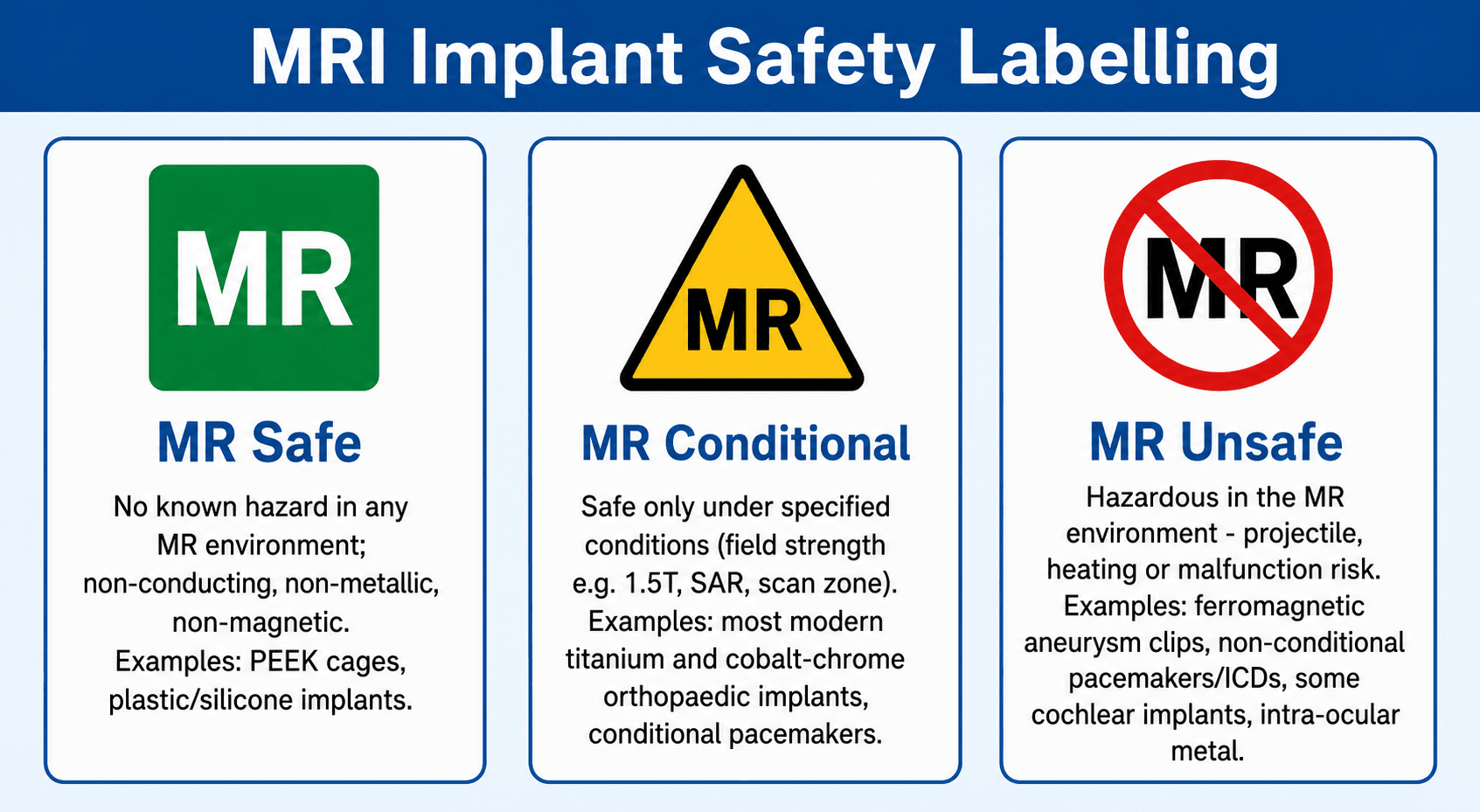
MR Safe: Non-conducting, non-metallic, non-magnetic — safe in ALL MR environments
MR Conditional: Safe under SPECIFIC conditions (field strength, SAR limits, scan duration, gradient specifications)
MR Unsafe: Known hazard in ALL MR environments — MUST NOT enter the MR scanner room
Key: The term 'MRI compatible' is NO LONGER used — it has been replaced by the three-tier classification system
- The three MRI safety categories: MR Safe (no hazard in any MR environment), MR Conditional (safe under specific conditions), MR Unsafe (hazardous in MR).
- Hazards of metal in MRI: missile/projectile effect (translational force), torque (rotational force), RF-induced heating, and image artefact.
- Most modern orthopaedic implants (titanium, cobalt-chrome, tantalum) are MR Conditional at 1.5T — safe to scan under specified conditions.
- Absolute contraindications: non-MR-conditional cardiac pacemakers/defibrillators, ferromagnetic intracranial aneurysm clips, metallic foreign bodies (especially intraocular).
- 1.5T produces less metal artefact than 3T. Spin echo sequences are preferred over gradient echo near metal.
- “Titanium alloy produces the LEAST susceptibility artefact and ferromagnetic force — the preferred material where later MRI is anticipated.
- “Stainless steel (316L) produces SIGNIFICANT artefact but most modern implants are non-ferromagnetic and MR Conditional at 1.5T.
- “Cobalt-chrome (CoCr) produces moderate artefact — between titanium and stainless steel.
- “The 'missile effect' occurs when ferromagnetic objects experience strong translational force toward the magnet bore — potentially lethal.
- “Implant heating risk depends on: implant geometry (loops concentrate current), field strength, SAR, and scan duration.
Overview
Why the surgeon is asked. MRI safety in patients with implants is one of the most clinically important topics in musculoskeletal radiology. As MRI use continues to increase and the population of patients with orthopaedic implants grows, orthopaedic surgeons are frequently asked whether their patients can safely undergo MRI. The common version of the question is a patient with a joint replacement who needs MRI of the spine, and a safe answer rests on understanding how implants and the magnetic field interact.
Ferromagnetism, not metal. The interaction between an implant and the magnetic field depends on the ferromagnetic properties of the material, not simply on whether it is metal. Ferromagnetic materials (iron, nickel and cobalt in certain alloys) experience strong forces in the field; non-ferromagnetic metals (titanium, tantalum and most modern orthopaedic alloys) experience minimal forces and are generally safe.
The three safety categories. ASTM International defines three standardised labels, and every device carries one of them:
- MR Safe - poses no hazard in any MR environment: non-metallic, non-conducting, non-magnetic items such as plastic, ceramic and PEEK cages
- MR Conditional - safe under specified conditions documented by the manufacturer (field strength, spatial gradient, SAR limits, body part scanned). Most modern orthopaedic implants are MR Conditional at 1.5T
- MR Unsafe - poses hazards in all MR environments and must not enter the scanner room
The obsolete term "MRI compatible" should no longer be used; the three-tier classification replaced it.
The Hazards of Metal in the Magnet
Missile effect. Translational force pulls a ferromagnetic object toward the scanner bore and can accelerate it to lethal velocity. The force is proportional to the ferromagnetism of the material and to the spatial gradient of the magnetic field.
Torque. A ferromagnetic object experiences a rotational force that tries to align its long axis with B0. This can displace an implant, the traditional concern being the first 6 weeks before tissue ingrowth; how far that concern still applies to modern implants is discussed under Controversies.
Heating. A metallic implant, especially one forming a loop or with a long conductive path, can absorb radiofrequency energy and heat, risking thermal tissue damage.
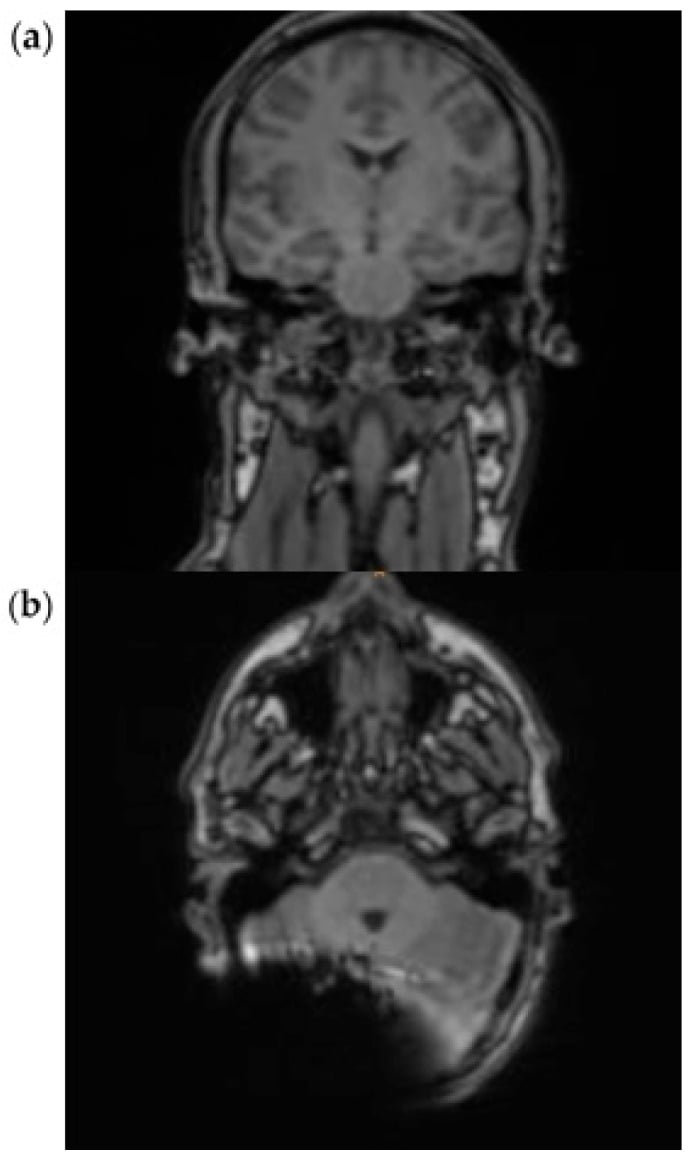
Artefact. Metal distorts the local magnetic field, producing signal void, signal pile-up and geometric distortion that can render images non-diagnostic. Reducing it is the subject of its own section below.
MATHMRI Hazards of Metal
Hook:MATH: Missile, Artefact, Torque, Heating — the four hazards of metal in MRI.
Absolute Contraindications
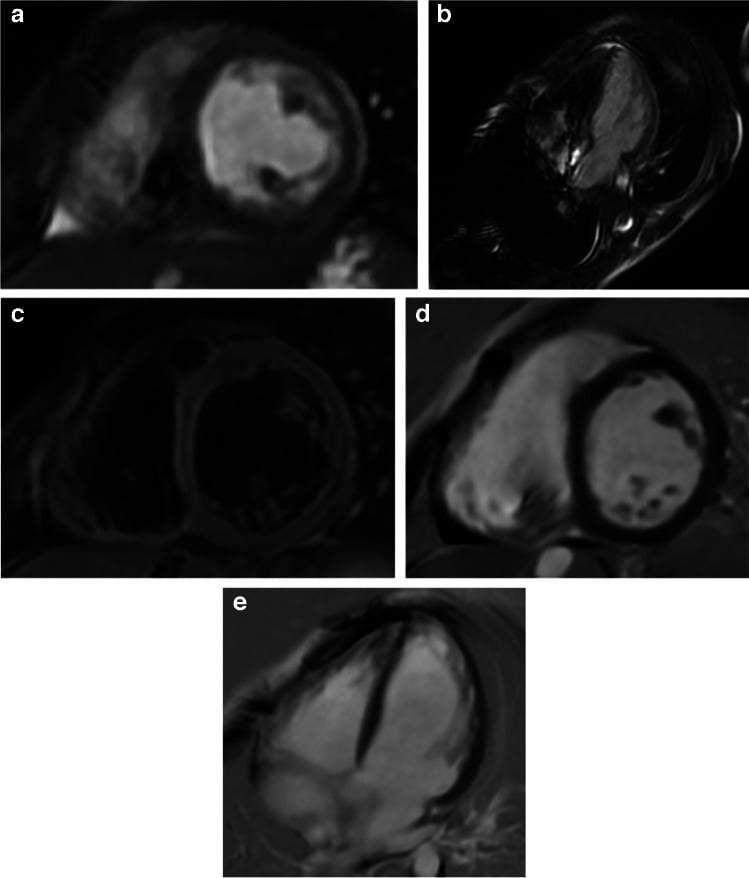
Cardiac pacemakers and defibrillators. This is the most critical MRI safety scenario. A non-MR-conditional pacemaker or implantable cardioverter-defibrillator (ICD) is an absolute contraindication. The potential harms:
- Lead heating causing myocardial thermal injury
- Induced electrical currents causing inappropriate pacing or defibrillation
- Device malfunction, reset or permanent damage
- Lead tip displacement due to electromagnetic forces
MR-conditional cardiac devices. Modern MR-conditional pacemakers, available since approximately 2011, can be scanned under strict conditions:
- A specific field strength only (usually 1.5T only)
- Specific SAR limits
- Reprogramming to MR mode before scanning and restoration afterward
- Cardiology supervision with continuous monitoring
The orthopaedic relevance. Patients with cardiac devices frequently require MRI for orthopaedic conditions of the spine, shoulder and hip. Check the device type, consult cardiology, and consider alternative imaging if the device is MR Unsafe. Never bypass the screening process.
Ferromagnetic intracranial aneurysm clips can torque and displace in the magnetic field, causing fatal intracranial haemorrhage.
Cochlear implants. Older cochlear implants are MR Unsafe; newer models may be MR Conditional. Always verify with the manufacturer.
Intraocular metallic foreign body. Metallic fragments in the eye, for example from grinding, can move and cause retinal damage. Orbital radiograph screening is required if the history suggests the risk.
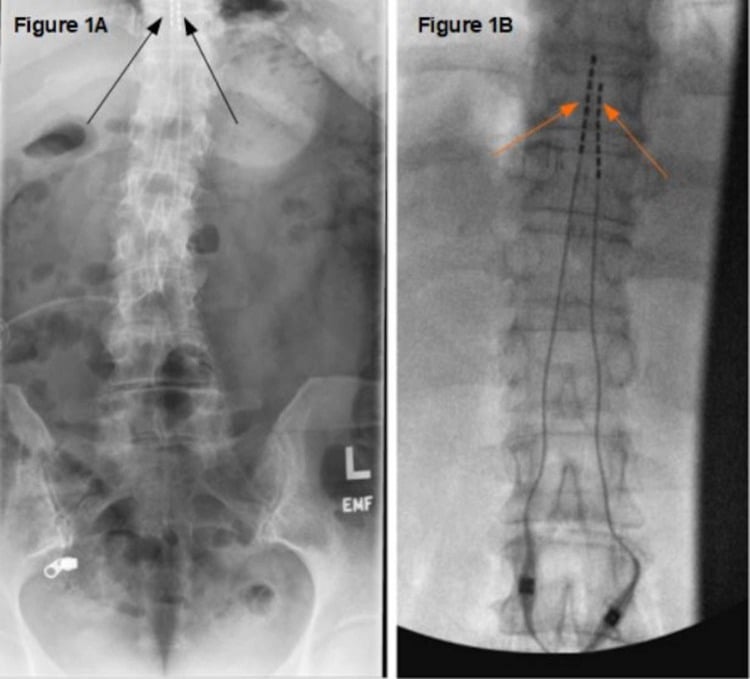
Other electronic devices. Many neurostimulators, insulin pumps and drug infusion devices are MR Unsafe unless specifically certified as MR Conditional.
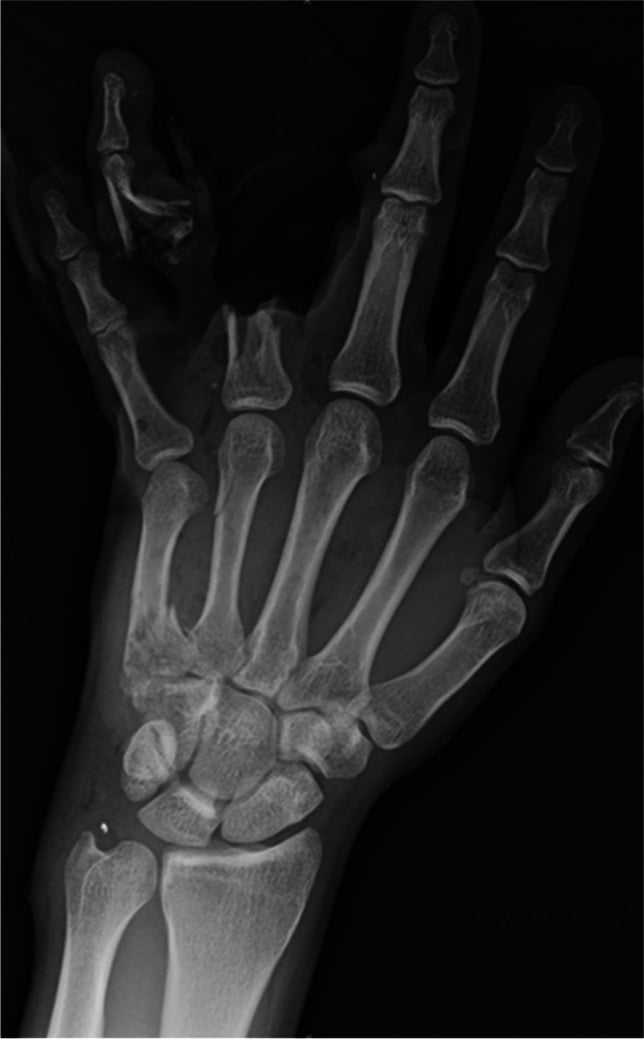
PACEDMRI Contraindications
Hook:PACED: check for these five categories before EVERY MRI scan. Missing one could be fatal.
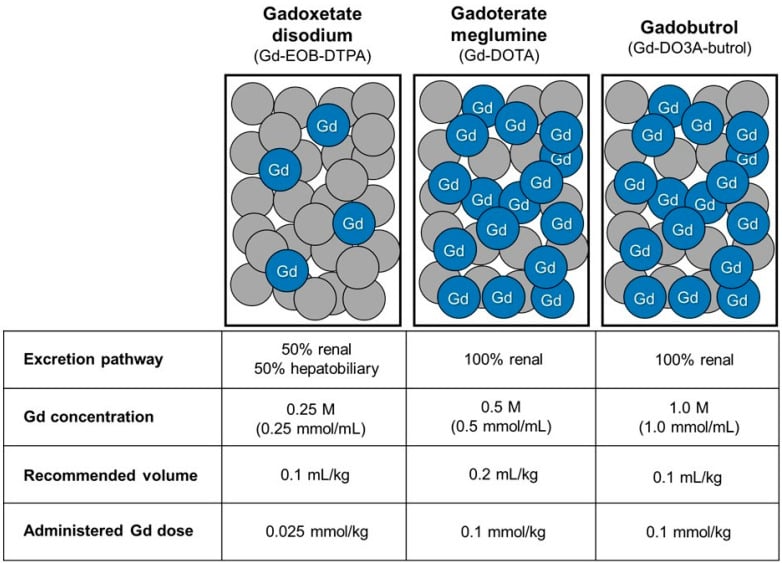
Gadolinium Contrast Agents: Safety and Contraindications
Beyond implants and devices, the other major MRI contraindication the surgeon must know concerns gadolinium-based contrast agents (GBCAs).
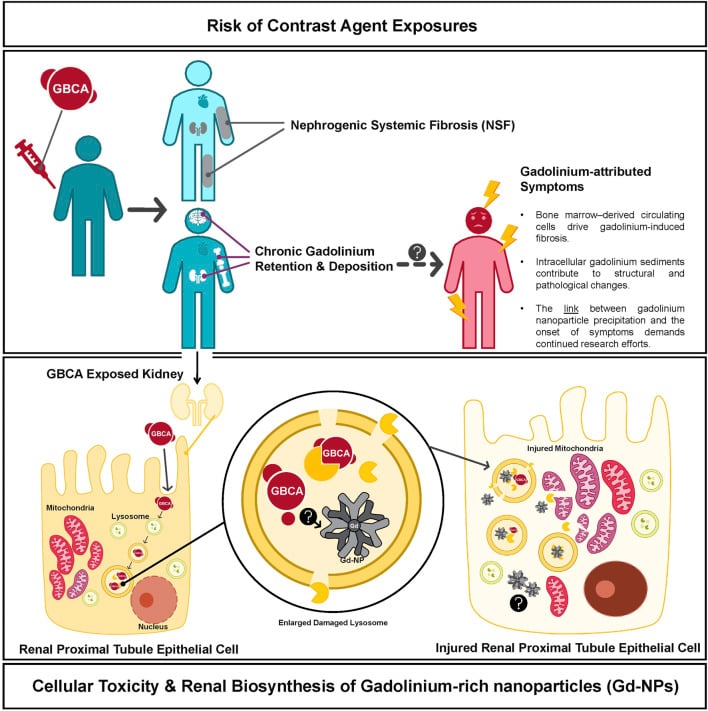
Nephrogenic systemic fibrosis (NSF) is a rare but serious scleroderma-like fibrosing disorder of skin, joints and viscera linked to GBCAs in patients with severe renal impairment: eGFR below 30 mL/min/1.73m², dialysis, or acute kidney injury. Screen renal function (eGFR) before giving contrast to at-risk patients.
Agent classes. In the ACR scheme the older Group I (linear) agents carry the highest NSF risk and are largely withdrawn or restricted; Group II (macrocyclic) agents have a very low or negligible NSF risk and are now preferred. With appropriate agent selection and renal screening, NSF is now very rare.
Retention and deposition. Trace gadolinium can deposit in the brain (dentate nucleus, globus pallidus) and bone, more with linear agents. The clinical significance is uncertain, but it favours using the lowest effective dose of a Group II agent.
Hypersensitivity and pregnancy. Acute hypersensitivity reactions are uncommon but possible, from urticaria to anaphylaxis, so ask about any prior contrast reaction. Gadolinium crosses the placenta and is avoided in pregnancy unless essential; non-contrast MRI itself is generally considered safe in pregnancy when indicated.
In a patient with renal impairment who needs contrast (e.g. suspected periprosthetic infection or tumour), check the eGFR, prefer a Group II macrocyclic agent at the lowest effective dose, and weigh whether a non-contrast protocol can answer the question.
Systematic Approach
The screening framework. The same six steps apply to every patient with a possible implant, and an implant that cannot be identified is assumed MR Unsafe unless the clinical need is urgent and the risk-benefit ratio favours scanning.
- Action
- Complete a standardised MRI safety questionnaire for EVERY patient
- Key Considerations
- Questions must cover: cardiac devices, surgical implants, foreign bodies, cochlear implants, metallic fragments, occupational exposure
- Action
- Identify the exact implant: manufacturer, model, material
- Key Considerations
- Surgical records, implant cards, hospital databases, or contact the operating surgeon. Radiographs can help identify implant type
- Action
- Consult manufacturer MRI safety documentation or MRIsafety.com
- Key Considerations
- Categorise as MR Safe, MR Conditional, or MR Unsafe. Note specific conditions for MR Conditional devices
- Action
- Assess whether the clinical benefit of MRI outweighs any residual risk
- Key Considerations
- If implant cannot be identified, consider alternative imaging (CT, ultrasound). Urgency of clinical need vs risk
- Action
- Select appropriate MRI protocol to minimise risks and artefact
- Key Considerations
- 1.5T preferred. Spin echo sequences. Wider bandwidth. STIR over chemical fat sat. Consider MAVRIC-SL/SEMAC
- Action
- Record the safety assessment, implant details, and conditions met
- Key Considerations
- Document in the medical record for medicolegal protection and future reference
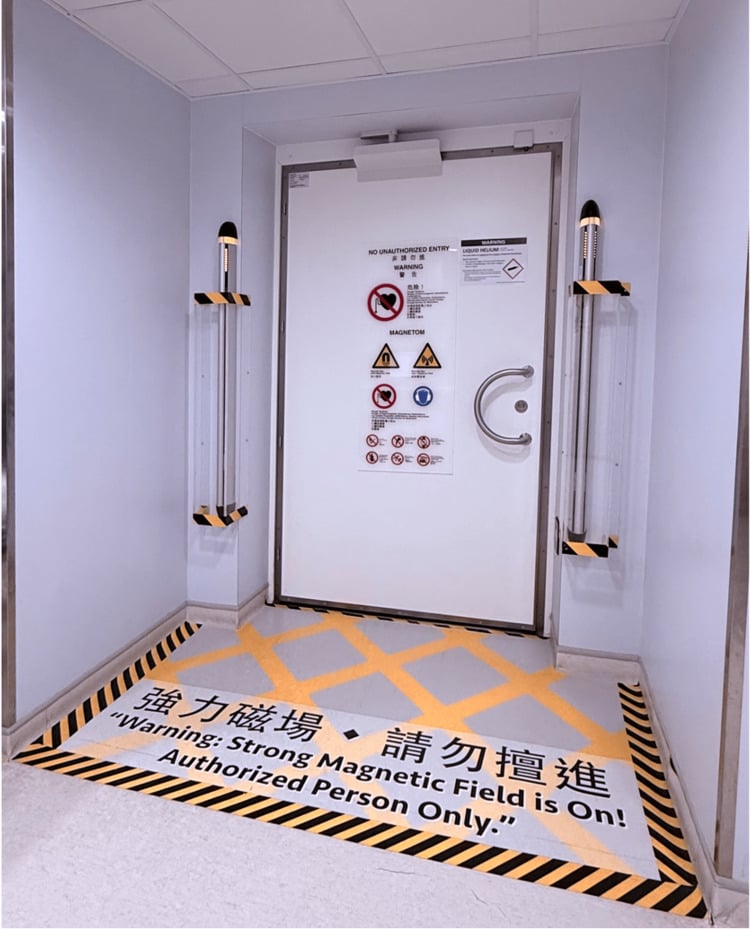
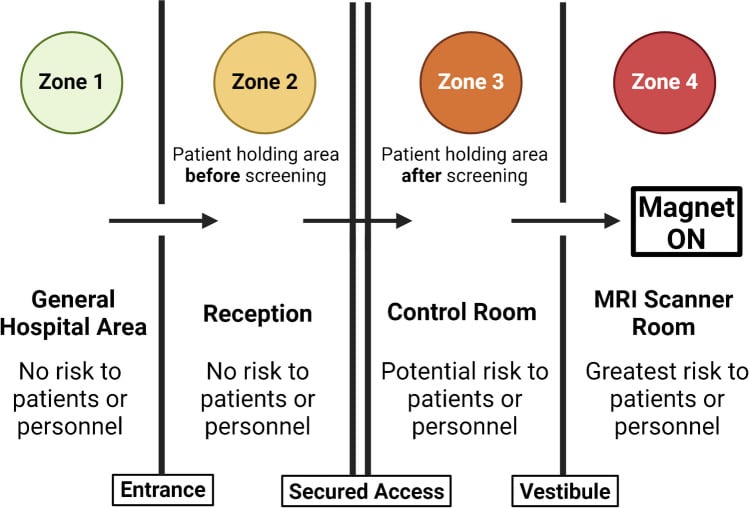
The MRI environment: the ACR safety zones. Screening is enforced physically through the ACR four-zone access-control model. The magnet is always on, so access is controlled by location rather than by switching the field off, and the zones escalate control as the magnet is approached.
- Area
- Freely accessible public area outside the MR environment (e.g. corridors, general reception)
- Access
- Open to everyone; no screening
- Area
- Interface between the public Zone I and the controlled Zone III — where patients are greeted, screened and history taken
- Access
- Patients under supervision of MR personnel; screening begins here
- Area
- Strictly restricted region (including the scanner control room) where free access by unscreened people/objects can cause serious injury
- Access
- Physically controlled (locked/badge access); only screened patients and MR personnel
- Area
- The MR scanner (magnet) room itself — the most restricted zone; the magnetic field is always present
- Access
- Entry only by screened individuals under direct MR-personnel supervision; clearly marked, magnet-on signage
Implant Materials and MRI
- Ferromagnetism
- Non-ferromagnetic
- Artefact Severity
- Minimal — smallest artefact of all metals
- MRI Safety
- MR Conditional at 1.5T and 3T (most implants)
- Common Uses
- Spinal instrumentation, fracture plates, screws, total joint stems
- Ferromagnetism
- Very weakly ferromagnetic
- Artefact Severity
- Moderate — larger artefact than titanium
- MRI Safety
- MR Conditional at 1.5T (most modern implants)
- Common Uses
- Femoral heads, tibial trays, bearing surfaces
- Ferromagnetism
- Weakly/non-ferromagnetic
- Artefact Severity
- Significant — largest artefact of common orthopaedic metals
- MRI Safety
- MR Conditional at 1.5T (most modern 316L implants)
- Common Uses
- Fracture plates, intramedullary nails, cerclage wires, K-wires
- Ferromagnetism
- Non-ferromagnetic
- Artefact Severity
- Minimal to moderate
- MRI Safety
- MR Conditional at 1.5T
- Common Uses
- Acetabular augments, spinal fusion cages, tumour implants
- Ferromagnetism
- Weakly ferromagnetic (temperature-dependent)
- Artefact Severity
- Minimal to moderate
- MRI Safety
- Usually MR Conditional at 1.5T
- Common Uses
- Staples, fracture fixation devices, shape memory implants
- Ferromagnetism
- Non-magnetic (polymer)
- Artefact Severity
- None — MR transparent
- MRI Safety
- MR Safe
- Common Uses
- Spinal fusion cages, suture anchors, interference screws
Titanium. Titanium alloy (Ti-6Al-4V) is the preferred material where MRI is likely to be needed later. It is non-ferromagnetic, so there is no missile or torque risk; it produces minimal susceptibility artefact, so diagnostic imaging near the implant is possible; it is MR Conditional at 1.5T and on many 3T scanners; and it is biocompatible with excellent osseointegration. Its limitation is that it cannot be used for bearing surfaces, because its wear characteristics for articulation are poor.
Reducing Artefact Around Metal
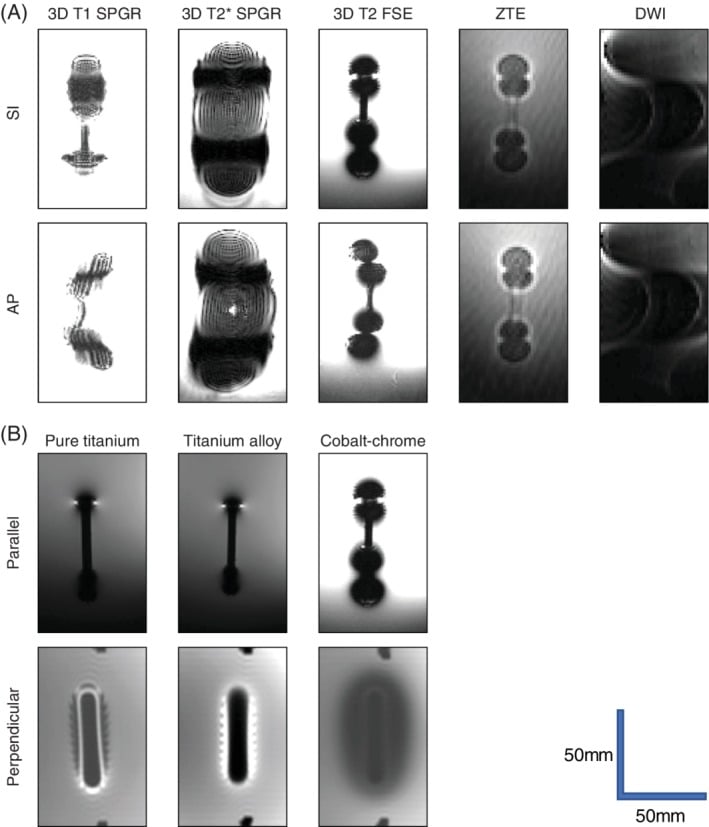
Spin echo, not gradient echo. Spin echo sequences use a 180-degree refocusing pulse that partly corrects field inhomogeneities; gradient echo has no refocusing pulse and produces much more artefact. Fast spin echo is the preferred form.
Wider receiver bandwidth reduces the size of the susceptibility artefact, the geometric distortion, at the cost of increased noise.
STIR rather than chemical fat saturation. STIR, used for fluid and oedema detection, is based on T1 relaxation rather than frequency, so it works near frequency-shifted metal where chemical fat saturation does not.
Smaller voxels. Thinner slices and a higher matrix reduce intravoxel dephasing.
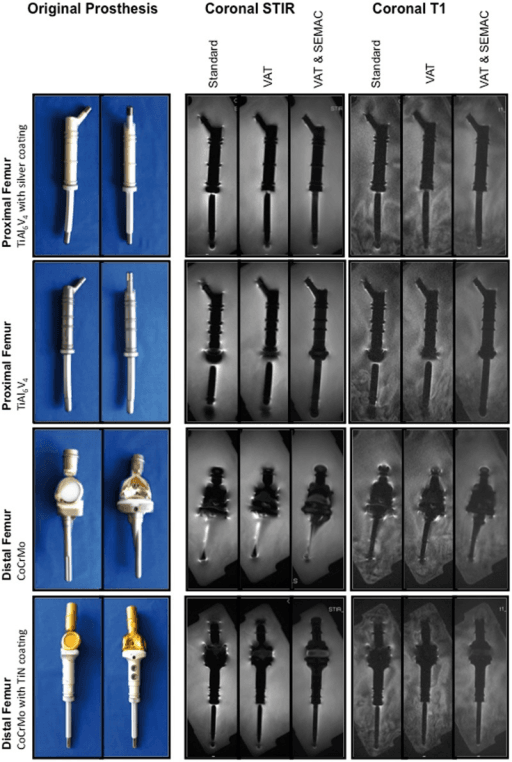
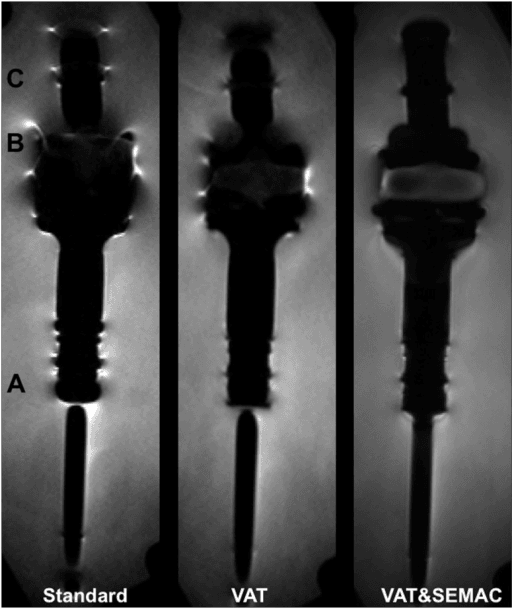
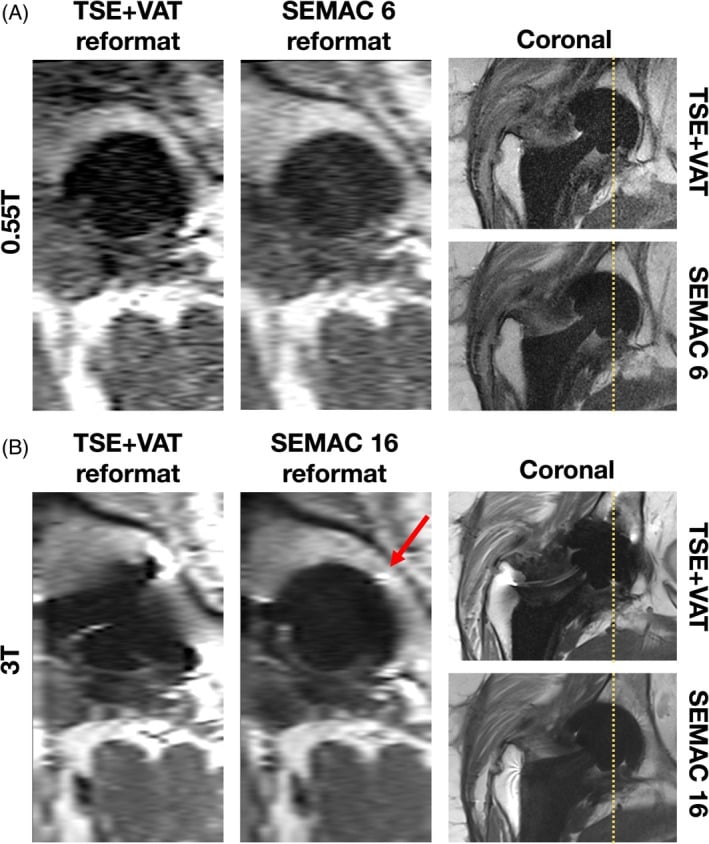
Dedicated sequences. MAVRIC-SL and SEMAC are dedicated metal artefact reduction sequences that use multi-spectral imaging and slice-encoding corrections to dramatically reduce artefact.
Field strength. Scanning at 1.5T instead of 3T halves susceptibility artefact, and the rule of thumb that artefact roughly scales with field strength favours 1.5T for large implants. But 3T is not universally inferior near metal: it offers higher signal-to-noise, and with modern multispectral sequences and high bandwidth, diagnostic imaging around smaller implants (screws, anchors, fine wires) at 3T is often acceptable. The field-strength choice should be individualised to implant size, alloy and the clinical question rather than applied as an absolute.
SWIMSArtefact Reduction Strategies
Hook:SWIMS through the artefact: Spin echo, Wider bandwidth, Inversion recovery, MAVRIC, Smaller voxels/lower field.
Specific Clinical Scenarios
Safety. Virtually all modern total hip and knee replacement components are MR Conditional at 1.5T:
- Titanium femoral stems and tibial baseplates
- Cobalt-chrome femoral components and femoral heads
- Stainless steel components (older designs)
- Polyethylene (UHMWPE) liners, which are MR transparent
Whether to wait after implantation before scanning is discussed under Controversies.
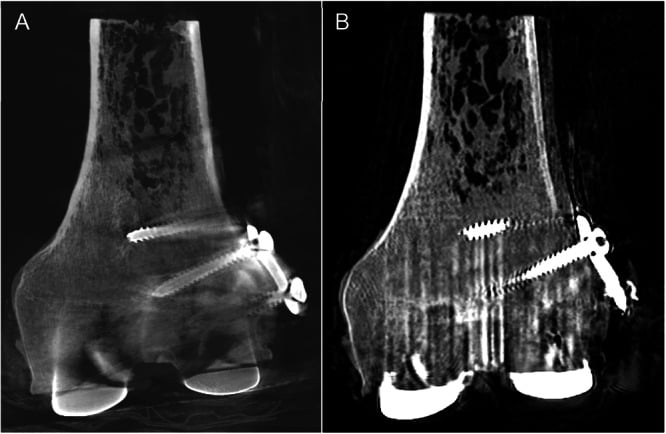
Artefact management. Joint replacement components produce significant artefact, particularly cobalt-chrome and stainless steel. For periprosthetic assessment (infection, adverse reaction to metal debris, component loosening) the full artefact-reduction protocol above is essential, with MAVRIC-SL or SEMAC added if available, and it can provide diagnostic imaging of periprosthetic soft tissues despite the presence of large metallic components.
What you miss without a multispectral sequence. "If available" understates it. In 122 arthroplasty patients (74 hip, 27 shoulder, 21 knee) imaged with both, MAVRIC visualised synovium and periprosthetic bone significantly better than metal-artefact-reduction FSE at every joint. More usefully for decision-making, findings were visible only on MAVRIC in a substantial minority: osteolysis in 16% of hips, 22% of shoulders and 24% of knees. In the shoulder the gap was starkest, with supraspinatus tears in 44% of cases seen on MAVRIC and not on FSE at all.
The practical reading. High-bandwidth FSE plus STIR is a competent protocol and will answer many questions, but around a painful arthroplasty a normal metal-artefact-reduction FSE does not exclude osteolysis, and in the shoulder it comes close to a coin toss for the rotator cuff. If the clinical question is periprosthetic soft tissue and multispectral imaging is not available on the platform, say so in the report rather than reporting a negative study as reassuring. The trade-offs are real: MAVRIC adds scan time, is not available on every platform, and the supporting data come from subjective image grading in a single specialist centre.
When MRI Is Contraindicated: Imaging Alternatives
The question still has to be answered. When MRI is genuinely contraindicated (a non-MR-conditional cardiac device that cannot be reprogrammed, an unidentifiable implant, or a confirmed intraocular ferromagnetic foreign body that cannot be removed in time), the choice of alternative depends on whether the target pathology is bony, soft tissue, vascular or infective.
- Best For
- Bone detail, osteolysis, component position, loosening, fracture
- Key Strength
- Excellent osseous and implant geometry; fast; widely available
- Key Limitation
- Ionising radiation; inferior soft-tissue contrast; residual streak artefact near dense metal
- Best For
- Periprosthetic fluid, abscess, tendon integrity, guided aspiration
- Key Strength
- No artefact from metal; dynamic; allows real-time aspiration/biopsy
- Key Limitation
- Operator-dependent; limited depth and field of view; cannot assess bone or deep central structures
- Best For
- Component position, loosening, periprosthetic fracture, lysis screening
- Key Strength
- Cheap, reproducible, baseline for change over time
- Key Limitation
- Low sensitivity for early soft-tissue and marrow pathology
- Best For
- Suspected periprosthetic infection or loosening when MRI/CT equivocal
- Key Strength
- Functional/metabolic information; whole-body survey
- Key Limitation
- Limited spatial resolution; lower specificity; radiation; time-consuming
- Best For
- Vascular assessment when MR angiography is unavailable
- Key Strength
- Rapid vascular mapping without magnetic field exposure
- Key Limitation
- Iodinated contrast load; radiation; calcium/metal can obscure lumen
Match the modality to the question. There is no single replacement for MRI. For a suspected periprosthetic infection in a pacemaker-dependent patient, ultrasound-guided aspiration plus CT and inflammatory markers usually answers the question; for acute neurology with an intraocular foreign body, non-contrast CT and CT angiography cover most emergencies. Choose the alternative for the specific diagnostic question rather than defaulting to a single substitute.
Guidelines, Registries & Global Practice
MRI safety is governed worldwide by a consistent framework — standardised ASTM International terminology (MR Safe / MR Conditional / MR Unsafe), the four-zone access-control model, and mandatory pre-scan screening — but the implementing society and the local infrastructure vary by region. Demand is rising globally as both MRI utilisation and the prevalence of orthopaedic implants increase with ageing populations.
Side-by-Side Guidance
- Core Position
- ACR Manual on MR Safety: four safety zones, designated MR Medical Director and MR Safety Officer, screening of all persons/objects
- Practical Emphasis
- Strong governance and personnel roles; widely adopted reference for zone control
- Core Position
- MHRA guidance on safe use of MRI equipment plus RCR clinical standards; emphasises documented local safety policy
- Practical Emphasis
- Regulatory device-safety focus and clear local accountability
- Core Position
- Defines MR Safe / Conditional / Unsafe terminology and the icons used on device labelling and in the bore environment
- Practical Emphasis
- The shared vocabulary all other guidance is built on
- Core Position
- Manufacturer Instructions for Use specify the exact MR Conditional parameters (field strength, spatial gradient, SAR, scan time)
- Practical Emphasis
- The legally and clinically binding source for any individual implant
- Core Position
- Protocols permitting scanning of selected non-MR-conditional cardiac devices at 1.5T with EP supervision
- Practical Emphasis
- Shifts some legacy devices from absolute contraindication to conditional, protocol-driven
Registries and Implant Identification
When the operative note or implant card is missing, national arthroplasty registries can help identify the device and therefore its alloy and MR labelling. Large registries include the National Joint Registry (NJR, UK), the American Joint Replacement Registry (AJRR, US), the Australian Orthopaedic Association National Joint Replacement Registry (AOANJRR), and the Swedish and Norwegian registries. Manufacturer databases and curated resources such as MRIsafety.com complement these for non-arthroplasty hardware.
High- vs Limited-Resource Practice Variation
In well-resourced centres, 1.5T and 3T scanners, dedicated metal-artefact-reduction sequences (MAVRIC, SEMAC, WARP, MARS), ferromagnetic detection systems, and formal MR safety officer roles are routine. In limited-resource settings, access to MRI itself may be restricted, advanced metal-suppression sequences may be unavailable, and implant identification can be difficult where surgical records or registries are incomplete. Where MRI capacity is constrained, CT (with metal-artefact-reduction reconstruction), ultrasound, and radiographs carry more of the diagnostic load, and rigorous screening discipline becomes even more important because rescue resources are limited.
The Surgeon's Responsibilities (Universal)
Regardless of region, the operating surgeon should: accurately document the implant manufacturer, model, and material in the operative record; provide the patient with an implant identification card; and communicate implant details to radiology whenever MRI is being considered.
Controversies & Areas of Uncertainty
The 6-week post-implantation wait. The traditional teaching that MRI should be delayed for 6 weeks after implantation, to allow tissue ingrowth to resist torque, is largely historical: it applied to a concern about ferromagnetic implant migration. For modern non-ferromagnetic titanium and cobalt-chrome implants, translational force and torque are minimal, there is little evidence that early scanning displaces a well-fixed implant, and the wait is no longer considered necessary if the clinical need is urgent. Most authorities now permit earlier scanning of MR Conditional non-ferromagnetic implants when clinically indicated, while still exercising caution with any genuinely ferromagnetic device.
Scanning non-MR-conditional cardiac devices. A major shift over the past decade is the recognition that many legacy (non-MR-conditional) pacemakers and defibrillators can be scanned at 1.5T under a strict institutional protocol with electrophysiology supervision, device interrogation and reprogramming, and this is now reflected in some cardiology society guidance. It remains an off-label, protocol-driven decision rather than a green light, and the safest answer is still to treat a non-MR-conditional device as a contraindication unless a formal pathway with cardiology is in place.
Tattoo and cosmetic pigment heating. Some tattoo and permanent-makeup pigments contain iron oxide and can cause local heating or a tingling sensation, occasionally a superficial burn. This is usually a minor, self-limiting issue rather than a contraindication: patients should be counselled, monitored and given a means to alert staff, and large or recently applied tattoos near the region of interest warrant extra caution.
Clinical Decision Scenarios
Practise clinical reasoning and management decisions out loud
“A 70-year-old patient with a total hip replacement develops new-onset thigh pain 5 years post-operatively. You want to request an MRI of the hip. The patient also has a cardiac pacemaker.”
“An examiner asks you to explain why titanium produces less MRI artefact than stainless steel, and what strategies you would use to minimise artefact around a stainless steel implant.”
“A patient presents to the emergency department with a metallic foreign body in the orbit suspected from an industrial accident two days ago. They now need an urgent brain MRI for unrelated acute neurological symptoms.”
Safety Categories (ASTM)
- MR Safe: no hazard in any MR environment (plastic, ceramic, PEEK)
- MR Conditional: safe under specific conditions (most modern ortho implants at 1.5T)
- MR Unsafe: hazardous in all environments (old pacemakers, ferromagnetic clips)
- Term 'MRI compatible' is OBSOLETE — do not use
Absolute Contraindications (PACED)
- Pacemakers/ICDs (non-MR-conditional)
- Aneurysm clips (ferromagnetic intracranial)
- Cochlear implants (non-MR-conditional)
- Eye metallic foreign bodies (orbital radiograph screening)
- Electronic devices (neurostimulators, insulin pumps)
Metal Hazards (MATH)
- Missile (projectile) effect — translational force on ferromagnetic objects
- Artefact — signal void and geometric distortion
- Torque — rotational force aligning object with B0
- Heating — RF-induced current in conductive loops
Implant Materials
- Titanium: least artefact, non-ferromagnetic, gold standard for MRI-safe implants
- CoCr: moderate artefact, MR Conditional at 1.5T
- Stainless steel 316L: most artefact, MR Conditional at 1.5T
- PEEK: MR Safe — no artefact (polymer, not metal)
Artefact Reduction (SWIMS)
- Spin echo over gradient echo (refocusing pulse corrects field distortion)
- Wider bandwidth (reduces artefact extent, increases noise)
- Inversion recovery = STIR (not chemical fat sat near metal)
- MAVRIC-SL / SEMAC (dedicated multi-spectral sequences)
- Smaller voxels / lower field (1.5T, not 3T)
Evidence Base
MRI Safety Update 2008: Screening Patients for MRI
- Systematic pre-MRI screening (a standardised questionnaire plus active verbal interview) is the cornerstone of patient safety, identifying implants, devices, and foreign bodies before scanning.
- Implant and device safety must be assessed against the current ASTM terminology — MR Safe, MR Conditional, MR Unsafe — and the obsolete term 'MR compatible' should be abandoned.
- Conditions specified for an MR Conditional device (static field strength, spatial gradient, SAR, time-varying gradients) must all be satisfied; an implant cleared at 1.5T is not automatically safe at 3T.
Projectile Cylinder Accidents in the MR Suite
- Ferromagnetic nitrous oxide and oxygen cylinders brought into the scanner room became dangerous projectiles drawn toward the bore.
- Four of the last five projectile accidents at the reporting institutions occurred within the preceding three years, despite existing screening policies and staff education.
- Projectile incidents continue to occur and may be increasing, underscoring that policy alone is insufficient without enforced physical access control.
Safety evidence underscores the importance of screening and protocol adherence.