Tibial Tubercle Apophysitis | Adolescent Athletes | Activity Modification | Self-Limiting
- Traction apophysitis: Repetitive stress on tibial tubercle from patellar tendon during growth spurt
- Self-limiting condition: Resolves when physis closes (typically 1-2 years), may leave painless bump
- Clinical diagnosis: Point tenderness over tibial tubercle, worsened by resisted knee extension
- Treatment is conservative: Activity modification, ice, stretching - rarely any surgery needed
- X-rays not routine: Reserve for atypical features or to rule out other pathology
- “Most common cause of anterior knee pain in athletic adolescents
- “Bilateral in 20-30% but usually asymmetric
- “Persistent bump over tibial tubercle after resolution is normal - not a complication
- “Rarely, a loose ossicle may require excision if symptomatic in adulthood
Overview and Epidemiology
Osgood-Schlatter disease (OSD) is a traction apophysitis of the tibial tubercle in active adolescents: localised pain, swelling and tenderness at the insertion of the patellar tendon. It is the most common cause of knee pain in athletic adolescents.
Who. Boys peak at 12-15 years and girls at 10-13, earlier because puberty is earlier; Gholve's review in the Evidence Base puts the girls' window at 8-12. The historical male to female ratio is about 3:1, and it is narrowing as more girls play sport. 20-30% are bilateral, often asymmetric in severity.
Which sports. Running, jumping and kicking sports: soccer, basketball, gymnastics and volleyball.
Risk factors. Intrinsic factors belong to the patient, extrinsic factors to the training.
- Intrinsic: skeletal immaturity with an open tibial tubercle physis; male sex (puberty timing and sports participation); rapid growth; quadriceps tightness, which increases the traction force; hamstring tightness, which adds load to the extensor mechanism
- Extrinsic: high-impact running, jumping and kicking sports; heavy training volume during growth; poor conditioning with a sudden increase in activity; hard playing surfaces, which increase impact loading; inadequate rest between training sessions
A common viva extension is "name other traction apophysites". OSD is the prototype of a family of overuse injuries at a tendon or muscle insertion onto a secondary ossification centre (apophysis) during the growth spurt, all sharing the same biology and conservative management:
- Osgood-Schlatter - tibial tubercle (patellar tendon insertion).
- Sinding-Larsen-Johansson - inferior pole of the patella (patellar tendon origin) - same knee, one level higher.
- Sever disease - calcaneal apophysis (Achilles insertion) - the commonest cause of paediatric heel pain.
- Iselin disease - base of the 5th metatarsal (peroneus brevis insertion).
- Medial epicondyle apophysitis ("Little League elbow") - medial humeral epicondyle (common flexor-pronator/UCL traction).
- Others: iliac crest / ASIS / AIIS apophysitis (pelvic avulsion spectrum), and the olecranon apophysis in throwers and gymnasts.
The unifying principles: a growing athlete, activity-related pain at the named bony insertion, a clinical diagnosis (imaging only for atypical features or avulsion), and a self-limiting course with load management, stretching and time until the apophysis fuses.
Pathophysiology and Mechanisms
The tibial tubercle. The bony prominence on the anterior proximal tibia where the patellar tendon inserts. It develops from a secondary ossification centre, an apophysis, that appears at around 8-12 years, and its stages of maturation map onto the periods of vulnerability.
- Age (years)
- 0-8
- Description
- Entirely cartilage, no ossification
- Clinical Relevance
- Rarely symptomatic at this age
- Age (years)
- 8-12
- Description
- Secondary ossification center appears
- Clinical Relevance
- Beginning of vulnerability period
- Age (years)
- 12-14
- Description
- Ossification extends proximally from apophysis
- Clinical Relevance
- Peak vulnerability - highest OSD incidence
- Age (years)
- 14-18
- Description
- Apophysis fuses to tibial epiphysis
- Clinical Relevance
- OSD symptoms resolve with fusion
Why the growth spurt. The apophysis is biomechanically weaker than mature bone or the patellar tendon. During the adolescent growth spurt, rapid bone growth increases muscle-tendon tension while the apophysis has not yet fused, and repetitive traction from the powerful quadriceps produces microtrauma (microavulsion), inflammation and sometimes fragmentation of the apophysis.
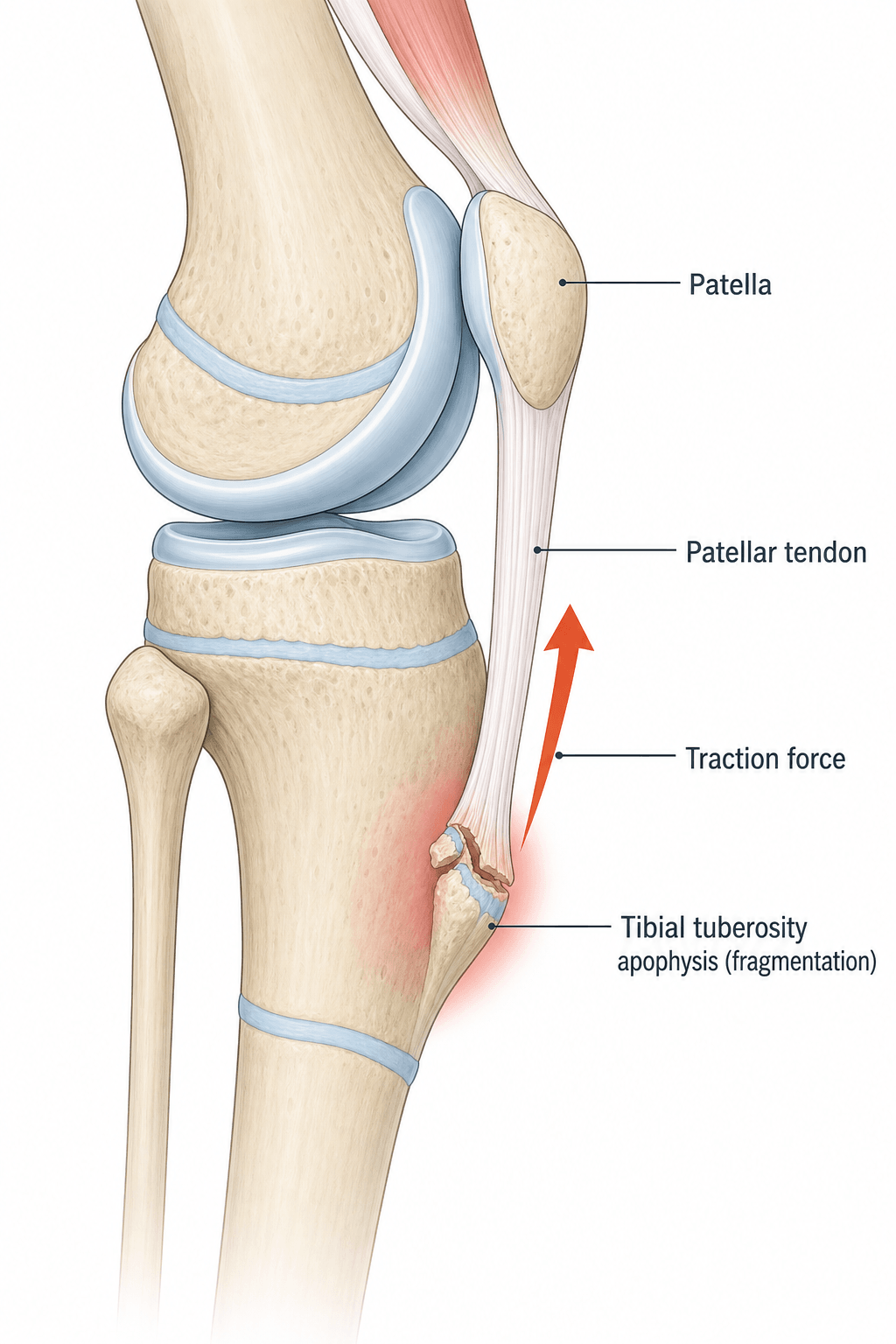
The extensor mechanism. Quadriceps force passes through the quadriceps tendon to the patella, which acts as a sesamoid and pulley, and then through the patellar tendon to the tibial tubercle. The patella increases the quadriceps moment arm by 30-50% (the fulcrum effect) and the tendon-bone junction concentrates the force, so in the growing adolescent the apophysis, the weakest link in the chain, sits under high tensile stress. Rapid femoral growth tightens the quadriceps and adds to that tension.
The cartilaginous apophysis is the weak link. During the epiphyseal stage the apophysis may avulse as a whole with acute trauma (jumping sports, landing). Unlike OSD, which is chronic, overuse and gradual in onset with extension preserved, avulsion is an acute injury with sudden pain, inability to extend the knee and a visible or palpable deformity. Treat it as a fracture: it needs urgent orthopaedic referral and usually requires surgical fixation.
Increased Q-angle (greater than 15 degrees in males, greater than 18 degrees in females) may increase lateral patellar tracking and contribute to patellofemoral symptoms. However, the relationship between Q-angle and OSD specifically is less clear. Q-angle is more relevant to patellofemoral pain syndrome.
Classification Systems
Severity is graded by when the pain comes and what it stops the patient doing, and the grade sets both the treatment and the expected duration.
- Symptoms
- Pain only after activity, no swelling at rest
- Impact on Activity
- Can complete training sessions
- Treatment Approach
- Ice after activity, stretching, continue sports
- Symptoms
- Pain during AND after activity, mild swelling
- Impact on Activity
- Performance affected, some activity limitation
- Treatment Approach
- Modify activity level, patellar strap, formal physio
- Symptoms
- Pain at rest, limits daily activities, walking painful
- Impact on Activity
- Unable to participate in sport
- Treatment Approach
- Rest from sport, possible short immobilization, physio
Severity guides duration. Mild OSD may improve in 6-8 weeks with basic activity modification. Moderate OSD typically requires 3-6 months of modified activity. Severe OSD may need 6-12 months, possibly with periods of complete rest. All grades typically resolve when the physis closes, but symptom duration is proportional to severity.
Clinical Assessment
History. Age and sex, the sport and how often and how hard it is played, and any recent increase in training volume or intensity. Then the pain itself: where it is, when it comes and what provokes it. OSD pain is worse with running, jumping, kneeling, squatting and stairs. Ask about the other knee, and about any acute injury.
Red flags. Each of these points away from routine OSD:
- Night pain or rest pain: consider tumour or infection
- Acute traumatic onset: avulsion fracture
- Knee effusion: unusual for OSD and suggests other pathology
- Systemic symptoms (fever, weight loss): infection or malignancy
- A very young child, under 8: OSD is rare, so investigate
- Hip symptoms: SCFE or Perthes, and the hip is examined in all knee pain regardless
Inspection. A visible, enlarged tubercle. Compare the two sides, since bilateral disease may be asymmetric. Look for an effusion, which is unusual in OSD and suggests another diagnosis, and note limb alignment and muscle bulk.
Palpation. Point tenderness over the tibial tubercle is pathognomonic. Then palpate the whole patellar tendon for tendinopathy, the inferior pole of the patella for Sinding-Larsen-Johansson, the medial and lateral joint lines for meniscal pathology, and the patella and peripatellar tissues.
Movement. Knee range is usually full, with perhaps slight discomfort in flexion; passive flexion may be painful at end range, where it compresses the tubercle. Quadriceps and hamstring flexibility are often reduced. Hip range must be examined to exclude referred pain from SCFE.
Special tests. Resisted knee extension reproduces the pain over the tubercle. Patellar mobility is normal, unlike patellofemoral syndrome; ligament stability should be normal and meniscal tests negative.
SCFE and Perthes disease commonly present as knee pain in children due to referred pain along the obturator nerve. In ANY child presenting with knee pain, especially if obesity or limited hip ROM is present, you MUST examine the hip. Missing SCFE can lead to avascular necrosis and hip destruction.
Differential diagnosis. The table sets out five differentials in an adolescent with anterior knee pain, and how tenderness location separates them. Others to keep in mind are chondromalacia patellae (softening of the articular cartilage), Hoffa fat pad syndrome (inflammation of the infrapatellar fat pad), lateral patellar compression, tumour (rare: bone tumours, osteoid osteoma) and referred hip pain from SCFE, or Perthes in the younger child.
- Key Features
- 10-15y athletes, activity-related pain, bump
- Tenderness Location
- Tibial tubercle (anterior, distal to patella)
- Management
- Activity modification, stretching, ice
- Key Features
- Similar age/mechanism, pain at inferior pole
- Tenderness Location
- Inferior pole of patella
- Management
- Same conservative treatment as OSD
- Key Features
- Anterior knee pain, worse sitting/stairs
- Tenderness Location
- Diffuse peripatellar, retropatellar
- Management
- VMO strengthening, patellar taping
- Key Features
- Older athletes (16+), jumping sports
- Tenderness Location
- Inferior pole patella to tendon insertion
- Management
- Eccentric exercises, load management
- Key Features
- Acute traumatic event, swelling, unable to extend
- Tenderness Location
- Tibial tubercle with deformity
- Management
- URGENT - surgical fixation usually needed
Investigations
A clinical diagnosis. Point tenderness over the tibial tubercle in an athletic adolescent during the growth spurt is sufficient, and imaging is not required in typical cases. Reserve it for atypical presentations or to exclude other pathology:
- Acute traumatic event (rule out avulsion fracture)
- Atypical age, too young or too old for OSD
- Night pain or rest pain (rule out tumour)
- Effusion (unusual for OSD)
- Failure to improve with 3-6 months of conservative treatment
- Suspected loose ossicle in a symptomatic adult
What the lateral radiograph shows. Soft-tissue swelling anterior to the tubercle, fragmentation or irregular ossification of the apophysis, a separate ossicle within the patellar tendon, which may persist, and after fusion a prominent tubercle.
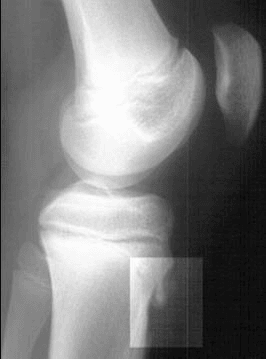
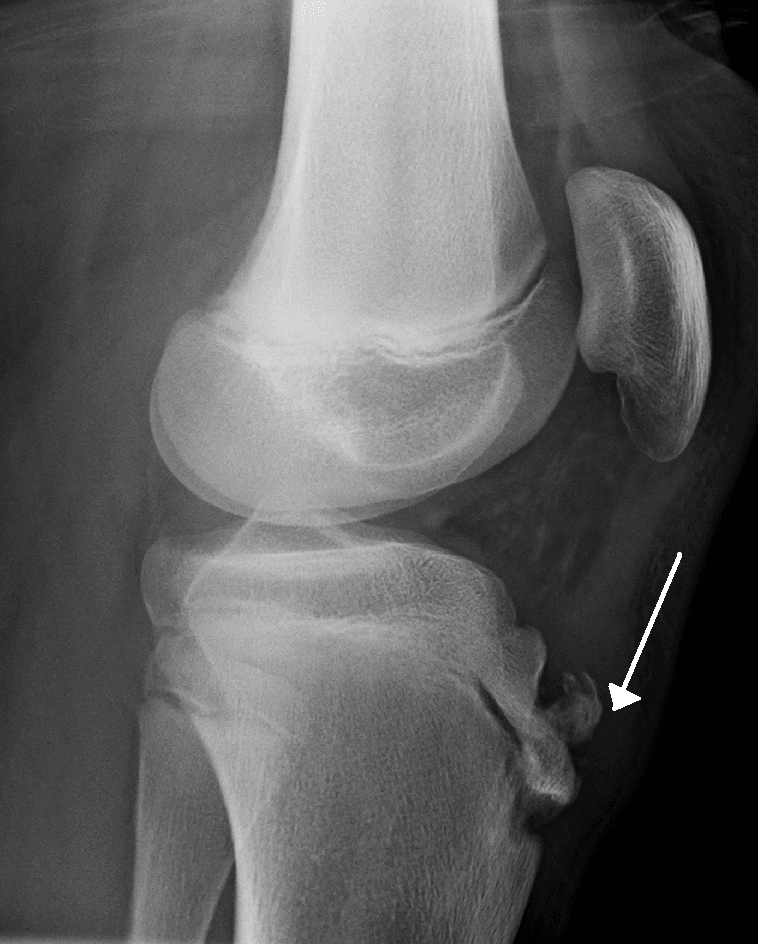
Other modalities have narrower jobs: ultrasound for the tendon and soft tissues, MRI for the red flags.
- Indication
- First-line if imaging needed
- Findings
- Soft tissue swelling, fragmentation, ossicle
- Clinical Use
- Confirm diagnosis, rule out fracture
- Indication
- Assess patellar tendon, soft tissues
- Findings
- Tendon thickening, fragmentation, bursa
- Clinical Use
- Useful if tendinopathy suspected
- Indication
- Rule out tumor, stress fracture, infection
- Findings
- Edema at tubercle, soft tissue changes
- Clinical Use
- Rarely needed - reserve for red flags
Management Algorithm
Most cases are managed in primary care, and every case starts with conservative treatment. 95%+ of OSD resolves with conservative treatment alone - but say "eventually", not "soon". Almost nobody needs surgery, and that is the reassuring half. The other half belongs in the same sentence: in Holden's preregistered prospective cohort of 51 adolescents, 37 per cent still had OSD-related knee pain at two years, with a median symptom duration of 42 months in that subgroup, and more than one in five had stopped sport because of it. Promising a 12-year-old that this settles in a few months is the commonest way to lose a family's confidence. Counsel an excellent long-run outlook, an unpredictable and often long course, and review that specifically asks whether they have quietly given up their sport.
Modify activity, do not stop it. Reduce intensity and volume rather than resting completely, avoid the painful activities (deep squats, jumping, kneeling), and continue sport at a reduced level if it is tolerable, cross-training with low-impact swimming or cycling. Prolonged complete rest is not recommended: it weakens muscles, detrains the athlete and delays return to sport. The exception is the severe case with rest pain, which may need a short period of immobilisation.
Stretch. Quadriceps stretching reduces the traction force on the tubercle, hamstring stretching decreases the quadriceps demand, and hip flexor stretching improves mechanics. Hold each stretch for 30 seconds, 3-4 times daily, and add a dynamic warm-up before activity.
Strengthen. Eccentric quadriceps work once the acute pain settles, with core stability to reduce the load on the knee during activity and hip strengthening to improve biomechanics, progressed gradually as symptoms allow.
Adjuncts. A patellar strap or brace reduces traction on the tubercle and a knee pad protects it when kneeling. Ice for 15-20 minutes after activity, or heat, gives symptom relief. NSAIDs are for short-term acute flares, not long-term use.
Surgical Technique
Surgery for Osgood-Schlatter disease is extremely rare. It is not indicated for active OSD in adolescents. It is reserved for the symptomatic ossicle in the skeletally mature patient, or for cosmetic removal of a prominent tibial tubercle, and in rare adults with persistent symptoms from a loose ossicle within the patellar tendon, excision, open or arthroscopic, gives excellent outcomes.
Indications. Patient selection is key: the patient must be skeletally mature, must have failed prolonged conservative management and must have an imaging-confirmed symptomatic ossicle. The indications:
- Skeletal maturity (closed tibial tubercle physis)
- Persistent focal pain over the ossicle
- Failed conservative management of 6 or more months
- Imaging confirms a symptomatic ossicle within the tendon
Technique. A straightforward procedure in the appropriately selected patient:
- Longitudinal or transverse incision over the tibial tubercle
- Identify the ossicle within the substance of the patellar tendon
- Excise the ossicle and debride the tendon edges
- Repair the tendon if needed
- Some surgeons also smooth the prominent tibial tubercle
Outcomes. Over 90% good or excellent results with pain relief, return to sport typically at 3-4 months, and recurrent pain as the main complication, with extensor weakness rare.
Complications
- Incidence
- Very common (50%+)
- Risk Factors
- Part of natural history
- Management
- Reassurance - cosmetic only, does not affect function
- Incidence
- Rare (less than 1%)
- Risk Factors
- Acute trauma in severe OSD
- Management
- Surgical ORIF if displaced, cast if non-displaced
- Incidence
- 5-10%
- Risk Factors
- Large initial ossicle, non-compliance
- Management
- Ossicle excision if failed conservative treatment
- Incidence
- Uncommon
- Risk Factors
- Return to sport too early, ongoing overuse
- Management
- Eccentric loading program, activity modification
- Incidence
- 10-20%
- Risk Factors
- Prominent tubercle persists
- Management
- Knee pads, reassurance, rarely surgical reduction
Kneeling. Discomfort on kneeling is the commonest residual complaint. The table's 10-20% sits against Krause's series, in which 60% still could not kneel without discomfort; his was a referred and therefore more symptomatic population, which the evidence card notes will overstate the proportion with lasting symptoms.
The viva below asks "what is genu recurvatum and why does it occur?" - here is the examinable answer, which is a paediatric physeal problem distinct from any adult cause:
- What it is: a knee that hyperextends (a recurvatum deformity) - the tibia sits in extension beyond neutral.
- Why it occurs in this context: the tibial tubercle apophysis is the anterior extension of the proximal tibial physis. An injury to that anterior physis - from a tubercle avulsion fracture, from its surgical fixation across the physis in a young child, or (rarely) from severe apophyseal disruption - can cause a localised anterior growth arrest. The posterior physis keeps growing while the front does not, so the proximal tibia tilts into recurvatum (an asymmetric physeal arrest deformity).
- Who is at risk: the skeletally immature child with substantial growth remaining - which is exactly why hardware is ideally kept out of/parallel to the physis and why these children need growth monitoring after tubercle injury or surgery.
- Why OSD itself rarely causes it: ordinary OSD does not arrest the physis (Krause's natural-history series found NO premature epiphyseal arrest) - recurvatum is a complication of the avulsion/iatrogenic end of the spectrum, not of uncomplicated apophysitis.
Exam point: genu recurvatum after a tibial tubercle injury = anterior proximal-tibial physeal arrest with continued posterior growth in a skeletally immature child - prevent it by respecting the physis and monitoring growth; uncomplicated OSD does not cause it.
Postoperative Care and Rehabilitation
After ossicle excision in the adult, rehabilitation is phased by time and by strength, and the conservatively treated adolescent follows the stretching, strengthening and activity-modification programme under Management Algorithm.
Post-Ossicle Excision Protocol
- Weight-bearing as tolerated
- ROM exercises as comfort allows
- Ice, elevation for swelling
- Gentle quadriceps sets
- Full ROM expected by 6 weeks
- Progressive strengthening
- Bike, swimming for cardio
- Avoid deep squats, jumping
- Sport-specific training
- Plyometrics progression
- Jogging, running progression
- Full return based on strength testing
- Typically 3-4 months for full competition
- Ongoing maintenance stretching
Outcomes
Natural history. Most cases resolve completely when the tibial tubercle apophysis fuses, typically within 1-2 years, and most athletes return to full sport without long-term problems. That is the typical course; the Holden cohort under Management Algorithm is the reminder that a substantial minority are still symptomatic at two years. 5-10% have some symptoms in adulthood, usually mild or related to an ossicle within the tendon.
Predictors of a prolonged course.
- Severe initial presentation
- Delay in activity modification
- Ongoing intense sports participation without modification
- Bilateral involvement
Parents often worry about the residual bump over the tibial tubercle. Reassure them this is part of the normal healing process - the prominence represents bone that formed during the inflammatory phase and is now incorporated into the mature tubercle. It is cosmetic only and does not affect function or sports performance.
Guidelines, Registries & Global Practice
Global Epidemiology:
- OSD is the most common cause of activity-related anterior knee pain in adolescents worldwide. In youth elite male football the clinical point prevalence is around 17%, yet roughly 80% of affected players have no time-loss (Schultz et al, Phys Ther Sport 2022, PMID 35305497).
- Peak age tracks the pubertal growth spurt: boys approximately 12-15 years, girls approximately 8-13 years (earlier maturation). The historical male predominance has narrowed substantially as female sports participation has risen.
- Bilateral involvement occurs in 20-30% of cases, frequently asymmetric. A history of another apophysitis (Sever disease) is a strong associated factor (OR 16.8 in elite footballers, PMID 35305497).
- Adolescent knee pain (including OSD) is not uniformly trivial: in an individual-participant-data meta-analysis, 51% still reported knee pain at 12 months, with female sex and bilateral pain predicting a poorer course (Holden, Rathleff et al, Pain 2021, PMID 33449504).
Side-by-side Guidance and Authoritative Sources:
- Position on Imaging
- Clinical diagnosis; radiographs only for atypical features or to exclude other pathology
- First-line Treatment
- Activity modification, relative rest, stretching, ice, analgesia as needed
- Surgery
- Reserved for skeletally mature patients with a symptomatic ossicle after failed conservative care
- Position on Imaging
- No routine imaging; X-ray only if red flags or diagnostic doubt
- First-line Treatment
- Reassurance, self-care, activity modification, simple analgesia, physiotherapy
- Surgery
- Specialist referral only for persistent or atypical symptoms
- Position on Imaging
- Clinical diagnosis; image to exclude avulsion, tumour or infection if red flags
- First-line Treatment
- Education, load management, eccentric and flexibility programme
- Surgery
- Rarely indicated; ossicle excision in mature symptomatic patients
- Position on Imaging
- Ultrasound increasingly used to confirm tubercle changes; X-ray for red flags
- First-line Treatment
- Conservative load management; injection therapy investigational only
- Surgery
- Arthroscopic or open ossicle excision after physeal closure
No society publishes a formal high-level (Grade A) treatment guideline for OSD because randomised evidence is sparse. Recommendations are consensus/expert-opinion level, converging on the same message: clinical diagnosis, conservative load-managed treatment, and surgery only for the skeletally mature refractory ossicle. Injection therapies (including prolotherapy) remain investigational with low-quality evidence (Sanderson and Bryant, J Foot Ankle Res 2015, PMID 26500703).
- There is no dedicated OSD registry; population-level signal comes from claims and cohort datasets. A large US commercial-claims analysis of adolescent sports injuries found female adolescents more likely than males to undergo surgery for OSD (adjusted OR 1.8, 95% CI 1.38-2.39), although operative rates overall remained low and stable (Bonazza et al, Arthrosc Sports Med Rehabil 2019, PMID 32266341).
- Arthroplasty-style implant registries (e.g. AOANJRR, NJR, AJRR) are not relevant to OSD as it is non-arthroplasty paediatric pathology.
- Across health systems, OSD is managed predominantly in primary care, general practice, and sports-medicine/physiotherapy services, with orthopaedic referral reserved for suspected avulsion fracture or the refractory skeletally mature patient.
- Common sporting contexts worldwide include soccer, basketball, netball and similar youth sports. Access to physiotherapy and sports medicine services varies by health system but follows the same conservative principles globally.
- Practice variation centres on adjuncts (patellar straps, injections) and the threshold for imaging rather than on the core conservative principle, which is globally consistent.
MCQ Practice Points
Q: An adolescent presents with knee pain after jumping. How do you distinguish OSD from avulsion fracture? A: OSD has GRADUAL onset, pain during/after activity, ability to extend knee, and no visible deformity. Avulsion has ACUTE onset after trauma, inability to extend knee, visible/palpable deformity, and severe pain. X-ray shows displaced fragment in avulsion vs fragmentation in OSD.
Q: Which of the following is an indication for X-ray in suspected OSD? A: Night pain (rule out tumor), acute traumatic onset (rule out avulsion), failure to improve after 6 months conservative treatment, atypical age (less than 8 or after skeletal maturity). Routine OSD does NOT require imaging.
Q: What is the recommended activity level for adolescent with OSD? A: Activity MODIFICATION, not complete rest. Continue sport at reduced level if tolerable. Avoid painful activities (deep squats, kneeling, jumping). Cross-train with low-impact activities. Complete rest weakens muscles and delays return.
Q: What happens to the bump after OSD resolves? A: The tibial tubercle prominence typically persists as a painless, cosmetic bump in 50-75% of patients. This represents ossification that occurred during the healing process and is now incorporated into the mature tubercle. It is NOT a complication and does not affect function.
Q: A 12-year-old with knee pain has point tenderness at the INFERIOR POLE of patella. What is the diagnosis? A: Sinding-Larsen-Johansson syndrome - traction apophysitis at the inferior pole of patella (where central patellar tendon originates). Same mechanism as OSD but at the proximal end of the patellar tendon. Treatment is identical - activity modification, stretching, ice.
Medicolegal Considerations
- Clear history of gradual onset and activity-related symptoms
- Documentation of point tenderness specifically over tibial tubercle
- Hip examination performed (to exclude SCFE/Perthes)
- Discussion of self-limiting nature and expected timeline
- Activity modification advice given (not complete rest)
- Risk of persistent symptoms
- Hardware removal may be needed
- Scar
- Stiffness
SCFE commonly presents as knee pain in obese adolescent males. Missing SCFE diagnosis causes significant morbidity from AVN. Document hip examination in ALL adolescents presenting with knee pain. This is a frequent source of litigation in pediatric orthopaedics.
Clinical Decision Scenarios
Practise clinical reasoning and management decisions out loud
“A 13-year-old boy who plays soccer presents with 3 months of anterior knee pain. The pain is worse after training and he has noticed a bump at the front of his knee.”
“An 11-year-old female gymnast presents with bilateral anterior knee pain. She trains 20 hours per week and has competition in 6 weeks. Parents want a solution so she can compete.”
“A 14-year-old basketball player jumps for a rebound and lands with sudden severe knee pain. He cannot extend his knee and you notice a visible deformity over the tibial tubercle.”
Diagnosis
- Clinical diagnosis - imaging not required
- Point tenderness over tibial tubercle
- Pain with resisted knee extension
- 10-15 years, athletic, growth spurt
Treatment
- Activity MODIFICATION not complete rest
- Stretching: quads, hamstrings, hip flexors
- Ice after activity (15-20 min)
- Patellar strap during sport
- NSAIDs short-term for flares only
Imaging Indications
- Acute traumatic onset (avulsion)
- Night pain (tumor)
- Failure after 6 months conservative
- Atypical age or presentation
Red Flags
- Acute trauma with inability to extend = AVULSION
- Night/rest pain = tumor, infection
- Knee effusion = not typical for OSD
- Hip symptoms = SCFE, Perthes
Prognosis
- 90%+ resolve with skeletal maturity
- Duration 1-2 years (until physis closes)
- Bump persists but is painless
- 5-10% adult symptoms (usually ossicle)
Evidence Base
Osgood-Schlatter disease (OSD) has few high-level trials; the strongest data concern its benign natural history and the outcomes of ossicle excision in the small refractory subgroup.
Natural History of Osgood-Schlatter Disease
- Retrospective review of the natural history of 69 knees in 50 patients with untreated OSD
- 76% reported no limitation of activity at follow-up, but 60% still could not kneel without discomfort
- Two groups emerged: those with radiological fragmentation (often left a separated ossicle or abnormally ossified tuberosity) and those with soft-tissue swelling only (asymptomatic at review)
- Low incidence of patellar instability or anterior knee pain, and NO case of premature proximal tibial epiphyseal arrest
Osgood Schlatter Syndrome - Contemporary Review
- Critical review establishing OSD as a traction apophysitis of the tibial tubercle from repetitive strain on the secondary ossification centre
- Approximately 90% of patients respond well to non-operative treatment (rest, ice, activity modification, rehabilitation exercises)
- Boys typically 12-15 years, girls 8-12 years; symptoms exacerbated by jumping sports and direct kneeling contact
- Surgical excision of the ossicle/free cartilage reserved for skeletally mature patients who remain symptomatic
Prognostic Factors for Adolescent Knee Pain (IPD Meta-analysis)
- Individual-participant-data meta-analysis of 1281 unique adolescents (10-19y) with non-traumatic knee pain across 13 prospective studies (including OSD)
- 51% still reported knee pain at 12 months - adolescent knee pain is NOT reliably trivial or short-lived
- Poorer prognosis predicted by higher baseline pain frequency, lower quality of life, female sex, and bilateral pain
- BMI, pain sensitivity, and knee strength were NOT associated with prognosis
Ossicle Resection with Tibial Tubercleplasty for Unresolved OSD
- Retrospective review of 16 knees in 15 patients undergoing ossicle excision plus tibial tubercleplasty after failed non-operative treatment
- 12 of 15 patients (75%) returned fully to pre-operative activities and sport; 2 partial, 1 did not return
- Mean post-operative Lysholm 76.5, mean IKDC 75, mean Tegner activity level 6.8
- Authors recommend deferring surgery until skeletal maturity and adding tubercleplasty when resecting the ossicle
Arthroscopic Ossicle Excision in Athletes with Unresolved OSD
- 11 competitive athletes (mean age 23y) with persistent tibial tubercle pain (mean 15.5 months) treated arthroscopically
- Mean Kujala score improved 82.9 to 98.5 and Lysholm 87.5 to 96.9 (both significant at p of 0.01) at mean 66-month follow-up
- Mean return to sport-specific training 6.7 weeks; all returned to the same competitive level
- Arthroscopic approach reported to speed recovery and avoid open patellar-tendon damage
Prevalence and Time-loss of OSD in Youth Elite Football
- Cross-sectional and nested case-control study of youth elite male footballers (cross-sectional n = 127)
- Clinical point prevalence of OSD was 17%, yet 80% had NO time-loss despite symptoms
- Previous Sever disease was strongly associated with OSD (OR 16.8, 95% CI 1.6-174.5)
- Growth velocity and ultrasonographic bone-maturity (Ehrenborg) stage were NOT associated in age-matched analysis
Prolotherapy Injections for Lower-limb Tendinopathy and OSD (Systematic Review)
- Systematic review of prolotherapy for lower-limb tendinopathy and fasciopathy; 8 studies in three groups - Achilles tendinopathy (5), plantar fasciopathy (2) and Osgood-Schlatter disease (1)
- THE OSD EVIDENCE IS A SINGLE TRIAL: Topol's double-blinded RCT of 65 knees in 54 adolescent athletes (mean age 13.3), randomised to dextrose prolotherapy, lignocaine injection or supervised usual care
- At 3 months, unaltered sport was similar for lignocaine (90%) and prolotherapy (100%), but ASYMPTOMATIC sport favoured prolotherapy significantly - 67% versus 23%
- Topol scored 14 of 18 on the review's quality tool and was rated GOOD - one of only two such studies in the review, so 'low-quality evidence' misdescribes this particular trial
- Adverse events were NOT REPORTED in the Osgood-Schlatter study - an absence of reporting, not a demonstration of safety
Is the Prognosis of Osgood-Schlatter Poorer Than Anticipated? 24-Month Prospective Cohort
- Preregistered prospective cohort of 51 adolescents aged 10-14 with OSD, followed for 24 months, with 90% (46) available at follow-up
- 37% (17 of 46) STILL REPORTED OSD-RELATED KNEE PAIN AT TWO YEARS - and in that subgroup the median time since symptom onset was 42 months (IQR 38-51)
- MORE THAN 1 IN 5 had stopped sport because of knee pain
- Those with continuing pain had significantly worse KOOS Sport/Recreation (74 versus 91) and lower quality of life (EQ-5D-Y mean difference 0.11)
- A higher De Flaviis ultrasound grade at baseline predicted pain at 2 years; adolescents with NO imaging changes at baseline were less likely to still hurt
- An ununited ossicle was present in 32% of those rescanned at follow-up