FOOSH injuries, torus fractures, physeal patterns and safe immobilisation
- Buckle fractures are stable compression injuries with no complete cortical break.
- Distal radius remodelling is strong, especially in younger children and sagittal-plane deformity.
- Physeal injuries need careful reduction attempts and follow-up for growth disturbance.
- A displaced complete fracture is not a buckle fracture.
- Cast tightness and median nerve symptoms must be actively checked.
- “Point tenderness over distal radius after FOOSH should be imaged.
- “Buckle fractures can often be treated with removable splint and clear advice.
- “Repeated forceful physeal reductions increase growth-plate risk.
- “Document median nerve before and after reduction.
Overview and Epidemiology
Paediatric distal radius injuries are among the most common fractures in childhood, usually after a fall on an outstretched hand. They range from a stable compression injury to a displaced fracture involving both cortices or the distal radial physis, and the clinical skill is matching the amount of treatment to the true stability of the injury.
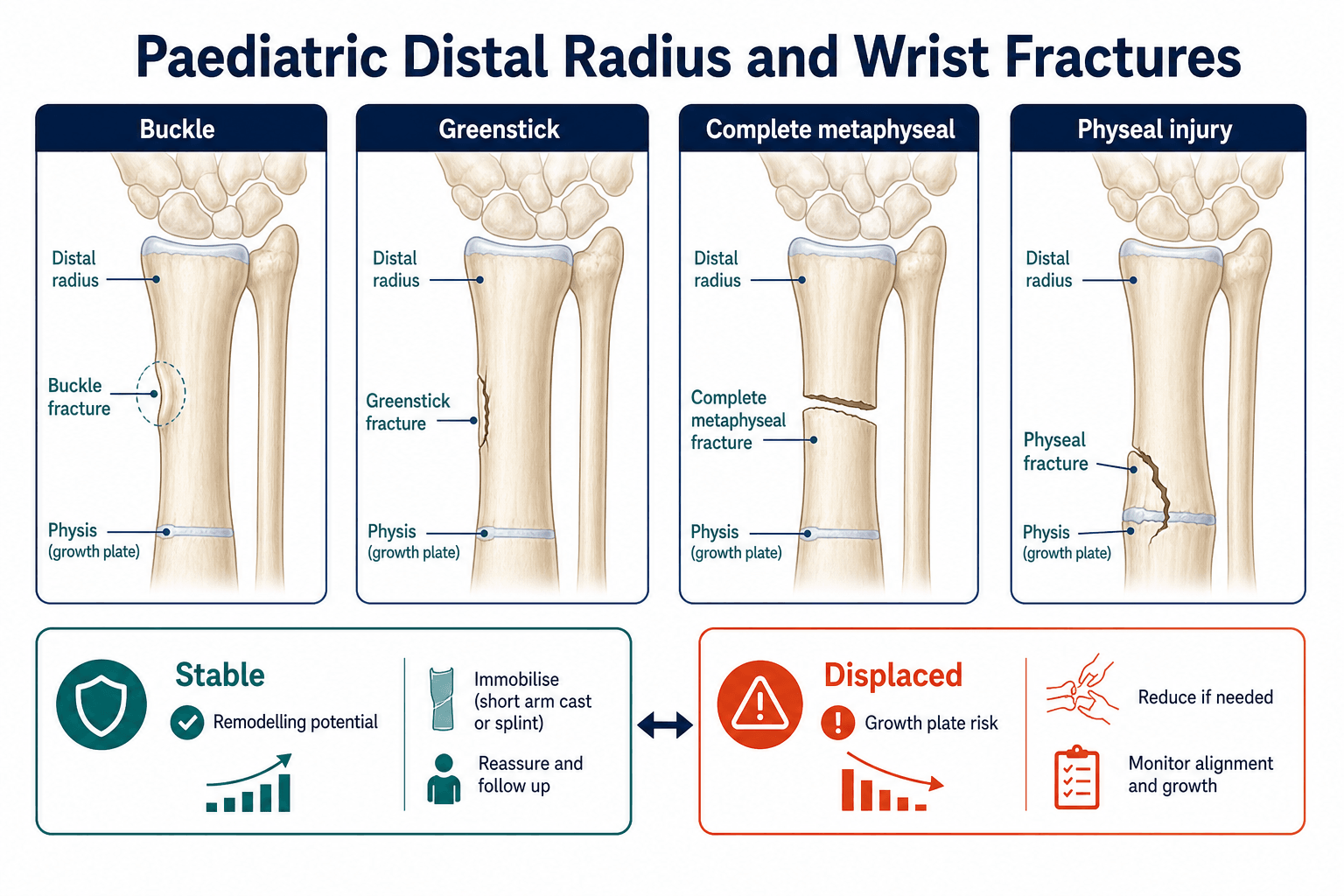
Naming the injury. A buckle fracture is a compression bulge in the cortex, stable because there is no complete cortical disruption, and it should not be treated like a displaced fracture. Conversely, a complete metaphyseal fracture or displaced physeal injury should not be softened into the word "buckle" just because the child is young: it is a complete fracture wearing a nicer name.
The goals. Identify the pattern, protect the skin and nerves, and avoid unnecessary follow-up for stable buckle fractures. Reduce unacceptable deformity gently, use a well-moulded non-tight cast when one is needed, and give families clear cast and swelling return advice.
Pathophysiology
Mechanism. Most paediatric distal radius fractures follow an axial load through an extended wrist. The pattern depends on bone elasticity, cortical failure, the integrity of the periosteal hinge, and whether the force exits through the metaphysis or the physis.
Remodelling. Remodelling potential is excellent near the distal radial physis, and how much a deformity will correct depends on the age of the child, the plane of the deformity and its proximity to the physis.
- Younger children have more growth remaining; remodelling is less reliable in adolescents and in injuries close to skeletal maturity
- Sagittal-plane deformity remodels more predictably than coronal deformity, and rotation does not remodel reliably
- The closer the fracture lies to the distal radial physis, the greater the correction available
- Remodelling is also less reliable in unstable complete fractures
Shortening or bayonet apposition may be acceptable in selected young children, but it should not be used as a blanket rule for adolescents near skeletal maturity.
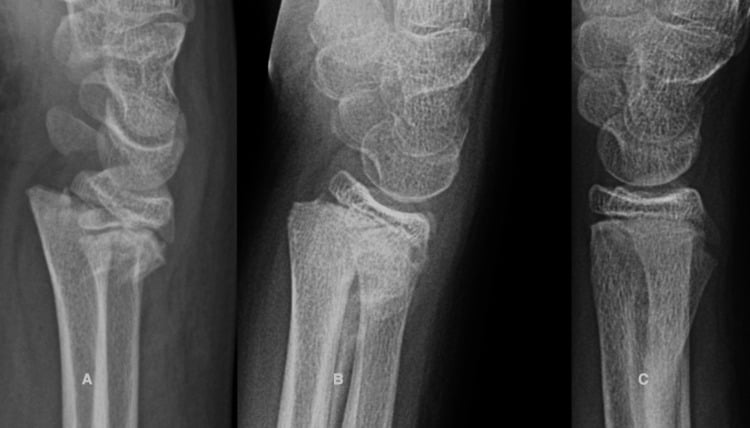
The physes. The distal radial physis contributes major forearm growth, which is why physeal injuries require surveillance. Distal ulna physeal injury deserves its own attention: growth disturbance can create ulnar variance and distal radioulnar joint problems, and it should not be forgotten when the radius fracture dominates the X-ray.
Classification
Classification by fracture type drives treatment: a stable buckle fracture is a different injury from a displaced metaphyseal or physeal one.
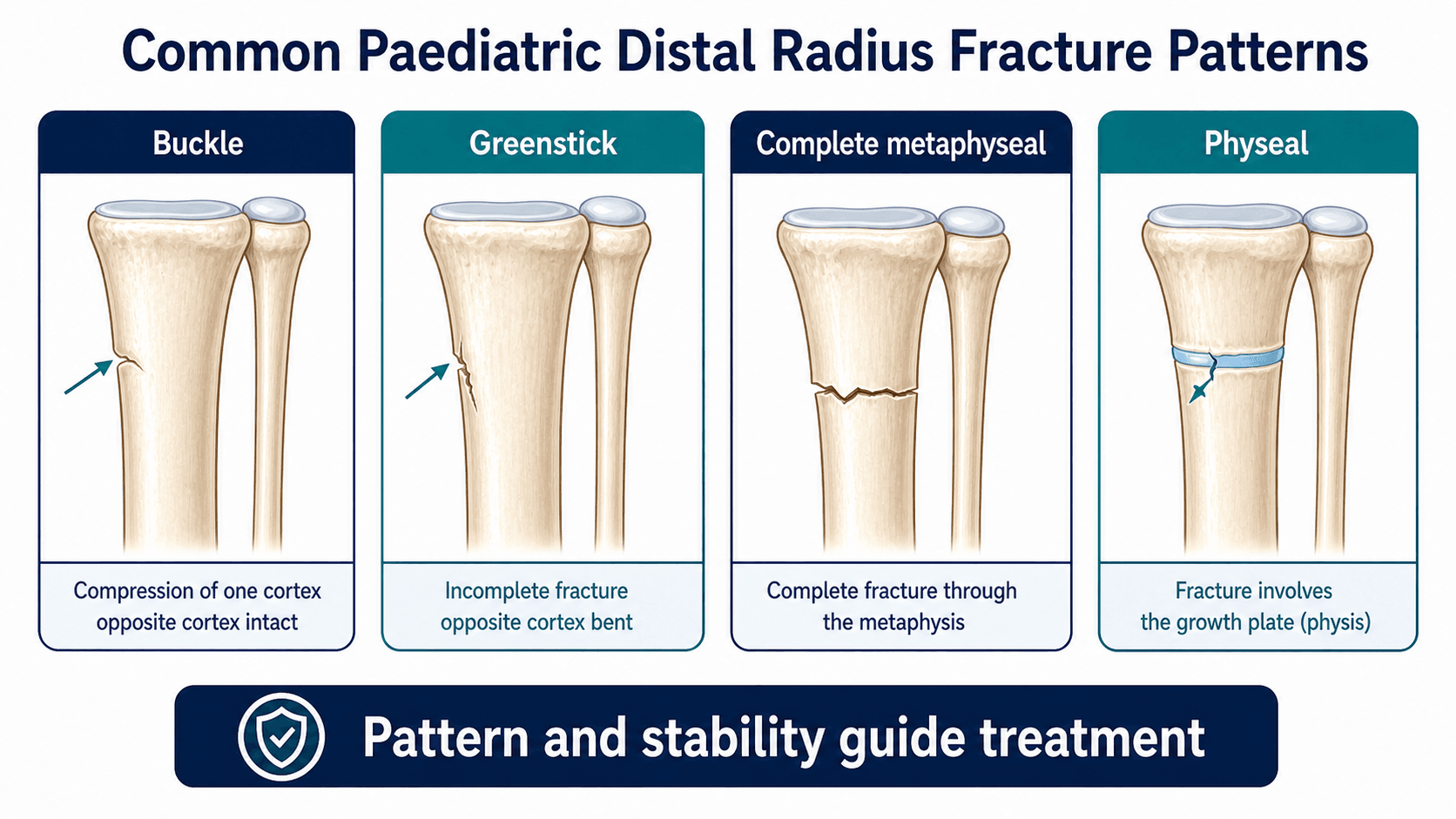
- Structural problem
- Compression crumples one cortex but the bone is not broken through.
- What it means clinically
- Inherently stable when correctly diagnosed; treatment is for comfort and confidence.
- Structural problem
- The tension cortex fails and the compression cortex bends.
- What it means clinically
- The intact cortex can preserve partial stability, but angulation can persist unless moulded or reduced.
- Structural problem
- Both cortices fail, often with dorsal angulation, translation or shortening.
- What it means clinically
- This is an unstable fracture pattern compared with a buckle injury; reduction and follow-up depend on age and alignment.
- Structural problem
- A Salter-Harris injury: the distal radial or ulnar physis fails because the growth plate is weaker than surrounding ligaments.
- What it means clinically
- Reduction should be gentle, and displaced injuries need surveillance for growth disturbance.
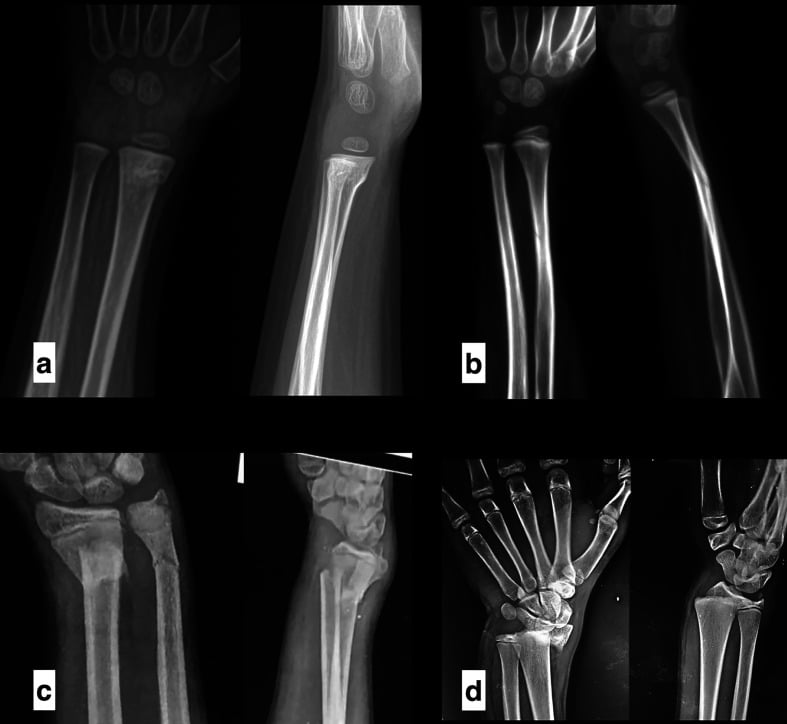
Stability. Each pattern is then graded by how far it can be trusted to stay where it is:
- Stable: a true buckle, minimal pain, no deformity, intact cortex
- Potentially unstable: greenstick, complete fracture, associated ulna fracture
- Unstable: displaced complete fracture, bayonet apposition in an older child, displaced physeal injury
- High-risk: open injury, neurovascular symptoms or compartment concern
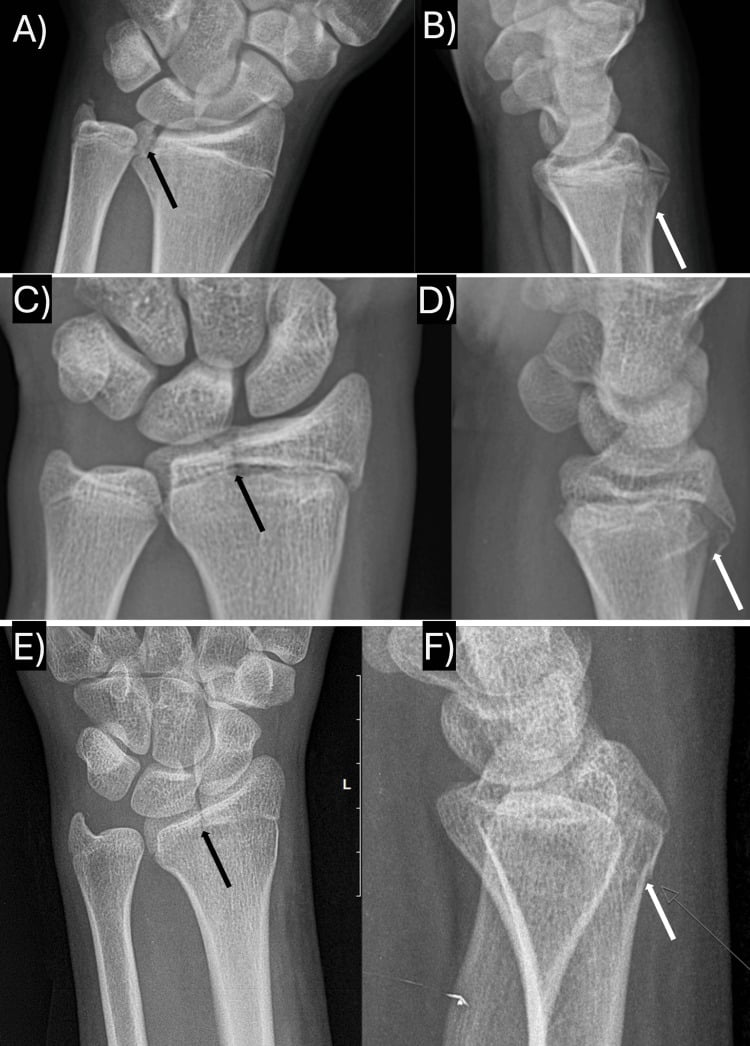
Transitional fractures. A transitional fracture may look like a Salter-Harris III on the AP view but show a Salter-Harris II component on the lateral, so both projections are needed to define the fracture.
Clinical Presentation
History
The history should separate a stable low-energy wrist injury from a displaced fracture, associated injury or safeguarding concern.
- Useful details
- Fall on outstretched hand, sport, scooter, trampoline, fall from height, direct blow or crush.
- Why it matters
- Higher-energy mechanisms increase the chance of complete fracture, associated elbow injury, open injury or neurovascular concern.
- Useful details
- Distal radius, distal ulna, snuffbox, whole forearm or elbow.
- Why it matters
- Focal distal radial pain fits buckle or distal radius fracture; snuffbox or elbow pain changes imaging.
- Useful details
- Refusal to use the hand, visible deformity, finger movement and ability to tolerate a splint.
- Why it matters
- Deformity and severe pain make a simple buckle fracture less likely.
- Useful details
- Numbness or paraesthesia in thumb, index or middle fingers.
- Why it matters
- Suggests median nerve irritation from swelling, deformity or tight immobilisation.
- Useful details
- Increasing pain, swollen fingers, colour change, numbness or inability to move fingers.
- Why it matters
- This is a cast safety problem until proven otherwise.
- Useful details
- Recurrent fractures, very low-energy injury, inconsistent history, delay in presentation or non-mobile child.
- Why it matters
- May require metabolic bone or child protection assessment.
Examination
Inspection separates a comfortable stable injury from a deformed unstable fracture, and what separates a buckle from a displaced physeal fracture is cortical stability, deformity, tenderness pattern and radiographic alignment. Skin, deformity, median nerve and perfusion are checked before any cast goes on, because they detect urgent problems. Do not force wrist movement when the diagnosis is clinically obvious.
- What to check
- Bruising, open wound, threatened skin, cast pressure, finger swelling and colour.
- Decision it informs
- Open or threatened-skin injuries need urgent escalation; tight casts must be split or removed.
- What to check
- Dorsal or volar angulation, translation, shortening and forearm shape.
- Decision it informs
- Visible deformity usually means complete or physeal fracture, not a simple buckle injury.
- What to check
- Distal radius, distal ulna physis, DRUJ, snuffbox, forearm shaft and elbow.
- Decision it informs
- Guides radiograph field and prevents missed ulna, scaphoid, Galeazzi-equivalent or elbow injury.
- What to check
- Thumb, index and middle-finger sensation; thumb opposition or flexion when age-appropriate.
- Decision it informs
- Document before and after reduction because swelling or deformity can compromise the nerve.
- What to check
- Radial pulse, capillary refill, warmth and finger movement.
- Decision it informs
- Confirms vascular safety and helps detect evolving compartment or cast problems.
- What to check
- Pain out of proportion, pain with passive finger stretch, increasing analgesia need and tense swelling.
- Decision it informs
- Requires urgent review; do not dismiss it as expected fracture pain.
Tenderness and sensation. Localise the pain to the distal radius or ulna and feel over the physis itself: local physeal tenderness can be the clue to a physeal injury, and it changes follow-up. Test ulnar and radial sensation as well as the median nerve.
Investigations
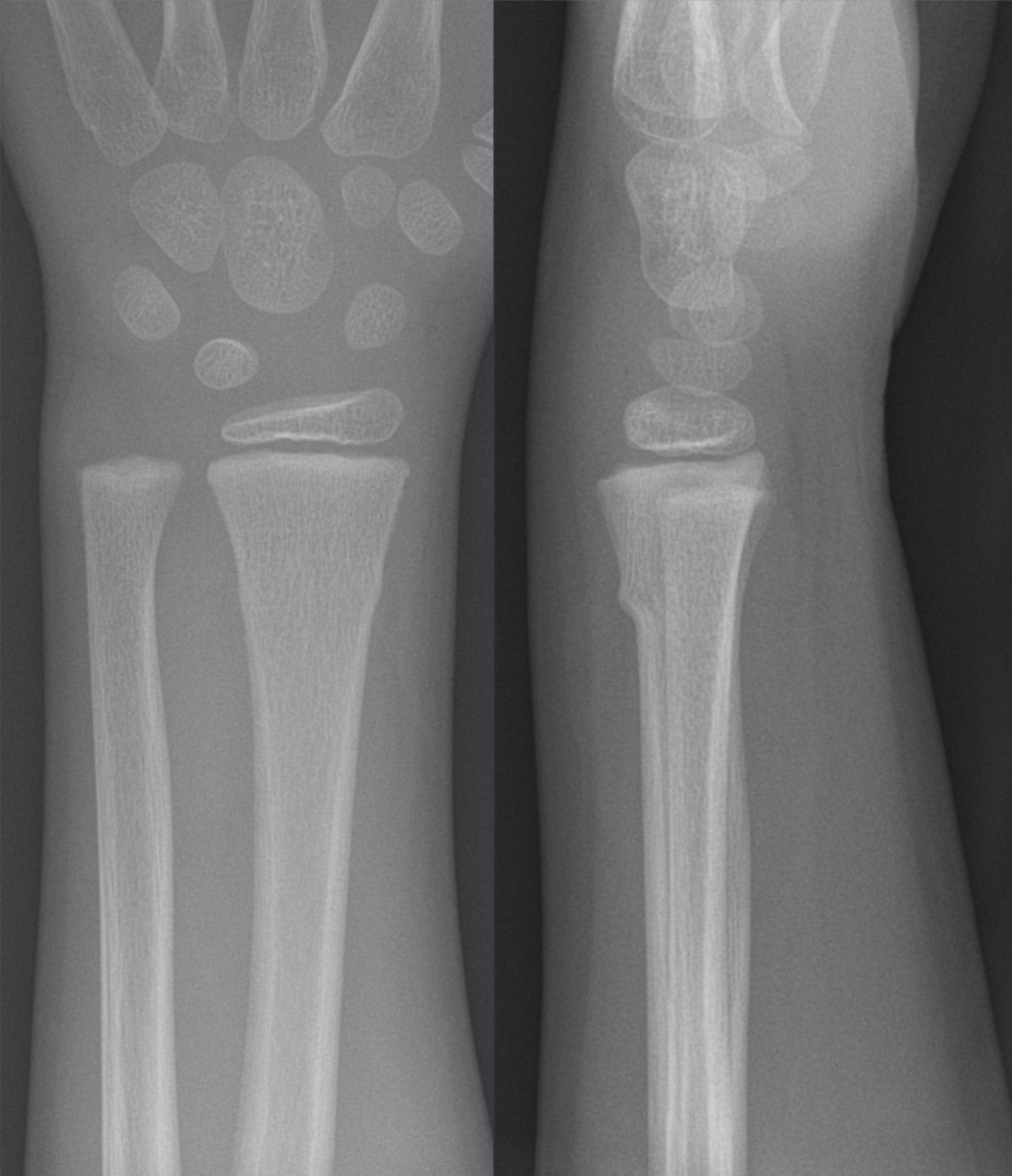
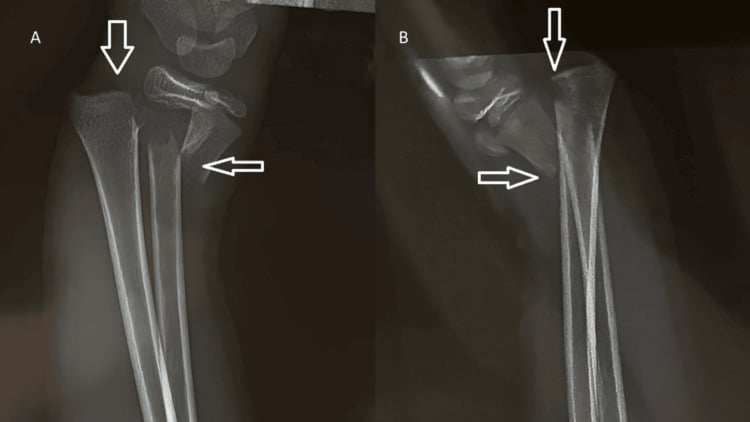
The lateral view is essential, because a subtle dorsal buckle can be missed on the AP alone.
- Investigation
- AP and lateral wrist radiographs including distal radius and ulna
- Decision it informs
- Classifies buckle, metaphyseal or physeal injury
- Investigation
- Forearm or elbow radiographs as indicated
- Decision it informs
- Detects associated injury
- Investigation
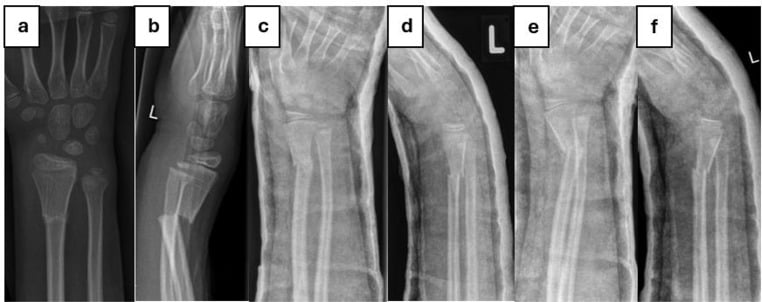
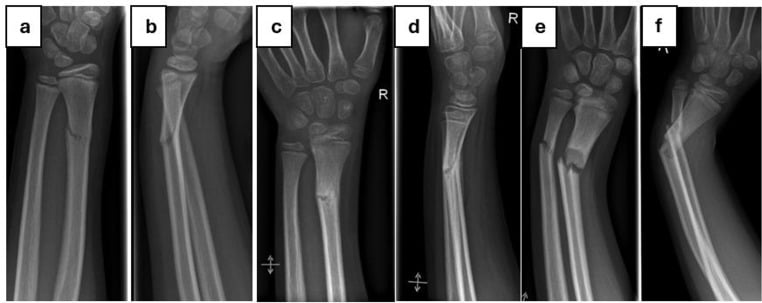
- Repeat AP and lateral films
- Decision it informs
- Confirms alignment and cast quality
- Investigation
- Scaphoid views or MRI in selected adolescents
- Decision it informs
- Avoids missed carpal injury
Reading the film. Look at both cortices, and confirm there is no physeal extension, before calling a buckle fracture. Then assess dorsal or volar tilt, translation, shortening and any associated ulna fracture, and do not miss a distal ulna physeal injury. In adolescents, consider a carpal injury if the pain is not explained by the distal radius findings.
Repeat imaging. Whether and when to repeat the films depends on stability, age, reduction and the local fracture protocol.
Differential Diagnosis
- Clue
- Diffuse pain without focal bony tenderness or radiographic abnormality.
- Clinical consequence
- Use cautiously; focal distal radial tenderness in a child is a fracture until assessed properly.
- Clue
- Snuffbox tenderness, pain with axial thumb loading, adolescent age group.
- Clinical consequence
- May need scaphoid views, immobilisation and interval imaging or MRI.
- Clue
- Ulnar-sided physeal tenderness or associated distal ulna fracture.
- Clinical consequence
- Carries growth-arrest and ulnar-variance risk; do not focus only on the radius.
- Clue
- Distal radial fracture with DRUJ pain, distal ulna physeal injury or ulnar head prominence.
- Clinical consequence
- Requires DRUJ and ulna assessment, not just routine distal radius management.
- Clue
- Inconsistent history, delay, non-mobile child or additional injuries.
- Clinical consequence
- Escalate safeguarding assessment before routine discharge.
- Clue
- Very low-energy mechanism, recurrent fractures or abnormal bone lesion.
- Clinical consequence
- Consider metabolic bone disease or benign bone lesion work-up.
Management
The first decision is whether the injury is truly stable. A true buckle fracture can be managed simply because it is a stable compression injury; a displaced complete or physeal fracture needs an alignment assessment, a reduction decision, a good cast and follow-up.
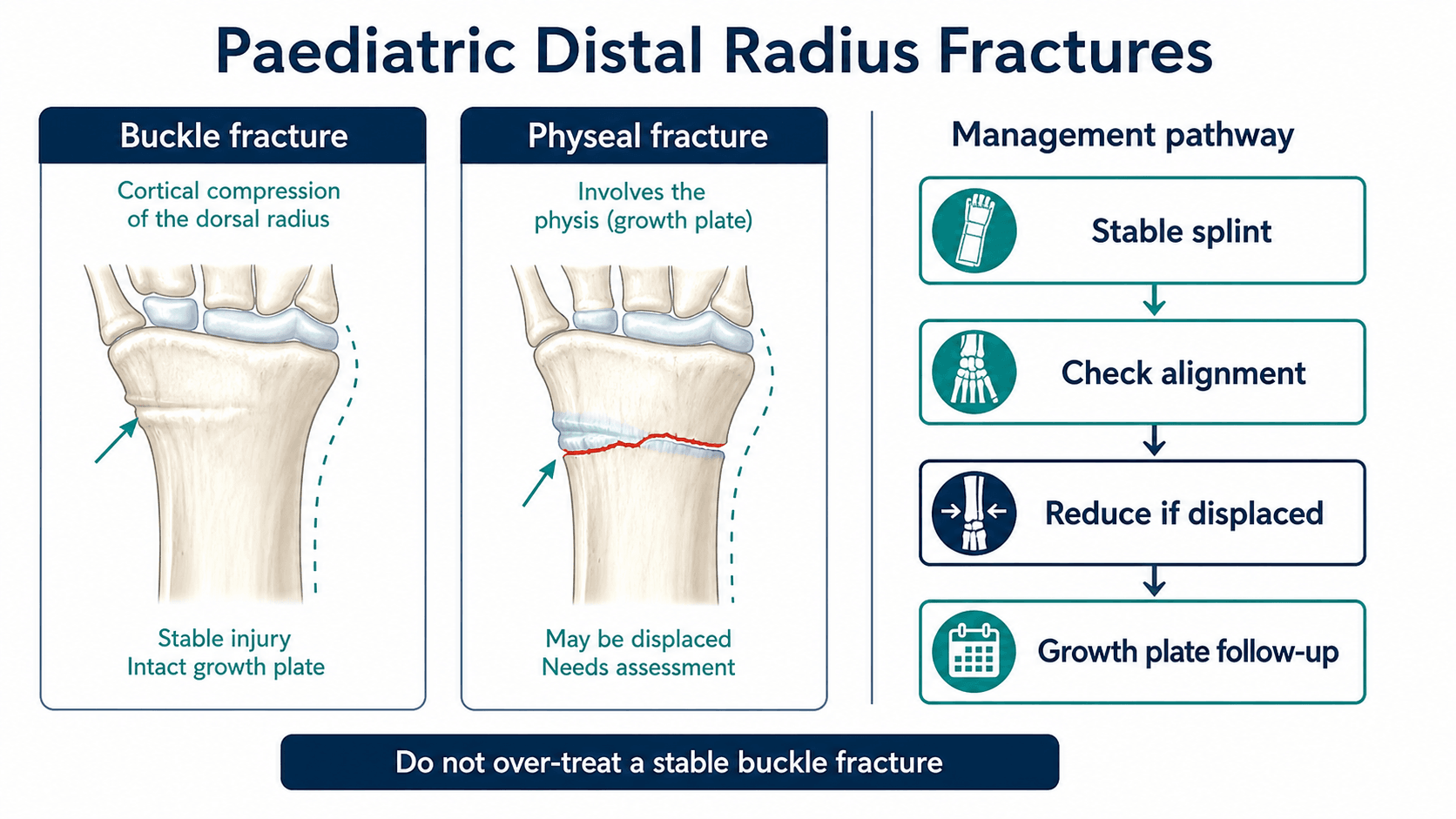
The treatment steps up with instability:
- Splint for stable buckle injuries
- Cast for pain control or for stable fractures needing support
- Reduce displaced fractures or unacceptable alignment
- Operate for irreducible, open, neurovascular-compromising or unstable patterns
- Usual treatment direction
- Removable splint, soft bandage or simple immobilisation according to local protocol; analgesia and written advice.
- Follow-up focus
- Return if pain worsens, fingers swell or function does not recover as expected; routine repeat X-rays are often unnecessary when diagnosis is secure.
- Usual treatment direction
- Short-arm cast or splint/cast strategy depending on stability, age, pain and local protocol.
- Follow-up focus
- Confirm that alignment remains acceptable if there is displacement risk.
- Usual treatment direction
- Analgesia or sedation, closed reduction when alignment is unacceptable, well-moulded cast and post-reduction films.
- Follow-up focus
- Early review for redisplacement, especially with poor cast moulding, both-bone injury or older child.
- Usual treatment direction
- Gentle reduction if unacceptable; avoid repeated forceful attempts; immobilise and document neurovascular status.
- Follow-up focus
- Monitor reduction and later growth, particularly after high-energy injury or repeated manipulation.
- Usual treatment direction
- Assess DRUJ stability and ulnar physis; treat associated instability rather than ignoring it.
- Follow-up focus
- Watch for ulnar variance, wrist pain and forearm rotation problems.
- Usual treatment direction
- Urgent orthopaedic management, cast release when tight, antibiotics and theatre when open.
- Follow-up focus
- Safety takes priority over routine fracture pathway.
The stable buckle fracture
Explanation and movement. Explain to the family that this is a stable compression injury, and encourage finger, elbow and shoulder movement. When the diagnosis is secure and the family has clear return advice, a true torus fracture should not need repeated X-rays, prolonged casting or fracture-clinic congestion.
Return to sport. This depends on pain-free wrist motion, resolution of tenderness and the injury pattern, and a buckle fracture returns earlier than a displaced physeal or complete metaphyseal fracture. Avoid contact sport until the child is pain-free and the advised timeframe is complete.
Displaced metaphyseal and physeal fractures
Give analgesia and appropriate sedation, reduce unacceptable angulation or displacement gently, and apply a well-moulded cast that is not tight. Arrange fracture-clinic follow-up with repeat imaging when there is a risk of displacement.
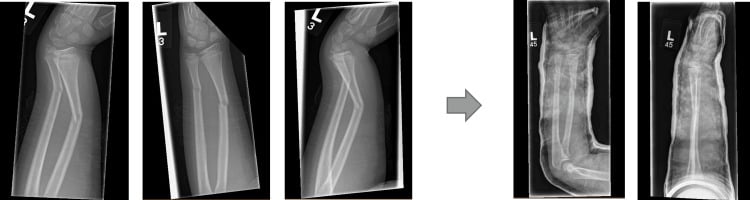
The cast mould. After reduction of a displaced fracture, the quality of the cast mould is the surgeon-controlled factor that most predicts redisplacement. A good cast is three-point moulded and elliptical (flattened) rather than round in cross-section.
The cast index. This is the internal sagittal (lateral) cast width divided by the internal coronal (AP) cast width, measured at the fracture level. A well-moulded elliptical cast has an index around 0.7; an index above 0.8, a round and poorly moulded cast, is strongly associated with loss of reduction. The three-point, gap, padding and Canterbury indices are related measures, and all quantify moulding or contact and predict redisplacement.
Acting on it. If the post-reduction cast index is above 0.8 or the mould is poor, anticipate redisplacement. Re-mould (for example, wedge) or review early, and have a low threshold for fixation in the older child.
The physis. Classify the Salter-Harris pattern and reduce gently if the position is unacceptable. The number of reduction attempts is itself a risk, because each forceful manipulation of a physeal fracture adds arrest risk. Beyond 10 days from injury, manipulation should be abandoned altogether, and a late displaced physeal fracture is usually better accepted and remodelled than re-reduced.
Surveillance. Growth disturbance may be delayed (Harris lines later), and more growth remaining means more surveillance. Follow physeal injuries for growth disturbance when the risk is meaningful; the complications section sets out in whom it is.
Fixation and special cases
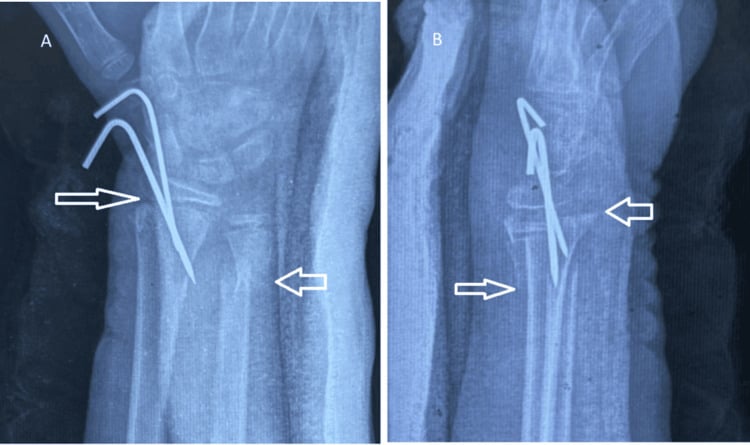
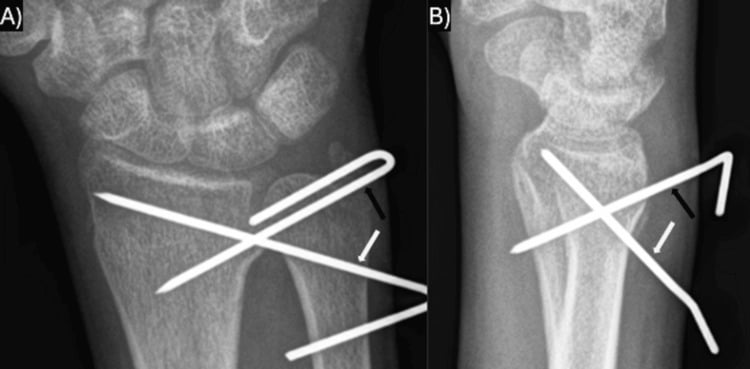
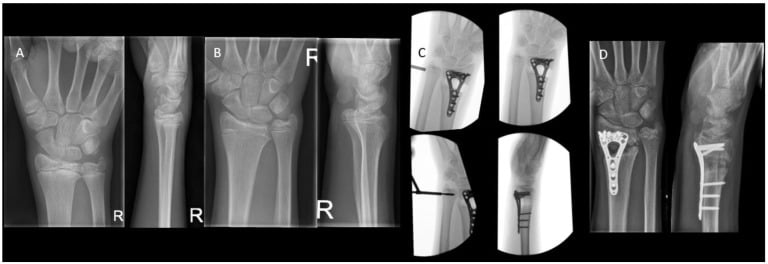
Open fractures and neurovascular compromise are managed urgently. Consider fixation for unstable, irreducible or recurrently displaced patterns, and for unacceptable alignment in the older child.
What "unacceptable" means
No validated threshold. The word "unacceptable" appears throughout any account of these fractures, and there is no validated threshold behind it. The most recent current-concepts review states plainly that even among experts there is little consensus on the optimal treatment of displaced metaphyseal fractures.
The 15° convention. The figure most often quoted, 15° of angulation, is described in the literature as the maximum acceptable limit but was never derived from an outcome study. The one series that specifically examined malunions above it found that all 40 fractures remodelled, from a mean of 23° down to 8° in the sagittal plane, so treat any single number you are given as convention.
Time, not speed. In that series remodelling speed was not related to age (mean 2.5° per month, faster with greater initial angulation). What younger children have is more time, not faster correction, and an adolescent near maturity has neither: growth remaining is the binding constraint.
Making the call. The decision is made from the child's age, the plane of the deformity and the physis, not from a protractor reading alone. Accepting a deformity in a young child with a sagittal-plane malunion is a defensible, evidence-consistent choice rather than a compromise.
The common error is mismatch: too much treatment for a buckle fracture or too little respect for an unstable physeal or complete fracture. A buckle fracture is a stability and comfort problem; a displaced physeal injury is a reduction, growth and follow-up problem.
Complications
Early
- Median nerve symptoms
- Cast tightness, swelling or pressure injury
- Loss of reduction
- Compartment syndrome, rare but serious
- Missed associated elbow or carpal injury
Acute median nerve dysfunction. A displaced distal radius fracture can injure the median nerve by stretch, contusion or compression. The first step is prompt fracture reduction, which relieves most stretch or compression neurapraxia, and then the nerve is re-examined. Two situations follow:
- A neurapraxia that is stable or improving after reduction is observed with serial examination
- A deficit that is progressive, or persists or worsens after an adequate reduction, is acute carpal tunnel syndrome: a surgical emergency requiring urgent carpal tunnel release (decompression)
Avoid over-flexed (Cotton-Loder) casting, which raises carpal tunnel pressure and can precipitate median neuropathy.
Late
- Malunion with residual deformity
- Distal radial or ulnar physeal arrest
- Wrist stiffness from over-immobilisation
- Refracture after early return to sport
- Cosmetic deformity or functional limitation if alignment is unacceptable
Who actually gets a growth arrest
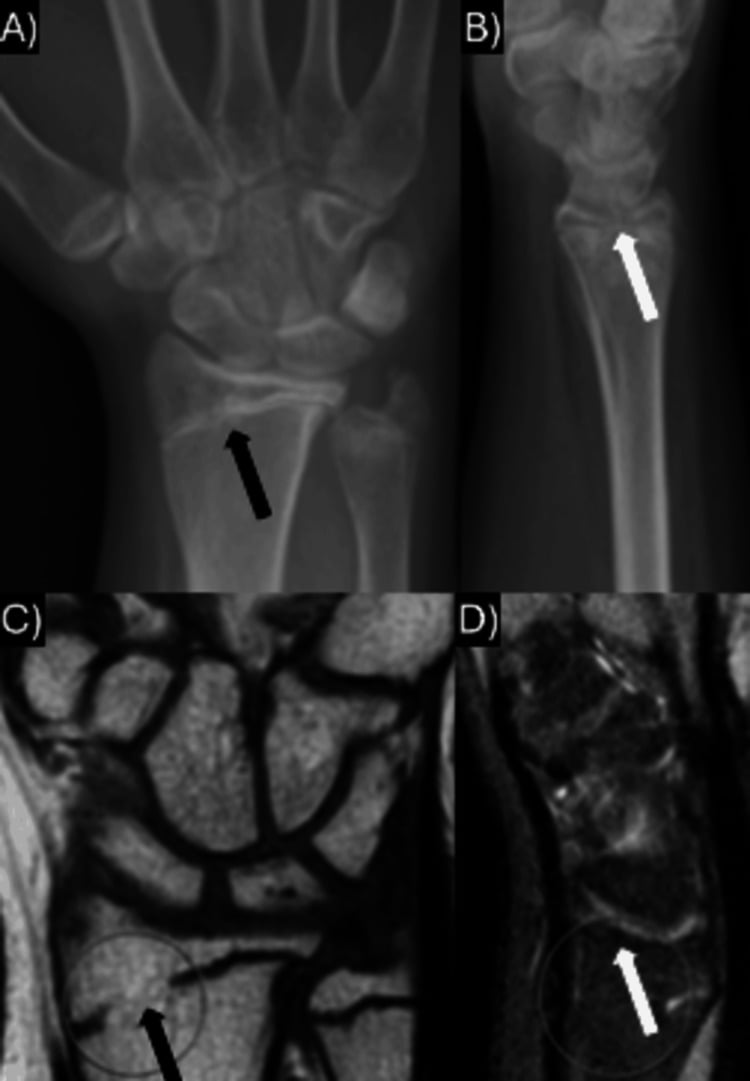
"Follow physeal injuries for growth disturbance" is only useful if you know in whom. The risk is not spread evenly, and three variables separate a child who needs a single check from one who needs surveillance to maturity:
- Arrest / growth disturbance rate
- Growth disturbance in about 20 percent, with complete arrest in about 14 percent
- What it changes
- The ulnar physis is far less forgiving than the radial one, and it is the injury most often overlooked when the radius fracture dominates the film
- Arrest / growth disturbance rate
- 34.8 percent versus 3.2 percent
- What it changes
- Displacement is the single clearest divider - an undisplaced injury is genuinely low-risk
- Arrest / growth disturbance rate
- 50 percent versus 11.1 percent
- What it changes
- A physeal fracture that crosses the germinal layer behaves differently from one that shears along it
- Arrest / growth disturbance rate
- 46.2 percent versus 9.5 percent
- What it changes
- Counter-intuitive but consistent: the nearly-mature physis tolerates injury WORSE, not better - though it has less growth left to distort
- Arrest / growth disturbance rate
- Growth disturbance in about 43 percent; every child aged 10 or under in the reported series needed a skeletal rebalancing procedure
- What it changes
- An intra-articular physeal injury in a young child should be consented for a second operation from the outset
Two consequences for practice. First, the consent conversation for a displaced Salter-Harris III/IV injury in a child with substantial growth remaining is a different conversation from the one for an undisplaced Salter-Harris II, and quoting a single pooled figure flattens a tenfold difference. Second, these are the children in whom repeated forceful manipulation must be avoided, because each additional attempt at closed reduction adds insult to a germinal layer that is already injured.
Guidelines, Registries & Global Practice
Paediatric distal radius fractures are a worldwide problem and the single most common skeletal injury requiring intervention in children. Practice varies more by health-system resource and local protocol than by true biological difference, so the global picture matters for any exam answer.
Global epidemiology
- Distal forearm fractures account for roughly a quarter to a third of all childhood fractures, with peak incidence around the pubertal growth spurt.
- Boys are affected more often than girls overall, mirroring activity exposure; in the FORCE cohort 61 percent were boys.
- Rising incidence has been linked to increased sport participation, higher body mass index and reduced bone mineral density in some populations.
- Distal ulnar physeal injuries show growth disturbance in around one in five cases, and intra-articular (Salter-Harris III/IV) distal radius fractures in around two in five.
Side-by-side guidance
- Torus (buckle) fractures
- Supports minimal immobilisation and discharge with safety-netting; reflects FORCE findings.
- Displaced and physeal fractures
- Timely reduction of unacceptable alignment, neurovascular documentation and structured follow-up.
- Torus (buckle) fractures
- Removable splint or simplified care for stable torus fractures.
- Displaced and physeal fractures
- Closed reduction for unacceptable alignment; pinning for unstable or recurrently displaced fractures; physis guides decisions.
- Torus (buckle) fractures
- Recognises torus as stable; protective immobilisation for comfort.
- Displaced and physeal fractures
- Reduction and well-moulded casting; emphasises cast index and Kirschner-wire fixation when unstable.
- Torus (buckle) fractures
- Aligns with minimal-immobilisation evidence for true torus injuries.
- Displaced and physeal fractures
- Accept remodelling in younger children; reserve fixation for instability or maturity.
Registry and trial evidence
- Paediatric fracture care is driven by trial evidence rather than implant registries (registries dominate adult arthroplasty, not childhood fractures).
- The FORCE equivalence RCT (965 children, 23 UK hospitals) is the landmark dataset supporting bandage-and-discharge for torus fractures.
- Cohort data from North American children's hospitals define the growth-arrest risk that justifies physeal surveillance.
High- versus limited-resource practice
- In well-resourced systems the debate is about doing less: removable splints, no routine repeat films and reduced clinic visits for buckle fractures.
- In limited-resource settings the priorities are accurate triage to avoid missing displaced or physeal fractures, safe casting where image-guided fixation is unavailable, and clear caregiver safety-netting because follow-up may be difficult.
- Across all settings the universal non-negotiables are neurovascular assessment, recognition of the physis and a well-moulded, non-tight cast when immobilisation is used.
Controversies and Areas of Uncertainty
Several questions in paediatric distal radius care remain genuinely unresolved, and examiners reward candidates who can state both sides rather than quote a single number.
- One side
- Off-ended (bayonet) complete fractures with good alignment can remodel without formal reduction in younger children.
- Other side
- Some surgeons still reduce to restore length, citing variable remodelling and parental expectation.
- One side
- Traditional teaching cites roughly 15 to 20 degrees sagittal in younger children, more with more growth remaining.
- Other side
- Remodelling studies show even higher angulation can correct, so thresholds are guides, not hard rules.
- One side
- Completing or moulding the fracture may reduce redisplacement.
- Other side
- Gentle moulding without completing the fracture avoids extra injury and is often sufficient.
- One side
- Percutaneous wiring reduces redisplacement and remanipulation.
- Other side
- Long-term functional benefit is unproven and pinning adds anaesthetic, scar and hardware risks.
- One side
- Some protocols still image at review.
- Other side
- High-level evidence supports discharge without routine repeat imaging when the diagnosis is secure.
- One side
- Imaging confirms the pattern and excludes physeal or complete fracture.
- Other side
- A validated clinical decision rule to avoid radiography in minor injuries is an explicit research priority from the FORCE programme.
Viva Approach and Common Pitfalls
- Question
- Is it truly a buckle fracture?
- Safe answer
- Check both cortices and the physis. A complete fracture or displaced physis should not be discharged as a buckle injury.
- Question
- Is the child neurovascularly safe?
- Safe answer
- Document median nerve and perfusion before and after reduction or cast application.
- Question
- Is the alignment acceptable for this child?
- Safe answer
- Younger children remodel more; adolescents and rotational deformity are less forgiving.
- Question
- Can the fracture redisplace?
- Safe answer
- Complete fractures, associated ulna fractures and poor cast moulding need closer follow-up than stable buckle fractures.
- Question
- Is there a growth-plate issue?
- Safe answer
- Name distal radial and distal ulnar physeal injuries explicitly and arrange surveillance when risk is meaningful.
- Question
- Does the family know when to return?
- Safe answer
- Increasing pain, swollen fingers, numbness, colour change or inability to move fingers is urgent.
Common pitfalls
- Why it is unsafe
- The child may be discharged without reduction or redisplacement follow-up.
- Better practice
- Confirm no complete cortical breach and no physeal extension.
- Why it is unsafe
- Growth arrest can later cause ulnar variance and DRUJ symptoms.
- Better practice
- Examine and report distal ulna tenderness and radiographic injury.
- Why it is unsafe
- Median nerve deterioration may be missed.
- Better practice
- Document sensation, motor function and perfusion before and after manipulation.
- Why it is unsafe
- Can worsen pain, nerve symptoms or compartment risk.
- Better practice
- Use appropriate padding, moulding and cast splitting when swelling risk is high.
- Why it is unsafe
- May increase iatrogenic growth-plate injury.
- Better practice
- Use adequate analgesia/sedation, gentle technique and senior help if reduction fails.
- Why it is unsafe
- Families may wait despite cast pain, numbness or swollen fingers.
- Better practice
- Give clear written and verbal return precautions.
Clinical Decision Scenarios
Practise clinical reasoning and management decisions out loud
“A seven-year-old has a distal radius buckle fracture after FOOSH. How do you manage it?”
“A child has a displaced distal radial Salter-Harris II fracture. What are your priorities?”
“A 13-year-old has a completely displaced, dorsally angulated complete metaphyseal distal radius fracture with bayonet apposition. The wrist is swollen and the child reports tingling in the thumb. How do you proceed?”
Buckle
- Compression bulge
- Stable
- No complete cortex break
- Splint
- Return advice
Displaced
- Deformity
- Both cortices or physis
- Reduction if unacceptable
- Moulded cast
- Repeat X-ray
Check
- Skin
- Median nerve
- Perfusion
- Finger movement
- Cast tightness
Do Not Miss
- Distal ulna physis
- Scaphoid in adolescent
- Galeazzi equivalent
- Compartment signs
Evidence Base: Buckle Fracture Trials
FORCE trial: bandage equivalent to rigid immobilisation for torus fractures
- Multicentre equivalence RCT of 965 children aged 4 to 15 across 23 UK hospitals.
- Pain at 3 days was equivalent: 3.21 vs 3.14 points, adjusted difference -0.10 (95% CI -0.37 to 0.17), within the prespecified margin of 1.0.
- No between-group difference in pain or function across 6 weeks of follow-up.
FORCE HTA: bandage is also cost-effective and complication-equivalent
- Complications were rare and equivalent: 5 (1.0%) with bandage versus 3 (0.6%) with rigid immobilisation.
- No difference in functional recovery, quality of life or school absence over 6 weeks.
- The offer of a bandage reduced treatment cost and was highly likely to be cost-effective.
Plint RCT: removable splint improves function over casting for buckle fractures
- RCT of 113 children aged 6 to 15 with distal radius and/or ulna buckle fractures (87 analysed).
- Removable splint gave better physical functioning (ASKp score) at day 14 and less difficulty with bathing, with no difference in pain.
- There were no refractures in either group.
Cochrane review: evidence supports removable splintage for buckle fractures
- Ten trials involving 827 children; four compared removable splintage versus below-elbow cast for buckle fractures.
- No short-term deformity in any buckle-fracture trial and no refracture at 6 months in the reporting trial.
- Below-elbow casts did not increase redisplacement versus above-elbow casts; percutaneous wiring reduced redisplacement of displaced fractures.
Current concepts: physis guides treatment of all distal radius fractures
- Distal radius fractures are the most common skeletal injury requiring intervention in children.
- Proximity to the physis and remaining skeletal growth guide treatment for all patterns, not just physeal fractures.
- Even among experts there is little consensus on optimal treatment of displaced metaphyseal fractures.
Distal ulna physeal fractures: ~20% growth disturbance
- Fifty-six children with distal ulnar physeal fracture; growth disturbance in 11 (19.6%), with complete arrest in 8 (14.3%).
- Displaced and Salter-Harris III/IV fractures had higher arrest rates (34.8% vs 3.2%; 50% vs 11.1%).
- Less than 2 years of growth remaining markedly raised arrest risk (46.2% vs 9.5%).
Intra-articular distal radius fractures carry high growth-arrest risk
- Twenty-eight skeletally immature patients with Salter-Harris III/IV distal radius fractures.
- Growth disturbance occurred in 12 (43%), substantially higher than rates after extra-articular physeal fractures.
- All four children aged 10 or younger developed arrest requiring skeletal rebalancing procedures.
Evidence Base: Physeal Injury Outcomes
Remodelling continues even above the 15 degree threshold
- Forty distal radius malunions in 33 children (aged 3 to 14) healed at 15 degrees angulation or more.
- All fractures remodelled; mean dorsovolar malunion fell from 23 to 8 degrees and radioulnar from 21 to 10 degrees.
- Remodelling speed (mean 2.5 degrees per month, range 0.4 to 7.6) decreased exponentially over time and rose with greater initial angulation - and was NOT related to age or sex in this cohort.
Distal radius-ulna fractures: review of principles and complications
- Management must include neurovascular assessment, soft-tissue evaluation and explicit attention to the radial and ulnar physes.
- Treatment ranges from casting with radiographic follow-up to urgent reduction and surgical fixation.
- Both early (median nerve, compartment) and late (growth arrest) complications can affect outcomes.
Late manipulation of physeal fractures risks iatrogenic arrest
- Nonsurgical management is most common because of marked remodelling potential.
- Physeal fractures presenting more than 10 days after injury should not be manipulated because of increased physeal-arrest risk.
- Substantial angulation or displacement warrants closed reduction with or without percutaneous pinning.