Ossification centres, anterior humeral line, radiocapitellar line and occult fracture signs
- Know the CRITOE ossification sequence and expected age range.
- The anterior humeral line should TOUCH the capitellar ossific nucleus at every age - that part is universal. The middle-third rule only holds from about five years (100 percent of normals); under five it lies outside the middle third in 25 percent, and under two it is in the anterior third in about 30 percent, so the adult rule over-calls fractures in toddlers.
- The radiocapitellar line should pass through the capitellum on every view.
- A posterior fat pad after trauma suggests intra-articular fracture until proven otherwise.
- Compare clinical swelling, tenderness and neurovascular status with the radiograph.
- “Ask whether the X-ray is a true lateral before trusting the lines.
- “Radiocapitellar alignment must be checked on AP and lateral views.
- “Baumann angle helps assess coronal alignment in supracondylar fractures.
- “The youngest children have the most cartilage and the least forgiving radiographs.
Overview and Epidemiology
Why the child's elbow is hard. In children the distal humerus and proximal radius are partly cartilaginous, so the radiograph shows only the ossified part of a much larger cartilaginous elbow. A fracture may pass through cartilage, an ossification centre may look like a fragment, and malalignment may be subtle unless the view is adequate and the landmarks are used correctly. Reading a child's elbow like an adult's is the common error; safe interpretation depends on knowing which landmark is reliable for the child's age.
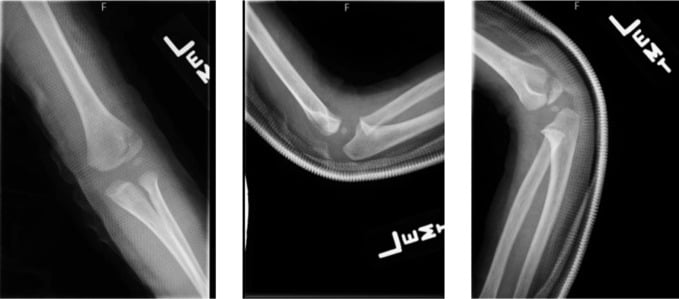
What is being missed. Common injuries include the supracondylar humerus fracture, the lateral condyle fracture, medial epicondyle avulsion or incarceration, the radial neck fracture, olecranon injury and the Monteggia lesion. Early on, soft-tissue signs may be the only clue.
The reading sequence. A normal-looking paediatric elbow radiograph can hide a fracture. The safe reader does not stare at the film hoping the fracture declares itself, and does not reassure the family until every step has been taken, in the same order every time:
- Confirm the patient's age and side.
- Confirm a true AP and a true lateral, with forearm films when a Monteggia lesion is possible. Poor views create false reassurance.
- Identify the CRITOE centres expected for the child's age.
- Check the anterior humeral line.
- Check the radiocapitellar line on both the AP and the lateral.
- Assess the fat pads and the soft-tissue swelling.
- Review the cortex at the sites that are commonly missed and treatment-changing: the supracondylar region, lateral condyle, medial epicondyle, radial neck and olecranon.
- Match the radiograph to swelling, focal tenderness, nerve function and perfusion.
The standard. Safety in this elbow comes from three things held together: knowing what normal ossification can look like, knowing exactly where each line is drawn and at what age it applies, and knowing when a subtle film still earns immobilisation, repeat imaging or senior review.
Ossification Centres
The sequence. CRITOE describes the usual order in which the ossification centres around the elbow appear: capitellum, radial head, internal epicondyle, trochlea, olecranon and external epicondyle.
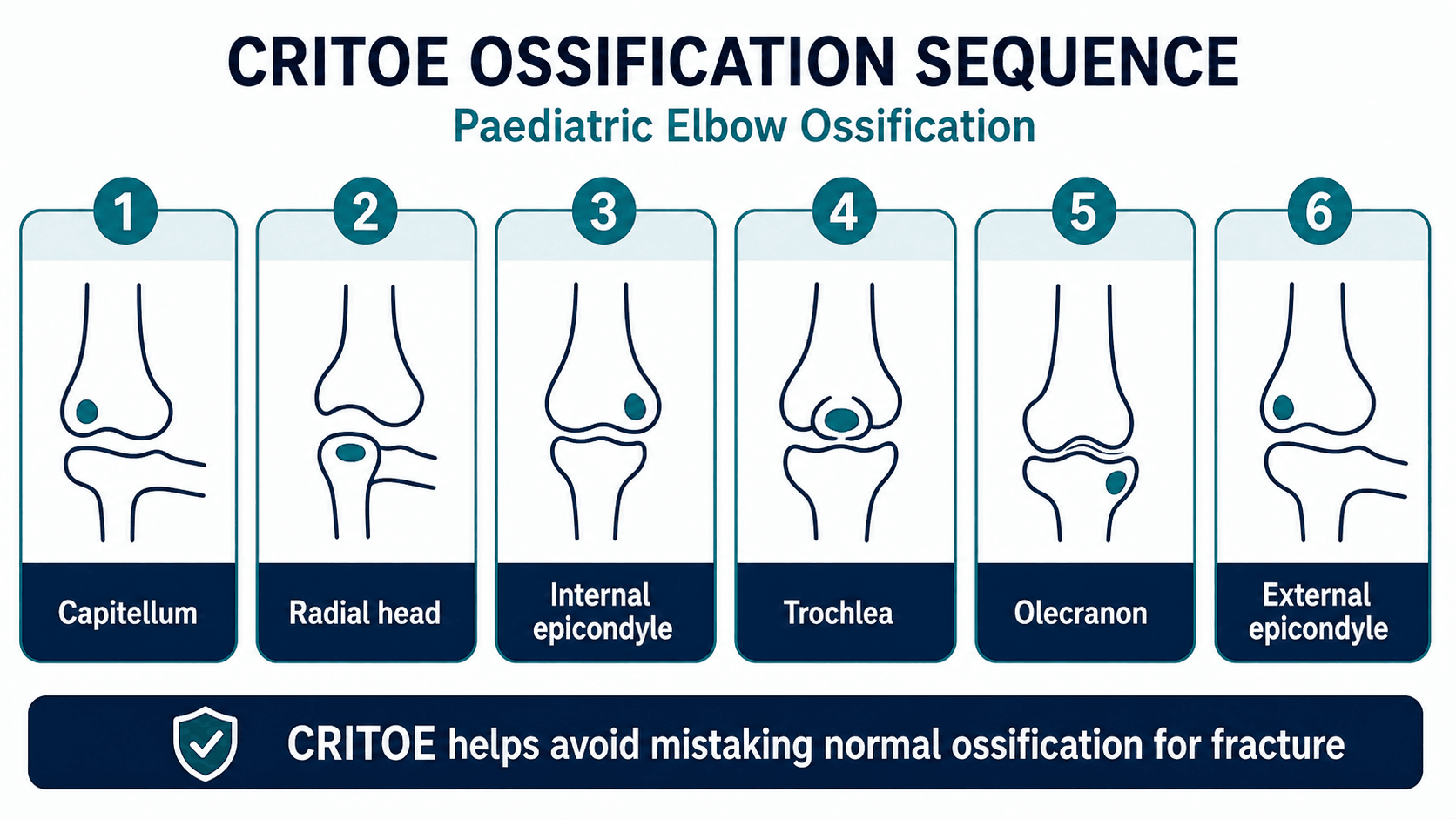
Order over age. The approximate ages follow a 1-3-5-7-9-11 guide, but they vary widely and the centres appear earlier in girls. The order is far more reliable than the exact age, and the order is what makes CRITOE a safety check rather than a memory test.
- Approximate age of appearance
- Around 1 year
- Note
- First to appear; the key lateral landmark
- Approximate age of appearance
- Around 3 years
- Note
- Lateral column clue
- Approximate age of appearance
- Around 5 years
- Note
- ALWAYS appears before the trochlea
- Approximate age of appearance
- Around 7 years
- Note
- Can ossify in fragments, a normal appearance; overcalling it as fracture without clinical correlation is the risk
- Approximate age of appearance
- Around 9 years
- Note
- Posterior centre
- Approximate age of appearance
- Around 11 years
- Note
- Last to appear
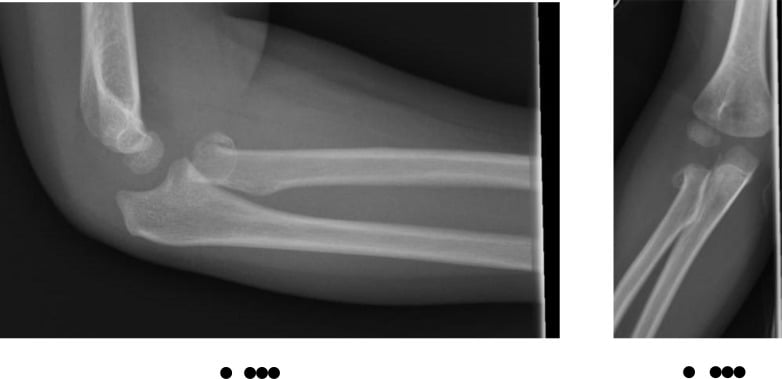
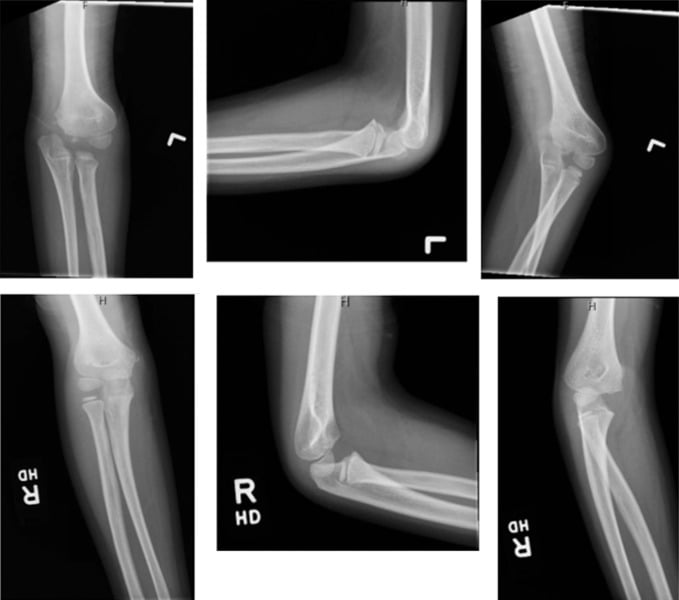
The medial epicondyle rule. Because the internal (medial) epicondyle always ossifies before the trochlea, the trochlea should never be visible without the medial epicondyle also present in its normal position. If a trochlear centre is visible and the medial epicondyle is absent from where it belongs, do not call the elbow normal: the fragment has been avulsed and may be incarcerated within the joint, classically after an elbow dislocation that has spontaneously reduced. A rounded ossific density sitting at the joint line is the displaced epicondyle until proven otherwise. This single rule is a classic exam trap, and the fragment it identifies may need surgery.
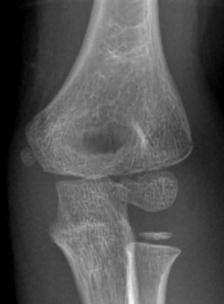
Other traps. Three more situations catch readers out:
- Safe interpretation
- May be a normal ossification centre depending on age and position.
- Risk if missed
- Calling normal anatomy a fracture.
- Safe interpretation
- Much of the distal humerus is cartilage and displacement may be underestimated.
- Risk if missed
- False reassurance from an apparently subtle film.
- Safe interpretation
- Compare the other side only if it changes management and does not delay urgent care.
- Risk if missed
- Delaying treatment for a clinically important injury.
Baumann Angle: Definition and Use
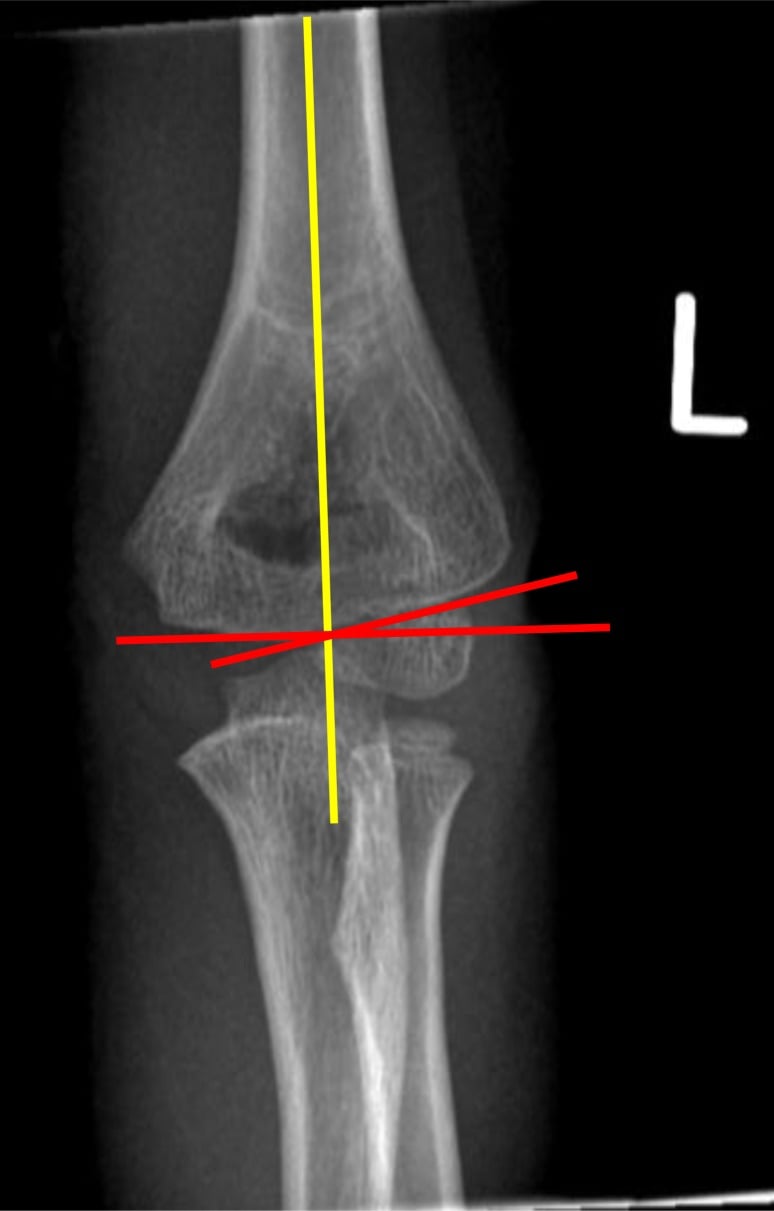
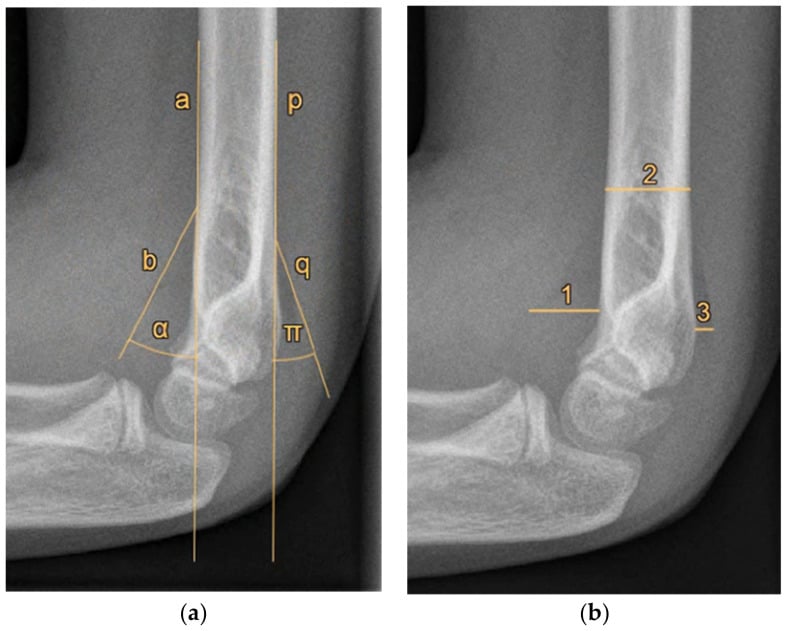
What it is. The angle between the long axis of the humeral shaft and a line drawn along the lateral condylar (capitellar) physis on a true AP view. It is the standard coronal-alignment measure after a supracondylar fracture, but it is only useful if you know exactly what it is and where it fails.
Normal value. Approximately 70 to 80 degrees, but published normals span a wide range. The reliable rule is to be within about 5 degrees of the uninjured elbow.
Which way it moves. It reflects coronal (varus/valgus) alignment of the distal humerus, and an increased angle reflects varus malreduction. The direction is easy to invert, so anchor it to the carrying angle: in 200 normal elbows the Baumann angle correlated negatively with the carrying angle (r = -0.674), so the higher the Baumann angle, the less valgus the elbow.
Why it matters. Varus malalignment, an increased Baumann angle, predicts cubitus varus, the 'gunstock' deformity, after a supracondylar fracture.
The catch. It is highly view-dependent and unreliable on a rotated or oblique AP, so confirm view quality and compare with the normal side. The direction is also a documented source of textbook confusion: three variant definitions circulate, and with the reciprocal (perpendicular) definition the direction flips (Acton and McNally, 'Baumann's confusing legacy', Injury 2001, PMID 11164401).
Clinical Presentation
History. The history guides which part of the elbow radiograph deserves extra attention:
- Fall on the outstretched hand or hyperextension injury: supracondylar fracture and radial neck injury are common considerations
- Direct lateral elbow pain: consider a lateral condyle fracture, which can be subtle and clinically important
- Medial pain after dislocation: look for medial epicondyle avulsion or an incarcerated fragment
- Forearm pain or deformity: do not stop at the elbow; image the forearm for a Monteggia pattern
- Pain escalation, paraesthesia, a cool hand or colour change: neurovascular warning symptoms
- Time since injury and analgesia already given: swelling and compartment concern may evolve
Examination. Inspect the elbow from the front and the side. Marked swelling, deformity, skin puckering or bruising supports a significant injury even if the fracture line is subtle. Palpate systematically over the supracondylar region, lateral condyle, medial epicondyle, radial head, olecranon, forearm and wrist, and avoid forceful range of motion in an obviously fractured elbow.
Tenderness against the film. Compare the site of maximal tenderness with the radiograph. A child with lateral condyle tenderness and a barely visible lateral metaphyseal line should not be labelled as a simple sprain without follow-up.
Neurovascular status. Documenting it is part of elbow radiology assessment, because the X-ray and the hand must be read together.
- Child-friendly test
- Radial pulse, capillary refill, hand colour and temperature.
- Why it matters
- Detects pulseless pink or pulseless pale hand after supracondylar injury.
- Child-friendly test
- Thumb IP flexion and index DIP flexion.
- Why it matters
- AIN palsy is common in extension supracondylar fracture.
- Child-friendly test
- Wrist or finger extension.
- Why it matters
- Assesses posterior interosseous/radial nerve function.
- Child-friendly test
- Finger abduction or crossing.
- Why it matters
- Important in flexion-type supracondylar injuries and medial epicondyle patterns.
- Child-friendly test
- Light touch where the child can cooperate.
- Why it matters
- Documents baseline and supports safe follow-up.
Investigations
- Investigation
- AP and true lateral elbow radiographs
- Decision it informs
- Allows CRITOE, AHL, RCL and fat-pad assessment
- Investigation
- Internal oblique view or repeat radiographs
- Decision it informs
- Detects minimally displaced lateral condyle fracture
- Investigation
- Forearm radiographs including elbow and wrist
- Decision it informs
- Checks ulna alignment and radiocapitellar relation
- Investigation
- Ultrasound, MRI or CT in selected cases
- Decision it informs
- Defines occult or intra-articular injury when management changes
View quality first. The lateral should be a true lateral with the distal humeral condyles superimposed; an oblique film can make the anterior humeral line and the fat pads misleading. If the AP is rotated, the Baumann angle and coronal alignment are less reliable. When either alignment line looks abnormal, first check whether the view is true, then assume injury until proven otherwise.
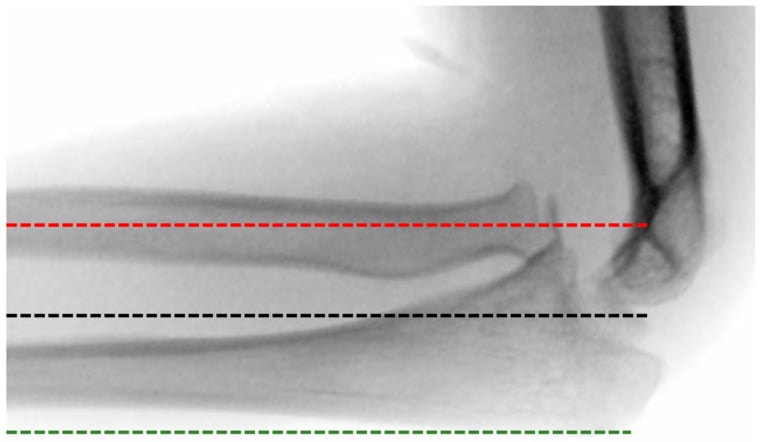
Drawing the anterior humeral line. Draw it along the anterior cortex of the distal humerus on the true lateral. It is not a line down the middle of the humeral shaft or a random vertical line, and drawing a mid-shaft line or trusting an oblique lateral are the common errors.
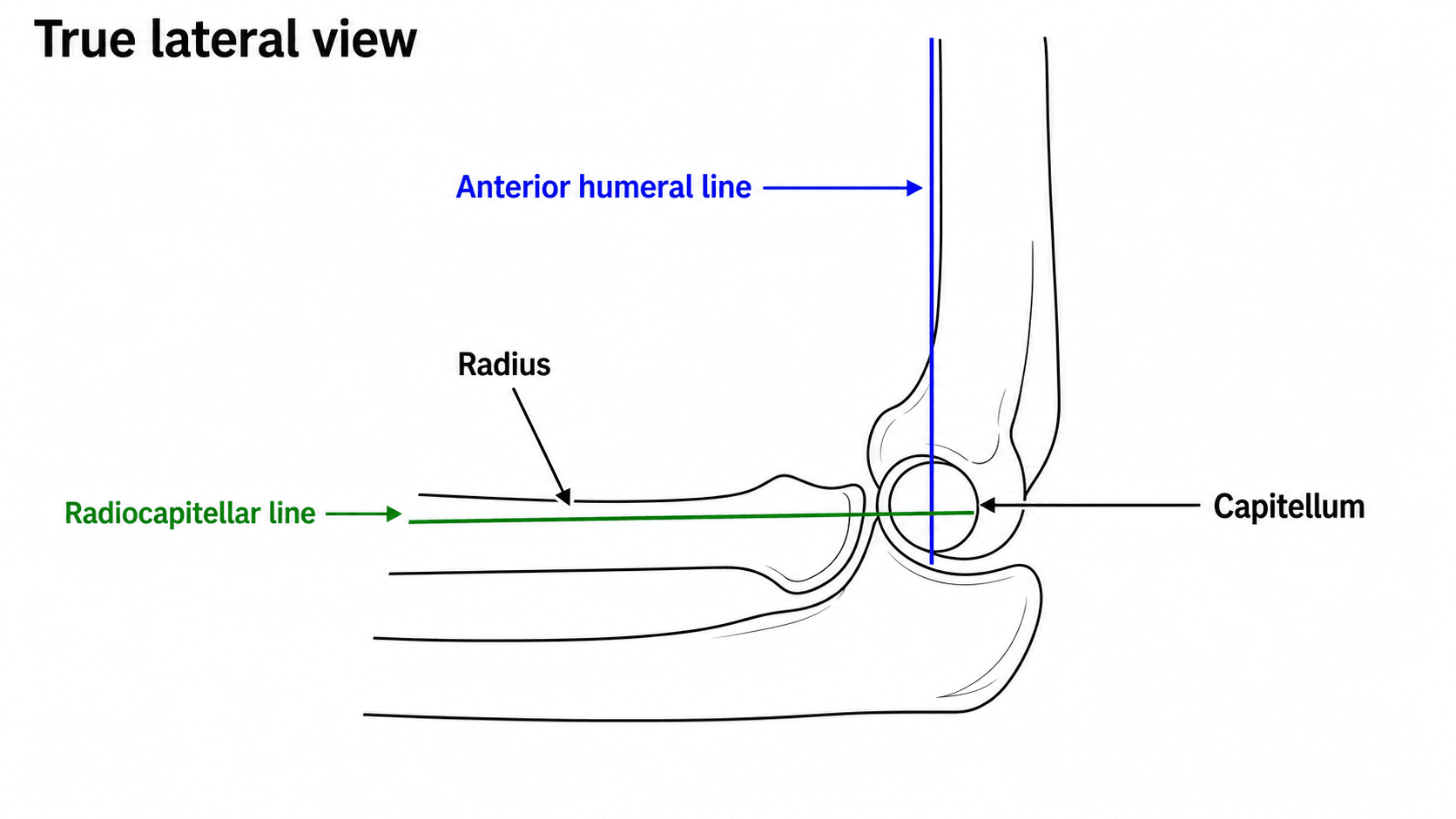
Reading it by age. The rule you apply depends on the child's age, and this is where the sign is most often misread. In a normative study of paediatric elbows the line touched the capitellar ossific nucleus in 100% of children at every age; what changes with age is where it crosses:
- Five years and older: through the middle third in 100%. A line that does not cross the middle third is abnormal and should prompt a search for an extension-type supracondylar fracture.
- Under five years: outside the middle third in 25% of normal children.
- Under two years: in the anterior third in about 30% of normal children.
What stays reliable. In a toddler, a line running through the anterior third of the capitellum is a normal variant in roughly one child in three, and treating the adult rule as absolute over-calls fractures in exactly the age group that gets supracondylar injuries. The finding that holds at every age is failure to touch the ossific nucleus at all: if the line misses the capitellum entirely, look for pathology whatever the child's age. The Baskovic series in the evidence section found the line in the middle third less often still in the youngest children; the percentages differ between series, but in both the proportion rises with age.
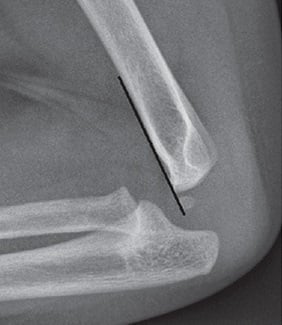
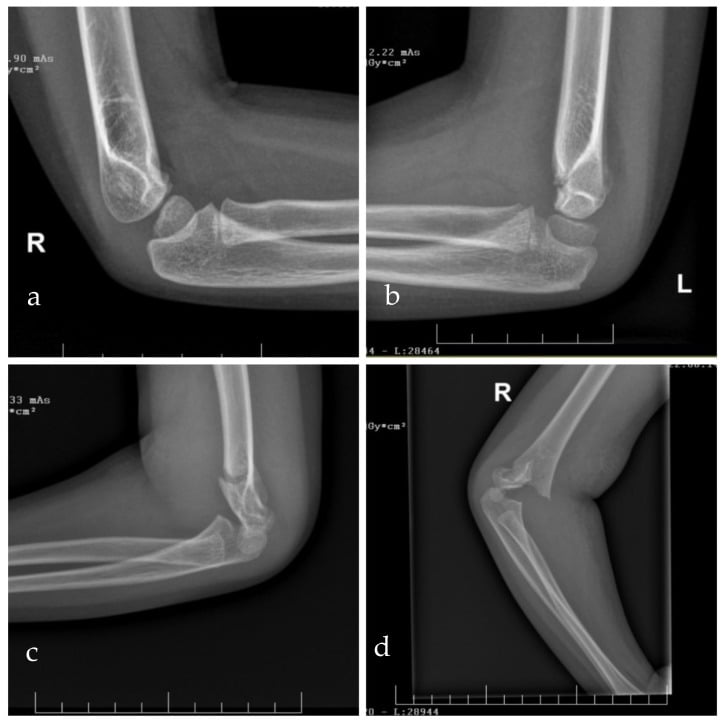
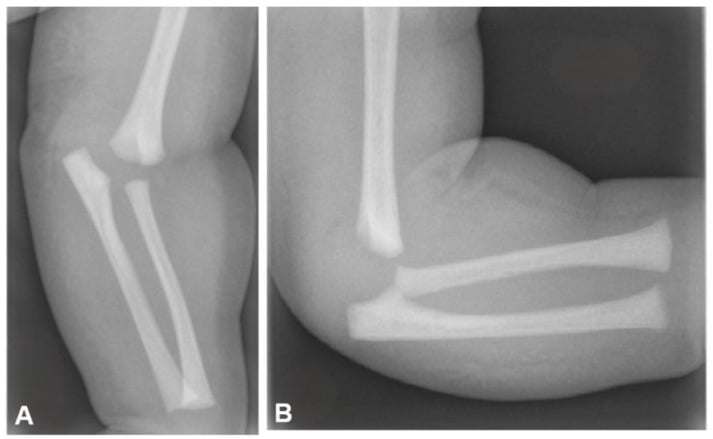
The radiocapitellar line. Draw it through the centre of the radial shaft and neck; it should pass through the capitellum on the AP and the lateral. If it misses the capitellum on an adequate film, look for a Monteggia injury, radial head dislocation, elbow dislocation or radial neck injury. If the film is poor, repeat it or obtain adequate imaging before dismissing the finding.
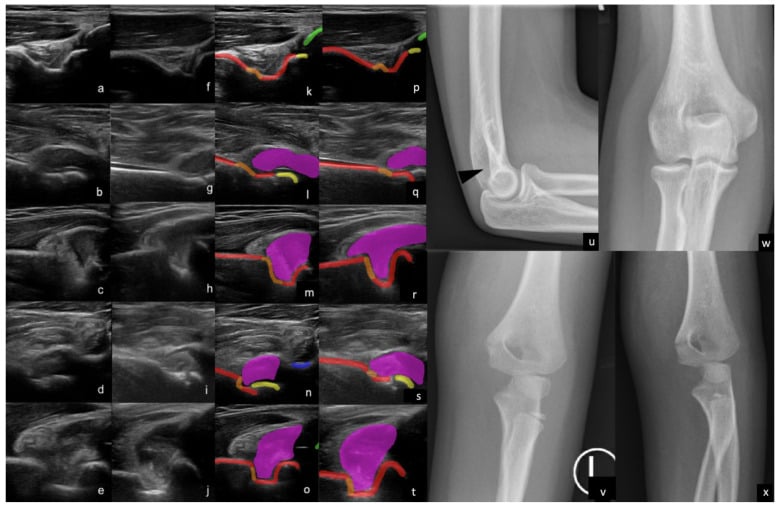
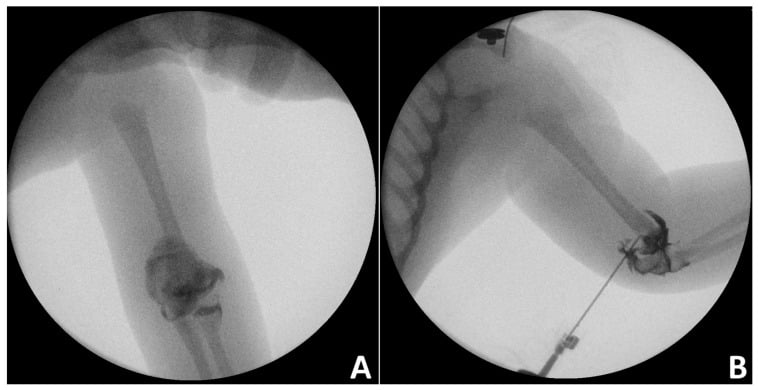
Fat pads and the occult fracture. A posterior fat pad after trauma is abnormal, not a normal variant. When the clinical story fits, it should raise concern for an occult intra-articular injury and trigger a careful search for an occult supracondylar, lateral condyle, radial neck or other elbow injury. A raised anterior fat pad (the sail sign) supports an effusion.
Treat the effusion seriously. In a swollen, painful elbow, an effusion without a visible fracture line still earns immobilisation, safety-netting and follow-up or repeat imaging. Reassuring the family despite swelling, pain and an effusion is the error to avoid.
Ultrasound. It can reveal cartilage and fluid that plain films under-represent, but it is operator-dependent and should answer a specific unresolved question.
Differential Diagnosis
The differential is really a list of injuries that look subtle on a paediatric elbow film, and the reader's job is to separate normal developmental anatomy from a treatment-changing fracture.
- Discriminating feature
- Smooth, corticated, in expected CRITOE position for age; symmetrical clinical exam
- Pitfall / consequence
- Overcalling a fracture; unnecessary immobilisation or surgery
- Discriminating feature
- Abnormal AHL, posterior fat pad, cortical break; when occult, a posterior fat pad with normal or near-normal AHL and focal supracondylar tenderness
- Pitfall / consequence
- Reassuring on the fat pad sign alone; 43 percent of fat-pad occult fractures are supracondylar
- Discriminating feature
- Lateral metaphyseal fragment or subtle joint extension; widened on internal oblique view; lateral ecchymosis
- Pitfall / consequence
- AP view underestimates displacement; late slip under cast leads to non-union
- Discriminating feature
- Missing or displaced medial ossification centre; fragment within the joint after dislocation
- Pitfall / consequence
- Forgetting CRITOE order and missing an incarcerated fragment requiring surgery
- Discriminating feature
- Subtle radial head/neck angulation; effusion; radiocapitellar line still intact
- Pitfall / consequence
- Calling it normal when angulation is mild
- Discriminating feature
- Radiocapitellar line misses the capitellum plus ulna plastic deformation or fracture
- Pitfall / consequence
- Stopping at the elbow and not imaging the whole forearm
- Discriminating feature
- Toddler, axial-traction mechanism, arm held pronated, often normal radiograph
- Pitfall / consequence
- Over-imaging, or conversely missing a true fracture by assuming pulled elbow
Management
When a fracture is suspected. Protect the elbow and plan the next look:
- Immobilise in an above-elbow backslab or appropriate splint
- Avoid circumferential tight casting in a swollen elbow
- Arrange repeat imaging or specialist review if an occult fracture is suspected
- Give clear swelling and neurovascular return advice
When to escalate. Senior or orthopaedic review is needed for:
- Displaced supracondylar, lateral condyle or Monteggia injuries
- A possible or confirmed medial epicondyle incarceration
- A radiocapitellar line not crossing the capitellum on adequate views
- Neurovascular symptoms or a pulseless hand
- Marked swelling despite a subtle X-ray
- Uncertainty between an ossification centre and a fracture fragment
Follow-up. Review continues after the first visit:
- Review X-rays for displacement in injuries known to move
- Check nerve and vascular status at follow-up
- Begin motion when fracture stability allows
- Monitor stiffness, cubitus varus, non-union or growth disturbance, depending on the injury
- Revisit the original films if recovery does not match the diagnosis
Complications
Early. Soon after injury:
- Missed supracondylar fracture
- Missed pulseless pink or pulseless pale hand
- Missed lateral condyle displacement
- Incarcerated medial epicondyle after dislocation
- Compartment syndrome from swelling or a tight cast
Late. Later, the injury can declare itself as:
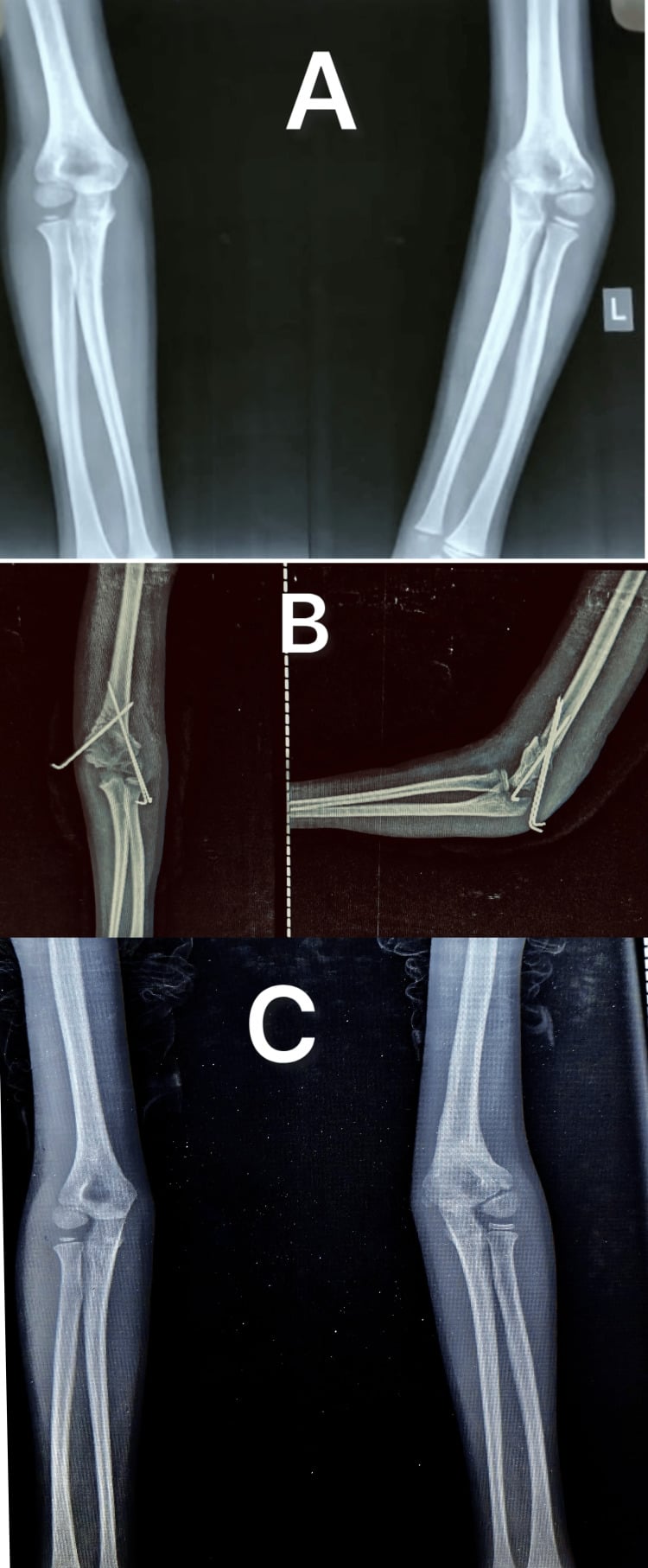
- Cubitus varus after a malunited supracondylar fracture
- Lateral condyle non-union and fishtail deformity
- Elbow stiffness
- Chronic radial head dislocation after a missed Monteggia lesion
- Growth disturbance or angular deformity
Guidelines, Registries & Global Practice
Global epidemiology
- Supracondylar humerus fracture is the most common paediatric elbow fracture, accounting for roughly 55 to 70 percent of elbow fractures in children, with a peak incidence between 5 and 7 years of age and a fall on the outstretched hand the usual mechanism.
- Lateral condyle fractures are the second most common (around 12 to 20 percent of paediatric elbow fractures); medial epicondyle avulsions follow, often associated with elbow dislocation.
- The Kappelhof meta-analysis confirms that when a post-traumatic fat pad sign is present, the occult fracture rate is high (44.6 percent), reinforcing effusion as a globally relevant warning sign.
- Distribution is broadly consistent across high- and low-resource settings, though delayed presentation and missed lateral condyle and Monteggia injuries are reported more often where access to follow-up imaging is limited.
Side-by-side guidance
- Emphasis
- AP and true lateral as first-line; advanced imaging only when it changes management
- Practical point
- Comparison views of the contralateral elbow are discouraged as routine
- Emphasis
- Documented neurovascular status, timely senior review and clear escalation for displaced or vascular injuries
- Practical point
- Pulseless hand is a time-critical pathway, not a radiology decision
- Emphasis
- Structured assessment of alignment lines and fat pads; AO/OTA paediatric coding for fracture description
- Practical point
- Use reproducible measures (AHL position, Baumann angle) on adequate views
- Emphasis
- Caution interpreting lines and angles in the very young because ossification is incomplete
- Practical point
- Serial radiographs and clinical correlation over single-film reassurance
Registry and resource notes
- Paediatric elbow fractures are not tracked by arthroplasty registries; the evidence base is built from trauma series, meta-analyses and observer-reliability studies rather than implant registries.
- High-resource settings can readily obtain internal oblique views, ultrasound and MRI for equivocal cases; the priority in limited-resource settings is a true AP and lateral, disciplined use of alignment lines and fat pads, and robust safety-netting with planned re-review when advanced imaging is unavailable.
Controversies and Areas of Uncertainty
- Comparison views of the opposite elbow. Routine contralateral films were once common to "check" an ossification centre. Most paediatric bodies now discourage this because of the extra radiation dose and limited yield; reserve it for genuinely ambiguous cases where it will change management and does not delay urgent care.
- Which sagittal measure to trust. The Baumann angle is widely taught but is highly view-dependent and unreliable in isolation. The anterior humeral line position and the AHL-to-capitellum distance have better reproducibility, so several authors argue these should lead sagittal assessment.
- Grading the posteriorly hinged (Gartland type 2) fracture. Interobserver agreement on Gartland type 2 is poor. The AHL index has been proposed as a more reproducible way to decide which extension injuries need reduction, but it is not yet a universal standard.
- Imaging the occult fracture. When a fat pad sign is the only finding, practice varies between immobilise-and-review, early MRI, or ultrasound. With a 44.6 percent occult fracture rate the safe default is to treat as a fracture; advanced imaging is reserved for cases where confirming or excluding injury changes management.
- The very young elbow. In children under about four years, normal alignment lines frequently miss the middle third of the capitellum, so the under-fours remain the group where over- and under-calling are both most likely.
Viva Approach and Common Pitfalls
Read every paediatric elbow film in the same order. The order matters because the common failures are predictable: trusting a poor lateral, forgetting CRITOE, drawing the anterior humeral line on the wrong cortex, drawing the radiocapitellar line away from the radial neck, overlooking a posterior fat pad, or stopping at the elbow when the problem is a Monteggia lesion.
The anterior humeral line and radiocapitellar line are not slogans. They are physical landmark checks. If a diagram shows the line in the wrong place, it teaches the wrong anatomy. The anterior humeral line follows the anterior distal humeral cortex. The radiocapitellar line follows the radius, not the ulna, and it must reach the capitellum.
When the radiograph and examination disagree, respect the patient. A child with marked swelling, focal bony tenderness and a posterior fat pad needs immobilisation and review even if the fracture line is not visible. A child with nerve symptoms or poor perfusion needs urgent escalation even before the radiology report returns.
Common pitfalls
- Drawing AHL through the wrong cortex.
- Drawing RCL away from the radial neck.
- Ignoring view quality.
- Missing a posterior fat pad.
- Forgetting the medial epicondyle after dislocation.
- Not imaging the forearm in suspected Monteggia injury.
Clinical Decision Scenarios
Practise clinical reasoning and management decisions out loud
“A child has elbow trauma and a posterior fat pad but no obvious fracture. What does this mean?”
“The radiocapitellar line does not cross the capitellum. What are you worried about?”
“A three-year-old has fallen on an outstretched hand. The elbow is swollen and tender but the anterior humeral line appears to pass just anterior to the capitellum. How do you interpret this?”
Sequence
- Confirm view
- CRITOE
- AHL
- RCL
- Fat pads
Lines
- AHL through capitellum on lateral
- RCL through capitellum on AP and lateral
- Baumann angle for coronal alignment
Occult Clues
- Posterior fat pad
- Anterior sail sign
- Focal tenderness
- Subtle cortical break
Do Not Miss
- Supracondylar fracture
- Lateral condyle fracture
- Medial epicondyle incarceration
- Monteggia lesion
- Neurovascular injury
Evidence Base
Posterior fat pad sign carries a high occult-fracture rate
- Meta-analysis of 10 studies, 250 children with a positive fat pad sign and follow-up imaging.
- Pooled occult fracture rate was 44.6 percent (95% CI 30.4 to 59.7).
- Most common occult sites: supracondylar humerus 43 percent, proximal ulna 19 percent, proximal radius 17 percent, lateral condyle 14 percent.