Within 60 Minutes Pre-Incision | Single Dose Usually Sufficient | Cefazolin Gold Standard | Redose If Prolonged Surgery
- Timing is critical: Within 60 minutes before incision (optimal 30 minutes) - achieves tissue levels before contamination
- Cefazolin 2g IV is gold standard for clean orthopaedic surgery (3g if 120kg or more)
- Single dose sufficient for most procedures - prolonged prophylaxis increases resistance without reducing infection
- Redose intraoperatively if surgery exceeds 2 drug half-lives (cefazolin: redose at 4 hours) or blood loss greater than 1500mL
- Stop within 24 hours post-op (most cases single dose) - longer duration NOT more effective and promotes resistance
- “Given too early (greater than 2 hours pre-incision): Levels drop before wound closure
- “Given after incision: Bacteria already attached, prophylaxis fails
- “Vancomycin requires 1-2 hour infusion - start earlier (120 minutes pre-incision)
- “Antibiotic cement does NOT replace systemic prophylaxis in arthroplasty
Principles of Antibiotic Prophylaxis
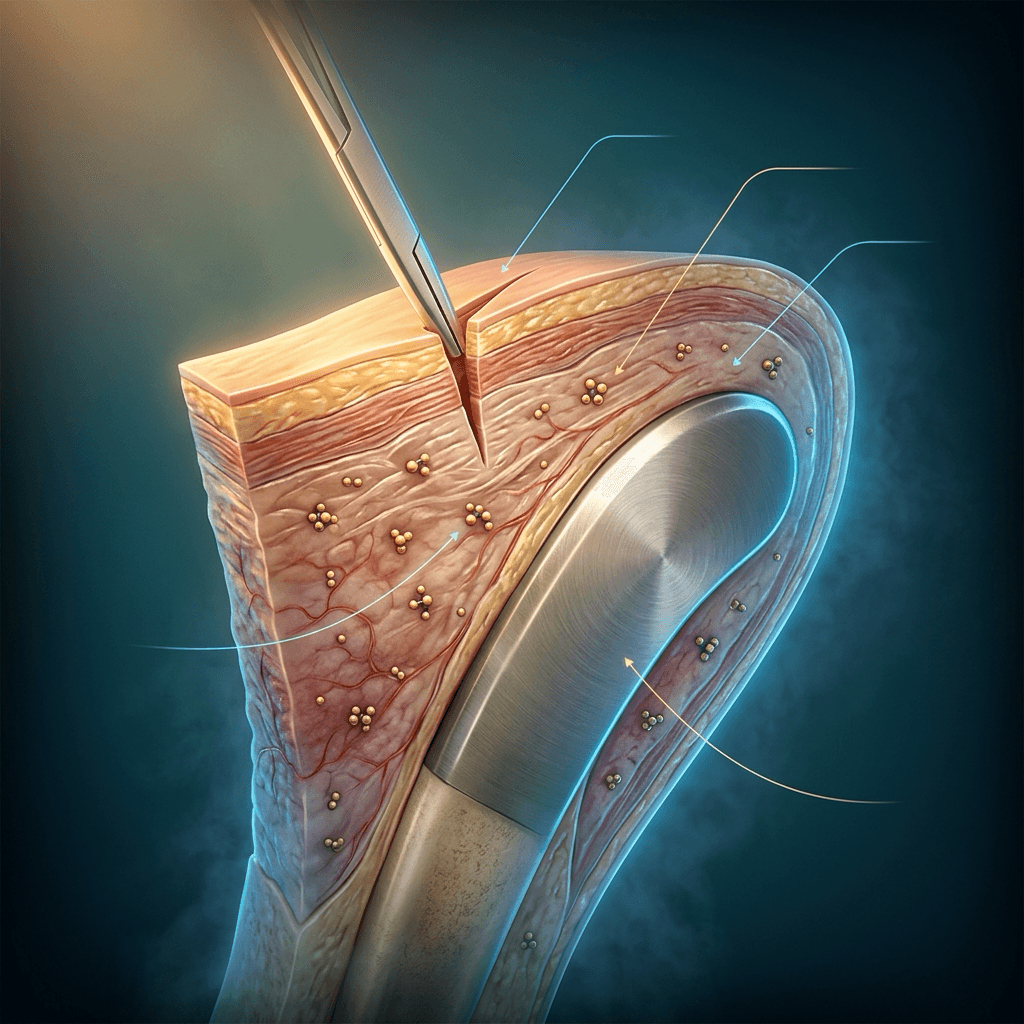
Prophylaxis aims to have therapeutic antibiotic concentrations in the tissues at the moment of bacterial contamination, which is the incision, and so to prevent surgical site infection. Given correctly, it reduces SSI by 50-60%.
How it works. Given before incision, the antibiotic reaches therapeutic levels in bone, soft tissue and haematoma. Bacteria then contaminate the site during surgery, from the skin, the air and the instruments, and are exposed to those levels immediately. They are killed during the initial vulnerable period before biofilm forms (the first 24-48 hours), which prevents attachment to tissue and implants, biofilm formation and infection. The window of effectiveness is narrow: the antibiotic must already be present at contamination.
Prophylaxis prevents infection in clean tissue, before contamination. Treatment eradicates infection in contaminated or infected tissue, after it. Timing distinguishes them: an antibiotic first given after incision is treatment, and too late to be prophylaxis.
History. The principle came first and the refinements followed:
- 1960s - Burke showed that prophylaxis is effective if given before contamination, the "decisive period"
- 1970s-1980s - routine use in clean orthopaedic surgery (arthroplasty, spine)
- 1990s-2000s - timing refined to within 60 minutes, duration shortened to a 24-hour maximum
- 2010s to present - evidence against prolonged prophylaxis: resistance, no benefit
Timing and Administration
Timing within 30-60 minutes before incision is the most important factor in whether prophylaxis works. Within that window 30 minutes is optimal, and 60 minutes still gives therapeutic levels. The timeline shows what happens either side of it.
Antibiotic Timing and Tissue Levels
Given more than 2 hours before incision, tissue levels rise then fall, may be subtherapeutic by incision, and drop before closure. SSI risk is higher than with optimal timing.
Acceptable. Cefazolin achieves therapeutic tissue levels by incision. Standard practice if the exact incision time is uncertain (for example, patient in the holding area).
Ideal timing. Peak tissue levels coincide with incision and contamination, giving the highest efficacy for infection prevention. Recommended by guidelines (SCIP, IDSA).
Tissue levels must be therapeutic at incision, when bacteria contaminate the surgical site. If levels are adequate, bacteria are killed before attachment; if they are low, infection risk increases.
Given after incision, the antibiotic is treatment, not prophylaxis. Bacteria are already attached to tissues and implants, the window is missed, and SSI risk is significantly increased.
Working with the anaesthetist. Coordinate the timing with anaesthesia. The antibiotic goes in once the patient is in theatre with IV access established, and before skin preparation and draping. Common practice is to give it at induction, about 30 minutes before incision, which lands in the optimal window and avoids a too-early dose in the holding area.
Vancomycin is the exception. It needs a 1-2 hour IV infusion, because rapid infusion causes red man syndrome through histamine release. Start it 120 minutes before incision so that the infusion is complete by the time the knife goes in.
Started in the usual 30-60 minute window, like cefazolin, the vancomycin infusion is incomplete at incision and prophylaxis fails. Know the pharmacokinetics of the antibiotic you are giving.
Antibiotic Selection by Clinical Scenario
The first-line agent is chosen for the target pathogens of the procedure, and for clean orthopaedic surgery it is cefazolin. Allergy, MRSA colonisation and open fractures change the choice.
- Target Pathogens
- S. aureus, S. epidermidis
- First-Line Agent
- Cefazolin 2-3g IV
- Alternative (Allergy/MRSA)
- Vancomycin 15 mg/kg IV
- Target Pathogens
- S. aureus, S. epidermidis, C. acnes
- First-Line Agent
- Cefazolin 2-3g IV (covers all)
- Alternative (Allergy/MRSA)
- Vancomycin + clindamycin (C. acnes)
- Target Pathogens
- S. aureus, S. epidermidis
- First-Line Agent
- Cefazolin 2g IV (single dose)
- Alternative (Allergy/MRSA)
- Vancomycin or clindamycin
- Target Pathogens
- S. aureus, Strep, some anaerobes
- First-Line Agent
- Cefazolin 2g IV
- Alternative (Allergy/MRSA)
- Clindamycin 900mg IV
- Target Pathogens
- MRSA + routine pathogens
- First-Line Agent
- Vancomycin 15 mg/kg + cefazolin 2g
- Alternative (Allergy/MRSA)
- Vancomycin alone (if beta-lactam allergy)
The organisms. After total hip and knee arthroplasty and clean spine surgery, S. aureus causes 30-40% of SSI, coagulase-negative staphylococci (S. epidermidis) another 30-40%, and streptococci 10-15%.
Why cefazolin. It is a first-generation cephalosporin, narrow in spectrum and so appropriate for prophylaxis, with excellent tissue penetration that achieves therapeutic levels in bone and soft tissue. Its half-life of about 2 hours, long for a cephalosporin, allows single-dose prophylaxis. Give a single dose, or 24 hours if the surgeon prefers, timed, dosed and redosed as above.
MRSA high-risk patients. Some surgeons add vancomycin to cefazolin. This is controversial, with no strong evidence behind it.
Antibiotic cement. PMMA bone cement loaded with gentamicin or vancomycin gives local, high-concentration antibiotic release. It may reduce infection in high-risk patients (revision, immunosuppressed), and joint registries (e.g. AOANJRR, Swedish/Norwegian) report benefit of antibiotic-loaded cement particularly in revision and high-risk arthroplasty. It provides local levels but no systemic coverage during surgery, so it does not replace systemic prophylaxis: give IV cefazolin as well. Cement is an adjuvant.
Intra-wound vancomycin powder. Separate from cement, vancomycin powder sprinkled into the wound before closure is widely used, especially in spine surgery, and increasingly studied in arthroplasty. Local levels far exceed the MIC for staphylococci while serum levels stay low, with negligible systemic absorption, so it targets the gram-positive organisms that cause most SSI without systemic vancomycin toxicity.
Does the powder work? Large retrospective and observational spine series suggested reduced deep SSI, but higher-quality data are mixed: the prospective FORTIFY-type/randomised evidence has not confirmed a consistent benefit. It remains an adjunct, not standard of care, and supplements, never replaces, correctly timed systemic prophylaxis. The harms to know:
- No gram-negative cover, with a theoretical concern of shifting deep infections toward gram-negative or polymicrobial organisms
- Seroma formation and wound-healing problems
- In spine, a theoretical effect on fusion/pseudarthrosis at high doses
Differential: Choosing the Right Agent (and Avoiding Look-Alikes)
The real differential in prophylaxis is matching the clinical situation to the correct agent, and distinguishing prophylaxis from treatment.
- Discriminating Feature
- Non-IgE reaction; cross-reactivity 1-3 percent
- Correct Action
- Cefazolin 2g (still first-line)
- Common Wrong Answer
- Defaulting to vancomycin unnecessarily
- Discriminating Feature
- True IgE (airway/cardiovascular collapse)
- Correct Action
- Vancomycin OR clindamycin
- Common Wrong Answer
- Giving cefazolin (contraindicated)
- Discriminating Feature
- Positive screen but penicillin-tolerant
- Correct Action
- Cefazolin PLUS vancomycin
- Common Wrong Answer
- Vancomycin alone (worse MSSA cover)
- Discriminating Feature
- Pre-existing pus, cultures, sepsis
- Correct Action
- Culture-directed treatment course
- Common Wrong Answer
- Calling it 'prophylaxis' and stopping at 24h
- Discriminating Feature
- Cutibacterium (C.) acnes risk
- Correct Action
- Cefazolin (covers C. acnes)
- Common Wrong Answer
- Assuming routine cover is inadequate
Management Algorithm
Guidelines, Registries & Global Practice
Global Epidemiology
Surgical site infection (SSI) is one of the most frequent healthcare-associated infections worldwide, and the single most informative reason to optimise prophylaxis. The burden differs sharply by resource setting.
- Finding
- Approximately 1-2 percent after clean elective arthroplasty (THA/TKA)
- Source / Evidence
- Consistent across major registries and cohort studies
- Finding
- Pooled cumulative incidence approximately 5.6 per 100 surgical procedures
- Source / Evidence
- WHO systematic review/meta-analysis (Allegranzi 2010)
- Finding
- Reported in roughly half of S. aureus isolates in some series
- Source / Evidence
- WHO systematic review (Allegranzi 2010)
- Finding
- Wide range across settings (roughly USD 174 to 34,000 attributable cost)
- Source / Evidence
- Systematic review of LMIC and European cost data (Monahan 2020)
The much higher SSI incidence in limited-resource settings reflects access, surveillance and sterilisation differences as much as antibiotic practice, which is why correctly timed, correctly dosed prophylaxis remains a globally relevant, low-cost intervention.
Major Guidelines Side by Side
The core recommendations are remarkably consistent across the major societies; differences are mostly in MRSA cover and emphasis rather than fundamentals.
- Preferred Agent / Dose
- Cefazolin 2g (3g if 120kg or more); vancomycin for MRSA/allergy
- Timing
- Within 60 min pre-incision (120 min vancomycin)
- Duration
- Single dose; not beyond 24h
- Evidence Strength
- Strong, multisociety consensus
- Preferred Agent / Dose
- Cefazolin first-line; weight-based; redose long cases
- Timing
- Within 60 min pre-incision
- Duration
- Single dose / 24h ceiling
- Evidence Strength
- Aligned with national guideline
- Preferred Agent / Dose
- Single-dose IV at induction; local microbiology-led agent choice
- Timing
- At induction (before incision)
- Duration
- Single dose preferred; avoid prolonged courses
- Evidence Strength
- Strong (NICE NG125 framework)
- Preferred Agent / Dose
- Early gram-positive cover; broaden for higher grade
- Timing
- As soon as possible after injury
- Duration
- Short, grade-appropriate; not open-ended
- Evidence Strength
- Guideline-level (Hoff 2011; AO principles)
- Preferred Agent / Dose
- Cefazolin/cefuroxime; weight-based; stewardship emphasis
- Timing
- Within 60 min pre-incision
- Duration
- Single dose; 24h maximum
- Evidence Strength
- Consensus, registry-informed
Across AAOS, NICE/BOA, ASHP/IDSA and EFORT the answer converges: cefazolin 2g (3g if 120kg or more), within 60 minutes of incision, redose at roughly 4 hours or after major blood loss, stop by 24 hours. Knowing these four, plus vancomycin's 120-minute infusion rule, answers most prophylaxis questions on any exam.
Registry and Surveillance Evidence
- Joint registries (NJR England & Wales, AJRR USA, AOANJRR Australia, Swedish SHAR, Norwegian and NZJR) consistently report deep infection / periprosthetic joint infection as a leading cause of early revision after THA and TKA, underlining prophylaxis as a modifiable risk factor.
- National antimicrobial stewardship surveillance programmes (e.g. national prescribing surveys and care standards in multiple countries) repeatedly identify excessive duration as the commonest prophylaxis error, echoing the harm signal in the Branch-Elliman 2019 cohort.
- The duration-dependent harm (acute kidney injury, C. difficile) demonstrated in large cohorts is the evidential backbone of the universal 24-hour ceiling.
Global Practice Variation
- Variation
- Common in high-MRSA-prevalence units; avoided where MRSA is low
- Reason
- Local MRSA epidemiology and AKI risk tolerance
- Variation
- Routine in some registries (esp. cemented arthroplasty); selective elsewhere
- Reason
- Registry data favour ALBC in revision/high-risk; debated for routine primary
- Variation
- Short fixed courses (high-resource) vs longer empiric courses (limited-resource)
- Reason
- Access to timely debridement and soft-tissue cover
- Variation
- Standardised in many high-income centres; variable elsewhere
- Reason
- Programme resourcing and baseline MRSA carriage
Antibiotic-loaded cement and MRSA decolonisation are adjuncts; they do not replace correctly timed systemic prophylaxis anywhere in the world.
MCQ Practice Points
Q: What is the optimal timing for cefazolin administration in elective orthopaedic surgery?
A: Within 60 minutes before skin incision (ideally 30-60 minutes). Cefazolin has a short infusion time (5-10 minutes) so can be given close to incision. This achieves peak tissue concentrations at the time of incision when bacterial contamination occurs. Earlier administration results in subtherapeutic levels at the critical time.
Q: When should cefazolin be redosed during a prolonged orthopaedic procedure?
A: Every 3-4 hours (or after 1500mL blood loss). Cefazolin has a half-life of 1.8-2 hours, so redosing at 2 half-lives maintains therapeutic levels. Major guidelines (ASHP/IDSA, AAOS, NICE/BOA, EFORT) recommend redosing at approximately 4 hours OR after 1.5L blood loss OR significant haemodilution. Vancomycin does NOT usually require intraoperative redosing.
Q: A patient has a documented "penicillin allergy" causing mild rash. What is the appropriate antibiotic prophylaxis for elective TKA?
A: Cefazolin 2g IV is appropriate. True cross-reactivity between penicillins and cephalosporins is less than 2% for most cephalosporins. Only IgE-mediated anaphylaxis to penicillin is a contraindication. Mild rash, GI upset, or uncertain history does NOT preclude cephalosporin use. Only use vancomycin for documented severe (Type I) penicillin allergy.
Q: What antibiotic prophylaxis regimen is recommended for Gustilo IIIB open tibial fractures?
A: Cefazolin 2g IV PLUS gentamicin 5mg/kg (max 320mg), consistent with EAST (gram-positive cover for all open fractures, gram-negative cover added for Type III), started as soon as possible and ideally within 1 hour of injury (BOAST, NICE NG37). EAST continues Type III prophylaxis for 72 hours after injury or not more than 24 hours after soft-tissue coverage; NICE NG37 and BOAST require definitive soft-tissue cover within 72 hours of injury. Cefazolin covers Gram-positive organisms (Staph aureus), gentamicin covers Gram-negatives. For faecal or potential clostridial (farm) contamination, EAST adds high-dose penicillin. Clindamycin + gentamicin if penicillin allergic. Surgical debridement remains the most important intervention.
Q: What is the most common organism causing surgical site infection following total hip arthroplasty?
A: Staphylococcus aureus (including MSSA and MRSA). Coagulase-negative staphylococci (e.g., S. epidermidis) are second most common, particularly in late infections. This is why cefazolin (excellent Staph coverage) is first-line prophylaxis, and why MRSA screening/decolonization is performed in high-risk patients.
Antibiotic Prophylaxis Viva Scenarios
Practise clinical reasoning and management decisions out loud
“What is your antibiotic prophylaxis protocol for a primary total hip arthroplasty in a 75kg, otherwise healthy patient?”
“A 35-year-old presents to the emergency department with a Gustilo Type IIIB open tibia fracture from a motorcycle crash. Discuss your antibiotic prophylaxis strategy including agent selection, timing, and duration.”
Core Principles
- Timing: Within 60 minutes pre-incision (optimal 30 minutes)
- Duration: Single dose OR 24 hours maximum (longer = harm, no benefit)
- Redosing: Every 2 half-lives (cefazolin at 4h) OR blood loss greater than 1500mL
- Prophylaxis given BEFORE contamination, treatment given AFTER infection
Cefazolin: Gold Standard
- Dose: 2g IV (if less than 120kg), 3g IV (if greater than or equal to 120kg)
- Timing: 30-60 minutes pre-incision
- Covers: S. aureus (MSSA), S. epidermidis, Streptococcus
- Redose: Every 4 hours intraoperatively (half-life 2 hours)
- Duration: Single dose OR 24 hours maximum
- Historical 1g dose is OBSOLETE (inadequate tissue levels)
Timing Critical Points
- Optimal: 30 minutes pre-incision (peak tissue levels at incision)
- Acceptable: 60 minutes pre-incision
- Too early: Greater than 120 minutes (levels drop before closure)
- Too late: After incision (bacteria already attached, prophylaxis fails)
- Vancomycin: Start 120 minutes pre-incision (requires 1-2h infusion)
Redosing Indications
- Surgery duration exceeds 2 half-lives of drug
- Cefazolin: Redose at 4 hours (half-life 2h)
- Vancomycin: Redose at 12 hours (half-life 6h, rarely needed)
- Gentamicin: Do NOT redose (single dose only, nephrotoxic)
- Blood loss greater than 1500mL: Redose regardless of time
Duration: When to STOP
- Clean surgery: Single dose sufficient (best evidence)
- If continued: 24 hours MAXIMUM, then STOP
- Greater than 24h: No benefit, increases resistance, C. diff, adverse effects
- Do NOT continue until drains removed (outdated practice)
- Exception: Open fractures (Type I/II: 24h after wound closure; Type III: 72h after injury or 24h after cover)
Procedure-Specific Prophylaxis
- THA/TKA/Clean spine: Cefazolin 2-3g (single dose or 24h)
- Open fracture Type I/II: Cefazolin, stop 24h after wound closure
- Open fracture Type III: Cefazolin + gentamicin, 72h after injury or 24h after cover
- Shoulder arthroplasty: Cefazolin (covers C. acnes)
MRSA and Allergy Alternatives
- MRSA colonized: Vancomycin 15 mg/kg IV (start 2h pre-incision)
- Beta-lactam allergy: Vancomycin OR clindamycin 900mg IV
- Vancomycin infusion: 1-2 hours required (start 120 min pre-incision)
- Red man syndrome if vancomycin infused too rapidly
- Cephalosporin-penicillin cross-reactivity: 1-3% (not 10%)
Open Fracture Specifics
- Timing: As soon as possible, ideally within 1h of injury (BOAST, NICE NG37)
- Type I (less than 1cm): Cefazolin, stop 24h after wound closure
- Type II (1-10cm): Cefazolin, stop 24h after wound closure
- Type III (greater than 10cm, high-energy): Cefazolin + gentamicin, 72h after injury or 24h after cover
- Gentamicin: 5 mg/kg IV q24h (single daily dose)
- Farm/faecal (clostridial) contamination: add high-dose penicillin (EAST)
- Definitive soft-tissue cover within 72h of injury (NICE NG37, BOAST), then reassess
Common Exam Traps
- Trap: 1g cefazolin → Wrong (obsolete), use 2-3g based on weight
- Trap: Continue until drains removed → Wrong (stop at 24h)
- Trap: Vancomycin at 30 min pre-incision → Wrong (needs 2h for infusion)
- Trap: Prolonged prophylaxis reduces infection → Wrong (no benefit, increases harm)
- Trap: Antibiotic cement replaces IV → Wrong (cement is adjuvant, not replacement)
- Trap: Post-incision antibiotics → Wrong (treatment not prophylaxis, too late)
Evidence Base
Timing of Antibiotic Prophylaxis (Landmark)
- Prospective cohort of 2847 elective clean / clean-contaminated procedures
- Lowest SSI when antibiotics given in the 2 hours before incision: 0.6 percent (preoperative)
- Perioperative (within 3h after incision) 1.4 percent; postoperative 3.3 percent (RR 5.8)
- Early administration 2-24h pre-incision 3.8 percent (RR 6.7) - levels fall before incision
Decisive (Effective) Period - Burke's Classic Animal Study
- Defined the 'effective period' of preventive antibiotic action in experimental dermal/incisional lesions
- Antibiotic suppression of staphylococcal infection is maximal when given before bacteria reach tissue
- The effective window closes within approximately 3 hours of contamination
- Provides the biological rationale for pre-incision (not post-incision) dosing
Duration and Harm of Prolonged Prophylaxis (Landmark Cohort)
- National VA cohort of 79,058 procedures (cardiac, total joint, colorectal, vascular)
- Extended prophylaxis did NOT reduce SSI compared with less than 24 hours
- Each additional day increased acute kidney injury (aOR up to 1.82) in duration-dependent fashion
- C. difficile risk rose markedly with duration (aOR 3.65 at 72 hours or more)
ASHP/IDSA/SIS/SHEA Clinical Practice Guidelines
- Multisociety consensus guideline for antimicrobial prophylaxis in surgery (still the reference standard)
- Cefazolin recommended for clean orthopaedic surgery; weight-based dosing (2g, 3g if 120kg or more)
- Administration within 60 minutes before incision (120 minutes for vancomycin/fluoroquinolones)
- Single dose preferred; duration should not exceed 24 hours for the great majority of procedures
Cefazolin Tissue Penetration in Obesity
- Pharmacokinetic study of 2g cefazolin across BMI strata in gastric bypass patients
- Therapeutic tissue levels achieved in only 48 percent (BMI 40-49), falling to 10 percent (BMI 60 or more)
- Serum levels were frequently adequate while tissue levels were sub-therapeutic with rising BMI
- Demonstrates that fixed dosing underdoses heavier patients at the tissue level
Comparative Effectiveness of Prophylactic Agents in Arthroplasty
- VA cohort of 18,830 elective primary hip and knee arthroplasties
- Overall 30-day SSI rate 1.4 percent; cefazolin-only 1.3 percent vs vancomycin-only 2.3 percent
- Higher SSI with vancomycin-only likely reflects sub-optimal weight-based dosing, not true inferiority
- Supports cefazolin as first-line; reserve vancomycin for true allergy or MRSA risk
Dual (Cefazolin + Vancomycin) Prophylaxis in TKA
- Review of dual cefazolin + vancomycin prophylaxis in total knee arthroplasty
- No consistent reduction in OVERALL infection vs cefazolin alone across studies
- Selective benefit reported for MRSA infection and in revision TKA cohorts
- Vancomycin adds acute kidney injury risk; teicoplanin a less nephrotoxic alternative outside the US
Open Fracture Antibiotics - EAST Guideline
- EAST practice management guideline update for prophylactic antibiotics in open fractures
- Gram-positive cover started as soon as possible after injury; add gram-negative cover for Type III; high-dose penicillin for faecal or clostridial contamination (Level I)
- Fluoroquinolones offer no advantage over cephalosporin/aminoglycoside regimens and may give higher infection rates in Type III
- Type I/II: stop 24 hours after wound closure; Type III: 72 hours after injury or not more than 24 hours after soft-tissue coverage (Level II)
- Once-daily aminoglycoside dosing is safe and effective for Type II and III fractures (Level II)
Open Fracture Antibiotics - Cochrane Review
- Pooled data from 913 participants across 7 randomised/quasi-randomised trials
- Antibiotics reduced early infection vs placebo/no antibiotic (RR 0.41, 95 percent CI 0.27-0.63)
- Absolute risk reduction 8 percent; number needed to treat 13
- Insufficient data to judge effect on osteomyelitis, nonunion, amputation or death