Os Trigonum | Dancers | Plantarflexion
- Os trigonum = accessory ossicle (unfused lateral tubercle of the posterior talar process)
- Ballet dancers and footballers classically affected
- Pain with forced plantarflexion (en pointe, kicking downward)
- FHL tendon may be involved (adjacent, in groove)
- Endoscopic/arthroscopic excision is the preferred operative treatment
- “Os trigonum present in around 9% of feet (meta-analysis pooled prevalence)
- “Posterior impingement test reproduces pain
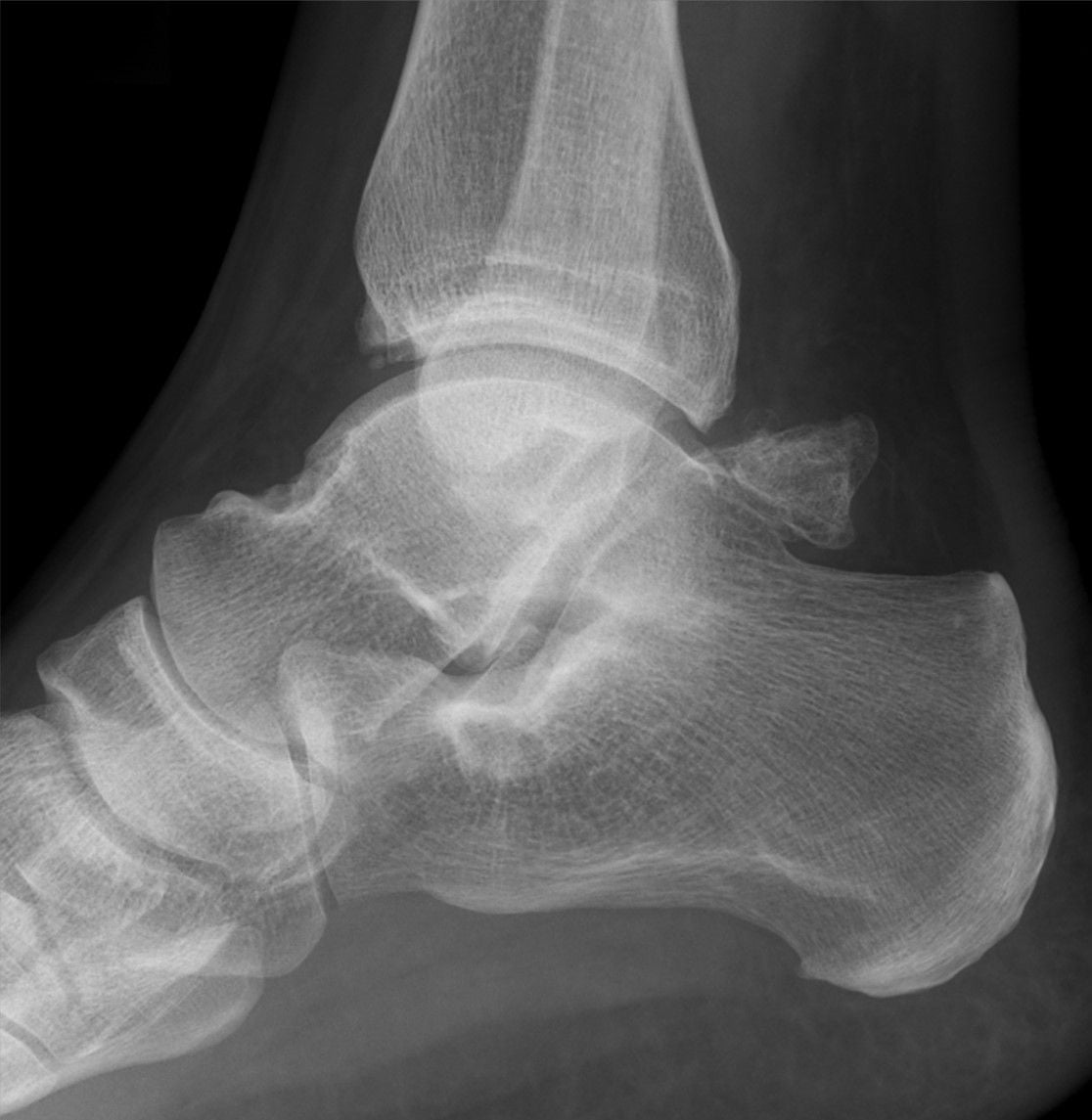
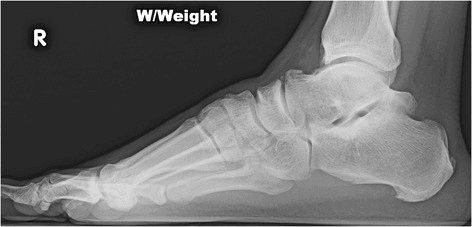
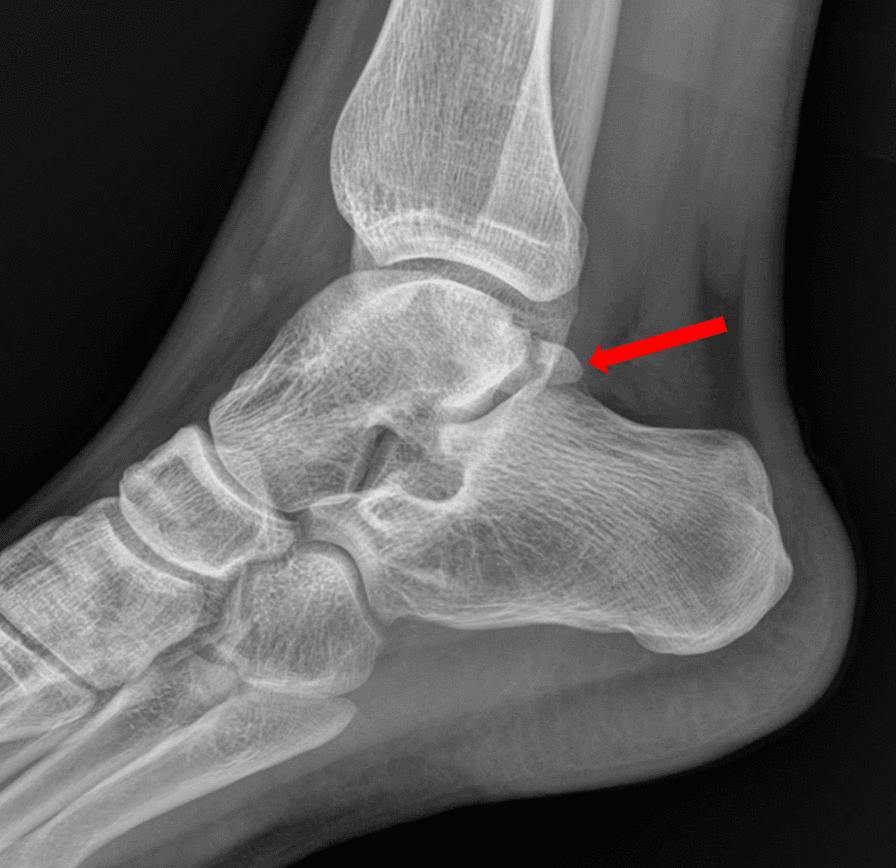
- “Lateral X-ray shows os trigonum or large Stieda process
- “FHL tenosynovitis is common associated finding
Overview and Anatomy
Posterior ankle impingement is the pinching of structures at the back of the ankle during plantarflexion. The most common cause is an os trigonum or a prominent Stieda process, and the classic patients are ballet dancers and footballers.
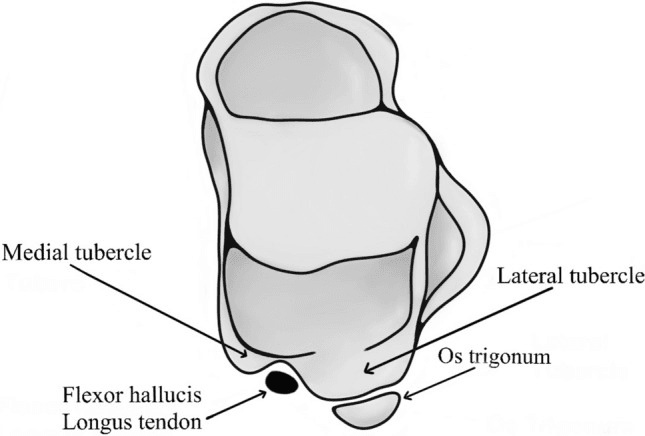
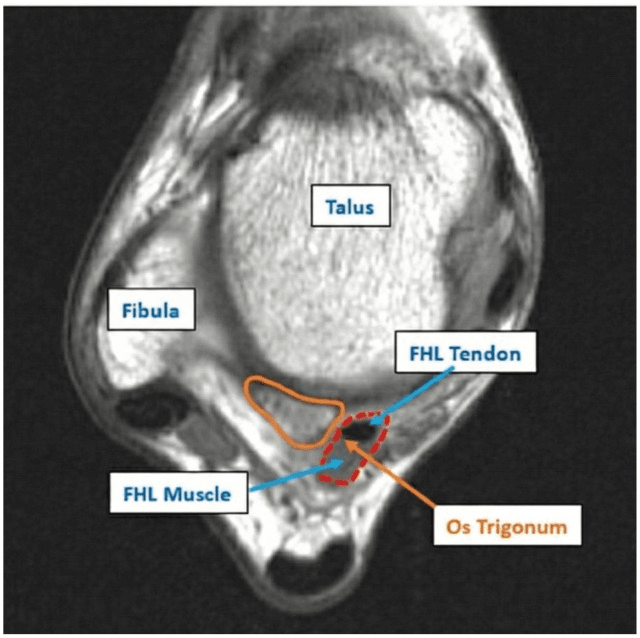
The posterior talus. The back of the talus carries a medial and a lateral tubercle. The flexor hallucis longus (FHL) tendon runs in the groove between them and can become involved in posterior impingement.
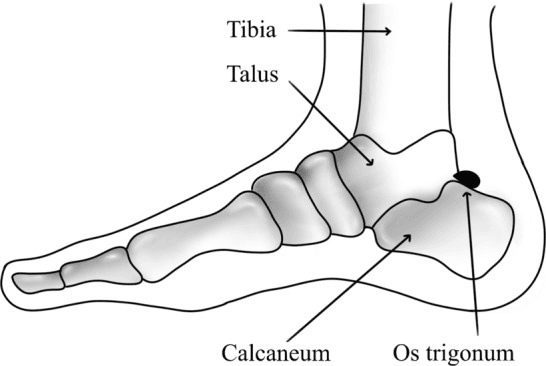
Os trigonum and Stieda process. In a proportion of people the lateral tubercle of the posterior talar process develops as a separate ossicle, the os trigonum, an unfused secondary ossification centre. A Stieda process is the same tubercle elongated and still continuous with the talus. Both impinge posteriorly in plantarflexion.
How common is an os trigonum? A 2025 meta-analysis of 36,612 feet found a pooled prevalence of approximately 9%, with a wide reported range of 1.7-32.5% and the highest figures in East Asia. Read that with the imaging in mind: it was 8.2% on plain radiographs against 24.2% on MRI, so the "prevalence" of an os trigonum is substantially a statement about how hard you looked.
Pathophysiology
The nutcracker. Forced or repetitive plantarflexion, as in dancing en pointe or kicking downward, compresses the os trigonum or Stieda process between the posterior tibial plafond and the calcaneus. Repetitive loading causes synovitis, capsular thickening and bone marrow oedema in the ossicle, and in chronic cases disruption of the synchondrosis between the os trigonum and the talus.
Impingement without an ossicle. Soft tissue can impinge on its own: the FHL, or the capsule through synovitis and scarring. A substantial minority of cases have no ossicle, but the true proportion, and the optimal treatment of pure soft-tissue impingement, are not well defined by high-level evidence.
The FHL. In its fibro-osseous tunnel the tendon lies immediately medial to the os trigonum, and it is maximally loaded with the ankle plantarflexed and the great toe pushing off. Repetitive plantarflexion and hallux motion produce stenosing tenosynovitis, thickening of the tendon and sheath that can trigger or lock the hallux: "dancer's tendinitis". Impingement and FHL pathology frequently coexist but behave as distinct entities, and either may occur in isolation.
OSSPosterior Impingement Causes
Hook:OSS = Os trigonum, Stieda, Soft tissue cause posterior impingement!
Clinical Presentation
History. Ballet dancers describe posterior ankle pain, particularly with en pointe work; footballers may feel it on downward kicking and swimmers on push-off. The pain is worse with plantarflexion and may come with triggering of the great toe if the FHL is involved.
The posterior impingement test (van Dijk's test). With the patient seated or prone and the knee flexed to relax the gastrocnemius, grasp the foot and perform a quick, repetitive passive forced hyperplantarflexion of the ankle. Recognisable reproduction of the patient's deep posterior pain is a positive test. A small rotatory "grinding" movement at end-range increases posterior compression and heightens sensitivity, and the manoeuvre is often repeated in slight external and internal rotation.
Reading the result. The test has high sensitivity, so a negative, pain-free test essentially rules out bony posterior impingement. Its specificity is lower, because forced plantarflexion also loads the FHL, Achilles and posterior capsule; a positive test is not by itself diagnostic and should be correlated with imaging and, when equivocal, a diagnostic injection.
The rest of the examination.
- Palpate the posterolateral ankle, between the Achilles and peroneal tendons, for tenderness
- Move the great toe with the ankle plantarflexed: passive flexion and extension may reproduce symptoms or show triggering, and pain or triggering on passive hallux dorsiflexion and resisted hallux flexion points to coexisting FHL tenosynovitis rather than pure osseous impingement
- Exclude Achilles pathology: tenderness at the insertion, Thompson test
Investigations
Radiographs. The lateral view shows an os trigonum as a separate ossicle or a prominent Stieda process as an elongated tubercle, and both are best assessed on a true lateral.
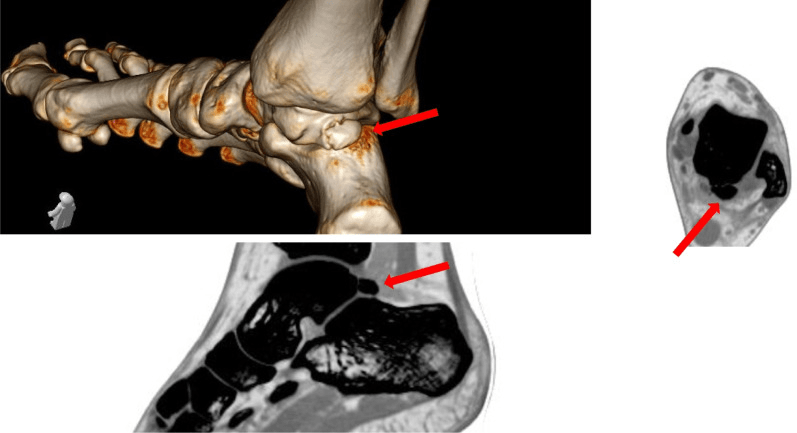
CT better defines the anatomy, particularly for surgical planning, and shows the relationship of the ossicle to the talus.
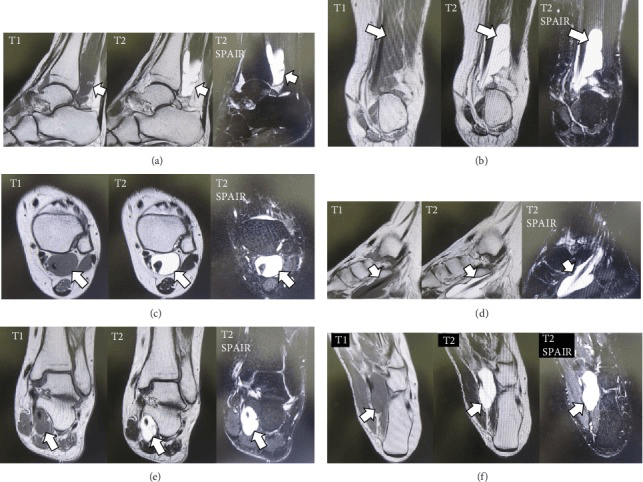
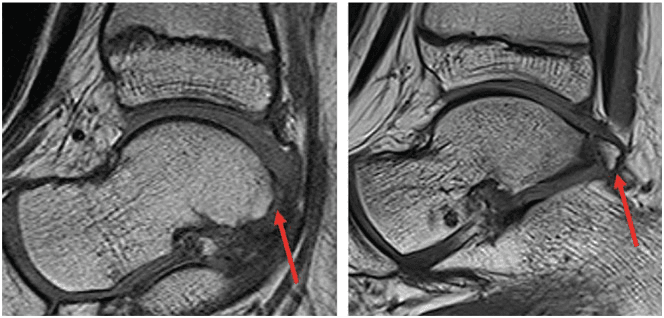
MRI shows bone oedema in the os trigonum or lateral tubercle, FHL tenosynovitis and associated soft-tissue inflammation.
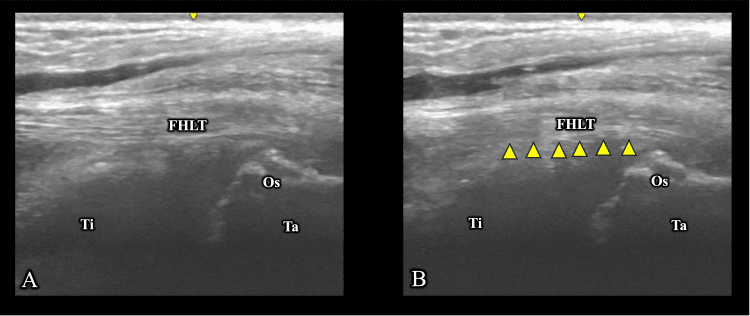
Ultrasound can assess the FHL tendon dynamically.
Diagnostic injection. An image-guided local anaesthetic injection to the posterior ankle that relieves symptoms confirms the pain source. Greater than 70% relief of the pain on the posterior impingement test supports the diagnosis, particularly when imaging is equivocal.
The incidental ossicle. An os trigonum is a common asymptomatic anatomical variant. Imaging findings must correlate with a positive impingement test, and ideally a confirmatory diagnostic injection, before symptoms are attributed to it.
Differential Diagnosis
- Pain pattern / trigger
- Deep posterior pain on forced plantarflexion (en pointe, kicking)
- Key examination
- Positive forced plantarflexion test, posterolateral tenderness
- Discriminating investigation
- Lateral X-ray ossicle/process; MRI bone edema; relief on diagnostic injection
- Pain pattern / trigger
- Posteromedial pain, may trigger/lock great toe
- Key examination
- Pain on resisted hallux flexion and passive hallux extension in plantarflexion
- Discriminating investigation
- MRI/US thickened FHL (over 6mm), fluid in sheath; dynamic US shows stenosis
- Pain pattern / trigger
- Superficial posterior pain, worse on push-off and dorsiflexion stretch
- Key examination
- Tender Achilles insertion or midportion, NOT deep on plantarflexion
- Discriminating investigation
- US/MRI tendon thickening; impingement test negative
- Pain pattern / trigger
- Posterior heel pain at bursa, shoe pressure
- Key examination
- Tender retrocalcaneal space, posterosuperior calcaneal prominence
- Discriminating investigation
- Lateral X-ray Haglund deformity; MRI bursal fluid
- Pain pattern / trigger
- Hindfoot pain on uneven ground, stiffness
- Key examination
- Restricted/painful subtalar motion
- Discriminating investigation
- CT (coalition); weightbearing X-ray/MRI
- Pain pattern / trigger
- Acute post-traumatic posterior pain
- Key examination
- Acute tenderness, history of injury (Shepherd fracture)
- Discriminating investigation
- CT distinguishes acute fracture from chronic os trigonum (smooth corticated margins)
Management
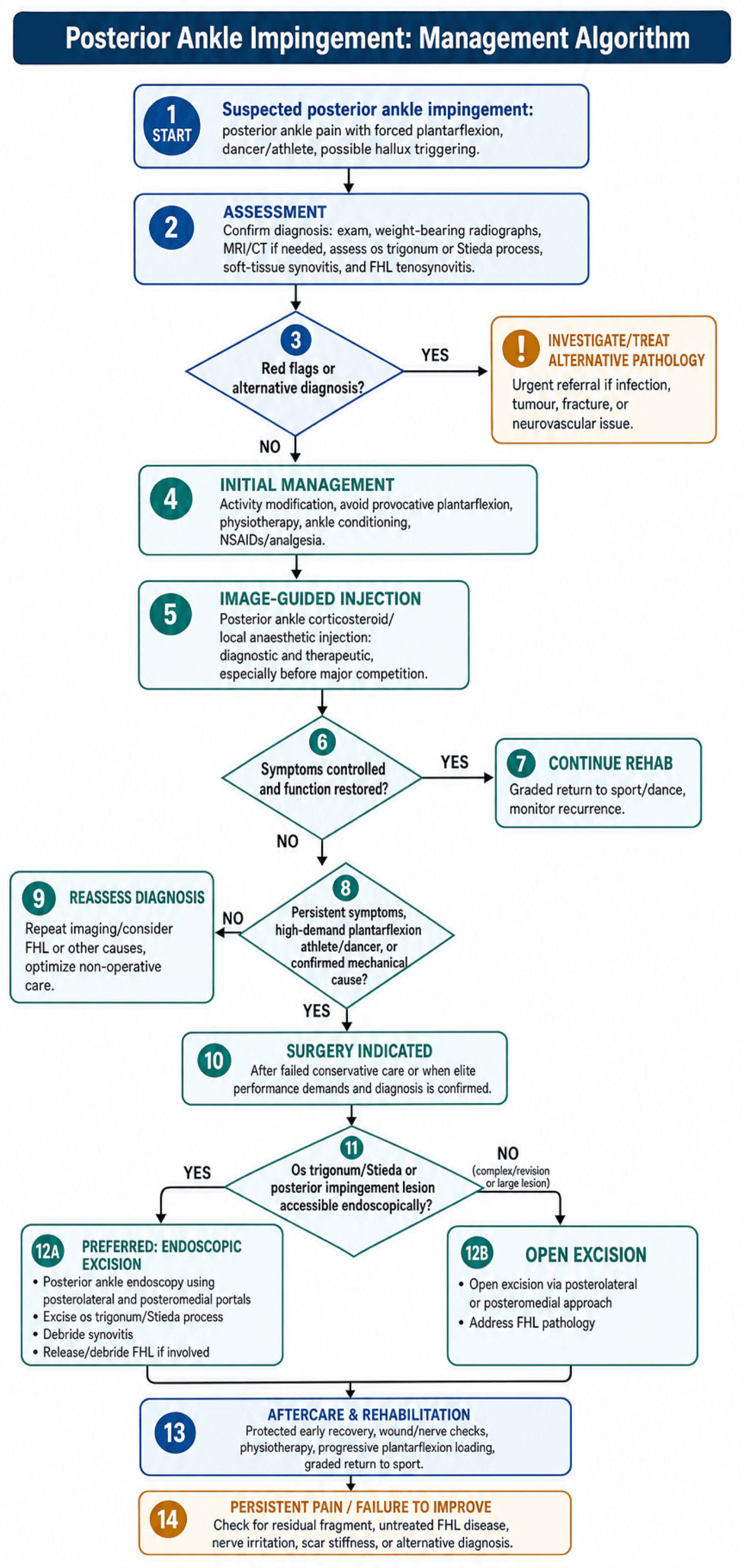
Start without surgery. Non-operative care consists of:
- Activity modification, avoiding provocative plantarflexion
- Physiotherapy for ankle conditioning, avoiding excessive plantarflexion
- NSAIDs or analgesia for symptomatic relief
- A corticosteroid injection to the posterior ankle, which may provide relief and is both diagnostic and therapeutic
Conservative treatment may be successful in mild cases, but dancers and athletes often require surgery to return to activity. The evidence for non-operative treatment is very weak (few patients, retrospective), so no evidence-based protocol exists; a trial of activity modification, physiotherapy and image-guided injection remains reasonable before surgery in non-elite patients.
When to operate. Surgery is indicated for:
- Failed conservative treatment
- Athletes and dancers who require plantarflexion
- Confirmed posterior impingement with an identifiable cause
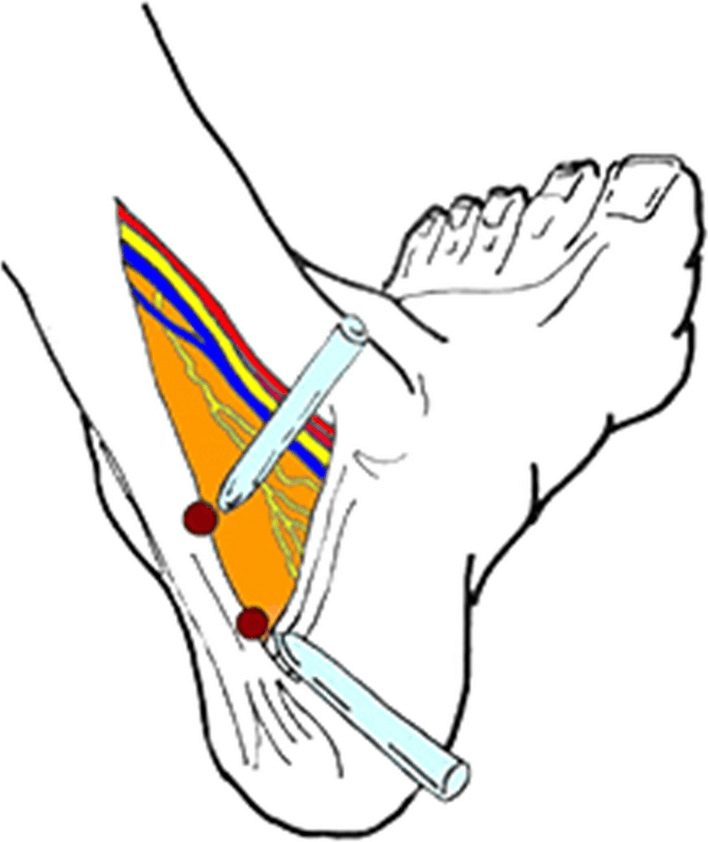
Endoscopic excision is the preferred method, with less morbidity and faster recovery than open surgery. Two portals, posterolateral and posteromedial, are placed on either side of the Achilles tendon; the os trigonum or Stieda process is excised, and FHL tenosynovitis, if present, is addressed in the same procedure by releasing the tendon.
The posterior tibial neurovascular bundle (tibial nerve and posterior tibial artery) lies just medial to the FHL, the key danger on the posteromedial side. Establish the posterolateral portal first and stay lateral to the FHL, the safe zone.
Open excision goes through a posterolateral or posteromedial approach, with similar outcomes but a longer recovery.
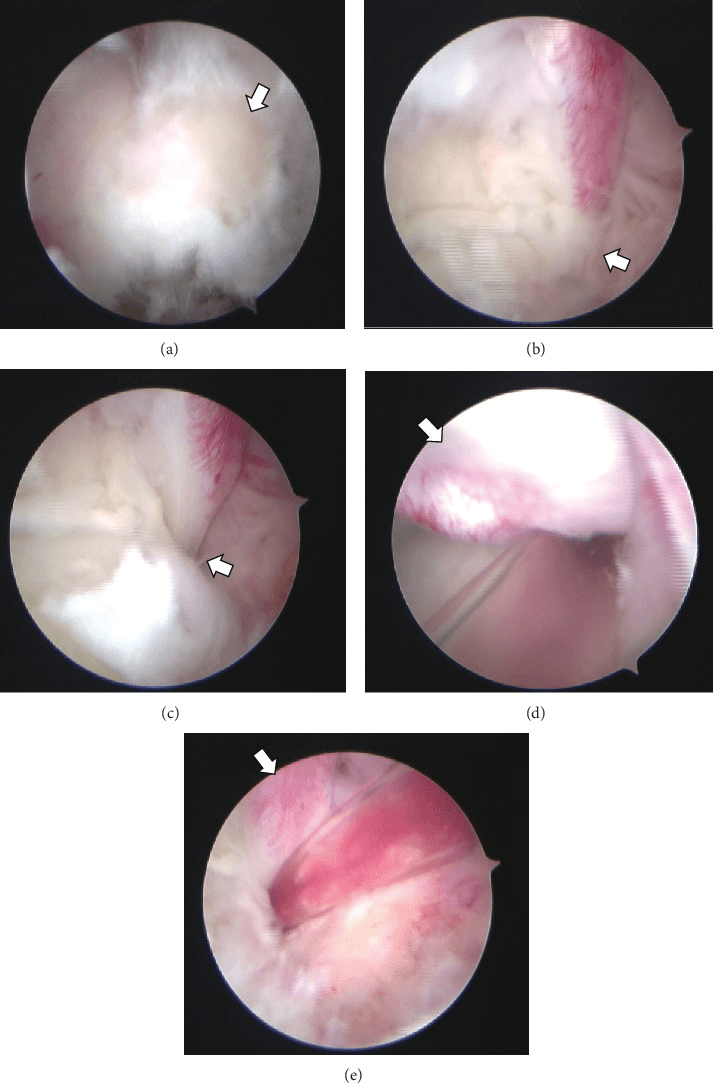
Outcomes. Results are good to excellent. In a systematic review of operated dancers 89% had a good-to-excellent outcome, and in an endoscopic series 94% returned to their previous sport.
Complications
Of the untreated condition.
- Persistent posterior ankle pain limiting plantarflexion-dependent activity such as dance and kicking sports
- Progressive FHL tenosynovitis or stenosis, with hallux triggering or locking
- Synchondrosis disruption or chronic fragmentation of the os trigonum, with ongoing mechanical symptoms
- Career-limiting loss of performance in elite dancers and athletes
Of surgery. Nerve injury is the most important. Portal-related neurological complications run at about 1.9% overall in large ankle arthroscopy series, the sural nerve at risk laterally and the tibial nerve with its medial calcaneal and plantar branches medially; most are transient and resolve within about 6 months.
- Incomplete excision: a residual os trigonum or Stieda fragment is the commonest cause of persistent symptoms and surgical failure (overall failure about 5-15%)
- Untreated coexisting FHL pathology, a recognised cause of surgical failure, with symptoms persisting despite osseous excision
- Posterior tibial vessel injury or haematoma, wound problems, infection (rare)
- Stiffness and scarring of the posterior recess; FHL weakness if excessive tendon is debrided, critical to avoid in dancers
- Persistent neuritis or scar dysaesthesia at portal sites, reported transiently in up to about 15% in some series
Rehabilitation and Return to Sport
The protocol is staged, and its key principle is early motion:
- Early phase (0-2 weeks). A short period in a removable boot or backslab with protected weight-bearing; endoscopic patients often weight-bear as comfort allows within days. Begin early active ankle plantar- and dorsiflexion and hallux motion as soon as the wounds allow, to prevent re-scarring and adhesion of the posterior recess, a recognised cause of recurrent symptoms and stiffness.
- Intermediate phase (2-6 weeks). Progress to full weight-bearing out of the boot, restore the full range including the plantarflexion arc, and add calf and FHL strengthening and proprioception. After an FHL release or tenosynovectomy, protect against forced hallux dorsiflexion early but keep the toe gliding to avoid adhesion.
- Return to sport (6 weeks onward). Introduce sport-specific plantarflexion loading in a graded manner: relevé and pointe work for dancers, kicking for footballers, turn push-off for swimmers.
How long. Typical return is around 6-12 weeks for general sport and around 12-16 weeks (or longer) for elite dance and forced-plantarflexion athletes. Isolated FHL tendinopathy recovers more slowly than osseous impingement, at about 16 weeks (Rietveld). In the one randomised trial, endoscopic excision returned athletes to their previous level in about 7 weeks against 11-12 weeks after open excision.
Setting this staged, early-motion protocol, and counselling the longer timeline when the FHL is involved, is what delivers high return-to-sport figures.
Guidelines, Registries & Global Practice
Global Epidemiology
Posterior ankle impingement is predominantly an overuse condition of athletes who repetitively plantarflex — classically ballet dancers (en pointe / relevé) and football/soccer players (instep kicking), and also gymnasts, divers, swimmers (turn push-off) and downhill runners. An os trigonum is present in roughly 9% of feet worldwide (highest in East Asian populations), but is asymptomatic in most. There is no dedicated implant registry for this soft-tissue/osseous procedure; outcome evidence comes from case series, one RCT and systematic reviews rather than national arthroplasty registries.
Society Guidance — Side by Side
There are no disease-specific clinical practice guidelines from the major bodies for posterior ankle impingement; recommendations are derived from expert/society positions on hindfoot endoscopy and from sports-medicine consensus:
- Position relevant to PAIS
- Endorse hindfoot arthroscopy as a recognized, effective option for posterior impingement; emphasize confirming the diagnosis (exam + imaging ± diagnostic injection) before surgery
- Position relevant to PAIS
- Support a trial of non-operative care first, then minimally invasive (endoscopic) or open excision; stress neurovascular safety with portal placement
- Position relevant to PAIS
- Two-portal hindfoot endoscopy (van Dijk) regarded as the standard minimally invasive technique; recognized in foot and ankle arthroscopy teaching
- Position relevant to PAIS
- In dancers, distinguish isolated PAIS, PAIS with FHL tendinopathy and isolated FHL injury; counsel longer return when FHL is involved
Registry & Outcome Notes
No joint registry captures this procedure. The strongest data point is the single RCT (endoscopic vs open, Level II) plus Level IV series and a complications study reporting an overall ankle-arthroscopy complication rate of ~3.5% with portal-related neurological injury ~1.9%.
High- vs Limited-Resource Practice Variation
- Well-resourced settings: MRI and image-guided diagnostic injection are standard, and endoscopic two-portal excision is widely available, allowing faster return to sport in elite athletes.
- Limited-resource settings: Diagnosis often rests on clinical examination and plain lateral radiographs; open excision through a posterolateral or posteromedial approach remains an entirely valid, effective treatment where endoscopic equipment or expertise is unavailable, with the trade-off of slower recovery and a higher (but still acceptable) complication rate.
Related pages: Os Trigonum Syndrome covers the commonest single bony cause in full - it and this page describe largely the same entity, and are registered as a duplicate pair pending merge; Ankle Impingement Syndromes is the umbrella covering both ends of the joint, and Anterior Ankle Impingement the mirror-image problem of forced dorsiflexion in footballers; FHL Tendinitis and Flexor Hallucis Longus Anatomy for the tendon that shares the fibro-osseous tunnel and coexists with bony impingement often enough that the two are treated in the same sitting; Talus Fractures for the lateral tubercle fracture (Shepherd fracture) that an os trigonum is misread as, and vice versa; Achilles Tendinopathy for the other cause of posterior ankle pain in the same athletes, and the one that must be excluded before a hindfoot endoscopy is planned; and Lateral Ankle Instability for the coexisting pathology that changes both the diagnosis and the operation.
Controversies & Areas of Uncertainty
Endoscopic versus open excision. Only one randomised trial exists (Georgiannos and Bisbinas, Level II), and it favours endoscopy for faster return and fewer complications; most other evidence is Level IV/V. Open excision remains acceptable, especially where endoscopic expertise is limited or extensive FHL work is anticipated.
Posteromedial versus posterolateral open approach. The posteromedial approach gives direct access to the FHL but risks the tibial nerve and posterior tibial vessels; the posterolateral is simpler, but FHL access is harder. There are no high-level comparative data, and the choice is surgeon-dependent.
Routine FHL release. Whether to release or decompress an FHL that looks normal intraoperatively is debated, because the failures from untreated FHL disease have to be weighed against the morbidity an unnecessary release adds. Current practice is to address the FHL only when pre-operative or intraoperative pathology is demonstrated.
MCQ Practice Points
Q: What is an os trigonum? A: An unfused secondary ossification center of the lateral talar process (posterior process of talus). Pooled prevalence is around 9% of feet (meta-analysis). Causes posterior ankle impingement when symptomatic.
Q: What tendon pathology is commonly associated with posterior ankle impingement? A: Flexor hallucis longus tenosynovitis ("dancer's tendinitis"). The FHL runs in a groove between the medial and lateral talar tubercles and can be compressed.
Q: Which structure is the key landmark protecting the neurovascular bundle in two-portal hindfoot endoscopy? A: The FHL tendon. Working lateral to the FHL keeps you away from the posterior tibial neurovascular bundle (tibial nerve and posterior tibial artery), which lies medial to it. Portal-related nerve injury is the commonest complication (~1.9%).
Exam Viva Scenarios
Practise clinical reasoning and management decisions out loud
“A 22-year-old ballet dancer has posterior ankle pain worse when going en pointe. How do you assess and manage her?”
“You are seeing a 28-year-old competitive swimmer in your sports medicine clinic who has been experiencing progressive posterior right ankle pain for the past 8 months. She describes deep posterior ankle pain that is particularly worse during the push-off phase of her turns when she plantarflexes forcefully against the wall. The pain started insidiously without any specific injury and has progressively worsened to the point where it is affecting her training and competition times. She has tried 3 months of rest from competitive swimming, physiotherapy focusing on ankle strengthening and flexibility, and NSAIDs without significant improvement. She is frustrated and concerned as she has national championships in 4 months. On examination, she has deep tenderness to palpation in the posterior ankle between the Achilles tendon and peroneal tendons. You perform a posterior impingement test (passive forced plantarflexion) which clearly reproduces her deep posterior ankle pain. Her Achilles tendon is non-tender and normal on palpation. The retrocalcaneal bursa is non-tender. When you assess her flexor hallucis longus (FHL) by asking her to flex and extend her great toe with the ankle in different positions, she has pain with passive hallux extension when the ankle is in plantarflexion (stretches the FHL), but there is NO triggering or clicking of the great toe. Active and passive ankle range of motion is full and symmetrical, but extremes of plantarflexion reproduce her posterior pain. She has brought radiographs from her sports physician. The lateral ankle X-ray report states: 'Normal bony alignment. No fracture. No os trigonum identified. The lateral talar process appears normal in size and morphology (no prominent Stieda process). Achilles tendon insertion appears normal.' The radiologist specifically notes: 'No osseous cause for posterior impingement identified.' The patient is confused and asks: (1) The X-ray shows no bone problem - so what is causing my posterior impingement? (2) How do we diagnose what's causing my pain if there's no os trigonum? (3) Do I still need surgery even though there's no bone to remove? (4) If I do need surgery, what would you actually do if there's nothing to take out?”
“You are seeing a 26-year-old professional contemporary dancer in your complex foot and ankle clinic for a second opinion. She underwent endoscopic excision of a symptomatic right os trigonum 9 months ago performed by another surgeon at a different institution. The initial presentation was classic posterior ankle impingement - deep posterior ankle pain worse with plantarflexion during dance, positive posterior impingement test, lateral X-ray showing os trigonum, MRI confirming bone marrow edema in the ossicle. She had failed 6 months of conservative management (rest, physiotherapy, two corticosteroid injections) prior to surgery. The operative report from the previous surgery describes: 'Endoscopic excision of os trigonum via two-portal posterior ankle approach. Posterolateral and posteromedial portals established. Os trigonum identified and excised arthroscopically. FHL visualized and appeared normal. No release performed as no evidence of stenosis. Wounds closed. No complications.' Post-operatively, she was initially better for about 6-8 weeks. However, her symptoms have gradually returned and she now describes similar posterior ankle pain to pre-operative levels. She is extremely frustrated and concerned that the surgery 'didn't work'. She reports: (1) Deep aching posterior ankle pain, particularly with plantarflexion during dance, (2) The pain is in a similar location to before surgery, perhaps slightly more medial, (3) She now also experiences occasional clicking or snapping sensation in the posterior ankle when she moves her great toe, which she didn't have before surgery, (4) The pain is affecting her ability to perform and she is considering whether she should retire from professional dancing. On examination, she has well-healed posterolateral and posteromedial arthroscopic portal scars with no signs of infection or wound complications. There is deep tenderness to palpation in the posterior ankle, slightly more prominent medially than laterally. Passive forced plantarflexion reproduces her posterior ankle pain (positive posterior impingement test - similar to pre-op). When you assess her flexor hallucis longus by asking her to actively flex and extend her great toe, you can palpate and hear a distinct SNAP or CLICK in the posterior ankle, and she reports this is the clicking she has been experiencing. This was NOT documented in her pre-operative assessment. Resisted plantarflexion of the hallux is painful. Passive forceful extension of the hallux with the ankle in plantarflexion reproduces deep posterior pain. Her ankle range of motion is full but extremes of plantarflexion reproduce her posterior pain. You review the post-operative radiographs she brought (taken at 3 months post-op by the previous surgeon): Lateral ankle X-ray report states: 'Post-surgical changes. Partial excision of os trigonum with small residual ossicle fragment noted posterior to talus (approximately 5mm x 3mm). Alignment normal.' You also order a NEW MRI which reports: 'Post-surgical changes in posterior ankle. Small residual os trigonum fragment present (5mm) with surrounding bone marrow edema. Flexor hallucis longus tendon is markedly thickened (8mm diameter, normal less than 6mm) with high T2 signal consistent with tendinopathy. Moderate fluid around FHL tendon sheath (tenosynovitis). The FHL appears stenosed in the fibro-osseous tunnel at the level of the posterior talus. Post-surgical scarring noted in the posterior ankle recess. Findings suggestive of: (1) Incomplete os trigonum excision with residual symptomatic fragment, (2) FHL tendinopathy and stenosing tenosynovitis (possibly missed at initial surgery or developed post-operatively).' The patient has multiple questions: (1) Why didn't the surgery work - did the surgeon not remove the whole bone? (2) The report mentions my FHL tendon - could this be the problem now rather than the bone? Was this missed initially? (3) Do I need another operation? If so, what would be different this time? (4) Is there a risk that revision surgery could make things worse? I'm worried about ending my dance career. (5) Could there be something else causing my pain that everyone has missed?”
Causes (OSS)
- Os trigonum (unfused ossicle)
- Stieda process (elongated tubercle)
- Soft tissue (FHL, capsule)
Clinical
- Dancers, footballers
- Pain with plantarflexion
- Posterior impingement test positive
- FHL triggering may be present
Diagnosis
- Lateral X-ray shows ossicle/process
- MRI shows bone edema, FHL pathology
- Injection confirms diagnosis
Treatment
- Conservative first if possible
- Endoscopic excision preferred
- Two-portal posterior approach
- 89% good-excellent, 94% return to sport
Evidence Base
Georgiannos & Bisbinas — Endoscopic vs Open Os Trigonum Excision (RCT, 5-yr)
- Randomized controlled trial, 52 athletes (26 endoscopic vs 26 open), 5-year follow-up
- Return to training 4.6 vs 9.6 weeks and to previous sports level 7.1 vs 11.5 weeks, both favoring endoscopic (p less than 0.001)
- Complication rate 3.8% (1/26) endoscopic vs 23% (6/26) open
- AOFAS hindfoot scores higher with endoscopic; VAS-FA similar between groups
van Dijk — Two-Portal Hindfoot Endoscopy (technique foundation)
- Describes the prone two-portal (posterolateral + posteromedial) hindfoot endoscopy approach
- Single platform to address os trigonum, FHL release, posterior tendon/joint pathology
- Lower morbidity, reduced postoperative pain and day-case treatment versus open surgery
- Companion ICL series reported no major complications in 240 consecutive procedures
Zengerink & van Dijk — Complications in Ankle Arthroscopy
- 1305 ankle arthroscopies (anterior and posterior two-portal hindfoot) over 19 years
- Overall complication rate 3.5%; neurological complications 1.9%, related to portal placement
- Most complications transient and resolved within 6 months with no functional limitation
- Posterior two-portal hindfoot approach compared favourably with anterior arthroscopy