Four-Part Concept | Blood Supply Critical | PROFHER Shapes Treatment
- Neer classification based on 4 parts: head, greater tuberosity, lesser tuberosity, shaft
- Displacement criteria: greater than 1cm translation or over 45° angulation
- Blood supply: the posterior circumflex humeral artery supplies about 64% of the head and the anterior circumflex (via the arcuate artery) about 36% - the arcuate is torn in ~80% of displaced fractures, which is why AVN is far less common than that figure suggests
- PROFHER trial: No difference between operative and non-operative treatment at 2 years
- 85% are minimally displaced and treated non-operatively with good outcomes
- “Greater tuberosity displacement greater than 5mm in active patients warrants surgery
- “Elderly 4-part fracture = reverse shoulder arthroplasty (RSA) is gold standard
- “Valgus-impacted 4-part fractures have better blood supply - may be fixable
- “Axillary nerve at risk - assess deltoid and lateral shoulder sensation
Overview and Epidemiology
Proximal humerus fractures make up 4-5% of all fractures and are the third most common fracture in the elderly, after the hip and the distal radius. They are strongly associated with osteoporosis.
Who and how. The distribution is bimodal: young males injured by high energy, and elderly females injured by low energy. Incidence peaks between 60 and 90 years, and the female predominance increases with age.
- Low-energy fall onto the outstretched hand in the elderly - 80%
- High-energy trauma in the young - motor vehicle accidents, sports
- Pathological fracture in metastatic disease
Anatomy and Blood Supply
The four parts. Neer's classification divides the proximal humerus into four segments, Codman's parts. The muscles attached to each decide which way it displaces.
- Articular segment (head) - the blood supply concern
- Greater tuberosity - supraspinatus, infraspinatus and teres minor attach; supraspinatus pulls it superiorly
- Lesser tuberosity - subscapularis attaches and internally rotates it
- Shaft - pectoralis major, deltoid and latissimus attach; pectoralis major pulls it medially, and the deltoid may displace it laterally
The classic teaching. The arcuate artery, the intraosseous continuation of the anterolateral ascending branch of the anterior circumflex humeral artery, enters at the intertubercular (bicipital) groove and spirals into the head. The textbook line is that it is the head's main supply. It is a real and important vessel, a terminal one with poor collaterals, and it is torn in about 80% of displaced fractures.
The corrected version. Osteonecrosis after these fractures is uncommon, and that mismatch with the 80% is the clue that the classic teaching is only half right. Quantitative gadolinium MRI in twenty-four cadaver shoulders found that the posterior circumflex humeral artery supplies 64% of the humeral head and the anterior circumflex only 36%, the posterior vessel dominating in three of the four head quadrants (Hettrich, PMID 20360519). The posterior circumflex supplies the greater tuberosity as well.
Why it matters. Two consequences change what you do.
- A head can stay perfused despite an obviously disrupted arcuate artery, so judge its viability by the posteromedial hinge and the calcar, not by assuming the arcuate is the whole story.
- The posterior circumflex runs with the axillary nerve through the quadrangular space, so protect both during posterior dissection and inferior screw placement.
- Origin
- Axillary artery
- Course
- Wraps anterior to surgical neck
- Clinical Significance
- Gives the arcuate artery; supplies about 36% of the head - torn in ~80% of displaced fractures
- Origin
- Anterolateral ascending branch
- Course
- Enters bicipital groove, spirals to head
- Clinical Significance
- Terminal intraosseous vessel with poor collaterals - but its loss alone does not guarantee AVN
- Origin
- Axillary artery
- Course
- Through quadrangular space with axillary nerve
- Clinical Significance
- DOMINANT head supply (~64%, Hettrich) plus greater tuberosity - protect it in posterior dissection
- Origin
- Subclavian continuation
- Course
- Behind pectoralis minor
- Clinical Significance
- At risk in fracture-dislocations
The axillary nerve. It exits the quadrangular space and wraps around the surgical neck 5-7cm below the acromion. It is at risk with anterior dislocation and at surgery.
Classification Systems
Neer (1970). The category is the number of parts displaced past the threshold of over 1cm of translation or over 45° of angulation. Count displaced parts, not fracture lines or fragments. A shattered-looking film with nothing past the threshold is a one-part fracture, and a comminuted surgical neck with one displaced greater tuberosity is two-part.
It is the commonly missed one. The fixation threshold for an isolated greater tuberosity fragment is far tighter than the Neer rule, over 5mm, and over 3mm in an overhead athlete or manual worker, because even small superior displacement causes subacromial impingement and loses external rotation. Do not apply the 1cm rule here and call it undisplaced.
Neer or AO. The AO/OTA system (11-A/B/C) is more comprehensive, but Neer is more commonly used clinically and in the orthopaedic exam. Be familiar with both, and use Neer for treatment decisions.
- Description
- No fragment meets displacement criteria
- Blood Supply
- Intact
- Treatment Tendency
- Non-operative
- Description
- One fragment displaced (usually surgical neck or GT)
- Blood Supply
- Usually preserved
- Treatment Tendency
- ORIF if indicated
- Description
- Two fragments displaced (head + one tuberosity attached)
- Blood Supply
- At risk
- Treatment Tendency
- ORIF or arthroplasty
- Description
- All fragments separated (head isolated)
- Blood Supply
- High AVN risk
- Treatment Tendency
- Arthroplasty preferred
Clinical Assessment
History. The arm is held adducted, supported by the other hand. Establish the mechanism, pre-injury activity level and hand dominance, and comorbidities: osteoporosis, diabetes and rotator cuff disease.
Examination. Look for swelling, deformity and ecchymosis that tracks to the chest and arm; feel for crepitus and localised tenderness. Movement is severely limited by pain. The neurovascular examination covers the axillary nerve, the brachial plexus and the pulses.
Axillary nerve assessment is mandatory. Test deltoid contraction (arm abduction against resistance) and sensation over the regimental badge area of the lateral arm, and document both before and after any manipulation or surgery.
- How to Test
- Deltoid contraction, regimental badge sensation
- Positive Finding
- Weak abduction, numbness lateral arm
- Injury Rate
- 5-10% in fractures, higher with dislocation
- How to Test
- Motor and sensory exam all distributions
- Positive Finding
- Variable deficits multiple nerves
- Injury Rate
- Rare in isolated fractures
- How to Test
- Radial pulse, capillary refill, Doppler
- Positive Finding
- Absent pulse, cool pale hand
- Injury Rate
- Rare - fracture-dislocation risk
- How to Test
- Elbow flexion (biceps), lateral forearm sensation
- Positive Finding
- Weak flexion, numbness
- Injury Rate
- Rare
Associated injuries. Rotator cuff and brachial plexus injuries are associated with the fracture. In high-energy trauma, assess for an ipsilateral clavicle fracture (floating shoulder), scapula and rib fractures, and pulmonary injury. After a low-energy fall in the elderly, consider other fragility fractures and the need for bone health assessment.
- Distinguishing Features
- Localised tenderness, crepitus, ecchymosis tracking to chest/arm
- Key Investigation
- Trauma series radiographs (AP, scapular Y, axillary)
- Pitfall to Avoid
- Missing a concomitant dislocation on inadequate views
- Distinguishing Features
- Squared-off shoulder, arm held abducted/externally rotated, empty glenoid
- Key Investigation
- AP and axillary radiographs
- Pitfall to Avoid
- Reducing before documenting axillary nerve function
- Distinguishing Features
- Arm locked in internal rotation, light-bulb sign on AP, often after seizure or electrocution
- Key Investigation
- Axillary or CT imaging (light-bulb sign easily missed)
- Pitfall to Avoid
- Over-reliance on AP view alone - classically missed
- Distinguishing Features
- Tenderness and step at the ACJ, pain on cross-body adduction
- Key Investigation
- AP/Zanca view of the ACJ
- Pitfall to Avoid
- Attributing all shoulder pain to the humerus
- Distinguishing Features
- Weakness in abduction/external rotation, normal bony architecture
- Key Investigation
- Ultrasound or MRI
- Pitfall to Avoid
- Labelling a missed greater-tuberosity fracture as a cuff tear
- Distinguishing Features
- Minimal or no trauma, prior pain, lytic lesion on radiograph
- Key Investigation
- Radiograph plus staging imaging if suspicious
- Pitfall to Avoid
- Internal fixation without considering biopsy/staging
Investigations
Radiographs. Three views are essential: the true AP (Grashey), the scapular Y and the axillary. Together they form the trauma series and allow assessment of all four parts and of dislocation. When the axillary view is limited, the Velpeau view, a modified axillary taken with the patient leaning back over the cassette, avoids the need to abduct the arm and is useful in acute trauma with limited mobility.
- Technique
- 40° oblique to cassette
- What It Shows
- Glenohumeral joint space
- Key Assessment
- Head location, displacement, dislocation
- Technique
- 90° to Grashey
- What It Shows
- Lateral view of scapula
- Key Assessment
- AP displacement, dislocation direction
- Technique
- Beam through axilla
- What It Shows
- Glenoid and head relationship
- Key Assessment
- Dislocation, GT/LT displacement
- Technique
- Patient leaning back
- What It Shows
- Modified axillary
- Key Assessment
- When axillary not possible
CT. Recommended for all operative cases. 3D reconstructions help with the fracture pattern, articular involvement and head viability, and are superior for understanding complex patterns and for identifying head viability in valgus-impacted fractures. Always get a CT for:
- 3-part and 4-part fractures
- Head-split patterns
- Fracture-dislocations
- Pre-operative planning
MRI. Rarely indicated acutely. It may help assess the rotator cuff in the subacute phase, or evaluate the blood supply to the head with contrast enhancement.
Management Algorithm
The decision. Classify the pattern by Neer displacement, then weigh it against the patient's age, demand, comorbidity and bone quality. 85% of fractures are minimally displaced, one-part, and are treated non-operatively with good outcomes.
PROFHER. This landmark UK trial found no difference in functional outcome at 2 years between surgical and non-surgical treatment of displaced fractures, and changed practice significantly toward non-operative management, especially in elderly patients: the majority can be treated non-operatively with outcomes equivalent to surgery. Its population was adults with displaced fractures involving the surgical neck. The Evidence Base sets out what it did not cover, and those patterns are where surgery is still argued for.
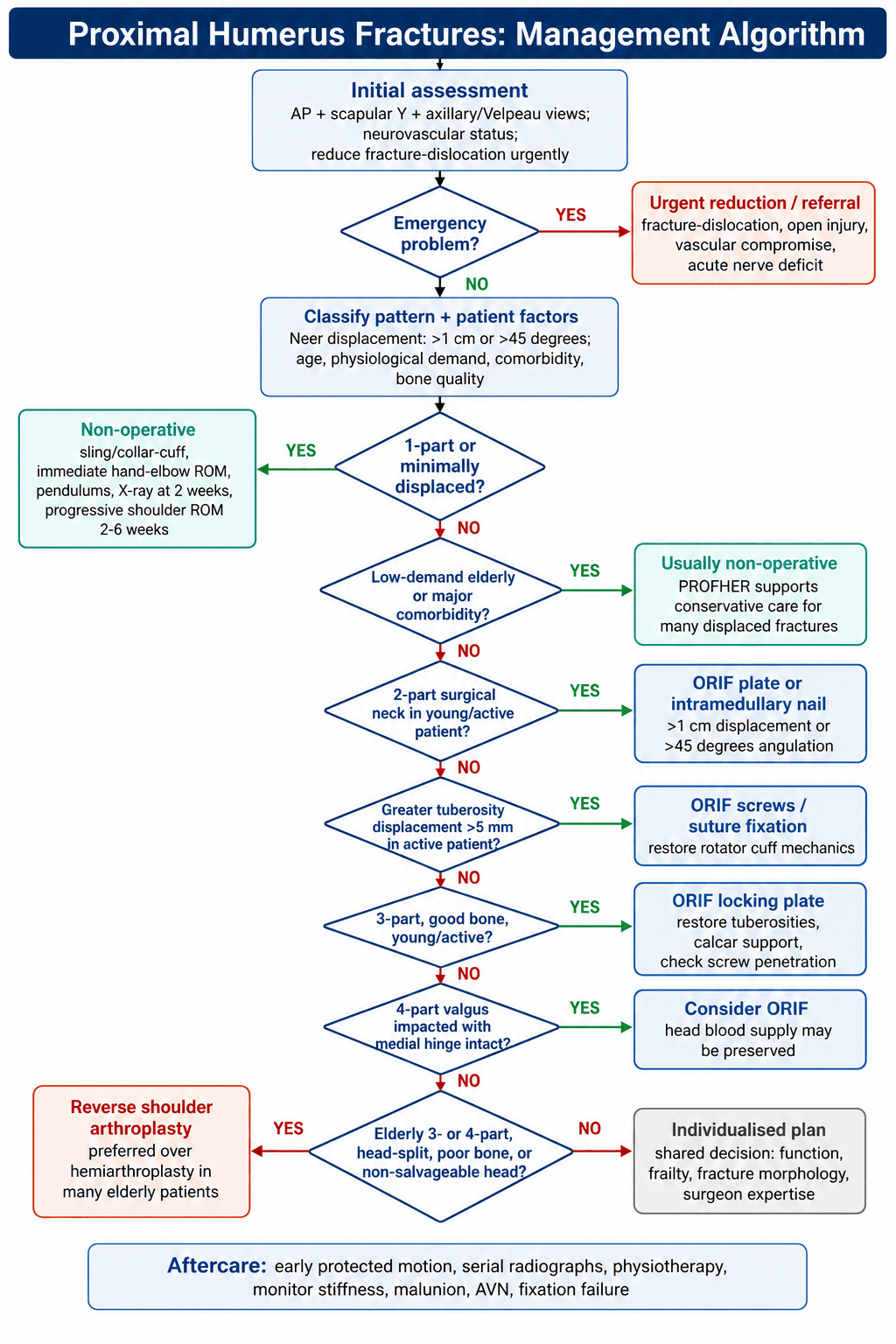
- Fracture Pattern
- 1-part (non-displaced)
- Key Consideration
- 85% of all proximal humerus fractures
- Treatment
- Sling, early ROM at 2 weeks
- Fracture Pattern
- 2-part surgical neck
- Key Consideration
- greater than 1cm displacement or over 45° angulation
- Treatment
- ORIF with plate or nails
- Fracture Pattern
- 2-part GT displacement greater than 5mm
- Key Consideration
- Affects rotator cuff function
- Treatment
- ORIF with screws/suture
- Fracture Pattern
- 3-part or valgus-impacted 4-part
- Key Consideration
- Head viability more likely
- Treatment
- ORIF if reducible
- Fracture Pattern
- Displaced 3-part or 4-part
- Key Consideration
- High AVN risk, poor bone quality
- Treatment
- Reverse shoulder arthroplasty
- Fracture Pattern
- Any displaced pattern
- Key Consideration
- PROFHER supports non-op
- Treatment
- Consider non-operative
Who. Non-operative treatment is indicated for:
- 1-part (minimally displaced) fractures
- Elderly low-demand patients with displaced fractures, on the PROFHER evidence
- Significant medical comorbidities precluding surgery
- Head-split or severely comminuted fractures in non-surgical candidates
Non-Operative Protocol
Collar and cuff or sling. Pendulum exercises begin immediately. Elbow, wrist, hand ROM.
Begin passive and active-assisted shoulder ROM. Supine exercises initially. X-ray at 2 weeks.
Progress to active ROM and strengthening. Most fractures clinically healed by 6-8 weeks.
Full strengthening programme. Return to activities as tolerated. Some stiffness may persist.
Surgical Technique
Consent. Warn of:
- Infection - 1-2% superficial, 0.5% deep
- Axillary nerve injury - 5-10%; document the pre-operative status
- AVN - rates by pattern under Complications
- Screw penetration - 14%, which may need removal
- Hardware failure or reoperation - 10-15%
- Stiffness - very common, so physiotherapy is critical
Equipment. Have ready:
- Proximal humerus locking plate (system of choice)
- Locking and cortical screws in multiple lengths
- K-wires, 1.6mm and 2.0mm, for temporary fixation
- Heavy sutures: No. 2 or 5 FiberWire/Ethibond
- Bone hook and elevator for reduction
- C-arm positioned from the contralateral side
Setup Checklist
30-45° trunk elevation. Head secured in padded headrest. Body shifted toward operative edge of table. Arm freely draped on arm board or mayo stand.
Avoid excessive lateral neck flexion - stretches plexus. Head in neutral rotation, supported centrally.
C-arm enters from contralateral side. Confirm AP, axillary, and Velpeau views achievable. Test imaging BEFORE draping.
Prep from nipple to neck, axilla to midline posteriorly. Free drape arm to allow full manipulation.
Blood pressure can drop significantly in beach chair position (cerebral hypoperfusion). Keep MAP above 70mmHg, and avoid sudden position changes.
Arthroplasty Options
Reverse over hemiarthroplasty. Reverse shoulder arthroplasty (RSA) has largely replaced hemiarthroplasty for fractures. With RSA the deltoid becomes the primary elevator rather than the rotator cuff, so it gives reliable pain relief and function regardless of tuberosity healing and allows earlier active motion; hemiarthroplasty outcomes depend heavily on tuberosity healing.
What the evidence supports. The Cochrane review found only very low-certainty evidence of a minimal functional difference between RTSA and hemiarthroplasty, but a lower complication and reoperation rate with RTSA, and registry data show lower cumulative revision after RTSA (see Evidence Base).
- Indications
- Young patient, good rotator cuff, good bone
- Pros
- Preserves native glenoid, revision possible
- Cons
- Outcomes depend on tuberosity healing, unpredictable
- Indications
- Elderly, rotator cuff deficient, 4-part fractures
- Pros
- Reliable outcomes, less dependent on tuberosities
- Cons
- Glenoid revision difficult, scapular notching
- Indications
- Fracture with pre-existing OA (rare)
- Pros
- Address arthritis simultaneously
- Cons
- Complex surgery, rarely indicated acutely
In both hemiarthroplasty and RSA, tuberosity reconstruction is critical. Tuberosities should be fixed around the prosthesis using heavy non-absorbable sutures in a tension-band configuration. Tuberosity malunion or non-union is the most common cause of poor outcomes after shoulder arthroplasty for fracture.
Complications
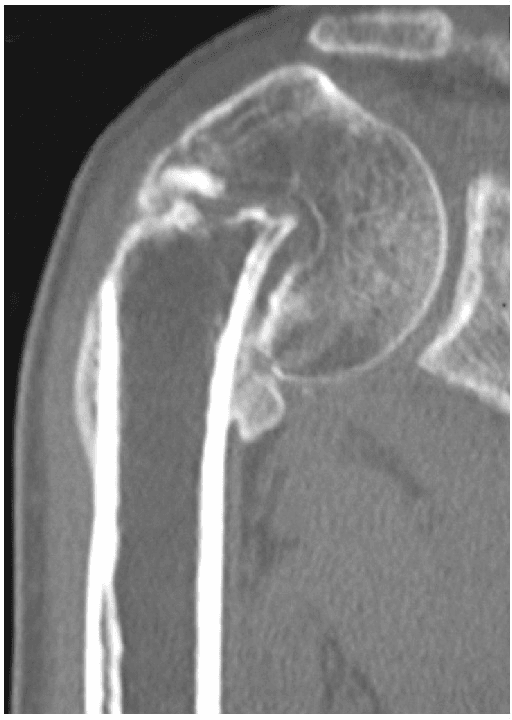
AVN. Risk tracks head ischaemia. Anatomic neck and head-split fractures carry the highest risk; 4-part fractures (15-35%) and 3-part fractures (3-14%) are also at risk. Valgus-impacted patterns have a lower risk because the medial soft-tissue hinge is preserved.
Malunion and stiffness. Malunion is the most common complication, especially of the greater tuberosity, where it causes impingement. Stiffness is common after both non-operative and operative treatment, and early ROM is key to preventing it.
- Incidence
- 15-35% (4-part)
- Risk Factors
- Displacement, head vascularity
- Management
- Close monitoring, arthroplasty if symptomatic
- Incidence
- Most common
- Risk Factors
- Non-op treatment, inadequate reduction
- Management
- Osteotomy if symptomatic, prevention key
- Incidence
- 5-10%
- Risk Factors
- Surgical neck fx, osteoporosis, smoking
- Management
- Bone graft and fixation or arthroplasty
- Incidence
- Common
- Risk Factors
- Prolonged immobilisation, adhesive capsulitis
- Management
- Prevention with early ROM, may need MUA or release
- Incidence
- 5-10%
- Risk Factors
- Dislocation, surgical approach
- Management
- Most recover - observe 3-6 months
- Incidence
- Variable
- Risk Factors
- Plate or GT malposition
- Management
- Hardware removal, tuberosity osteotomy
- Incidence
- Variable
- Risk Factors
- Technical error
- Management
- Remove offending screws
Postoperative Care and Rehabilitation
ORIF Rehabilitation Protocol
Sling immobilisation. Elbow, wrist, hand ROM. Pendulum exercises.
Begin passive and active-assisted ROM. Forward flexion in supine, ER to neutral.
Active ROM in all planes. X-ray confirmation of healing. Discontinue sling.
Progressive rotator cuff and deltoid strengthening. Return to activities 3-6 months.
Outcomes and Prognosis
- Shoulder Function
- Good to excellent
- Complications
- Minimal
- Notes
- 85% of fractures, reliable outcomes
- Shoulder Function
- Moderate
- Complications
- Stiffness, malunion
- Notes
- PROFHER supports in elderly
- Shoulder Function
- Variable
- Complications
- Hardware issues, AVN
- Notes
- Best in young with good bone
- Shoulder Function
- Unpredictable
- Complications
- Tuberosity dependent
- Notes
- Falling out of favour
- Shoulder Function
- Reliable
- Complications
- Scapular notching
- Notes
- Current gold standard for 4-part elderly
Prognostic factors. Function at 1-2 years is the best predictor of long-term outcome. The factors that affect it:
- Age - older patients have more stiffness
- Initial displacement, which correlates with soft-tissue injury
- Bone quality
- Patient activity level
- Tuberosity healing, for arthroplasty
Guidelines, Registries & Global Practice
Global Epidemiology
Proximal humeral fractures account for roughly 4-5% of all fractures and are the third most common fragility fracture in older adults after the proximal femur and distal radius. In Court-Brown's epidemiology (Injury 2018), their incidence is rising across high-income populations as longevity increases, with a marked female predominance from low-energy falls and a smaller cohort of younger patients sustaining high-energy injuries.
Side-by-Side Guidance and Evidence
- Region
- UK / international
- Core Recommendation
- No functional benefit of surgery over non-operative care for most displaced surgical-neck fractures
- Evidence Base
- Level I (RCT and high-certainty systematic review)
- Region
- USA
- Core Recommendation
- Non-operative care reasonable for many displaced patterns; reserve arthroplasty for selected elderly 3/4-part fractures
- Evidence Base
- Consensus informed by RCT evidence
- Region
- UK
- Core Recommendation
- Multidisciplinary fragility-fracture pathway, shared decision-making, default to non-operative for older low-demand patients
- Evidence Base
- Guideline / quality standard
- Region
- International
- Core Recommendation
- Restore medial column and head viability for fixation; RTSA where head not reconstructable
- Evidence Base
- Expert principles plus cohort data
- Region
- Europe
- Core Recommendation
- Individualised: physiological age, bone quality and pattern over chronological age; rising RTSA use for fracture
- Evidence Base
- Registry and cohort evidence
Registry Evidence and Practice Variation
- AOANJRR (Australia), NJR (UK), AJRR (USA): all record rising RTSA use for fracture
- RTSA shows lower cumulative revision than hemiarthroplasty for fracture indications
- Registries capture real-world implant survival beyond trial populations
- Surgery rates vary widely between health systems despite Level I evidence favouring non-operative care
- High-income settings: locking plate or RTSA; resource-limited settings rely on closed treatment or external fixation
- PROFHER-2 (ongoing, RTSA vs HA vs non-surgery) will further refine choice in 3/4-part fractures
Bone Health and Medications
- Low-energy fracture over age 50 triggers bone-health assessment (DEXA, vitamin D)
- Anti-resorptives (bisphosphonates, denosumab) and anabolic agents per local formularies
- These agents are widely subsidised and available across most national health systems; calcium and vitamin D supplementation as indicated
- Fracture liaison services reduce re-fracture risk globally
- Falls assessment and frailty optimisation alongside fracture care
- Structured smoking-cessation support (counselling, nicotine replacement, pharmacotherapy) aids bone healing
Any proximal humerus fracture from a low-energy mechanism in a patient over 50 should trigger bone health assessment - DEXA, vitamin D, and consideration of anti-resorptive therapy through a fracture liaison service. This is a consistent recommendation across international guidelines for secondary fracture prevention.
Viva Scenarios
Exam Viva Scenarios
Practise clinical reasoning and management decisions out loud
“A 75-year-old woman presents after a fall at home. She has pain and inability to move her left shoulder. X-rays show a displaced 4-part proximal humerus fracture with the head in valgus position. She is otherwise healthy and independent with ADLs.”
“A 45-year-old competitive recreational tennis player falls during a match. He has a displaced 3-part fracture (greater tuberosity and surgical neck displaced) with moderate osteopenia. He is very keen to return to sport.”
“A 60-year-old presents after high-speed MVA. On examination, the shoulder is squared-off with absent axillary nerve function. X-rays show a 3-part fracture-dislocation with the head posteriorly dislocated. CT confirms significant glenoid bone loss from a Hill-Sachs reverse lesion.”
MCQ Practice Points
Q: What is the main blood supply to the humeral head? A: Answer it in two halves. The classic answer is the arcuate artery, the ascending branch of the anterior circumflex humeral artery, entering at the intertubercular groove. The quantitative answer is that the posterior circumflex humeral artery supplies about 64% of the head and the anterior circumflex about 36% (Hettrich, PMID 20360519). Beware the number that gets misquoted here: 80% is the proportion of displaced fractures in which the arcuate artery is DISRUPTED - it is not the share of perfusion the arcuate provides. The gap between that 80% disruption rate and the far lower osteonecrosis rate is precisely the evidence for posterior dominance.
Q: In Neer classification, what defines a 'displaced part'? A: greater than 1cm translation or over 45° angulation. Count displaced parts (not fracture lines) - there are 4 anatomical parts: head, greater tuberosity, lesser tuberosity, and shaft.
Q: What is the AVN rate in 4-part proximal humerus fractures? A: 15-35% for 4-part fractures, 3-14% for 3-part fractures. Valgus-impacted 4-part fractures have lower AVN risk due to preserved medial hinge.
Q: What did the PROFHER trial demonstrate? A: No significant difference in functional outcomes (Oxford Shoulder Score) at 2 years between surgical and non-operative treatment for displaced proximal humerus fractures. Cost-effectiveness favored non-operative treatment.
Q: Which nerve is most commonly injured in proximal humerus fractures? A: Axillary nerve (5-10% incidence). It wraps around the surgical neck 5-7cm below the acromion. Test deltoid contraction and regimental badge sensation.
Q: For a 75-year-old with a displaced 4-part fracture, what is the preferred arthroplasty option? A: Reverse shoulder arthroplasty (RSA). RSA provides more reliable outcomes than hemiarthroplasty because function is less dependent on tuberosity healing.
Key Anatomy
- 4 parts: Head, Greater tuberosity, Lesser tuberosity, Shaft
- Arcuate artery (from anterior circumflex) = main blood supply
- Axillary nerve 5-7cm below acromion - test deltoid and sensation
- Pectoralis major displaces shaft medially
Neer Classification
- Count DISPLACED parts (greater than 1cm or over 45°)
- 1-part = non-displaced = 85% of fractures = non-op
- 2-part = one displaced segment = consider ORIF if young/active
- 3-part = two displaced = ORIF vs arthroplasty
- 4-part = all separated = RSA in elderly
Treatment Algorithm
- 1-part: Sling and early ROM - excellent outcomes
- 2-part GT greater than 5mm: ORIF in active patients
- 2-part surgical neck: ORIF if young, consider non-op if elderly
- 3-part: ORIF if good bone and young, RSA if elderly
- 4-part: RSA preferred over hemiarthroplasty in elderly
Surgical Pearls
- Deltopectoral approach - cephalic vein laterally
- Plate 5-8mm below GT tip to avoid impingement
- Calcar screw improves stability
- Check screw penetration with fluoroscopy AP, axillary, Velpeau views
- Tuberosity repair with heavy sutures critical for function
Complications
- AVN: 15-35% in 4-part, 3-14% in 3-part
- Malunion: Most common complication overall
- Stiffness: Early ROM prevents adhesive capsulitis
- Axillary nerve injury: Document before surgery, most recover
Evidence Base
PROFHER Trial - Surgery vs Non-Surgery
- Pragmatic multicentre RCT of 250 adults (mean age 66 years) with displaced fractures involving the surgical neck. No significant difference in the Oxford Shoulder Score averaged over 2 years (39.07 surgical vs 38.32 non-surgical; difference 0.75 points, 95% CI -1.33 to 2.84; P=0.48). No difference in complications, secondary surgery, or mortality.
Cochrane Review - Interventions for Proximal Humeral Fractures
- 47 trials, 3179 participants. High-certainty evidence of no clinically important difference between surgery and non-surgery in shoulder function at 1 year (SMD 0.10, 95% CI -0.07 to 0.27) or 2 years, with a higher risk of additional surgery after operative treatment (RR 2.06). For RTSA versus hemiarthroplasty, only very low-certainty evidence of minimal between-group functional difference, but a lower complication and reoperation rate favouring RTSA.