Zone 1 | Tuberosity Avulsion | Peroneus Brevis and Lateral Plantar Band | Conservative | Excellent Prognosis
- Zone 1 is PROXIMAL to the 4-5 intermetatarsal articulation
- Avulsion mechanism via peroneus brevis and/or the lateral band of the plantar fascia - 3D mapping of 222 fractures shows either can dominate in a given foot
- Excellent blood supply - metaphyseal bone heals well
- Conservative treatment is standard - CAM boot or hard-soled shoe
- Very low nonunion rate (under 5%) compared to Jones (25-50%)
- “The 4-5 intermetatarsal joint is the KEY LANDMARK for zone classification
- “Zone 1 does NOT extend into the 4-5 joint - Jones fractures DO
- “Inversion injury causes avulsion; adduction stress causes Jones
- “Fibrous union is common but rarely symptomatic - not an indication for surgery
- “Conservative treatment succeeds in over 95% of cases
Overview
A pseudo-Jones fracture is an avulsion of the fifth metatarsal tuberosity, Zone 1 of the Lawrence and Botte classification. It is the most common fracture of the fifth metatarsal base, accounting for 93% of proximal fifth metatarsal fractures, and it has an excellent prognosis with conservative management.
The name is the trap. A pseudo-Jones fracture is not a Jones fracture. The true Jones fracture is Zone 2, at the metadiaphyseal junction, and it differs in location, mechanism, prognosis and treatment. The terminology is confusing enough that examiners test whether you understand the anatomical distinction, and the two must be clearly differentiated.
Anatomy and Pathophysiology
The tuberosity. Zone 1 is the styloid process, or tuberosity, of the fifth metatarsal, and it lies proximal to the fourth-fifth intermetatarsal articulation. Peroneus brevis inserts on its dorsolateral aspect, and the lateral band of the plantar fascia on the plantar aspect.
Blood supply. The tuberosity is metaphyseal bone with an abundant blood supply from multiple periosteal and nutrient vessels, and its cancellous bone promotes rapid healing. It has no watershed zone of the kind found at the metadiaphyseal junction. This vascular difference explains the dramatically different nonunion rates between the zones:
- Zone 1 - metaphyseal, with excellent periosteal and medullary supply
- Zone 2 - a watershed, where the nutrient artery meets the periosteal supply, so healing is poor
- Zone 3 - limited periosteal vessels only, so healing is also poor
Mechanism. The foot is in plantarflexion when a sudden inversion stress arrives, the typical ankle-sprain mechanism. Peroneus brevis contracts to resist the inversion and the tuberosity fragment avulses. Tension in the lateral band of the plantar fascia during inversion is the alternative mechanism, and accounts for the more plantar-based fracture patterns.
A Zone 2 fracture is produced differently, by an adduction force to the forefoot with the foot plantarflexed. The mechanism is therefore often the first clue to the fracture type: inversion means likely Zone 1.
What actually avulses the fragment. Peroneus brevis is the reflex answer, and it is contested. In the classic cadaveric and imaging study, Richli and Rosenthal (AJR 1984) found that the structure under tension at the moment of a typical inversion avulsion is the lateral cord (band) of the plantar aponeurosis, which inserts on the plantar-lateral tuberosity, rather than peroneus brevis. The fragment was usually pulled plantarward and proximally by this band, not dorsally by the tendon, and abductor digiti minimi also attaches here and contributes.
That explains why the fracture line is typically transverse/plantar, and why peroneus brevis function is almost always preserved even with a sizeable avulsion, so excising a small symptomatic fragment rarely weakens eversion.
Both, and it varies. The modern evidence largely resolves the argument. Combining 3D CT fracture mapping of 222 avulsion fractures with cadaveric dissection, He et al. (PMID 36045449) found three patterns: type I driven predominantly by the lateral band of the plantar fascia, type II predominantly by peroneus brevis, and type III by the two acting together, with one or two fracture lines.
Cadaveric footprint work supports this even-handedness. In 102 legs, peroneus brevis attached proximal to zone 2 in 40% and the lateral band in 27%, with no significant difference in footprint area between them, and the long plantar ligament does not attach to the fifth metatarsal at all (Kaneko, PMID 32995346). Either structure can be the avulsing force in a given foot, which is exactly why the fragment's size, direction and fracture-line orientation vary so much between patients.
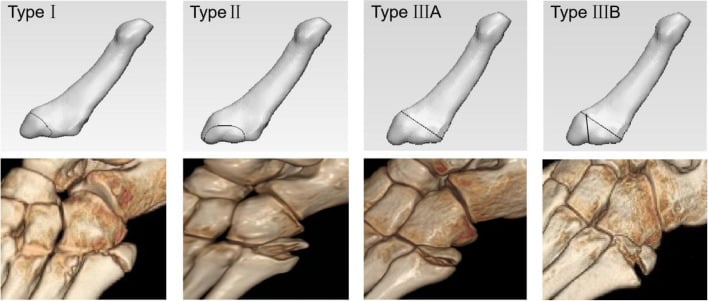
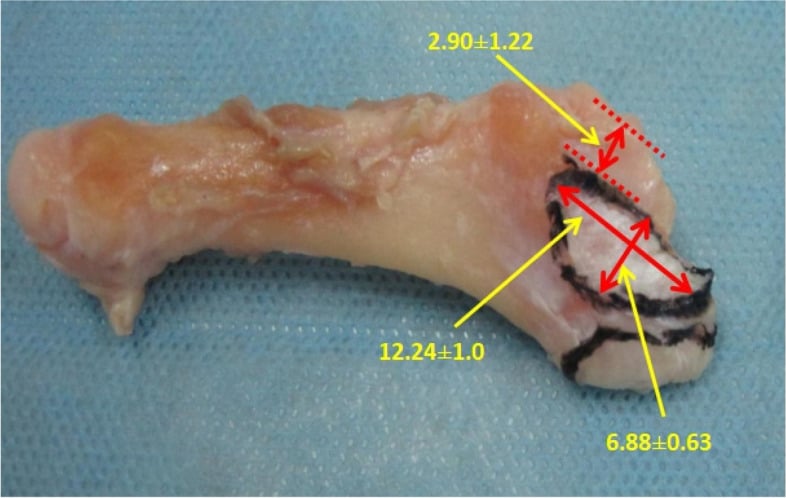
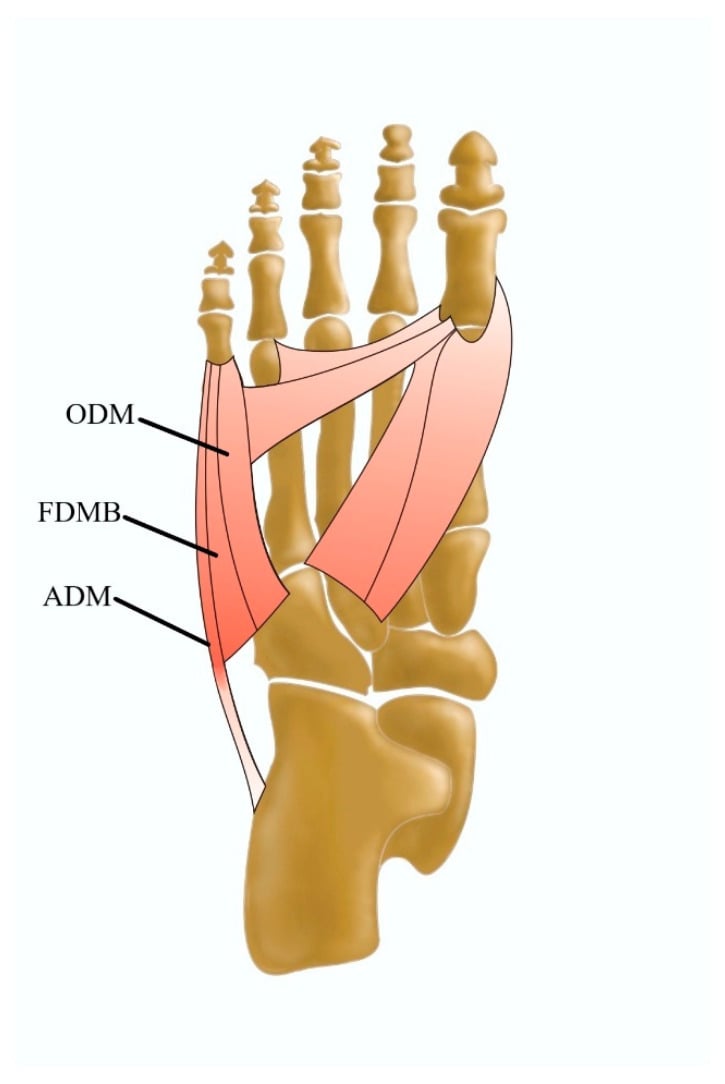
The tuberosity is avulsed by the combined pull of peroneus brevis and the lateral cord of the plantar aponeurosis; which dominates varies between individuals. Do not state peroneus brevis as the sole cause as though it were settled fact.
Classification
Lawrence and Botte. The proximal fifth metatarsal is divided into three zones, and the landmark that separates them is the fourth-fifth intermetatarsal articulation. A Zone 1 fracture is proximal to it, a Zone 2 fracture extends into it, and a Zone 3 fracture is distal to it. Look for this joint on the radiograph: it is the defining feature for classification.
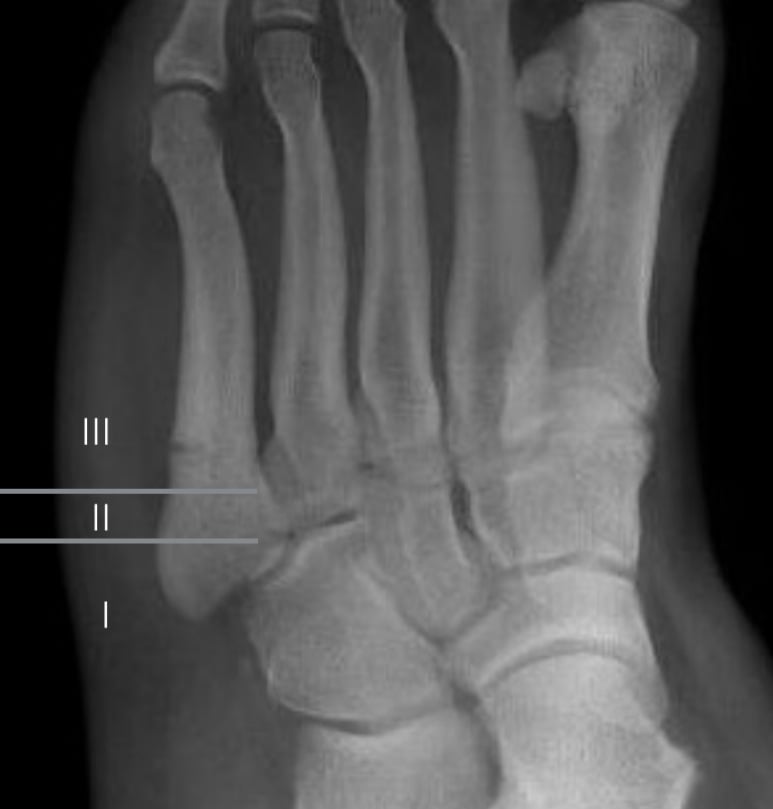
- Location
- Tuberosity - proximal to the 4-5 intermetatarsal joint
- Mechanism
- Inversion injury with avulsion by peroneus brevis or lateral plantar fascia
- Prognosis
- Union over 95% with conservative treatment; nonunion under 5%; excellent functional outcomes
- Treatment
- Conservative - CAM boot or hard-soled shoe, WBAT, 4-6 weeks
- Location
- Metadiaphyseal junction - extends into the 4-5 intermetatarsal joint
- Mechanism
- Adduction force to the forefoot with the foot plantarflexed - not an avulsion
- Prognosis
- Union 50-75% with conservative treatment; nonunion 25-50%; delayed union common
- Treatment
- Conservative: 6-8 weeks NWB in cast, prolonged immobilisation. Surgical: IM screw (preferred for athletes). Return to activity 12-20 weeks (12-16 weeks with conservative treatment)
- Location
- Proximal diaphysis - distal to the 4-5 intermetatarsal joint
- Mechanism
- Repetitive stress, often in athletes (basketball, tennis)
- Prognosis
- High risk of delayed union or nonunion; refracture risk with conservative treatment
- Treatment
- Usually surgical - IM screw; conservative treatment has a high failure rate. Return to activity 10-16 weeks with surgery
Zone 1 subtypes (Stewart). Zone 1 injuries are subdivided by fragment size and comminution. The small flake is the most common, and a comminuted fracture may extend to the cuboid articulation.
- Description
- Flake avulsion, fragment under 5mm
- Treatment
- Conservative (boot/shoe)
- Prognosis
- Excellent
- Description
- Fragment over 5mm
- Treatment
- Conservative (boot)
- Prognosis
- Excellent
- Description
- Multiple fragments; may extend to cuboid articulation
- Treatment
- Consider ORIF if over 2mm articular step-off
- Prognosis
- Good
The whole management algorithm turns on the zone, yet the Lawrence and Botte three-part scheme has repeatedly been shown to have poor interobserver and intraobserver reliability, with the Type II assignment the most ambiguous of the three (Marcus, PMID 41591313). It remains the shared language, and the biological contrast between a tuberosity avulsion and a metaphyseal-diaphyseal junction fracture is real. But distrust a borderline zone label and decide from the anatomy in front of you: where the fracture line sits relative to the fourth-fifth intermetatarsal articulation, and whether the fragment lies within the peroneus brevis footprint.
A newer two-part system splits fractures into avulsion (within the peroneus brevis footprint, biomechanically stable) and indirect (distal to that footprint, unstable under peroneus brevis load), using a landmark of roughly 15 mm from the tuberosity laterally and the inflection point of the articular curve medially. It achieved an interobserver kappa of 0.92 against Lawrence and Botte's poor agreement. It is a single validation study with only 23 patients followed to healing, so treat it as promising rather than established; the idea worth carrying into the viva is that stability depends on whether peroneus brevis is pulling the fragment off or bending the bone beyond it.
Clinical Assessment
History. The story is an inversion ankle injury, the same mechanism as an ankle sprain, with immediate pain over the lateral foot at the base of the fifth metatarsal and an initial inability to bear weight. Patients often present thinking they have "just an ankle sprain". Establish:
- The exact mechanism of injury
- Ability to bear weight
- Previous foot or ankle injuries
- Athletic activity level, occupation and functional demands
Examination. Swelling sits over the lateral foot at the fifth metatarsal base, and ecchymosis may extend along the lateral foot; compare with the other side. The key sign is tenderness over the tuberosity, and its location should be compared with tenderness at the metadiaphyseal junction (Zone 2). Assess weight-bearing, active ankle range of motion, peroneal strength against the other side, and gait.
Associated injuries. The same inversion mechanism can cause several injuries at once, and a lateral ankle ligament sprain is very common. Check the lateral malleolus and palpate the anterior process of the calcaneus, and always examine for:
- Lateral ankle ligament injury (ATFL, CFL)
- Peroneal tendon strain
- Anterior process of calcaneus fracture
- Cuboid fracture
- Lateral process of talus fracture
- Syndesmosis injury (widened ankle mortise) and subtalar injury
- Lisfranc joint injury, if there is significant midfoot swelling
Ottawa foot rules. A foot radiograph is indicated by any of:
- Bone tenderness at the base of the fifth metatarsal
- Bone tenderness at the navicular
- Inability to bear weight (4 steps) immediately and in the emergency department
A Zone 1 fracture will typically trigger the fifth metatarsal criterion.
Investigations
Radiographs. AP, lateral and oblique views of the foot, the oblique being the best for the fifth metatarsal base. Assess, in turn:
- Zone - where is the fracture relative to the 4-5 joint?
- Displacement - gap or step-off
- Comminution - single or multiple fragments
- Associated injuries - check the entire foot
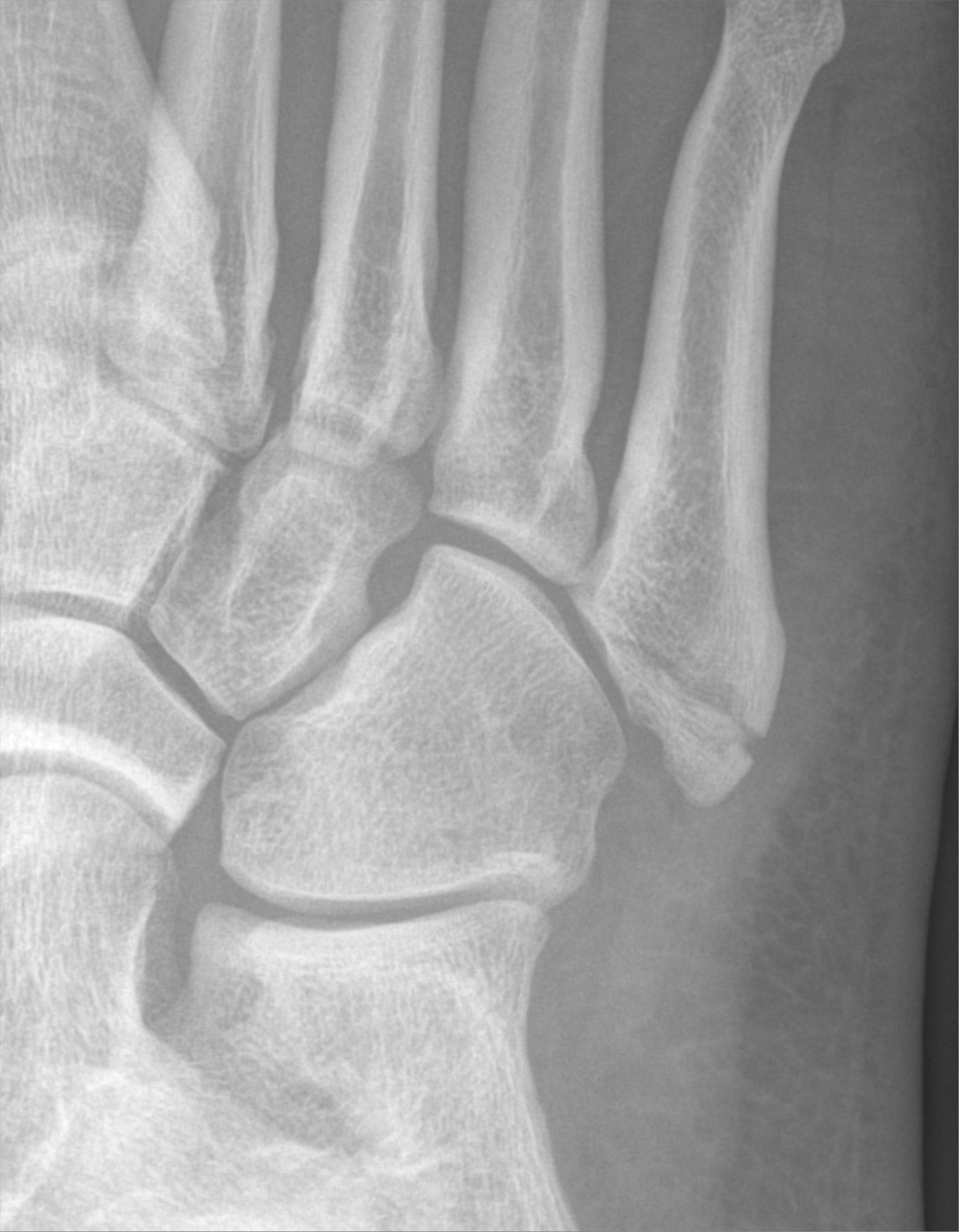
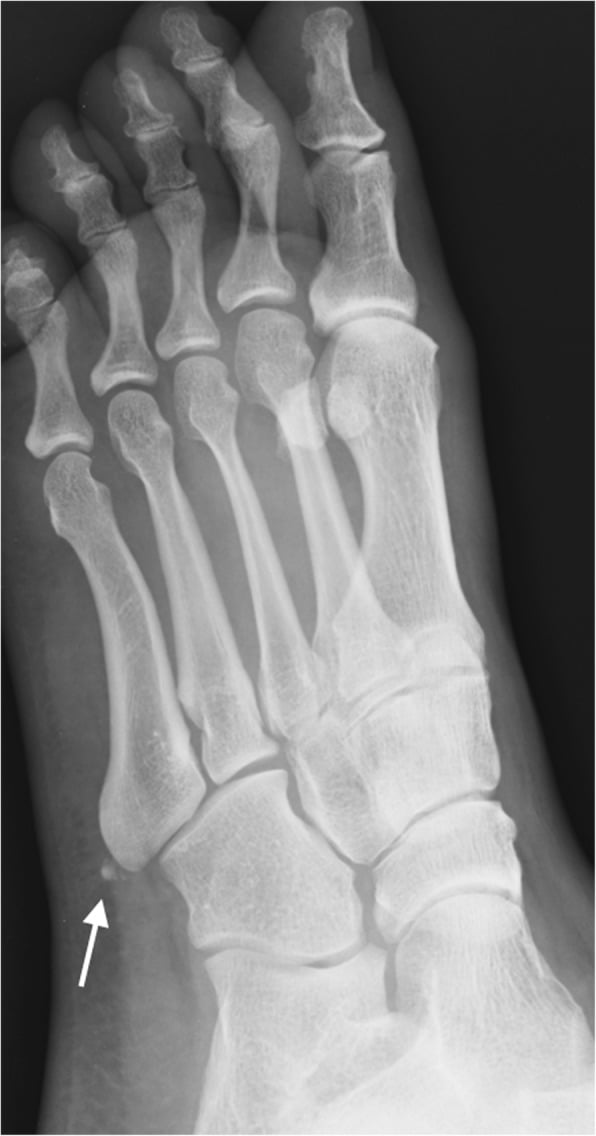
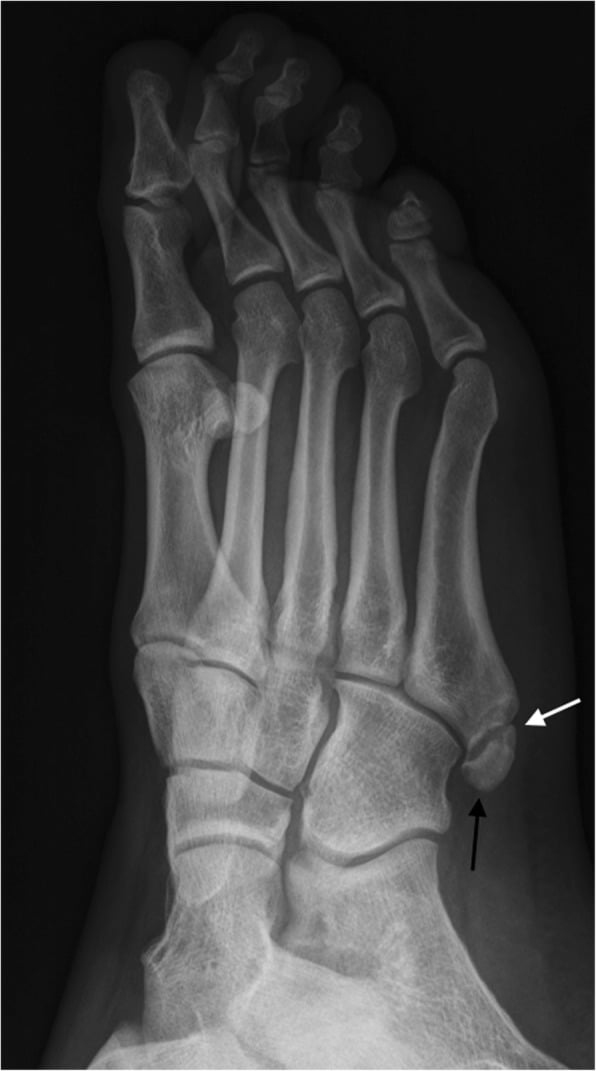
The Zone 1 appearance. The fracture line is transverse or oblique and does not extend into the 4-5 intermetatarsal articulation. A Zone 2 fracture line is often more horizontal, sits at the metadiaphyseal junction and extends into that joint. A Zone 1 fracture is typically non-displaced or minimally displaced, with the fragment pulled proximally: dorsally where peroneus brevis dominates, plantarward where the lateral band does.
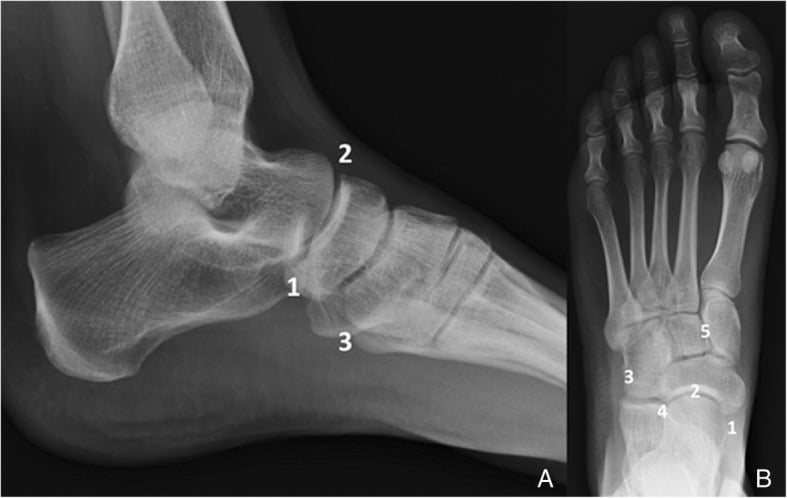
Os vesalianum. An accessory ossicle near the fifth metatarsal base, at the tip of the tuberosity within the peroneus brevis tendon, and the single most common structure mistaken for a pseudo-Jones fragment. It has smooth, rounded, corticated margins, does not "fit" the adjacent bone perfectly, is bilateral in many cases and is often incidental. An acute fracture has irregular margins, fits with the adjacent bone and is acutely tender. If uncertain, a radiograph of the other foot may help.
Os peroneum is a sesamoid in the peroneus longus tendon near the cuboid tunnel, a different location from Zone 1 fractures.
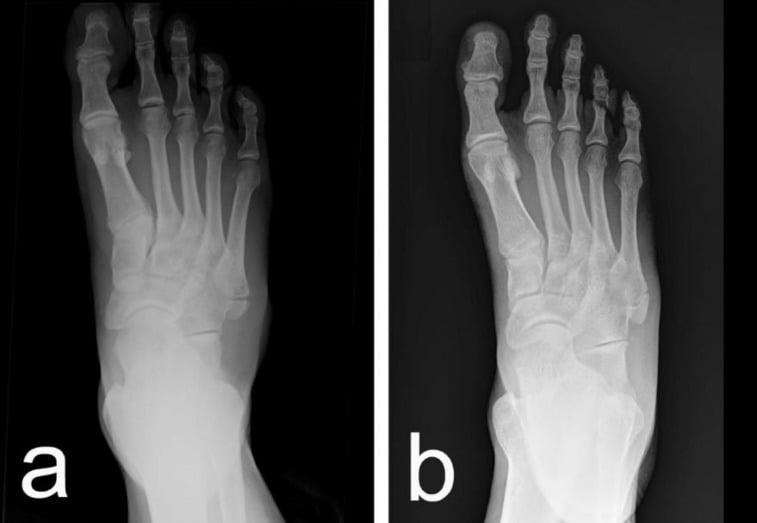
- Distinguishing Features
- Inversion injury, tenderness over tuberosity proximal to 4-5 joint
- Imaging Clue
- Transverse/oblique line NOT entering 4-5 joint
- Action
- Conservative (boot/shoe)
- Distinguishing Features
- Adduction load, tenderness at metadiaphyseal junction
- Imaging Clue
- Line enters the 4-5 intermetatarsal joint
- Action
- Consider IM screw (athletes)
- Distinguishing Features
- Insidious activity-related pain in athletes
- Imaging Clue
- Distal to 4-5 joint; sclerosis/periosteal reaction if chronic
- Action
- Often surgical; high refracture risk
- Distinguishing Features
- Often asymptomatic/incidental, may be bilateral
- Imaging Clue
- Smooth corticated margins, does not 'fit' adjacent bone
- Action
- No treatment; compare contralateral foot
- Distinguishing Features
- Lateral pain near cuboid; peroneus longus pathology
- Imaging Clue
- Sesamoid within peroneus longus near cuboid tunnel, distinct location
- Action
- Treat associated tendinopathy
- Distinguishing Features
- Same inversion mechanism, tenderness over ATFL/CFL
- Imaging Clue
- No fracture line; soft-tissue swelling
- Action
- Functional rehab
- Distinguishing Features
- Tenderness localised away from MT5 base
- Imaging Clue
- Fracture line in cuboid or anterior calcaneal process
- Action
- Treat per pattern; do not miss
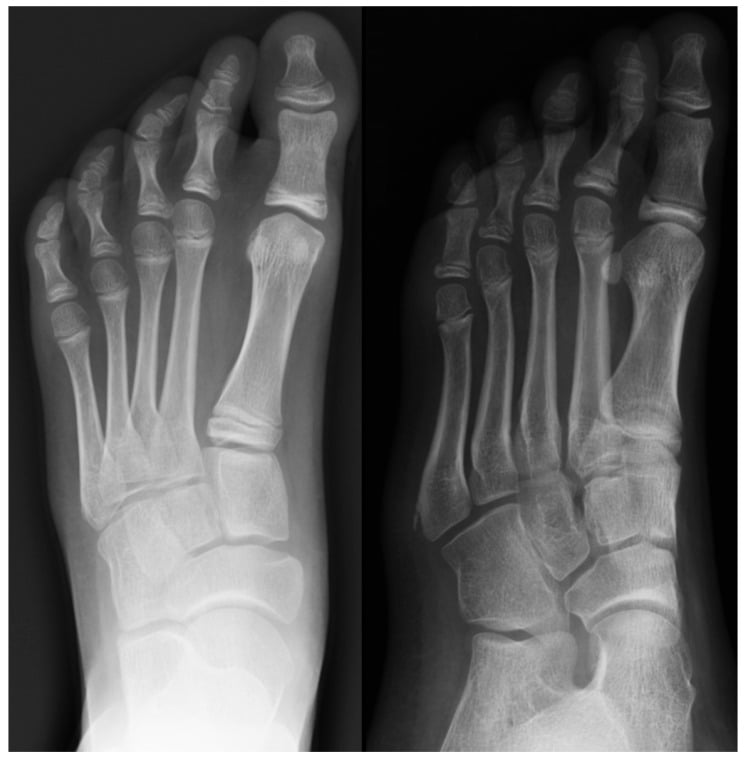
Advanced imaging is rarely needed. CT is for large comminuted fractures, for assessing involvement of the fifth metatarsal-cuboid joint, and for planning if ORIF is considered. MRI is for a suspected concurrent soft-tissue injury or a stress reaction without a clear fracture line, and is usually not needed for a typical Zone 1 fracture.
Management
The decision. Three questions settle it:
- Is this truly Zone 1, proximal to the 4-5 joint? If so, treat conservatively. Zone 2 and Zone 3 fractures follow a different algorithm, in which surgery is considered.
- Is there significant displacement or comminution? Minimal displacement is treated conservatively; over 2mm of step-off in the joint means considering ORIF.
- What is the patient's functional demand? Most patients are treated conservatively; with high-level athletes who have large fragments, discuss the options.
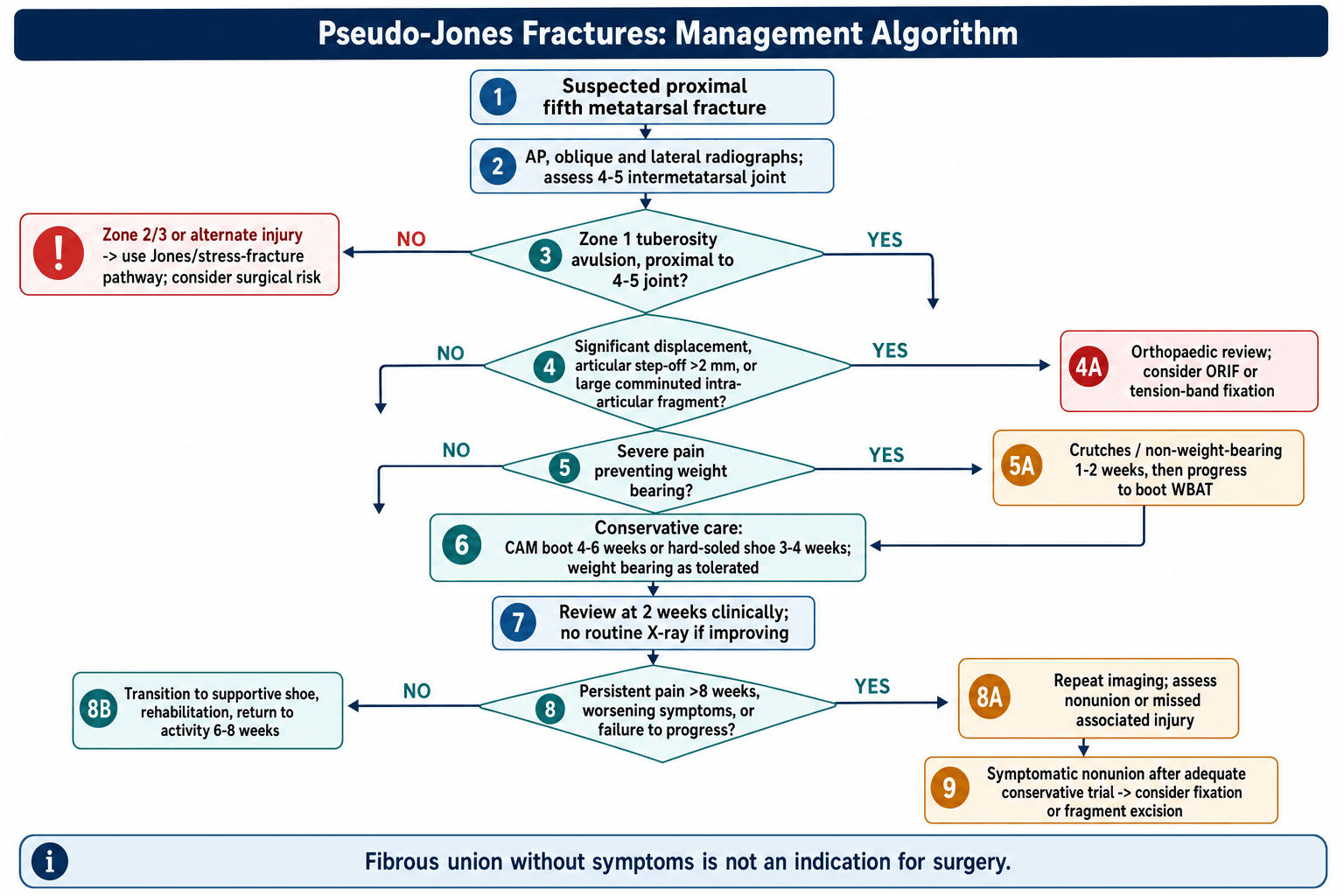
Conservative treatment is first line for all non-displaced or minimally displaced Zone 1 fractures, for displaced fractures that do not involve the articular surface significantly, and for most Type 1 and Type 2 fractures (over 95% of cases). The support is chosen by the fragment and the pain:
- Indication
- Most Zone 1 fractures (the most common option)
- Duration
- 4-6 weeks, then supportive shoe when comfortable
- Weight Bearing
- WBAT from day 1
- Indication
- Very small avulsion, minimal symptoms - may be sufficient for small flake fractures
- Duration
- 3-4 weeks
- Weight Bearing
- WBAT
- Indication
- Severe pain on initial weight-bearing
- Duration
- 1-2 weeks on crutches, then CAM boot
- Weight Bearing
- Progress to WBAT
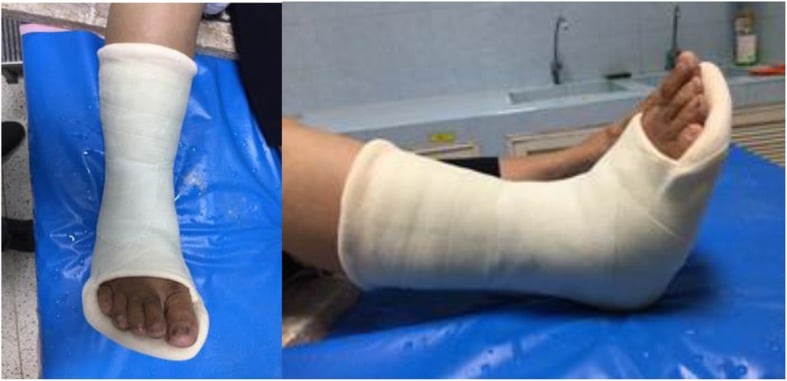
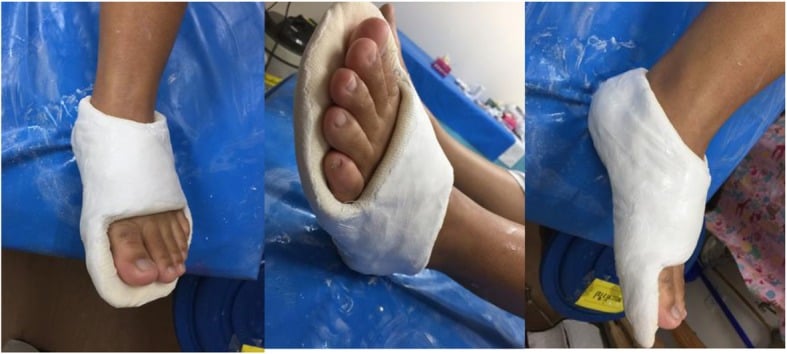
Rehabilitation runs in four phases:
- Weeks 0-2 - pain control, ice and elevation, gentle range of motion, weight-bearing in the boot or shoe as tolerated
- Weeks 2-4 - progress weight-bearing, ankle and foot range of motion, begin light strengthening
- Weeks 4-6 - out of the boot, progressive strengthening, balance and proprioception
- Weeks 6-8 - normal footwear, and sport-specific rehabilitation where it applies; full activity by 8-10 weeks typically
Follow-up. Review clinically at 2 weeks to check symptoms and at 6 weeks for discharge; no routine radiographs are needed if the patient is progressing well. Re-image for persistent pain beyond 8 weeks, worsening symptoms, failure to progress with rehabilitation, or concern about a missed concurrent injury.
Athletes follow the same conservative protocol, and may use a rigid-soled athletic shoe earlier. No evidence supports early surgery for Zone 1.
Older patients. Conservative treatment remains standard, and lower functional demands often allow faster progression. Monitor for concurrent ankle instability, and consider an osteoporosis work-up if appropriate.
Diabetic patients may need prolonged immobilisation. Monitor for skin complications in the boot, keep a lower threshold for imaging if healing is delayed, and watch for Charcot arthropathy if the foot is neuropathic.
Operative treatment is needed in less than 5% of cases. The indications:
- A displaced intra-articular fragment with more than about 2 mm of step-off at the metatarsocuboid joint (Type 3 with joint involvement)
- A fragment involving a large share of that articular surface, commonly cited as more than roughly 30 percent
- Symptomatic nonunion after an adequate conservative trial, or failed conservative treatment with persistent symptoms
- A large displaced fragment in a high-demand athlete - controversial, with no strong evidence
- Patient preference in specific circumstances
Candidates routinely conflate two different joints at the proximal fifth metatarsal, and examiners exploit it:
- The fourth-to-fifth intermetatarsal articulation is the classification landmark. A Zone 1 avulsion by definition does not enter it.
- The articular surface a Zone 1 fragment can actually involve is the fifth metatarsal-cuboid (metatarsocuboid) joint, the proximal articular face of the tuberosity. This is the surface that matters for the operative decision.
The avulsion stays conservative even when comminuted, unless the metatarsocuboid articular surface is disrupted, and a CT to map that joint comes before any fixation. Saying "it extends into the 4-5 joint so I will operate" is wrong twice over: a fracture into the 4-5 joint is by definition a Zone 2 Jones, not a Zone 1, and it is the cuboid joint, not the 4-5 joint, that drives Zone 1 operative decisions.
Surgical Technique
Choosing the operation. A CT assesses fragment size and joint involvement, and the fragment must be large enough to accept fixation:
- Lag screw - when the fragment is large enough to accept a screw
- Tension band - for larger tuberosity fragments
- Fragment excision - for a small symptomatic fragment too small for fixation
Set-up. Supine, with a bump under the ipsilateral hip and a tourniquet on the thigh. Make a longitudinal 4-5cm incision over the lateral aspect of the fifth metatarsal base, centred on the tuberosity, and identify and protect the sural nerve and its branches.
Screw fixation.
- Exposure - incise skin and subcutaneous tissue, identify the peroneus brevis insertion, and develop the interval between tendon and bone
- Preparation - clear soft tissue from the fracture site and fibrous tissue from the fracture ends, reduce the fragment anatomically and hold it with a pointed reduction clamp
- Fixation - insert a guidewire across the fracture, measure the screw length, drill and tap, then insert a 3.5mm or 4.0mm cortical screw with a washer to achieve interfragmentary compression
- Closure - irrigate, repair peroneus brevis if disturbed, close in layers and apply a well-padded below-knee splint
Tension band. Two parallel K-wires across the fracture with a figure-of-8 tension band wire; bend and cut the K-wires. It gives excellent compression across the fracture, suits larger fragments, and compresses dynamically with loading.
Complications
Fibrous union is the most common "complication", and it is not a true complication. It occurs in up to 30% of cases: the radiograph shows nonunion, but the fracture is painless, provides adequate functional stability and does not require treatment. Educate patients that radiographic healing may be incomplete but functional outcomes remain excellent. Treat the patient, not the X-ray.
Symptomatic nonunion. Nonunion overall occurs in under 5%, and a symptomatic nonunion requiring surgery in under 2%. It presents as persistent pain with activity, tenderness over the fracture site and pain with peroneal muscle contraction. Start with a conservative trial, extending the immobilisation; the surgical options are ORIF with bone graft or fragment excision, with excellent results if the nonunion is truly symptomatic.
- Incidence
- Usually asymptomatic
- Features
- Healing in a displaced position; rarely affects function
- Management and prevention
- Observation if asymptomatic; surgery rarely needed
- Incidence
- -
- Features
- Irritation of peroneus brevis tendon; painful over lateral foot
- Management and prevention
- May require hardware removal
- Incidence
- Screw breakage rare
- Features
- Loss of fixation; usually occurs with inadequate fragment size
- Management and prevention
- -
- Incidence
- 2-5% with surgical approach
- Features
- Temporary dysaesthesia common; permanent numbness rare
- Management and prevention
- Careful dissection; identify and protect sural nerve branches
- Incidence
- Rare with conservative treatment
- Features
- Can occur with surgical dissection; chronic irritation from hardware
- Management and prevention
- -
- Incidence
- Persistent weakness rare (under 5%)
- Features
- Transient weakness common after injury
- Management and prevention
- Resolves with rehabilitation
- Incidence
- Rare (under 1%); more common with prolonged immobilisation
- Features
- Disproportionate pain; swelling, skin changes; allodynia, vasomotor changes
- Management and prevention
- Early mobilisation, physical therapy, pain management referral
- Incidence
- Very rare with Zone 1 (under 1%); more common with premature return to activity
- Features
- -
- Management and prevention
- Adequate healing time (6-8 weeks minimum); progressive return to activity; gradual increase in loading
Postoperative Care
After ORIF the foot is protected and weight-bearing is built up in stages:
- Weeks 0-2 - below-knee splint or cast, non-weight-bearing on crutches, foot elevated above heart level, ice. First dressing change at 48 hours, watch for infection and swelling, sutures out at 10-14 days. The goals are pain control, less swelling and protection of the fixation.
- Weeks 2-4 - CAM boot at 2 weeks, partial weight-bearing (25-50%), gentle non-resistance ankle range of motion, continued elevation and ice
- Weeks 4-6 - full weight-bearing in the boot, active range of motion, light strengthening with theraband
- Weeks 6-8 - out of the boot if healing progresses and into a supportive athletic shoe, with progressive weight-bearing exercises, balance and proprioception training, and a walking programme to begin impact
- Weeks 8-12 and beyond - unrestricted weight-bearing in regular footwear; sport-specific rehabilitation, running progression and agility drills, with plyometrics for athletes
Radiographs at 2 weeks check hardware position and at 6 weeks assess healing, alongside the clinical assessment at 6 weeks. Further imaging only if symptomatic.
Return to sport is at 10-12 weeks for full contact sports, once the patient has full range of motion and strength, no pain with activity, and clearance from the surgeon. Conservative treatment returns patients to activity in 6-8 weeks. That faster recovery is one reason surgery is reserved for specific indications, and most patients do better avoiding surgery for a Zone 1 fracture.
What to watch for, by time since surgery:
- Early (0-2 weeks) - wound infection; compartment syndrome and DVT, both rare
- Delayed (2-6 weeks) - fixation failure, delayed union, sural nerve symptoms
- Late (6+ weeks) - hardware prominence or irritation, chronic pain, stiffness
Hardware removal is not routinely required. The indications are symptomatic hardware, peroneal tendon irritation, or patient preference after healing, it waits a minimum of 6-9 months after surgery, and only once the fracture is fully healed.
Outcomes and Prognosis
Union and function. Over 95% unite with conservative treatment. Long-term function is excellent in the vast majority, residual symptoms are expected to be minimal, and patient satisfaction with conservative management is high.
Return to activity. Full return takes 6-10 weeks, depending on what the patient is returning to:
- Return
- 2-3 weeks
- Return
- 4-6 weeks
- Return
- 8-10 weeks
- Return
- 4-6 weeks
- Return
- 6-8 weeks
- Return
- 8-10 weeks
Prognostic factors. A minimally displaced fracture, early mobilisation with protection, good patient compliance and the absence of concurrent injuries all favour a good result. The poor prognostic factors are rare: a large comminuted fragment, significant displacement with joint involvement, delayed presentation (over 3 weeks), and poor vascularity in diabetics and smokers.
Against Zone 2. The comparison that justifies the effort of getting the zone right:
- Zone 1 (Pseudo-Jones)
- Over 95%
- Zone 2 (Jones)
- 50-75%
- Zone 1 (Pseudo-Jones)
- 4-8 weeks
- Zone 2 (Jones)
- 8-20 weeks
- Zone 1 (Pseudo-Jones)
- 6-10 weeks
- Zone 2 (Jones)
- 12-20 weeks
- Zone 1 (Pseudo-Jones)
- Under 5%
- Zone 2 (Jones)
- 30-50% (varies)
- Zone 1 (Pseudo-Jones)
- Under 1%
- Zone 2 (Jones)
- 10-20%
Guidelines, Registries & Global Practice
Global Epidemiology, Guidelines and Practice Variation
Global Epidemiology
Metatarsal fractures are among the most common foot fractures, and the fifth metatarsal is the most frequently fractured of all the metatarsals (Petrisor, Foot Ankle Int 2006; PMID 16539897). Within the proximal fifth metatarsal, the tuberosity avulsion (Zone 1 / pseudo-Jones) is the predominant pattern, while the metaphyseal Jones (Zone 2) and proximal diaphyseal stress (Zone 3) fractures are far less common but disproportionately problematic (Lawrence and Botte, Foot Ankle 1993; PMID 8406253).
- Evidence
- Fifth metatarsal
- Source
- Petrisor 2006 (PMID 16539897)
- Evidence
- 42 years; female excess in older groups
- Source
- Petrisor 2006 (PMID 16539897)
- Evidence
- Tuberosity avulsion (Zone 1)
- Source
- Lawrence/Botte 1993 (PMID 8406253)
- Evidence
- Inversion with plantarflexion (ankle-sprain type)
- Source
- Lawrence/Botte 1993 (PMID 8406253)
- Presentation tracks sporting and recreation patterns internationally: clusters occur during field-sport seasons (football, rugby, soccer) and inversion-type injuries are common year-round where beach, court and uneven-ground recreation predominate - a pattern reproduced across coastal and sporting populations worldwide.
Guideline and Society Positions (Side-by-Side)
No single college issues a dedicated "pseudo-Jones" guideline; practice is anchored in the validated diagnostic rules and the AO/society teaching frameworks below. There is broad international agreement that Zone 1 avulsions are managed non-operatively.
- Position on Zone 1 avulsion
- Imaging indicated for tenderness at base of fifth metatarsal or inability to weight-bear; rules out fracture with high sensitivity
- Evidence level
- Level I (meta-analysis of decision rule)
- Position on Zone 1 avulsion
- Early functional, weight-bearing management; surgery not indicated for stable injuries
- Evidence level
- Level II
- Position on Zone 1 avulsion
- Tuberosity avulsions: symptomatic, functional treatment (stiff-soled shoe / boot); ORIF reserved for large displaced intra-articular fragments
- Evidence level
- Expert consensus
- Position on Zone 1 avulsion
- Conservative care with early mobilisation; Zone 1 distinguished sharply from Zone 2 where fixation is considered
- Evidence level
- Level IV
Registry Evidence
No national joint or fracture registry tracks pseudo-Jones fractures specifically; these are non-implant, non-arthroplasty injuries and fall outside arthroplasty registries (AOANJRR, NJR, AJRR). Population-level burden is therefore derived from epidemiological cohorts (Petrisor 2006, PMID 16539897) rather than registry data. This absence is itself an exam-relevant point: prognostic and treatment evidence rests on small cohorts and a single randomised comparison of conservative methods (Gray 2008, PMID 20307430).
International Practice Variation
- Immobilisation choice varies but outcomes do not: a randomised comparison found plaster slipper and tubigrip support gave equivalent 12-week outcomes, with plaster only modestly better for early pain (Gray 2008, PMID 20307430). Many centres now default to a removable CAM walker boot or stiff-soled shoe with weight-bearing as tolerated.
- Athlete pathways diverge by zone, not by Zone 1 management: across North American, European and Australasian sports-medicine practice, Zone 2/3 fractures in elite athletes are frequently fixed with an intramedullary screw for earlier, more reliable union (Roche/Calder 2013, PMID 22956165; Japjec 2015, PMID 26563480), whereas Zone 1 avulsions are managed conservatively regardless of athletic demand.
- Follow-up imaging is increasingly minimised internationally for typical Zone 1 injuries, reflecting the recognition that asymptomatic radiographic fibrous union is common and not an indication for surgery.
Viva Scenarios
Clinical Decision Scenarios
Practise clinical reasoning and management decisions out loud
“A 35-year-old woman presents after inverting her ankle stepping off a curb. X-ray shows a transverse fracture at the base of the fifth metatarsal, proximal to the 4-5 intermetatarsal articulation. What is the diagnosis and how would you manage this?”
“An examiner shows you two X-rays of fifth metatarsal base fractures and asks you to explain the difference between them and how this affects management.”
“A Zone 1 fracture at 3 months shows fibrous union on X-ray, but the patient is asymptomatic. The referring doctor asks if surgery is needed. What is your advice?”
MCQ Practice Points
High-Yield Exam Facts
Classification Must-Knows
-
The 4-5 intermetatarsal articulation is the critical landmark:
- Zone 1: PROXIMAL to this joint
- Zone 2: Extends INTO this joint
- Zone 3: DISTAL to this joint
-
Zone 1 accounts for 93% of proximal fifth metatarsal fractures - it's the most common pattern.
-
Terminology confusion:
- "Pseudo-Jones" = Zone 1 (NOT a true Jones fracture)
- "True Jones" = Zone 2
- Don't confuse them on exams
Mechanism Differentiation
-
Zone 1 mechanism: Inversion with plantarflexion (ankle sprain mechanism) causing avulsion by peroneus brevis
-
Zone 2 mechanism: Adduction force to forefoot - different from Zone 1
-
Avulsion structures: Peroneus brevis (dorsolateral) or lateral band of plantar fascia (plantar)
Blood Supply and Healing
-
Zone 1 has excellent blood supply - metaphyseal bone with abundant periosteal and medullary vessels
-
Zone 2 is a watershed zone - where nutrient artery meets periosteal supply = poor healing
-
This vascular difference explains the nonunion rates:
- Zone 1: Under 5%
- Zone 2: 25-50%
Treatment Principles
-
Over 95% of Zone 1 fractures heal with conservative treatment - this is the key point
-
Standard treatment: CAM boot, weight-bearing as tolerated, 4-6 weeks
-
Surgery is indicated in less than 5% of Zone 1 fractures:
- Over 2mm intra-articular step-off
- Symptomatic nonunion (rare)
- NOT indicated for routine Zone 1 fractures
-
Fibrous union is common (up to 30%) but asymptomatic - NOT an indication for surgery
Common Exam Traps
-
TRAP: Assuming all proximal 5th metatarsal fractures need surgery
- CORRECT: Zone 1 is conservative, Zone 2/3 consider surgery
-
TRAP: Treating radiographic fibrous union with surgery
- CORRECT: Only treat symptomatic nonunion (under 2% incidence)
-
TRAP: Confusing Zone 1 location
- CORRECT: Zone 1 is PROXIMAL to 4-5 joint, not INTO the joint
-
TRAP: Ordering routine follow-up X-rays
- CORRECT: Only needed if symptoms not improving
Differential Diagnosis Pearls
-
Os vesalianum: Smooth corticated margins, may be bilateral, doesn't "fit" with adjacent bone
-
Acute fracture: Irregular margins, fits with adjacent bone, acute tenderness
-
Associated injuries to check: Lateral ankle ligaments (ATFL, CFL), peroneal tendons, anterior process of calcaneus
Return to Activity
-
Conservative treatment return to activity: 6-8 weeks (faster than Zone 2)
-
Surgical treatment return to activity: 10-12 weeks (slower than conservative!)
-
This is why conservative treatment is preferred - better outcomes, faster recovery
Key Numbers to Memorize
- 93% - Percentage of proximal MT5 fractures that are Zone 1
- Over 95% - Union rate with conservative treatment
- Under 5% - Nonunion rate for Zone 1
- 4-6 weeks - Duration of CAM boot treatment
- 6-8 weeks - Return to full activity
- 30% - Incidence of asymptomatic fibrous union
- Under 2% - Symptomatic nonunion requiring surgery
Q: What is the critical anatomical landmark for classifying proximal fifth metatarsal fractures? A: The 4-5 intermetatarsal articulation. Zone 1 is PROXIMAL to this joint, Zone 2 extends INTO this joint, and Zone 3 is DISTAL to this joint.
Q: Why do Zone 1 fractures heal so much better than Zone 2 fractures? A: Zone 1 fractures occur in metaphyseal bone with excellent periosteal and medullary blood supply. Zone 2 fractures occur at a watershed zone where the nutrient artery meets periosteal vessels, resulting in poor vascularity and high nonunion rates (25-50% vs under 5%).
Q: A 25-year-old athlete has a Zone 1 fracture and wants to return to sport quickly. Should you offer surgical fixation? A: No. Conservative treatment with CAM boot provides faster return to activity (6-8 weeks) than surgery (10-12 weeks) and has over 95% success rate. Surgery is not indicated for routine Zone 1 fractures even in athletes.
Q: X-ray at 3 months shows fibrous union but patient is asymptomatic. What is your management? A: No treatment required. Fibrous union occurs in up to 30% of Zone 1 fractures and is rarely symptomatic. Treat the patient, not the X-ray. Surgery is only indicated for symptomatic nonunion (under 2% incidence).
Q: How do you differentiate Zone 1 from Zone 2 fractures by mechanism? A: Zone 1 (Pseudo-Jones) results from inversion injury with peroneus brevis avulsion - same mechanism as ankle sprain. Zone 2 (True Jones) results from adduction force to the forefoot with foot plantarflexed.
Q: What are the 5 most commonly tested concepts for Pseudo-Jones fractures? A: (1) Zone classification based on 4-5 joint relationship, (2) Zone 1 vs Zone 2 differentiation in location/mechanism/prognosis/treatment, (3) Conservative treatment as standard with over 95% success, (4) Fibrous union management - asymptomatic = no treatment, (5) The 4-5 intermetatarsal articulation as the key anatomical landmark.
DEFINITION
- Zone 1 = Tuberosity avulsion fracture
- PROXIMAL to 4-5 intermetatarsal articulation
- NOT a true Jones fracture (Zone 2)
- Most common proximal MT5 fracture (93%)
KEY LANDMARK
- 4-5 intermetatarsal articulation is THE critical landmark
- Zone 1: PROXIMAL to this joint
- Zone 2: INTO this joint
- Zone 3: DISTAL to this joint
MECHANISM
- Inversion with plantarflexion
- Avulsion by peroneus brevis or lateral plantar fascia
- Same mechanism as ankle sprain
- Different from Zone 2 (adduction stress)
PROGNOSIS
- Excellent - over 95% union with conservative treatment
- Metaphyseal bone = good blood supply
- Nonunion rate: under 5% (vs 25-50% for Zone 2)
- Fibrous union common but asymptomatic
TREATMENT
- Conservative = standard of care
- CAM boot or hard-soled shoe
- Weight-bearing as tolerated
- Duration: 4-6 weeks
Evidence Base
Zone Classification System (Defining Paper)
- Seminal paper describing at least three distinct fracture types at the proximal fifth metatarsal: the tuberosity avulsion fracture (Zone 1), the Jones (metaphyseal) fracture, and the proximal diaphyseal stress fracture. Emphasised that the diaphyseal stress fracture is commonly confused with the Jones fracture, obscuring vital differences in prognosis and treatment.
- Established that anatomical, biomechanical and vascular characteristics explain the diverse healing potentials; most fractures heal with immobilisation, whereas displaced intra-articular fractures, delayed unions and nonunions usually require operative methods.
Conservative Treatment of Tuberosity Avulsions (RCT)
- Prospective randomised comparison of two conservative methods (plaster slipper vs tubigrip support) for 37 tuberosity avulsion fractures of the proximal fifth metatarsal. Final clinical and radiological outcomes at 12 weeks were comparable between groups; plaster gave a modestly better pain/function score only during the first 2 weeks.
- Two patients in each group (4 of 37) showed no clear radiographic union at 12 weeks, yet only one patient remained symptomatic and required surgery - directly supporting that radiographic fibrous union is common but symptomatic nonunion is rare.