SITS Muscles | Supraspinatus Most Common | Tear Size Predicts Outcome | Repair vs Reconstruction
- SITS muscles: Supraspinatus, Infraspinatus, Teres minor, Subscapularis - rotator cuff components
- Force couple concept: RC depresses humeral head while deltoid elevates - loss disrupts mechanics
- Tear progression: Natural history shows increasing size and fatty infiltration over time
- Double-row repair: Improved footprint contact and biomechanical strength vs single-row
- Irreparable tears: Massive retracted tears with Goutallier Grade 3-4 fatty infiltration
- “Supraspinatus initiates abduction - tear causes painful arc 60-120 degrees
- “External rotation lag sign indicates infraspinatus/teres minor insufficiency
- “Subscapularis tear: belly-press test, lift-off test, bear-hug test positive
- “MRI shows tendon gap, retraction, muscle atrophy, fatty infiltration (Goutallier)
Overview and Epidemiology
Rotator cuff tears are among the most common shoulder pathologies. They form a spectrum from the partial-thickness tear to the massive full-thickness defect involving several tendons, and they result from a combination of intrinsic tendon degeneration and extrinsic mechanical factors.
Who. Prevalence increases dramatically with age: tears are rare under 40 and common over 60. Many are asymptomatic, and up to 50% of individuals over 60 have a tear on imaging. Occupational and sports-related overhead activity increases the risk, and symptomatic tears often present with pain, weakness and functional limitation.
The decision to treat rests on symptoms, functional impairment and patient goals, not on the presence of a tear on imaging. An asymptomatic tear may progress over time to become symptomatic.
Why the cuff tears. The cause is multifactorial. Intrinsic factors lie in the tendon itself:
- Tendon degeneration - age-related collagen breakdown and decreased vascularity
- The hypovascular critical zone, 1cm medial to the insertion (see Anatomy)
- Genetics - a family history increases risk
- Smoking - impairs healing and increases tear size
Extrinsic factors act on it from outside:
- Subacromial impingement, with a type I (flat), II (curved) or III (hooked) acromion in Bigliani's classification
- Os acromiale, an unfused acromial apophysis causing impingement
- Trauma - acute on chronic, a fall on the outstretched hand
- Overuse - repetitive overhead activity in swimmers, painters and throwers
Natural history. Tear size tends to increase over time: in a randomised trial of tears up to 3cm treated with physiotherapy alone, 37% had enlarged by more than 5mm on ultrasound at 5 years, with an inferior outcome (Moosmayer 2014), and muscle atrophy and fatty infiltration progress alongside, often irreversibly. Functional deficits worsen as the tear progresses. Pain may nonetheless decrease over time even as the tear enlarges (the pseudoparalytic shoulder).
Anatomy and Biomechanics
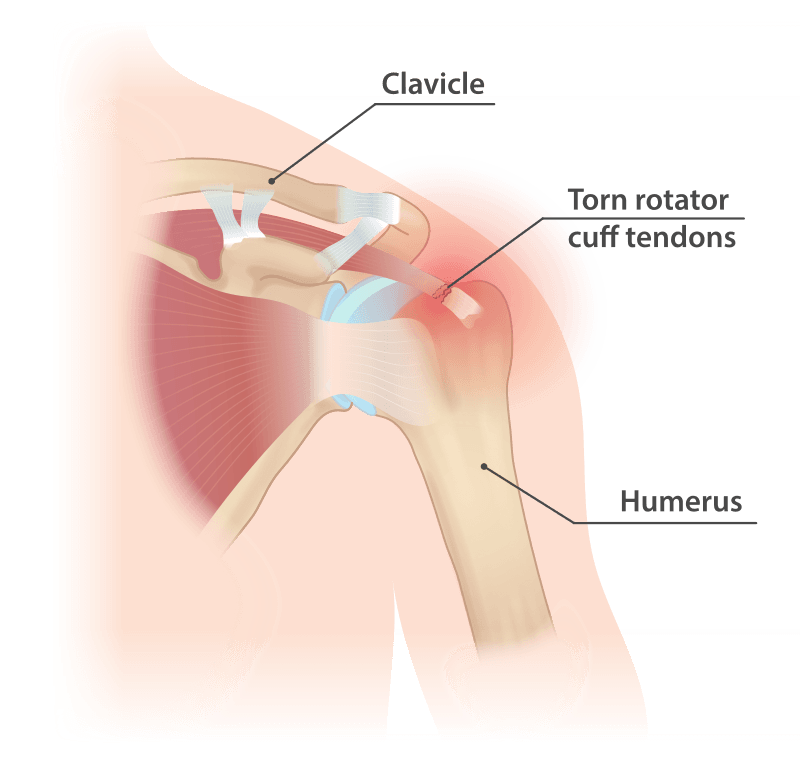
The cuff. Four muscles and their tendons arise from the scapula and insert on the humeral head, forming a circumferential cuff around the glenohumeral joint: supraspinatus superiorly, infraspinatus posterosuperiorly, teres minor posteroinferiorly and subscapularis anteriorly. The mnemonic is SITS, the cuff that sits on the humeral head and stabilises the glenohumeral joint. Supraspinatus is the most commonly torn tendon.
- Origin
- Supraspinous fossa scapula
- Insertion
- Superior facet greater tuberosity
- Function
- Initiates abduction 0-30 degrees, superior compression
- Nerve
- Suprascapular (C5-6)
- Origin
- Infraspinous fossa scapula
- Insertion
- Middle facet greater tuberosity
- Function
- External rotation, posterior stabilisation
- Nerve
- Suprascapular (C5-6)
- Origin
- Lateral border scapula
- Insertion
- Inferior facet greater tuberosity
- Function
- External rotation, adduction, posterior stabilisation
- Nerve
- Axillary (C5-6)
- Origin
- Subscapular fossa scapula
- Insertion
- Lesser tuberosity
- Function
- Internal rotation, anterior stabilisation, resists posterior subluxation
- Nerve
- Upper/lower subscapular (C5-7)
The critical zone. Approximately 1cm medial to the supraspinatus insertion on the greater tuberosity lies a hypovascular area, the watershed between the osseous blood supply from the humeral circumflex arteries and the muscular supply from the suprascapular and thoracoacromial arteries. This critical zone is particularly prone to degeneration and tear formation. The arteries of the cuff are:
- Suprascapular artery - supraspinatus and infraspinatus
- Anterior humeral circumflex artery - anterior cuff and subscapularis
- Posterior humeral circumflex artery - posterior cuff
- Thoracoacromial artery - contributes to the anterior structures
The force couples. The cuff and the deltoid form force couples that stabilise the humeral head. In the coronal plane the deltoid elevates the arm and pulls the head superiorly, while infraspinatus, teres minor and subscapularis provide the opposing inferior force, compressing and depressing the head. In the transverse plane subscapularis anteriorly counterbalances infraspinatus and teres minor posteriorly.
When the rotator cuff is torn, the force couple is disrupted. The deltoid pulls the humeral head superiorly without the opposing inferior force from the cuff. This causes superior migration of the humeral head, leading to subacromial impingement, acromioclavicular joint arthritis, and eventually rotator cuff arthropathy.
Classification Systems
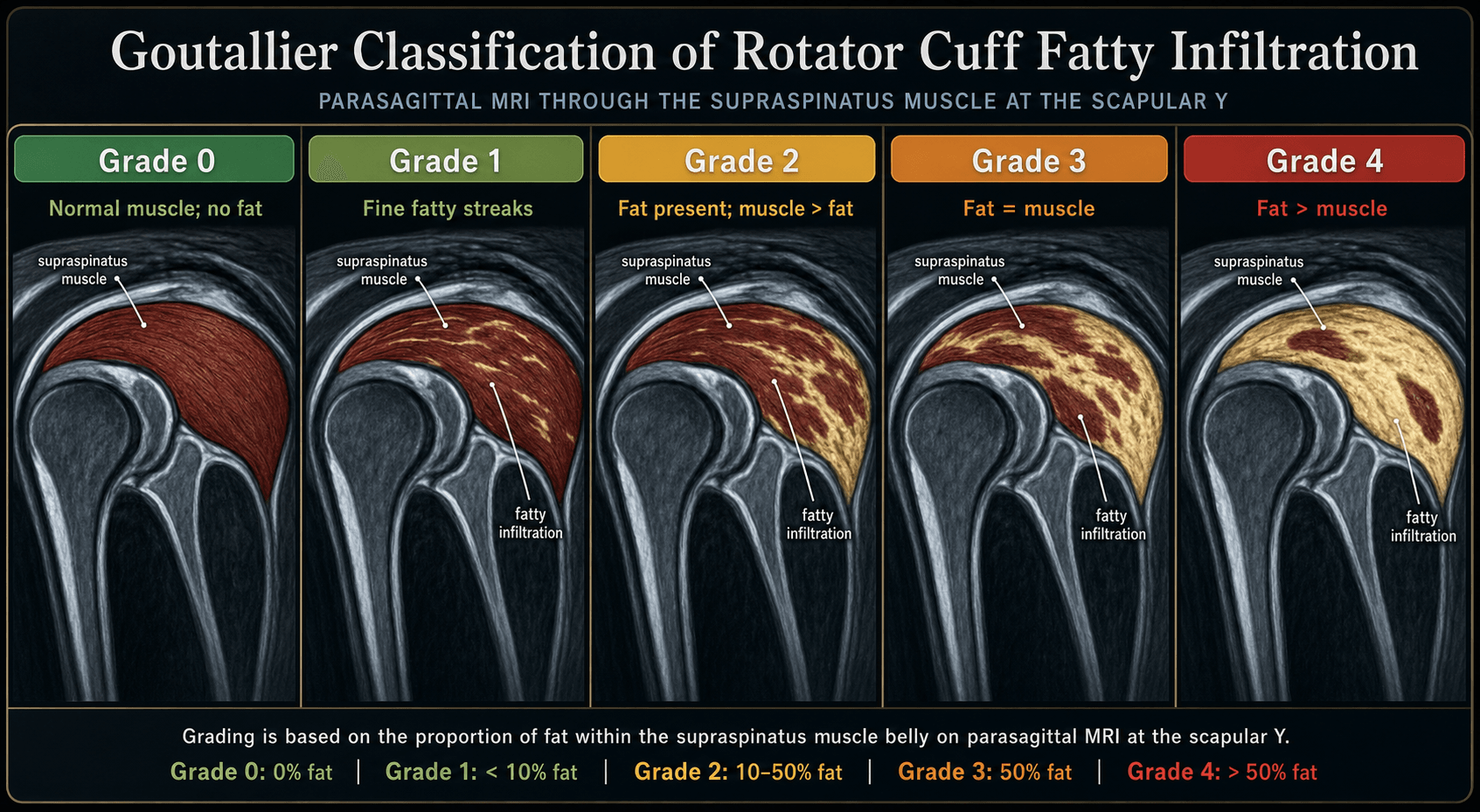
A tear is described by four things: its size (Cofield), the depth of a partial tear (Ellman), the fatty infiltration of its muscle (Goutallier) and the retraction of its tendon (Patte). Size, muscle quality and retraction each carry a prognosis for repair.
Cofield grades the tear by its maximum dimension in any plane.
- Dimension
- Less than 1cm
- Typical Repair
- Single-row arthroscopic
- Prognosis
- Excellent healing
- Dimension
- 1-3cm
- Typical Repair
- Double-row arthroscopic
- Prognosis
- Good healing potential
- Dimension
- 3-5cm
- Typical Repair
- Double-row with convergence
- Prognosis
- Guarded, longer rehab
- Dimension
- Greater than 5cm, or 2 or more complete tendons
- Typical Repair
- SCR or reverse TSA
- Prognosis
- Poor repair outcomes
A massive tear is defined by either criterion, its size or the number of complete tendons involved. It has poor healing potential with standard repair and may require an alternative such as superior capsular reconstruction or reverse total shoulder arthroplasty.
Clinical Assessment
History. Pain is anterolateral and often radiates to the deltoid insertion. Night pain is common, on lying on the shoulder, and disturbs sleep. The pain comes with overhead activity and with reaching behind the back. Establish whether the onset was acute and traumatic or insidious and degenerative.
Function. Weakness makes overhead activity and lifting difficult, and the patient struggles with tasks such as combing the hair or reaching for a wallet. Ask what the shoulder is costing them at work, in sport and in daily living.
Inspection and range. Look for wasting of the supraspinatus and infraspinatus fossae, asymmetry and scapular dyskinesis. Active motion is reduced more than passive, often limited by pain and weakness. Passive motion should be preserved; if it is limited, consider frozen shoulder or arthritis. A painful arc between 60 and 120 degrees of abduction indicates impingement.
Pseudoparalysis. Inability to elevate the arm actively despite full passive motion indicates a massive tear.
Tests for each tendon. Strength is tested tendon by tendon: supraspinatus with the empty-can or full-can test, external rotation against resistance at the side and at 90 degrees of abduction, and internal rotation with the belly-press and lift-off tests.
- Tendon Tested
- Supraspinatus
- Technique
- Arm 90deg abducted in the scapular plane (30deg forward), maximal internal rotation with thumb down, resist downward force
- Positive Finding
- Pain or weakness (pain indicates tendinitis, weakness indicates tear)
- Tendon Tested
- Supraspinatus
- Technique
- Arm 90deg abducted, 30deg forward, thumb up, resist downward force
- Positive Finding
- Pain or weakness (more specific)
- Tendon Tested
- Infraspinatus
- Technique
- Elbow 90deg flexed, arm at side, passively externally rotate, patient maintains
- Positive Finding
- Arm drops greater than 10 degrees
- Tendon Tested
- Teres minor
- Technique
- Arm 90deg abducted, elbow 90deg, externally rotate against resistance
- Positive Finding
- Cannot maintain external rotation
- Tendon Tested
- Subscapularis
- Technique
- Hand behind back, lift off from back against resistance
- Positive Finding
- Cannot lift hand off back
- Tendon Tested
- Subscapularis
- Technique
- Press hand against belly with elbow forward
- Positive Finding
- Elbow moves posterior to trunk
- Tendon Tested
- Subscapularis
- Technique
- Hand on opposite shoulder, resist pull-off
- Positive Finding
- Cannot resist or elbow drops
The external rotation lag sign is highly specific for a posterosuperior rotator cuff tear (infraspinatus/teres minor). A positive lag greater than 10 degrees indicates a large tear. The hornblower's sign (inability to externally rotate at 90 degrees abduction) suggests an even larger tear involving teres minor.
Impingement tests. Neer's sign, pain on passive forward flexion, indicates subacromial impingement. The Hawkins-Kennedy test is pain on internal rotation with the arm in 90 degrees of forward flexion. These tests are sensitive but not specific for rotator cuff tears.
Differential diagnosis. The table sets a cuff tear against the conditions that mimic it.
- Key Distinguishing Features
- Active more than passive motion loss, night pain, weakness in plane of torn tendon
- Discriminating Test/Imaging
- Positive lag/empty-can tests; MRI or ultrasound shows tendon defect
- Key Distinguishing Features
- Global loss of BOTH active AND passive motion, especially external rotation
- Discriminating Test/Imaging
- Equal active/passive restriction; near-normal cuff on imaging
- Key Distinguishing Features
- Painful arc with preserved strength, no true tendon discontinuity
- Discriminating Test/Imaging
- Positive Neer/Hawkins; MRI shows tendinopathy without full-thickness gap
- Key Distinguishing Features
- Stiffness, crepitus, deep joint-line pain, reduced passive rotation
- Discriminating Test/Imaging
- Radiographs show joint-space loss, osteophytes, often intact cuff
- Key Distinguishing Features
- Neck pain, dermatomal radiation, sensory change, reflex changes
- Discriminating Test/Imaging
- Spurling test positive; normal shoulder exam; MRI cervical spine
- Key Distinguishing Features
- Isolated infraspinatus/supraspinatus weakness and wasting without tendon tear
- Discriminating Test/Imaging
- EMG/nerve conduction; MRI may show spinoglenoid/suprascapular ganglion cyst
- Key Distinguishing Features
- Acute severe pain, often self-limiting, may mimic tear
- Discriminating Test/Imaging
- Radiographs/ultrasound show calcific deposit in tendon
Investigations
Radiographs come first. The standard shoulder series is three AP views, in neutral, internal and external rotation, with a scapular Y and an axillary lateral. On them, assess:
- Acromiohumeral distance - normal is greater than 7mm; less than 7mm suggests a massive tear
- Superior migration of the humeral head (chronic massive tear)
- Acromial morphology (Bigliani type) and os acromiale
- Greater tuberosity cysts, sclerosis and osteophytes
- Glenohumeral and acromioclavicular arthritis
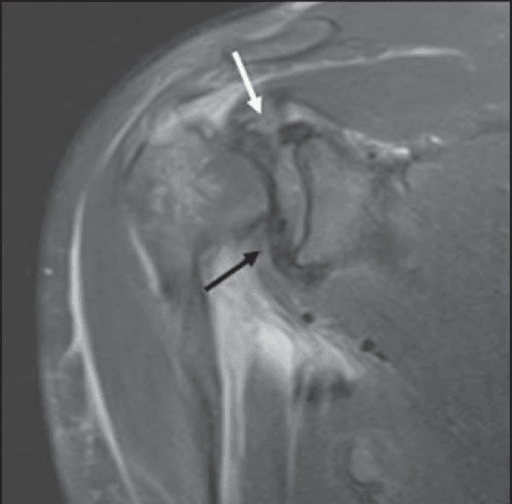
MRI is described as the gold standard for rotator cuff assessment. It shows the tear itself - its presence, size (anteroposterior and mediolateral), location, whether it is partial or full thickness, and whether a partial tear is articular or bursal-sided - and the tendon and muscle behind it:
- Tendon retraction (Patte stage)
- Muscle atrophy (the tangent sign on the sagittal view)
- Fatty infiltration (Goutallier grade)
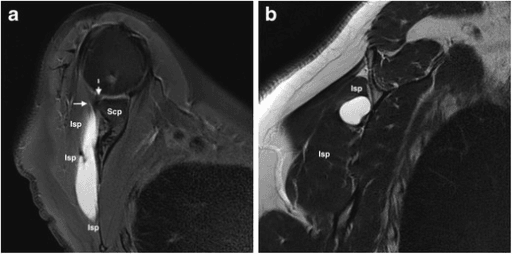
- Associated pathology: labral tears, biceps pathology and bone marrow oedema, and paralabral or intramuscular cysts, which can track along the cuff and are a clue to underlying tendon pathology
Ultrasound is dynamic, cheaper than MRI and useful for guided injection. It matches MRI for full-thickness tears but is less accurate for partial tears and for muscle quality. It has long been called operator-dependent, though pooled accuracy was similar whether a trained radiologist, a sonographer or an orthopaedic surgeon performed it.
CT arthrography is less commonly used but helpful in specific scenarios: when the patient cannot have MRI (pacemaker, metallic implants), and when bone quality needs assessing for revision surgery or arthroplasty planning. Goutallier grading of fatty infiltration is possible on it.
How accurate each test is. A systematic review and meta-analysis of ultrasound, MRI and MR arthrography in rotator cuff disorders (DOI) found that for full-thickness tears all three achieved sensitivity and specificity over 0.90. For partial-thickness tears and tendinopathy, specificity stayed above 0.90 but sensitivity fell to 0.67-0.83, and that drop applies to MRI as much as to ultrasound.
The missed partial tear. The error runs towards under-diagnosis. A normal MRI does not exclude a partial-thickness tear; on these figures roughly one in five to one in three is missed. If the history and examination point to a partial articular-sided tear and the scan is read as normal, the scan has not settled the question.
MR arthrography is the practical next step. It outperforms both non-contrast MRI and ultrasound for partial-thickness and labral tears, because joint distension demonstrates an articular-sided defect that a plain scan can miss.
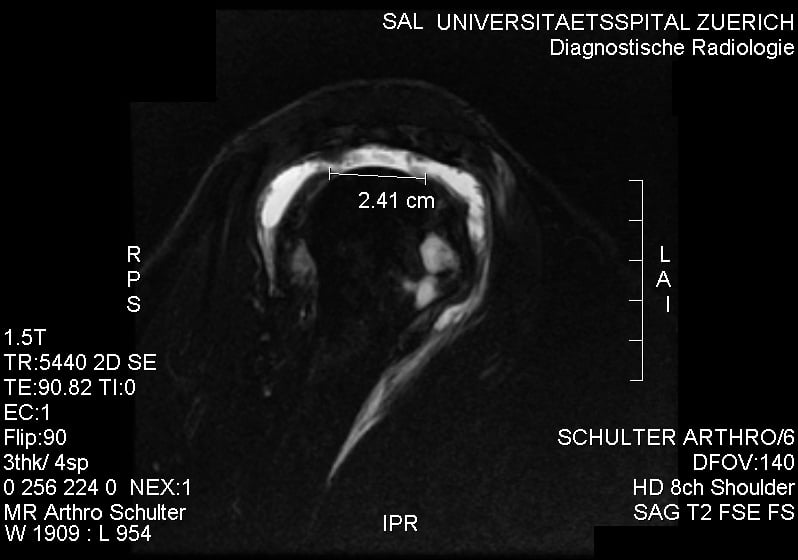
For detecting a full-thickness tear, ultrasound, MRI and MR arthrography are comparable, and the meta-analysis authors concluded that once accuracy, cost and safety are weighed together, ultrasound is the best first-line option. What MRI is genuinely unmatched for is everything downstream of detection: retraction, atrophy, fatty infiltration and associated labral or biceps pathology. Those determine reparability and the choice between repair, superior capsular reconstruction, transfer and arthroplasty, so argue for MRI on reparability assessment and surgical planning rather than on tear detection.
Predicting a poor repair. On MRI, these findings predict poor repair outcomes:
- Goutallier Grade 3-4 fatty infiltration
- Patte Stage 3 retraction
- A positive tangent sign
- Massive tear size
- Acromiohumeral distance less than 7mm (chronic massive tear with superior migration)
Management
The decision. Treatment follows the patient's age and demands, the tear and the state of its muscle, as the quick guide sets out.
- Tear Characteristics
- Small-medium tear, minimal retraction
- Treatment
- Arthroscopic single or double-row repair
- Key Pearl
- Early repair prevents progression and muscle atrophy
- Tear Characteristics
- Large tear (3-5cm), moderate fatty change
- Treatment
- Double-row repair with margin convergence
- Key Pearl
- Repair still possible but rehabilitation longer
- Tear Characteristics
- Massive tear, Goutallier 3-4
- Treatment
- Conservative management or reverse TSA
- Key Pearl
- Repair likely to fail - focus on function
- Tear Characteristics
- Greater than 5cm, severe retraction, fatty change
- Treatment
- Superior capsular reconstruction or graft augmentation
- Key Pearl
- Bridging option before arthroplasty
Who. Non-operative treatment suits:
- Elderly, low-demand patients
- Asymptomatic or minimally symptomatic tears
- Massive tears with Goutallier 3-4 (poor repair prognosis)
- Medical comorbidities precluding surgery
- Patient preference
The programme runs in steps:
- Activity modification, immediately: avoid painful overhead activity, modify work and sport, and make ergonomic adjustments
- Physiotherapy, for 6-12 weeks: strengthen the periscapular muscles for scapular stabilisation, strengthen the deltoid to compensate for cuff weakness, stretch to maintain or improve passive range, and address posterior capsule tightness, which contributes to superior migration
- Medication as needed: NSAIDs to reduce inflammation and pain, paracetamol for pain control
- Subacromial corticosteroid injection if conservative treatment fails, to reduce pain and inflammation; limit it to 3 injections per year because of the risk of tendon weakening
An injection may provide temporary relief, but it does not heal the tear.
37% of tears up to 3cm treated with physiotherapy alone enlarged by more than 5mm over 5 years in Moosmayer's randomised trial, with inferior outcomes, and the muscle atrophy and fatty infiltration that progress with them are largely irreversible. Delaying surgery may worsen repairability. In young, active patients with symptomatic tears, consider early surgery.
Surgical Technique
Indications. Small to medium tears (less than 3cm) with good tissue quality. Single-row fixes the tendon to the medial edge of the footprint only, so it restores partial footprint contact and may have higher re-tear rates than double-row in larger tears.
Consent. Cover re-tear, stiffness, infection, nerve injury (the axillary nerve is at risk, rarely) and failure to heal, which may require revision or an alternative treatment. The rates are in the Complications section.
Equipment. Have ready:
- 30-degree and 70-degree arthroscopes
- Suture anchors, typically 2-4 for a small-medium tear
- High-strength non-absorbable suture (FiberWire, MaxBraid)
- Graspers, suture retrievers and knot pushers
- A radiofrequency device for debridement and haemostasis
Position. Beach chair (most common) at 60-70 degrees upright, or lateral decubitus. Secure the head in the headrest in a neutral position and free-drape the arm so that it can move through a full range, held by an arm holder or an assistant. Pad the sacrum, heels and contralateral elbow and monitor blood pressure on the contralateral arm; consider hypotensive anaesthesia (MAP 55-65) to reduce bleeding. Mark the acromion, clavicle, coracoid and AC joint, and plan the posterior, lateral and anterior portals.
Steps.
- Diagnostic arthroscopy through the posterior (standard viewing) portal: assess the cartilage, labrum, biceps and subscapularis, identify the tear's location, size and mobility, and look for articular-side partial tears
- Subacromial decompression: instruments through the lateral portal, bursectomy to visualise the tear, and acromioplasty if the acromion is type II or III. Avoid aggressive acromioplasty, which weakens the deltoid origin
- Tear mobilisation: release adhesions (an interval slide for anterior-posterior mobility), debride frayed edges minimally to preserve tissue, and prepare the footprint on the greater tuberosity by removing soft tissue and lightly decorticating
- Anchor placement at the articular margin (medial footprint), 1-1.5cm apart, typically 2-4 anchors depending on tear size, at a 45-degree deadman angle for optimal pull-out strength
- Suture passage: pass the suture passer through the tear and retrieve the anchor suture, in a horizontal mattress configuration for strength, with tissue bites 5-8mm from the edge. Consider medial-lateral or side-to-side sutures if the gap is large
- Knot tying and assessment: sliding or non-sliding knots (surgeon preference), then check integrity, tension and footprint coverage. The shoulder should reach 140 degrees of forward flexion without undue tension on the repair
Biological Augmentation of the Repair
A rotator cuff repair is fundamentally a tendon-to-bone (enthesis) healing problem. The repaired interface heals with disorganised fibrovascular scar rather than a true graduated enthesis, which is why re-tear remains the commonest complication even with mechanically strong constructs.
Strategies that augment the biology of healing, as distinct from the construct itself, aim to lower the re-tear rate.
- Mechanism
- Multiple bone vents in the greater-tuberosity footprint release marrow stem cells and growth factors, forming a vascular clot over the footprint (the 'crimson duvet')
- Evidence / role
- Low-cost, low-risk; some studies show improved healing, particularly in larger tears
- Mechanism
- Autologous platelet concentrate delivering growth factors at the repair site
- Evidence / role
- Mixed evidence - at best a modest reduction in re-tear for small/medium tears with little functional gain; not a routine recommendation
- Mechanism
- Dermal allograft or biologic/synthetic patch laid over and reinforcing an intact but at-risk repair
- Evidence / role
- Reduces re-tear in selected larger repairs; distinct from bridging grafts or superior capsular reconstruction used for irreparable defects
- Mechanism
- Smoking cessation, diabetes control, avoiding NSAIDs in the early healing window
- Evidence / role
- The cheapest and most reliable lever on healing; optimise before elective repair
Complications
- Incidence
- 10-30% (size-dependent)
- Risk Factors
- Large tears, poor tissue quality, Goutallier 3-4, age over 65
- Management
- Revision repair, SCR, or arthroplasty
- Incidence
- 5-10%
- Risk Factors
- Pre-existing stiffness, diabetes, prolonged immobilisation
- Management
- Aggressive PT, manipulation under anaesthesia
- Incidence
- Less than 1% arthroscopic
- Risk Factors
- Diabetes, immunosuppression, revision surgery
- Management
- Antibiotics, irrigation/debridement, anchor removal
- Incidence
- 1-2%
- Risk Factors
- Aggressive acromioplasty, nerve injury
- Management
- Observation, nerve recovery, physio
- Incidence
- Less than 1%
- Risk Factors
- Traction, retractor placement, anchor misplacement
- Management
- Observation (most recover), nerve exploration if no recovery
- Incidence
- 1-3%
- Risk Factors
- Poor bone quality, osteoporosis, incorrect angle
- Management
- Revision with larger anchors or different location
Re-tear is the most common complication, and its rate climbs with the size of the tear: in the UKUFF trial, failure to heal at 12 months was small 34%, medium 32%, large 53% and massive 73%. The other factors that predict it:
- Fatty infiltration - Goutallier 3-4 dramatically increases re-tear
- Age over 65 years
- Smoking, which impairs healing and doubles the re-tear rate
- Diabetes, through poor tissue quality and delayed healing
- Repair technique - single-row has a higher re-tear rate than double-row in medium-large tears
Stiffness is prevented by starting passive range of motion within the first week, progressing to active-assisted motion at 6 weeks and avoiding prolonged immobilisation. Diabetic patients are at the highest risk and warrant an aggressive physiotherapy protocol.
Assessing Repair Integrity and Patterns of Re-tear
Because re-tear is the dominant complication, it is worth knowing how repair integrity is graded and where repairs fail. Postoperative integrity on MRI (or ultrasound) is described by the Sugaya classification, and the anatomical pattern of failure by the Cho classification.
- MRI appearance
- Sufficient thickness, homogeneously low signal
- Interpretation
- Intact, healed
- MRI appearance
- Sufficient thickness, partial high signal
- Interpretation
- Intact but some abnormal signal
- MRI appearance
- Insufficient thickness (less than half expected) without discontinuity
- Interpretation
- Thinned but continuous
- MRI appearance
- Minor discontinuity (one or two slices)
- Interpretation
- Small full-thickness re-tear
- MRI appearance
- Major discontinuity (more than two slices)
- Interpretation
- Medium-to-large re-tear
Types I-II are regarded as intact, type III as thinned but continuous, and types IV-V as re-tear.
The PATTERN of re-tear (Cho classification) is as important as its presence. Type 1 is failure at the tendon-bone interface - the tendon pulls off the lateral footprint. Type 2 is failure at the musculotendinous junction MEDIAL to the medial-row anchors ('medial cuff failure'). Type 2 is characteristic of knotless suture-bridge (transosseous-equivalent) double-row constructs: a very strong, over-tensioned medial row concentrates stress and strangulates the tendon, which then tears medial to it. This is the biomechanical reason for the warning against over-tensioning a double-row repair - and it guides revision, because the medial stump in a type 2 failure is often of poor quality.
Postoperative Care and Rehabilitation
Rehabilitation follows one of two protocols. A small-medium repair follows the standard timeline; a large or massive repair is tenuous and follows a more protective protocol.
Standard Rehabilitation Timeline
Protect the repair, prevent stiffness and minimise pain.
- Sling at all times except for exercises and hygiene (4-6 weeks)
- Passive range of motion from within the first week: pendulums, table slides
- Passive forward flexion progressing to 140 degrees by 6 weeks
- Passive external rotation progressing to 30-40 degrees by 6 weeks
- No active motion, to avoid activating the repaired tendons
- Cryotherapy and pain control: ice, analgesics, minimise NSAIDs (may impair healing)
Transition to active motion and gentle strengthening.
- Discontinue the sling at 6 weeks
- Active-assisted range: pulley and wand exercises
- Progress to active range: deltoid-initiated elevation, avoiding substitution patterns
- Gentle isometrics: sub-maximal contractions, avoiding pain
- Scapular stabilisation: periscapular muscle activation
Restore strength and function.
- Progressive resistance exercises, light weights progressing to heavier
- Rotator cuff strengthening with resistance bands (IR, ER, abduction)
- Functional activities: return to daily activities and work
- Sport-specific training: gradual return to overhead sport (6 months minimum)
Full strength and function.
- Most patients achieve maximal improvement by 12 months
- Continued home exercise programme for maintenance
- Return to full sport and work as tolerated
Outcomes and Prognosis
Outcome by tear size. Healing and function both fall as the tear gets bigger. The healing rates below are from the UKUFF trial: 217 repairs imaged by MRI or ultrasound at 12 months, 56% healed overall (Rashid 2017).
- Healing Rate
- 66%
- Functional Outcome
- Excellent
- Notes
- Most reliable results
- Healing Rate
- 68%
- Functional Outcome
- Good to excellent
- Notes
- Double-row improves healing
- Healing Rate
- 47%
- Functional Outcome
- Good
- Notes
- Healing less predictable, longer rehab
- Healing Rate
- 27%
- Functional Outcome
- Fair to good
- Notes
- Even with re-tear, pain often improved
Prognostic factors. Each factor has a favourable and an unfavourable end.
- Favourable
- Younger (less than 60 years)
- Unfavourable
- Advanced (over 70)
- Favourable
- Acute traumatic tear (as opposed to chronic degenerative)
- Unfavourable
- Chronic tear (greater than 6 months)
- Favourable
- Small to medium
- Unfavourable
- Massive
- Favourable
- Goutallier 0-1
- Unfavourable
- Goutallier Grade 3-4
- Favourable
- Patte 1-2
- Unfavourable
- Patte Stage 3
- Favourable
- Non-smoker
- Unfavourable
- Smoking, diabetes, worker's compensation
- Favourable
- Compliant
- Unfavourable
- Poor compliance
Structural healing (the tendon heals on MRI) does not always correlate with clinical outcome (pain and function). Many patients with re-tears on imaging have good clinical outcomes, with improved pain and function compared with their pre-operative state. The goal is a satisfactory clinical result, not necessarily perfect anatomic healing.
Guidelines, Registries & Global Practice
Global Epidemiology
- Population ultrasound prevalence of full-thickness tears approximately 20% overall, rising steeply with age (Yamamoto, Japan)
- Tears in 16.9% of asymptomatic and 36% of symptomatic individuals - many tears are clinically silent
- Prevalence increases markedly beyond the sixth decade across all studied populations
- Independent risk factors: increasing age, history of trauma, and dominant arm involvement
- Higher rates in heavy manual and repetitive overhead work; smoking and diabetes impair tendon quality and healing
- Ageing populations worldwide are driving a rising burden of degenerative tears and cuff-tear arthropathy
The population prevalence figures above are from Yamamoto et al (DOI).
Major Guidelines - Side by Side
- Position on Non-operative Care
- Structured exercise reasonable first-line for many tears
- Position on Surgery
- Repair appropriate for symptomatic full-thickness tears failing non-operative care; routine acromioplasty not required
- Evidence Strength
- Mostly moderate/limited - few strong recommendations
- Position on Non-operative Care
- Time-limited physiotherapy trial for atraumatic/degenerative tears
- Position on Surgery
- Early referral and repair for acute traumatic tears in suitable patients
- Evidence Strength
- Consensus-based national pathway
- Position on Non-operative Care
- Conservative care and physiotherapy as initial management
- Position on Surgery
- Surgery reserved for persistent symptoms after appropriate non-operative care
- Evidence Strength
- Pragmatic, resource-aware guidance
- Position on Non-operative Care
- Non-operative care for degenerative tears, especially low-demand patients
- Position on Surgery
- Earlier repair favoured in young/active and acute traumatic tears to limit irreversible change
- Evidence Strength
- Expert consensus and cohort evidence
The strongest cross-guideline agreement is that acute traumatic tears in active patients warrant early repair, while degenerative/atraumatic tears merit a structured physiotherapy trial first - supported by the MOON cohort showing roughly 75% avoid surgery (Kuhn et al, DOI). Practice variation is greatest around the value of routine acromioplasty and the role of superior capsular reconstruction.
Registry and High-Level Evidence
- Rotator cuff repair is a soft-tissue procedure and is not captured by the major arthroplasty joint registries (NJR, AJRR, AOANJRR, SHAR). The evidence base therefore rests on RCTs and meta-analyses (e.g. single- vs double-row, DOI) and large prospective cohorts (MOON).
- Reverse total shoulder arthroplasty for cuff-tear arthropathy is registry-tracked: national arthroplasty registries (NJR, AOANJRR, AJRR, Nordic registries) report rising reverse-TSA volumes and implant survival, complementing survivorship series such as Guery et al (DOI).
Global Practice Variation
- Arthroscopic repair is standard; MRI used routinely for staging
- Ready access to reverse TSA and graft augmentation (SCR, dermal allograft)
- Earlier surgical intervention in active patients
- Ultrasound often the primary imaging modality (lower cost, dynamic)
- Open or mini-open repair more common where arthroscopic expertise/equipment is limited
- Greater reliance on physiotherapy and longer non-operative trials
Consent and Documentation (Universal)
Applicable to any health system, informed consent for rotator cuff repair should cover:
- Re-tear risk (10-30%, size-dependent), and that re-tear does not always mean symptomatic failure
- Stiffness (5-10%, higher in diabetics), infection (under 1% arthroscopic), nerve injury and anchor complications
- Prolonged recovery (6-12 months to maximal improvement; longer for large/massive tears)
- Possibility of failed repair requiring revision, SCR or arthroplasty
- Documented trial and failure of appropriate non-operative care, and pre-operative staging of tear size, retraction and muscle quality (Goutallier)
MCQ Practice Points
Q: Which rotator cuff muscle is NOT innervated by the suprascapular nerve? A: Teres minor (innervated by axillary nerve). Supraspinatus and infraspinatus are both innervated by the suprascapular nerve (C5-6). Subscapularis is innervated by upper and lower subscapular nerves (C5-7).
Q: What is the critical zone of the rotator cuff and why is it significant? A: The critical zone is a hypovascular area approximately 1cm medial to the supraspinatus insertion. It represents a watershed zone between the osseous blood supply (humeral circumflex arteries) and muscular blood supply (suprascapular artery). This area is particularly prone to degeneration and tear formation.
Q: A rotator cuff tear measuring 4cm with Goutallier Grade 3 fatty infiltration and Patte Stage 3 retraction - what is the prognosis for repair? A: Poor prognosis. This is a large tear (3-5cm by Cofield) with unfavorable prognostic factors: Goutallier Grade 3 (fat equal to muscle) predicts poor healing, and Patte Stage 3 retraction (to the level of the glenoid) makes repair technically difficult. This tear may be irreparable and alternative treatments (partial repair, SCR, reverse TSA) should be considered.
Q: What does a positive external rotation lag sign indicate? A: An external rotation lag sign (arm drops more than 10 degrees when released from passive external rotation) indicates a posterosuperior rotator cuff tear involving infraspinatus and possibly teres minor. It is highly specific for a significant tear and suggests the need for surgical intervention.
Q: What is the biomechanical advantage of double-row repair over single-row repair for medium to large rotator cuff tears? A: Double-row repair provides: (1) Increased footprint contact area - better anatomic restoration, (2) Higher ultimate load to failure - stronger construct, (3) Better pressure distribution across repair site, (4) Lower re-tear rates for medium-large tears compared to single-row. However, clinical outcome scores are similar between techniques.
Q: A patient has a confirmed rotator cuff re-tear on MRI at 1 year post-repair but reports good pain relief and improved function. What is your management? A: No further surgery. This demonstrates that structural healing (MRI) does not always correlate with clinical outcome. Many patients with re-tears have good clinical outcomes with improved pain and function. If the patient is satisfied and functional, no additional intervention is needed. Surgery would only be considered for symptomatic re-tear with significant pain or functional impairment.
Exam Viva Scenarios
Practise clinical reasoning and management decisions out loud
“A 62-year-old recreational golfer presents with 12 months of progressive right shoulder pain and weakness. He has failed physiotherapy and a subacromial steroid injection. On examination, he has full passive range of motion, painful arc 60-120 degrees, positive empty can test, and external rotation lag sign of 15 degrees. MRI shows a full-thickness supraspinatus tear measuring 2.5cm with minimal retraction and Goutallier Grade 1 fatty infiltration of supraspinatus and infraspinatus. What is your assessment and management?”
“A 55-year-old manual laborer presents with severe right shoulder pain and inability to lift his arm. He fell off a ladder 6 months ago but delayed seeking treatment. Examination shows pseudoparalysis - he cannot actively elevate beyond 40 degrees but has full passive forward flexion. External rotation lag is 30 degrees. MRI shows a massive retracted tear of supraspinatus and infraspinatus (5.5cm), Patte Stage 3 retraction to the level of the glenoid, Goutallier Grade 3 fatty infiltration, and positive tangent sign. Acromiohumeral distance is 4mm. How would you manage this patient?”
“A 68-year-old diabetic woman underwent arthroscopic rotator cuff repair for a medium-sized tear 3 months ago. She returns to clinic with severe stiffness - active forward flexion is 60 degrees and passive forward flexion is 90 degrees. She reports shoulder pain at rest and with movement. She has been compliant with physiotherapy. How do you assess and manage this complication?”
Key Anatomy - SITS
- Supraspinatus: Superior cuff, initiates abduction, most commonly torn (suprascapular nerve C5-6)
- Infraspinatus: Posterior cuff, external rotation (suprascapular nerve C5-6)
- Teres minor: Posterior-inferior cuff, external rotation (axillary nerve C5-6)
- Subscapularis: Anterior cuff, internal rotation (upper/lower subscapular nerves C5-7)
- Critical zone: Hypovascular area 1cm medial to insertion - prone to degeneration
Classification Systems
- Cofield by size: Small (less than 1cm), Medium (1-3cm), Large (3-5cm), Massive (greater than 5cm or 2 tendons)
- Goutallier fatty infiltration: Grade 0 (normal) to Grade 4 (severe fat) - Grade 3-4 predicts poor repair
- Patte retraction: Stage 1 (near bony insertion), Stage 2 (level of humeral head), Stage 3 (level of glenoid)
- Tangent sign: Muscle belly below superior glenoid line on sagittal MRI indicates severe atrophy
Clinical Assessment
- Empty can test: Supraspinatus (arm 90deg abducted, 30deg forward, thumb down)
- External rotation lag sign: Infraspinatus (drop greater than 10 degrees when released from ER)
- Belly-press, lift-off, bear-hug tests: Subscapularis tears
- Pseudoparalysis: Cannot actively elevate but full passive motion (massive tear)
Surgical Techniques
- Single-row repair: Medial anchors only, suitable for small tears
- Double-row repair: Medial and lateral rows, better for medium-large tears (improved footprint, lower re-tear)
- Margin convergence: Side-to-side sutures for large U-shaped tears before bone fixation
- Superior capsular reconstruction: Fascia lata graft for irreparable tears in young patients
- Reverse TSA: Gold standard for cuff arthropathy with pseudoparalysis in elderly
Complications and Outcomes
- Re-tear: 10-30% (size-dependent) - many asymptomatic, good clinical outcomes despite re-tear
- Stiffness: 5-10%, higher in diabetics - early mobilization, aggressive PT, consider MUA
- Prognostic factors: Tear size, Goutallier grade, Patte stage, age, smoking, diabetes
- Rehabilitation: Passive immediate, active-assisted 6 weeks, strengthening 12 weeks, maximal improvement 12-24 months
Key Evidence and Pearls
- Double-row reduces re-tear for medium-large tears but similar clinical outcomes to single-row
- Tears progress in size (37% of tears up to 3cm enlarged more than 5mm over 5 years with physiotherapy alone) and fatty change (irreversible)
- Goutallier 3-4 and Patte 3 indicate irreparable tear - consider SCR or reverse TSA
- Force couple concept: RC compresses humeral head, deltoid elevates - disruption causes superior migration
- Asymptomatic tears common (50% over age 60) - treat symptoms, not imaging
Evidence Base and Key Trials
Single-Row vs Double-Row Repair - Systematic Review and Meta-Analysis
- Systematic review and meta-analysis including 6 Level I RCTs of single-row versus double-row repair
- Odds of an intact (healed) tendon were significantly higher with double-row repair (OR 1.93)
- No clinically significant difference in Constant, UCLA or ASES scores between techniques
- Structural benefit of double-row was concentrated in tears greater than 3cm (large/massive)
Natural History of Asymptomatic Rotator Cuff Tears
- Longitudinal sonographic study of patients with a contralateral asymptomatic rotator cuff tear
- 51% (23/45) of initially asymptomatic tears became symptomatic over a mean of 2.8 years
- Onset of symptoms was associated with a significant rise in pain and fall in ADL scores
- 9 of 23 re-imaged shoulders showed tear enlargement; no tear ever decreased in size
MOON Shoulder Group - Physical Therapy for Atraumatic Cuff Tears
- Multicentre prospective cohort of 452 patients with atraumatic full-thickness tears on a structured physiotherapy programme
- Patient-reported outcomes improved significantly at 6 and 12 weeks
- Fewer than 25% elected surgery; most who converted did so between 6 and 12 weeks
- Approximately 75% avoided surgery at 2-year follow-up