PI-LL Mismatch | SVA | Pelvic Parameters | Compensation Mechanisms
- PI is fixed - cannot be changed surgically (constant after skeletal maturity)
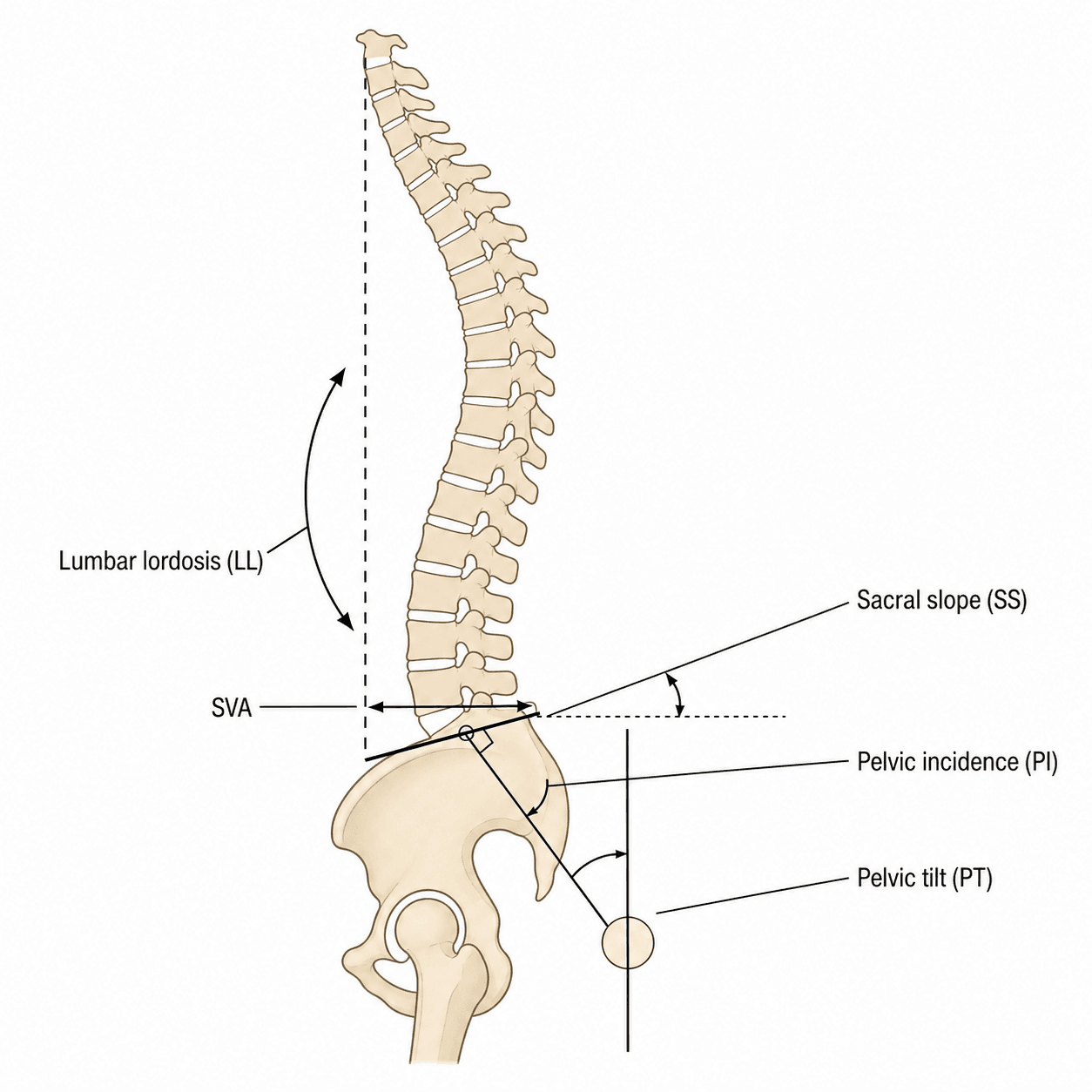
- PI = PT + SS is the fundamental spinopelvic equation
- LL should match PI within 10 degrees (target: PI - 9 to PI + 9)
- PT increases as compensation for sagittal imbalance (pelvic retroversion)
- SVA more than 50mm correlates strongly with pain and disability
- “Know PI-LL mismatch predicts outcomes better than any single parameter
- “Thoracic kyphosis and lumbar lordosis should be balanced (TK ≈ LL - 20)
- “Compensation cascade: thoracic hypokyphosis → pelvic retroversion → hip extension → knee flexion
- “Age-adjusted targets may be appropriate for elderly patients
Overview and Epidemiology
Sagittal balance parameters are radiographic measurements of spinal alignment in the sagittal (lateral) plane. They are fundamental to understanding spinal pathology, planning deformity correction surgery and predicting clinical outcome.
Why the sagittal plane. Sagittal imbalance is now recognised as the primary driver of disability in adult spinal deformity, surpassing coronal plane deformity in importance (Glassman et al, Spine 2005). Management has shifted accordingly, and the SRS-Schwab classification emphasises sagittal modifiers because they predict outcomes better than coronal curve magnitude alone. Health-related quality of life correlates strongly with sagittal parameters, and particularly with:
- PI-LL mismatch, a strong predictor of disability (Schwab et al, Spine 2012)
- SVA more than 50mm, with a strong, near-linear correlation with pain and functional limitation (Glassman et al, Spine 2005)
- PT more than 25°, which indicates progressive pelvic retroversion as compensation (Schwab et al, Spine 2012)
Who. The prevalence of adult spinal deformity rises markedly with age. Community studies of older adults report radiographic deformity, including sagittal malalignment, in a substantial proportion of those over 60 years, and demand for corrective surgery is increasing as populations age worldwide. Full epidemiological figures are summarised in the Guidelines, Registries and Global Practice section.
History. Dubousset first emphasised the importance of sagittal balance, describing the "cone of economy", the cone of stable standing posture. Pelvic incidence as a fixed morphological parameter was defined by Legaye and Duval-Beaupère, the four normative sagittal morphotypes by Roussouly et al (Spine 2005), and the modern outcome-linked spinopelvic framework by Schwab and Lafage.
Pathophysiology and Anatomy
Pelvic Parameters
The pelvis forms the foundation of spinal alignment and transmits forces between the spine and the lower limbs. Three angles describe it.
Pelvic incidence (PI) is the angle between the line perpendicular to the sacral endplate at its midpoint and the line from this point to the centre of the femoral heads. It is a fixed anatomical parameter: constant after skeletal maturity, and it cannot be changed surgically. Normal is 40-65°. PI determines the lumbar lordosis required for sagittal balance, so all surgical planning revolves around matching LL to PI.
Pelvic tilt (PT) is the angle between the vertical and the line from the midpoint of the sacral endplate to the femoral head centre. It is a positional parameter and changes with posture. Normal is less than 20° and more than 25° is pathological; when PT reaches 30-35°, pelvic compensation is typically exhausted.
Sacral slope (SS) is the angle between the sacral endplate and the horizontal, normally 30-50°. Like PT it is positional, and it decreases as the pelvis retroverts.
PI = PT + SS. The fundamental spinopelvic equation always holds. Because PI is fixed, the other two trade against each other: when PT increases with retroversion, SS must decrease proportionally, and when SS increases with anteversion, PT must decrease. The sum always equals the individual's PI.
Spinal Parameters
Lumbar lordosis (LL) is measured by the Cobb method from the superior endplate of L1 to the superior endplate of S1, normally 40-60°, with approximately two-thirds of it in the L4-S1 segment. It should match PI within 10 degrees (LL = PI ± 9°).
Thoracic kyphosis (TK) is measured from T4 (or T5) to the T12 superior endplate, normally 20-50°. It should balance the lordosis below it: TK ≈ LL - 20, roughly 20 degrees less than LL.
Sagittal vertical axis (SVA) is the distance from the C7 plumb line to the posterosuperior corner of S1. It is positive when the plumb line falls anterior to S1 (imbalance) and negative when it falls posterior. Normal is less than 50mm, and a positive SVA over 50mm is the disability threshold; a negative SVA is generally well tolerated.
Compensation Mechanisms
When lumbar lordosis is insufficient for a given PI, the body employs a cascade of compensatory mechanisms, in this order:
- Mechanism
- Thoracic hypokyphosis
- Effect
- Reduces TK to shift mass posteriorly
- Clinical Observation
- Flat upper back
- Mechanism
- Pelvic retroversion
- Effect
- Increases PT, decreases SS
- Clinical Observation
- Posterior pelvic tilt
- Mechanism
- Hip extension
- Effect
- Extends hip joint
- Clinical Observation
- Standing with hyperextended hips
- Mechanism
- Knee flexion
- Effect
- Flexes knee to shift mass
- Clinical Observation
- Bent-knee gait
- Mechanism
- Decompensation
- Effect
- Exhausted mechanisms
- Clinical Observation
- Forward trunk lean, uses aids
A patient with PT more than 30°, a positive SVA despite compensation and a bent-knee gait has exhausted all compensatory mechanisms. When the pelvis has maximally retroverted and SVA remains positive, the imbalance is surgical-level: it typically requires correction and is unlikely to improve with conservative treatment alone.
High Pelvic Incidence and Spondylolisthesis
The PI link beyond deformity. A high pelvic incidence is a recognised risk factor for developmental L5-S1 spondylolisthesis. A high PI means a more horizontal sacrum and a high sacral slope, which increases the anterior shear force at the lumbosacral junction and predisposes to slip in dysplastic or isthmic spondylolisthesis; the higher the PI, the higher the slip grade tends to be.
The Mac-Thiong / Spinal Deformity Study Group (SDSG) classification. This spinopelvic classification of L5-S1 spondylolisthesis divides high-grade slips by pelvic posture, and the SS/PT pattern guides whether a high-grade slip needs reduction:
- Balanced pelvis - high SS, low PT; the pelvis is still "anteverted" or balanced, and the slip is generally better tolerated
- Retroverted (unbalanced) pelvis - low SS, high PT; the pelvis has retroverted to compensate, a marker that the patient is decompensating and more likely to need realignment or reduction
- Unbalanced spine - the C7 plumb line falls anterior (positive global balance); the most severe group
Classification and Measurement
Measuring the Parameters
Measurements are made on the full-length standing films described under Investigations.
Pelvic incidence is constructed in four steps:
- Identify the midpoint of the sacral endplate
- Draw a line perpendicular to the sacral endplate at this point
- Draw a line from this midpoint to the centre of the femoral heads
- Measure the angle between these two lines
Pelvic tilt is the angle between a vertical reference line and the line from the S1 endplate midpoint to the femoral head centre. A positive value indicates retroversion, the normal position.
Sacral slope is the angle between a horizontal reference line and a line drawn along the sacral endplate.
SVA is measured by dropping a plumb line from the centre of the C7 vertebral body and measuring the horizontal distance to the posterosuperior corner of S1. It is positive if the plumb line falls anterior to S1 and negative if it falls posterior.
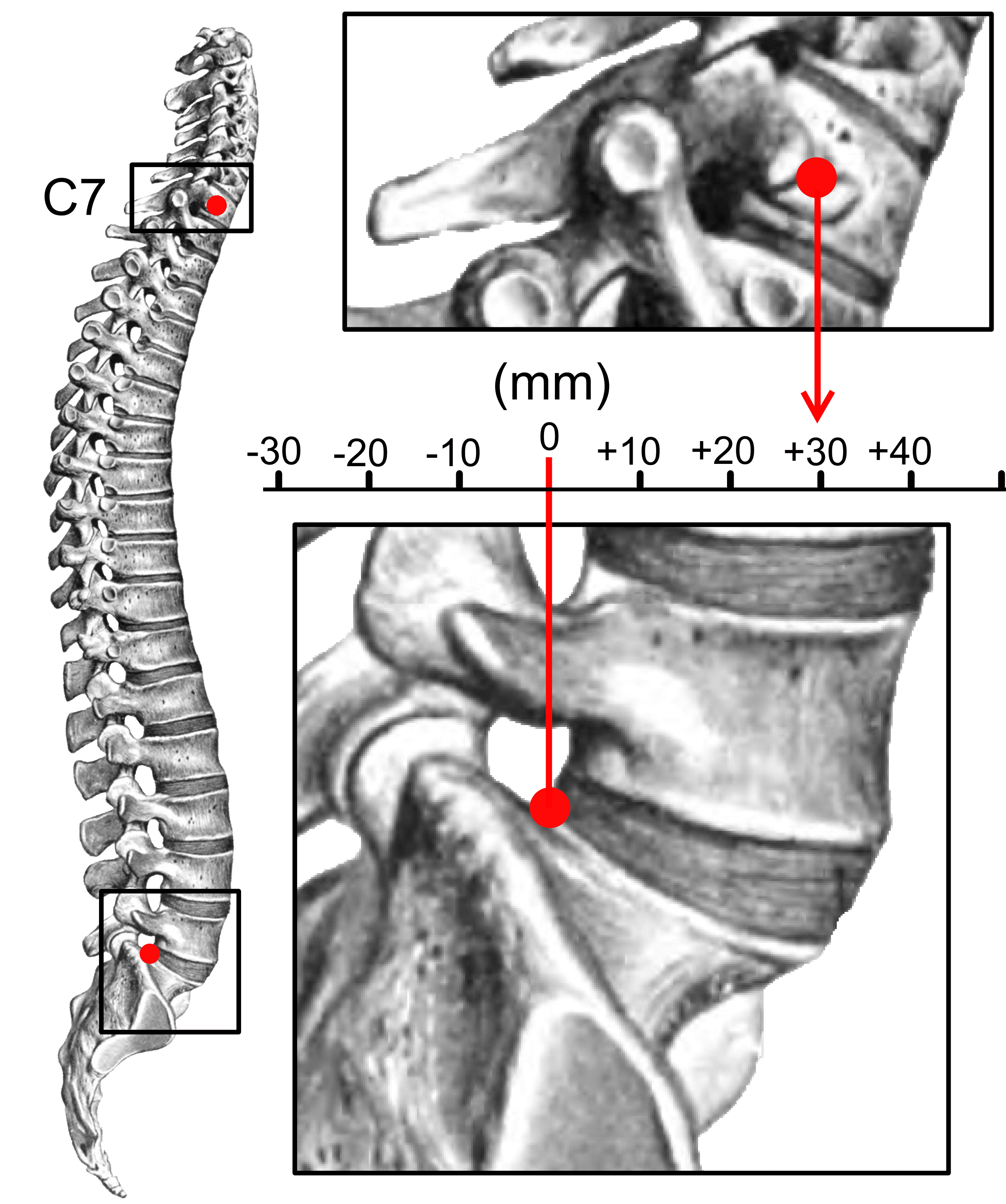
PI measurement is position-independent (can be measured on supine CT), but PT and SS require standing films as they are positional parameters. Always use standing full-length films for complete sagittal assessment.
Cervical Sagittal Alignment
The top-of-the-spine analogue. Pelvic incidence, PI-LL and SVA describe the thoracolumbo-pelvic spine. A complete sagittal-balance answer also covers the cervical spine, which has its own outcome-linked parameters and mirrors the PI-LL concept at the top of the spine:
- Cervical SVA (cSVA) - a plumb line from the centre of C2 to the posterosuperior corner of C7; over 40mm correlates with disability and myelopathy severity, the cervical equivalent of the global SVA threshold
- T1 slope (T1S) - the angle of the T1 superior endplate to horizontal, the cervical analogue of pelvic incidence, setting the "platform" the cervical spine sits on. A high T1 slope demands more cervical lordosis to keep the head balanced over the trunk, just as a high PI demands more lumbar lordosis.
- T1 slope minus cervical lordosis (T1S-CL) - the cervical analogue of PI-LL mismatch. A large mismatch (commonly cited as over about 15-20°) means the neck cannot generate enough lordosis for its T1 slope and predicts cervical malalignment and disability.
- Chin-brow vertical angle (CBVA) - the angle between a line drawn from chin to brow and the vertical, which measures gaze angle. It is the functional horizontal-gaze parameter, important in fixed kyphotic deformity and critical in fixed cervicothoracic (e.g. ankylosing spondylitis) deformity; the target for horizontal gaze is less than 10°.
Cervicothoracic reciprocity. A thoracolumbar deformity that pushes the trunk forward forces a compensatory increase in cervical lordosis and T1 slope to keep horizontal gaze. Correcting a lumbar deformity can therefore unload the neck or, if overdone, unbalance it.
Clinical Assessment
History
The questions to ask. The history establishes function, posture and prior surgery:
- Difficulty standing upright, or reduced walking distance?
- Need to lean on a shopping trolley or walker?
- Back pain location (axial or radicular)?
- Can you see the horizon when walking?
- Progressive postural change?
- Prior spinal surgery?
Reading the symptoms. Each pattern carries a sagittal implication:
- Sagittal Implication
- Positive SVA, decompensation
- Sagittal Implication
- Muscle fatigue from compensation
- Sagittal Implication
- Stenosis with imbalance
- Sagittal Implication
- Exhausted compensation
- Sagittal Implication
- Claudication or fatigue
Differential Diagnosis of Sagittal Malalignment
Positive sagittal balance and a forward-stooped posture are signs, not a diagnosis. The key exam skill is distinguishing the underlying cause, because management differs fundamentally.
- Key Distinguishing Feature
- PI-LL mismatch, reducible lordosis on extension
- Flexibility
- Often flexible early
- Typical Management Focus
- Restore LL to match PI
- Key Distinguishing Feature
- Prior lumbar fusion in kyphosis, fixed segment
- Flexibility
- Rigid at fused levels
- Typical Management Focus
- Osteotomy (often PSO)
- Key Distinguishing Feature
- Inflammatory back pain, fused 'bamboo' spine, raised CRP/HLA-B27
- Flexibility
- Rigid (ankylosed)
- Typical Management Focus
- Closing-wedge osteotomy, screen for unstable fracture
- Key Distinguishing Feature
- Disappears when supine, neuromuscular signs
- Flexibility
- Reducible (postural)
- Typical Management Focus
- Treat underlying myopathy/Parkinsonism
- Key Distinguishing Feature
- Forward lean relieves leg symptoms (neurogenic claudication)
- Flexibility
- Voluntary, reducible
- Typical Management Focus
- Decompression; balance often preserved
- Key Distinguishing Feature
- Focal kyphosis, acute pain, marrow oedema on MRI
- Flexibility
- Acute - variable
- Typical Management Focus
- Treat fracture/cause first
- Key Distinguishing Feature
- Pelvic compensation driven by hip, positive Thomas test
- Flexibility
- Hip-dependent
- Typical Management Focus
- Address hip pathology
Physical Examination
Standing. View the patient from the side and assess the sagittal contour, forward trunk lean relative to the pelvis, shoulder position relative to the hips, and overall balance and stability. Hip and knee flexion in stance are compensation. A patient who walks with bent knees has exhausted spinal and pelvic compensation and is using knee flexion as a last resort, which indicates severe sagittal imbalance requiring surgical consideration.
Specific tests. Four bedside tests add to observation:
- Plumb line assessment - drop a string from C7 and observe its position relative to the buttock crease
- Finger-floor distance - assesses flexibility
- Wall test - with the back against the wall, can the occiput touch?
- Forward gaze - can the patient look at the horizon without neck hyperextension?
Flexibility. Check whether the spine flexes normally on forward bending, lie the patient supine over a bolster to assess passive restoration of lordosis, and test for hip flexion contracture (Thomas test) and knee flexion contracture.
Neurology. Examine the L2-S1 myotomes, dermatomal sensation and the knee and ankle reflexes, look for long tract signs if the cervical spine is involved, and ask about bladder function.
Outcome Measures
Standard instruments. The Oswestry Disability Index (ODI), visual analogue scale (VAS) for back and leg pain, SF-36 (physical and mental components), SRS-22 (Scoliosis Research Society) and EQ-5D correlate with sagittal parameters and guide treatment decisions. The minimum clinically important difference (MCID) for ODI is 12-15 points.
Investigations
Imaging Protocol
Full-length standing radiographs are the gold standard: standing PA (or AP) and lateral views on a 36-inch (91cm) cassette, including C2 to the femoral heads, with a standardised arm position (hands on clavicles, or fists on shoulders) and a bilateral weight-bearing stance.
Flexibility films. A supine lateral over a bolster assesses lordosis restoration, lateral bending films assess coronal flexibility, and push-prone films assess sagittal flexibility.
MRI of the whole spine assesses neural compression, disc degeneration and the spinal cord and cauda equina, and rules out tumour, infection and other pathology.
CT, when indicated, assesses bone quality (Hounsfield units), a prior fusion mass and hardware, and is used for osteotomy planning.
Bone Density Assessment
DEXA with hip and spine T-scores is essential for surgical planning, and osteoporosis affects fixation strategy. CT-based density adds Hounsfield units from the planning CT: an L1 value less than 110 HU suggests osteoporosis and guides the decision on cement augmentation.
Special Studies
- CT myelogram - if MRI is contraindicated
- Flexion-extension radiographs - to assess instability
- Hip-to-ankle films - limb length and hip OA assessment
- Pulmonary function tests - in severe thoracic deformity
- Cardiac evaluation - for major surgery candidates
Management Algorithm
Non-Operative Treatment
Who it suits. Non-operative treatment is indicated for:
- Mild imbalance with adequate compensation
- Patient preference or a surgical contraindication
- High surgical risk with acceptable function
- Asymptomatic or minimally symptomatic patients
Physical therapy. Core strengthening (abdominals, paraspinals), hip flexor stretching to reduce flexion contracture, hamstring flexibility, postural awareness training and aerobic conditioning.
Pain management. Simple analgesics (paracetamol, NSAIDs) and neuropathic agents (gabapentin, pregabalin), with epidural injections (temporary, of diagnostic value) and facet injections.
Aids and lifestyle. Assistive devices are walking aids (a rollator walker with arm rests) and bracing, which has a limited role in adults. Lifestyle measures are weight optimisation, smoking cessation, activity modification and bone health optimisation.
Untreated sagittal imbalance with PI-LL mismatch more than 20° tends to progress over time. Curves may progress 1-2 degrees per year on average. The decision for surgery should balance progression risk against operative morbidity.
Complications
Complication Overview
Overall rates. Sagittal balance correction surgery carries significant complication rates, and knowing them is essential for patient counselling and surgical planning. Major complications occur in 25-50% and minor complications in 50-80%. Neurological risk depends on osteotomy type (see Correction Strategies), and revision surgery runs at 15-30% at 5 years.
Early Complications
- Incidence
- 2-14%
- Management
- Neuromonitoring, wake-up test, revision
- Incidence
- 5-15%
- Management
- Primary repair, fibrin sealant
- Incidence
- 5-10%
- Management
- Antibiotics, debridement
- Incidence
- 2-5%
- Management
- Prophylaxis, anticoagulation
- Incidence
- 15-30%
- Management
- Multidisciplinary management
- Incidence
- Variable
- Management
- Cell saver, transfusion protocol
Late Complications
Proximal junctional kyphosis (PJK) is the most common mechanical complication, defined as more than 10° kyphosis at the UIV. Risk factors are age, over-correction and osteoporosis, and it may require extension of the fusion.
Rod fracture has an incidence of 5-20%, with higher risk at the osteotomy site. It may be asymptomatic if the spine has fused; revise it if symptomatic or progressing.
Pseudarthrosis, nonunion at the fusion site, has smoking, diabetes and osteoporosis as risk factors and is revised with bone grafting.
Adjacent segment disease is degeneration above or below the fusion. It is more common with long, rigid constructs and may require extension.
Risk Factor Management
- Impact
- Pseudarthrosis, infection
- Optimisation Strategy
- Cessation 6+ weeks before surgery
- Impact
- Hardware failure, PJK
- Optimisation Strategy
- Medical treatment, cement augmentation
- Impact
- Infection, nonunion
- Optimisation Strategy
- Optimise HbA1c to less than 8%
- Impact
- Wound healing
- Optimisation Strategy
- Albumin more than 3.5, pre-habilitation
- Impact
- Multiple complications
- Optimisation Strategy
- Weight loss if feasible
Outcomes and Prognosis
Outcome Predictors
What predicts a good result. These are the strongest predictors of good outcomes, and the first, achieving appropriate PI-LL alignment, is the most consistent predictor of patient satisfaction:
- Achievement of PI-LL match (less than 10° mismatch)
- SVA correction to less than 50mm
- PT reduction to less than 25°
- No major complications
- Adequate bone quality
What predicts a poor one. Under-correction of the deformity leads to persistent symptoms, and over-correction increases PJK risk, especially in elderly patients, in whom age-adjusted targets may optimise outcomes. A major complication, revision surgery, persistent smoking and depression are also associated with poor outcomes.
Expected Results
Radiographic. SVA correction is achieved in 70-85% and PI-LL correction in 65-80%, with a fusion rate of 85-95%.
Clinical. Significant pain improvement is reported in 60-75%, ODI improvement greater than the MCID in 65-75%, patient satisfaction in 70-80%, and return to desired activities in 50-70%.
Long-Term Follow-up
- Key Assessments
- Wound healing, mobilisation
- Key Assessments
- Early alignment, function
- Key Assessments
- HRQOL measures, full-length films
- Key Assessments
- Fusion assessment, outcomes
- Key Assessments
- Mechanical complications, ASD
- Key Assessments
- Long-term surveillance
Guidelines, Registries & Global Practice
Sagittal balance is a worldwide concept with a shared evidence base. The parameters, thresholds and surgical targets below are applied across all major boards, with only modest regional differences in service organisation.
Global Epidemiology
- Figure
- High prevalence; positive sagittal balance the parameter most linked to disability
- Source
- Glassman et al, Spine 2005 (PMID 16166889)
- Figure
- Positive SVA / PI-LL mismatch, not coronal Cobb angle
- Source
- Schwab et al, Spine 2012 (PMID 22045006)
- Figure
- 6-95% across GAP proportion categories (22-70% in independent cohort)
- Source
- Yilgor 2017 (PMID 28976431); Gupta 2021 (PMID 33857668)
Demand for adult deformity surgery is rising globally as populations age. Across regions the same biomechanical principles apply, because pelvic incidence and the PI-LL relationship are population-independent.
Guideline & Society Guidance, Side by Side
- Position on sagittal alignment
- SRS-Schwab modifiers (PI-LL, PT, SVA) are the standard descriptive and planning framework; aim for grade 0
- Evidence level
- Level III, validated reliability
- Position on sagittal alignment
- Endorses spinopelvic measurement and restoration of PI-LL match and global balance in deformity correction
- Evidence level
- Expert consensus / Level III
- Position on sagittal alignment
- Support individualised, pelvic-incidence-based targets (GAP, Roussouly morphotype) over fixed population means
- Evidence level
- Level III
- Position on sagittal alignment
- No deformity-specific numeric target; recommend specialist multidisciplinary deformity services and shared decision-making
- Evidence level
- Guideline / consensus
- Position on sagittal alignment
- Emphasise restoration of sagittal alignment and patient-reported outcome tracking; no single fixed threshold mandated
- Evidence level
- Consensus / Level III
There is broad international agreement on the targets (PI-LL less than 10°, SVA less than 50mm, PT less than 25°, age-adjusted in the elderly); the main divergence is how strictly fixed thresholds versus individualised proportion-based goals (GAP, Roussouly) are applied.
Registry & Cohort Evidence
There is no dedicated international registry for sagittal alignment, but large multicentre cohorts (International Spine Study Group, European Spine Study Group) underpin the SRS-Schwab and GAP frameworks and the age-adjusted targets (Jalai/Lafage, Spine 2017, PMID 27974739).
Global Practice Variation
- High-resource settings: full-length standing or low-dose biplanar (EOS) imaging, intraoperative neuromonitoring, cell salvage and ICU support are standard for complex correction.
- Limited-resource settings: full-length standing radiographs remain the accessible gold standard; the same PI = PT + SS and PI-LL principles guide planning without specialised equipment.
- Across all settings: pelvic incidence is measured the same way and individualised lordosis targets apply universally.
Referral Principles (Universal)
Patients with suspected sagittal imbalance should be referred to a spinal surgeon with deformity experience. Initial workup should include full-length standing films and patient-reported outcome measures. Complex deformity correction is best performed at centres with neuromonitoring, cell salvage and critical-care support.
MCQ Practice Points
Q: What is the relationship between pelvic incidence, pelvic tilt, and sacral slope?
A: PI = PT + SS - this equation always holds true. Pelvic incidence is a fixed anatomical constant. When pelvic tilt increases (retroversion for compensation), sacral slope must decrease proportionally. This relationship is essential for understanding spinopelvic mechanics.
Q: What is the target lumbar lordosis for sagittal balance?
A: LL = PI ± 9 degrees (or PI-LL mismatch less than 10°). This means lumbar lordosis should approximately equal pelvic incidence. A patient with PI of 55° should have LL between 46-64°. This is the most important correlation with patient outcomes.
Q: What SVA value correlates with disability in sagittal imbalance?
A: SVA more than 50mm (5cm) correlates strongly with pain and disability. The SRS-Schwab classification uses 4cm and 9.5cm as thresholds. Positive SVA means C7 plumb falls anterior to the posterior-superior corner of S1.
Q: What does an elevated pelvic tilt indicate?
A: PT more than 25° indicates pelvic retroversion as compensation for sagittal imbalance. When PT reaches 30-35°, pelvic compensation is typically exhausted. This is a positional parameter that changes with posture, unlike PI which is fixed.
Q: What is the sequence of compensation mechanisms for sagittal imbalance?
A: The compensation cascade is: Thoracic hypokyphosis → Pelvic retroversion → Hip extension → Knee flexion → Decompensation. Pelvic retroversion (increasing PT) is the most powerful mechanism. Bent-knee gait indicates severely exhausted compensation.
Clinical Decision Scenarios
Practise clinical reasoning and management decisions out loud
“A 58-year-old woman presents with low back pain and difficulty standing upright. Full-length standing radiographs show: PI = 55°, PT = 32°, SS = 23°, LL = 25°, TK = 45°, SVA = +85mm. She reports increasing difficulty walking more than one block.”
“You are teaching a registrar about sagittal balance. They ask why some patients with loss of lumbar lordosis can stand upright while others cannot.”
“A 62-year-old man has iatrogenic flatback syndrome after L3-S1 posterior fusion 8 years ago. Current measurements: PI = 60°, PT = 28°, LL = 15°, SVA = +95mm. He cannot walk more than 50 meters without resting.”
“A medical student asks you to explain why pelvic incidence determines the required lumbar lordosis. They want to understand the biomechanical basis for the PI-LL relationship.”
Key Equations
- PI = PT + SS (fundamental spinopelvic equation)
- LL = PI ± 9° (target lumbar lordosis)
- PI-LL less than 10° (target mismatch)
- TK ≈ LL - 20° (thoracolumbar relationship)
Normal Values
- PI: 40-65° (fixed anatomical parameter)
- PT: less than 20° (less than 25° acceptable)
- SS: 30-50° (decreases with retroversion)
- LL: 40-60° (match to PI)
- SVA: less than 50mm (positive = anterior)
Compensation Cascade
- 1. Thoracic hypokyphosis (reduce TK)
- 2. Pelvic retroversion (PT increases, SS decreases)
- 3. Hip extension (hyperextend hips)
- 4. Knee flexion (bent-knee gait)
- 5. Decompensation (positive SVA, needs aids)
SRS-Schwab Modifiers
- PI-LL: 0 (less than 10°), + (10-20°), ++ (more than 20°)
- PT: 0 (less than 20°), + (20-30°), ++ (more than 30°)
- SVA: 0 (less than 4cm), + (4-9.5cm), ++ (more than 9.5cm)
- ++ in any modifier = severe disability
Exam Triggers
- Cannot stand upright = positive SVA
- High PT (more than 25°) = pelvic retroversion as compensation
- Bent-knee gait = severe decompensation
- Prior fusion + flatback = consider PSO
- PI-LL mismatch = key outcome predictor
Evidence and Guidelines
Positive Sagittal Balance and Health Status (Landmark)
- Multicentre study of 752 adult deformity patients; positive sagittal balance was the radiographic parameter most strongly correlated with adverse health status
- All health-status measures (SRS, SF-12, ODI) worsened in a linear fashion as C7 plumb line deviation increased
- Even mildly positive sagittal balance was detrimental; symptoms increased with progressive imbalance
- Lumbar (regional) kyphosis was poorly tolerated, whereas upper-thoracic kyphosis was better tolerated
SRS-Schwab Classification Validation (Landmark)
- Revised the prior Schwab classification to incorporate pelvic parameters; modifier cut-offs were derived from HRQOL analysis of a multicentre adult deformity database
- Excellent inter-rater reliability: Fleiss kappa 0.97-0.98 for PT and 0.96 for SVA, and 0.75-0.86 for PI-LL
- Intra-rater kappa averaged 0.88 (PI-LL), 0.97 (PT) and 0.97 (SVA)
- Three sagittal modifiers (PI-LL, PT, SVA) correlate with disability and define deformity severity
GAP Score for Individualised Targets (Landmark)
- Developed and validated a pelvic-incidence-based proportional score from 222 patients fused over 4 or more levels
- Area under the curve for predicting mechanical complications was 0.92 in the validation cohort
- Mechanical complication rate was 6% in a proportioned spinopelvic state versus 47% (moderately) and 95% (severely) disproportioned
- Components: relative pelvic version, relative lumbar lordosis, lordosis distribution index, relative spinopelvic alignment, and an age factor
Roussouly Classification of Normal Sagittal Alignment (Landmark)
- Prospective radiographic study of 160 asymptomatic volunteers in standardised standing posture
- Defined four sagittal morphotypes of the lumbar spine and pelvis based on sacral slope
- Demonstrated reciprocal relationships between sacral slope, pelvic incidence and the shape of the lumbar lordosis
- Provides the normative basis for matching restored lordosis to an individual's pelvic morphology
Age-Adjusted Alignment Goals (Lower-Limb Compensation)
- Full-body analysis of 778 adult deformity patients across age cohorts (under 40, 40-65, 65 and over)
- Ideal PT, PI-LL, SVA and T1 pelvic angle targets increase with age; SVA and TPA offsets decreased significantly with age
- Greater deviation from age-adjusted ideals recruited progressively more lower-limb compensation (knee flexion correlated across all ages)
- Older patients tolerated larger SVA and PT, supporting age-specific rather than fixed targets
Independent Validation of the GAP Score
- Independent cohort of 322 patients fused 7 or more levels to the pelvis, mean follow-up 69.7 months
- Mechanical complication rates were 21.8% (proportioned), 55.1% (moderately) and 70.4% (severely disproportioned)
- Discrimination at the clinically relevant 2-year mark was only FAIR: AUC 0.682 (95% CI 0.624-0.741), against 0.92 in the original validation. It rose with longer follow-up (0.708 at 5 years, 0.785 at 7, 0.907 at 12)
- Disproportioned states carried 2.5-3.2 fold relative risk of mechanical complication versus proportioned