Inferior Pole Patellar Apophysitis | Adolescent Athletes | Activity Modification | Self-Limiting
- Traction apophysitis: Repetitive stress on inferior pole of patella from patellar tendon during growth spurt
- Usually self-limiting: settles as the apophysis fuses and rarely needs surgery, but do not promise a fixed timescale - a substantial minority run well beyond 2 years, and painless calcification may persist
- Clinical diagnosis: Point tenderness over inferior pole of patella, worsened by resisted knee extension
- Treatment is conservative: Activity modification, ice, stretching - rarely any surgery needed
- Less common than OSD: Similar mechanism but affects proximal end of patellar tendon
- “Less common than Osgood-Schlatter but same mechanism and treatment
- “Bilateral in 20-30% but usually asymmetric
- “Often coexists with Osgood-Schlatter disease
- “Persistent calcification at inferior pole after resolution is normal
Overview and Epidemiology
Sinding-Larsen-Johansson (SLJ) syndrome is a traction apophysitis of the inferior pole of the patella in active adolescents. It causes localised pain, swelling and tenderness at the origin of the patellar tendon, and it is less common than Osgood-Schlatter disease (OSD), which shares its mechanism.
Who. Peak incidence is 11-14 years in boys and 10-13 years in girls, slightly younger than OSD, with a male to female ratio of approximately 2:1. It is bilateral in 20-30%, often asymmetric in severity, and is most common in running, jumping and kicking sports: soccer, basketball, gymnastics and volleyball.
How firm those figures are. The peak ages, the 2:1 male predominance and the 20-30% bilaterality are the conventional textbook figures, inherited from the older descriptive literature, and have not been re-measured in a large cohort. The hardest modern number is imaging prevalence: SLJ features in 0.8% of adolescents on MRI, against 2.3% for OSD (Kemmeren 2024, Evidence Base).
Risk factors. The intrinsic factors belong to the growing child:
- Skeletal immaturity with an open patellar apophysis
- Male sex (puberty timing, sports participation)
- Rapid growth, which increases tension
- Quadriceps tightness, which increases the traction force
- Hamstring tightness, which adds load to the extensor mechanism
The extrinsic factors belong to the training:
- High-impact sport: running, jumping, kicking
- Intense practice schedules during growth
- Poor conditioning, with a sudden increase in activity level
- Hard playing surfaces, which increase impact loading
- Inadequate rest, with no recovery time between training sessions
Pathophysiology and Mechanisms
The extensor mechanism. Quadriceps force passes through the quadriceps tendon, which inserts on the superior pole of the patella, then through the patella, which acts as a sesamoid and pulley, and then through the patellar tendon, which originates from the inferior pole and inserts on the tibial tubercle. The inferior pole is therefore the origin of the patellar tendon, and in the growing adolescent its apophysis takes high tensile stress at the tendon-bone junction.
The apophysis. The patella has a secondary ossification centre at its inferior pole that appears during childhood and fuses during adolescence.
- Age (years)
- 0-8
- Description
- Entirely cartilage, no ossification
- Clinical Relevance
- Rarely symptomatic at this age
- Age (years)
- 8-12
- Description
- Secondary ossification center appears at inferior pole
- Clinical Relevance
- Beginning of vulnerability period
- Age (years)
- 10-14
- Description
- Ossification extends, peak vulnerability
- Clinical Relevance
- Peak SLJ incidence
- Age (years)
- 14-18
- Description
- Apophysis fuses to patella
- Clinical Relevance
- SLJ symptoms resolve with fusion
Stage names follow the general scheme of apophyseal maturation (cartilaginous, apophyseal, epiphyseal, fusion); applied to the inferior patellar pole they are a descriptive convention with approximate ages, not a validated patella-specific staging system.
Why the inferior pole. The tendon-bone junction at the tendon's origin concentrates force, and the cartilaginous apophysis there is the weak link, biomechanically weaker than mature bone or the patellar tendon.
Why the growth spurt. Rapid bone growth increases muscle-tendon tension, and rapid femoral growth increases quadriceps tightness, while the apophysis has not yet fused. Repetitive traction from the powerful quadriceps then causes microtrauma, inflammation and sometimes fragmentation of the apophysis at the patellar tendon origin.
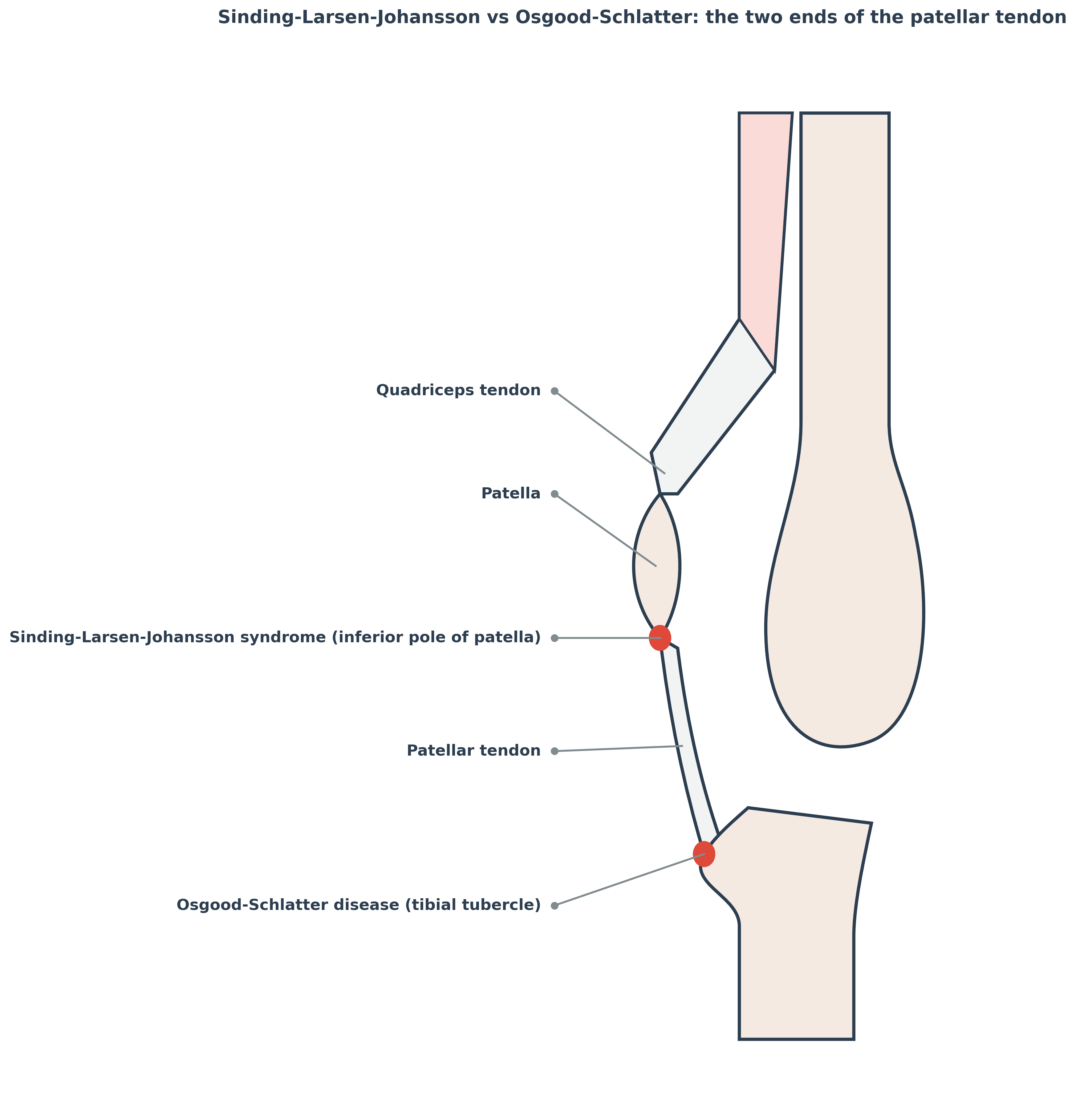
Relationship to Osgood-Schlatter. SLJ and OSD affect opposite ends of the patellar tendon: SLJ the origin at the inferior pole of the patella, OSD the insertion at the tibial tubercle. Both are traction apophysitides with the same mechanism, age group and treatment. They often coexist, representing stress at both ends of the extensor mechanism.
Classification Systems
Clinical Severity Grading
Grade by when the pain comes and what it stops the child doing. The grade sets the treatment.
- Symptoms
- Pain only after activity, no swelling at rest
- Impact on Activity
- Can complete training sessions
- Treatment Approach
- Ice after activity, stretching, continue sports
- Symptoms
- Pain during AND after activity, mild swelling
- Impact on Activity
- Performance affected, some activity limitation
- Treatment Approach
- Modify activity level, patellar strap, formal physio
- Symptoms
- Pain at rest, limits daily activities, walking painful
- Impact on Activity
- Unable to participate in sport
- Treatment Approach
- Rest from sport, possible short immobilization, physio
Mild SLJ may improve in 6-8 weeks with basic activity modification. Moderate SLJ typically requires 3-6 months of modified activity. Severe SLJ may need 6-12 months, possibly with periods of complete rest. All grades typically resolve when the physis closes, but symptom duration is proportional to severity.
Clinical Assessment
Making the diagnosis. Point tenderness localised to the inferior pole of the patella is the key positive finding, but it is not unique to SLJ: jumper's knee and an inferior-pole avulsion are tender at the same spot. What makes it SLJ is that tenderness together with skeletal immaturity (an open apophysis) and an insidious, activity-related onset with no acute injury.
History. The pain is worsened by running, jumping, kneeling, squatting and stairs. Ask about:
- Sport: type, frequency and intensity
- Recent increase in training volume or intensity
- Pain location, timing and aggravating factors
- Symptoms in the other knee
- Previous injury, to rule out acute trauma
- Tibial tubercle symptoms of coexisting OSD
Red flags. Each points to something other than SLJ:
- Night pain or rest pain: tumour, infection
- Acute traumatic onset: avulsion fracture
- Knee effusion: unusual for SLJ, suggests other pathology
- Systemic symptoms such as fever or weight loss: infection, malignancy
- A very young child, under 8: SLJ is rare, so investigate
- Hip symptoms: SCFE, Perthes
Inspection. Visible swelling over the inferior pole is less common than the Osgood-Schlatter bump. Compare both sides, because bilateral SLJ may be asymmetric, look for an effusion, which suggests another diagnosis, and assess overall limb alignment and muscle bulk.
Palpation. Point tenderness over the inferior pole is the cardinal finding, though it localises the problem rather than making the diagnosis, and there may be palpable calcification. Then palpate the whole patellar tendon for tendinopathy, the tibial tubercle for coexisting OSD, the medial and lateral joint lines for meniscal pathology, and the patella and peripatellar tissues.
Movement. Knee range is usually full, with perhaps slight discomfort in flexion; passive flexion may be painful at end range because it compresses the inferior pole. Quadriceps and hamstring flexibility are often reduced. Examine hip range too, to rule out referred pain.
Special tests. Resisted knee extension reproduces the pain over the inferior pole. Patellar mobility is normal, unlike patellofemoral pain syndrome, the ligaments should be stable, meniscal tests should be negative, and the child can straight-leg raise.
SCFE and Perthes disease commonly present as knee pain in children due to referred pain along the obturator nerve. In ANY child presenting with knee pain, especially if obesity or limited hip ROM is present, you MUST examine the hip. Missing SCFE can lead to avascular necrosis and hip destruction.
- Key Features
- 10-14y athletes, activity-related pain
- Tenderness Location
- Inferior pole of patella
- Management
- Activity modification, stretching, ice
- Key Features
- 10-15y athletes, activity-related pain, bump
- Tenderness Location
- Tibial tubercle (anterior, distal to patella)
- Management
- Same conservative treatment as SLJ
- Key Features
- Anterior knee pain, worse sitting/stairs
- Tenderness Location
- Diffuse peripatellar, retropatellar
- Management
- VMO strengthening, patellar taping
- Key Features
- Older athletes (16+), jumping sports
- Tenderness Location
- Inferior pole patella to tendon insertion
- Management
- Eccentric exercises, load management
- Key Features
- Acute traumatic event, swelling, unable to extend
- Tenderness Location
- Inferior pole with deformity
- Management
- URGENT - surgical fixation usually needed
Same pain, fused apophysis. Inferior-pole pain is age-determined at the same anatomical site. In the skeletally immature athlete with an open apophysis it is SLJ, a traction apophysitis; once the apophysis has fused, identical proximal-patellar-tendon pain in a jumping athlete is patellar tendinopathy (jumper's knee), an overload tendinopathy of the deep proximal tendon fibres rather than a bone-apophysis problem.
The distinction matters because management changes with maturity. SLJ is self-limiting and treated with activity modification, stretching and reassurance, whereas jumper's knee is driven by a structured progressive loading programme, eccentric decline-squat or heavy-slow-resistance training, with imaging-guided injection or surgery reserved for refractory cases. So in the 16-18-year-old with the "same" history, confirm skeletal maturity and shift both the diagnosis and the rehabilitation accordingly rather than labelling it persistent SLJ.
Investigations
A clinical diagnosis. Typical SLJ needs no imaging: point tenderness over the inferior pole in an athletic adolescent during the growth spurt is sufficient. Imaging is reserved for atypical presentations or to exclude other pathology.
When to X-ray. Any of these justifies a film:
- Acute traumatic event, to rule out avulsion fracture
- Atypical age, too young or too old for SLJ
- Night pain or rest pain, to rule out tumour or infection
- Effusion
- Failure to improve with 3-6 months of conservative treatment
- Suspected loose ossicle in a symptomatic adult
What the lateral film shows. It may show soft tissue swelling anterior to the inferior pole, fragmentation or irregular ossification of the inferior pole ossification centre, or a separate ossicle that may persist. After fusion, calcification may remain at the inferior pole.
- Indication
- First-line if imaging needed
- Findings
- Soft tissue swelling, fragmentation, ossicle
- Clinical Use
- Confirm diagnosis, rule out fracture
- Indication
- Assess patellar tendon, soft tissues
- Findings
- Tendon thickening, fragmentation, bursa
- Clinical Use
- Useful if tendinopathy suspected
- Indication
- Rule out tumor, stress fracture, infection
- Findings
- Edema at inferior pole, soft tissue changes
- Clinical Use
- Rarely needed - reserve for red flags
Management Algorithm
Non-Operative Management (First-Line for ALL Cases)
Conservative for all. Essentially all SLJ is managed conservatively, and surgery is a rarity, not a stage of the pathway. That says operative treatment is almost never required; it does not say symptoms reliably clear within a season, and a substantial minority of adolescent apophysitis runs beyond 2 years while still ending in full recovery without an operation.
The adolescent is the main patient. Treatment is a structured rehabilitation programme while the child continues modified activity. Educate the patient and parents that the condition is self-limiting and that calcification may persist, and do not over-treat.
Activity modification. Do not stop all activity; reduce its intensity and volume and continue sport at a reduced level if tolerable. Avoid the painful activities (deep squats, jumping, kneeling) and cross-train with low-impact activities such as swimming and cycling. Ice for 15-20 minutes after activity relieves symptoms.
Flexibility. Quadriceps stretching reduces the traction force on the inferior pole, hamstring stretching decreases quadriceps demand and hip flexor stretching improves mechanics. Stretch the quadriceps, hamstrings and hip flexors daily (30 sec × 3), holding stretches 30 seconds, 3-4 times daily, with a dynamic warm-up before activity.
Strengthening. Begin eccentric quadriceps work once acute pain settles, with core stability to reduce load on the knee and hip strengthening to improve biomechanics. Progress gradually as symptoms allow.
Adjuncts. Used as needed:
- Patellar strap or brace, which reduces traction on the inferior pole and may be worn during sport
- Knee pad, to protect the inferior pole when kneeling
- NSAIDs, short-term for acute flares and not long-term
- Ice or heat for symptom relief
Prolonged complete rest is NOT recommended. It weakens muscles, detrains the athlete, and delays return to sport. Modify activity to a tolerable level rather than stopping entirely. The exception is severe cases with rest pain, which may need a short period of immobilization.
Surgical Technique
Adults only. Surgery for SLJ is extremely rare. It is reserved for the adult, after skeletal maturity, with persistent symptoms from a loose ossicle at the inferior pole or persistent pain from calcification, and it is not indicated for active SLJ, or for acute symptoms, in adolescents.
Indications. Patient selection is key:
- Skeletal maturity, with a closed patellar apophysis
- Persistent focal pain over the ossicle
- Failed conservative management of 6 months or more
- Imaging confirming a symptomatic ossicle at the inferior pole
Technique. Ossicle excision is a straightforward procedure, arthroscopic or open. The open steps:
- Longitudinal or transverse incision over the inferior pole
- Identify the ossicle at the patellar tendon origin
- Excise the ossicle and debride the tendon edges
- Repair the tendon if needed
- Some surgeons also smooth a prominent inferior pole
Results. Good or excellent results with pain relief in the large majority of appropriately selected patients. The evidence is small retrospective series of carefully selected patients, not trial data, so quote it as a favourable expectation rather than a precise success rate. The main complication is recurrent pain; extensor weakness is rare.
Complications
- Incidence
- Common (30-50%)
- Risk Factors
- Part of natural history
- Management
- Reassurance - cosmetic only, does not affect function
- Incidence
- Rare (less than 1%)
- Risk Factors
- Acute trauma in severe SLJ
- Management
- Surgical ORIF if displaced, cast if non-displaced
- Incidence
- 5-10%
- Risk Factors
- Large initial ossicle, non-compliance
- Management
- Ossicle excision if failed conservative treatment
- Incidence
- Uncommon
- Risk Factors
- Return to sport too early, ongoing overuse
- Management
- Eccentric loading program, activity modification
- Incidence
- 10-20%
- Risk Factors
- Calcification persists
- Management
- Knee pads, reassurance, rarely surgical reduction
The incidence figures in this table are conventional estimates from clinical experience and small retrospective series, not measurements from cohort studies - no prospective SLJ cohort has quantified them. Medlar & Lyne (Evidence Base) found residual calcification was common and asymptomatic, which is the basis for the "30-50%" convention.
Avulsion is a different injury. The cartilaginous apophysis is the weak link, and during the epiphyseal stage the inferior pole may avulse with acute trauma in jumping sports or on landing. SLJ is chronic overuse, with a gradual onset and preserved extension; avulsion is acute, with sudden pain, inability to extend the knee and a visible or palpable deformity.
Treat an inferior pole avulsion as a fracture and refer urgently to orthopaedics. It usually requires surgical fixation: open reduction and internal fixation if displaced, a cast if non-displaced. Do not confuse it with SLJ.
The acute injury that mimics SLJ is the patellar sleeve fracture, a paediatric avulsion (peak 8-12 years) in which a sleeve of cartilage and periosteum is stripped off the pole of the patella, taking only a tiny fleck of bone. The classic trap is that the plain radiograph grossly under-represents the injury - the visible osseous fragment is small while the avulsed cartilage sleeve is large - so the true extensor-mechanism disruption is easily missed. Look for patella alta on the lateral film (the patella rides high once the inferior tether is lost), a palpable gap below the patella, and inability to perform a straight-leg raise or actively extend the knee. Most occur at the inferior pole (superior-pole and medial/lateral variants are described). Because the cartilage is radiolucent, MRI or ultrasound defines the true extent. Unlike SLJ this is a surgical injury: a displaced sleeve fracture needs open reduction and fixation (suture/anchor or tension-band) to restore the extensor mechanism, with the physis respected. This is the entity the viva is probing when it asks you to classify an "inferior pole avulsion."
Postoperative Care and Rehabilitation
Rehabilitation for Ossicle Excision (Adults)
Post-Ossicle Excision Protocol
- Weight-bearing as tolerated
- ROM exercises as comfort allows
- Ice, elevation for swelling
- Gentle quadriceps sets
- Full ROM expected by 6 weeks
- Progressive strengthening
- Bike, swimming for cardio
- Avoid deep squats, jumping
- Sport-specific training
- Plyometrics progression
- Jogging, running progression
- Full return based on strength testing
- Typically 3-4 months for full competition
- Ongoing maintenance stretching
Outcomes
Prognosis. The prognosis is good: the great majority resolve completely with skeletal maturity and without surgery, and most athletes return to full sport without long-term issues. Symptoms are conventionally said to settle within 1-2 years, as the patellar apophysis fuses.
Do not promise the timescale. The best prospective prognostic data on this family of apophysitis come from Osgood-Schlatter: of 51 adolescents followed for 24 months, 37% still had apophysitis-related knee pain at 2 years, the median symptom duration in that subgroup was 42 months, and more than 1 in 5 had stopped their sport (Evidence Base). Counsel families that recovery is usually complete but can take years.
Into adulthood. A minority have symptoms persisting into adulthood, usually as patellar tendinopathy at the same site. 5-10% have some adult symptoms, usually mild or related to an ossicle. The rare complications are inferior pole avulsion fracture and persistent symptomatic calcification.
A prolonged course is predicted by:
- Severe initial presentation
- Delay in activity modification
- Ongoing intense sports participation without modification
- Bilateral involvement
- Coexisting Osgood-Schlatter disease
Parents often worry about the residual calcification at the inferior pole. Reassure them this is part of the normal healing process - the calcification represents bone that formed during the inflammatory phase and is now incorporated into the mature patella. It is cosmetic only and does not affect function or sports performance.
Guidelines, Registries & Global Practice
Global epidemiology. Sinding-Larsen-Johansson syndrome is a worldwide condition of the skeletally immature, jumping/running athlete and is consistently reported as less common than its sister apophysitis, Osgood-Schlatter disease. As girls' participation in jumping and running sports has grown internationally, female incidence is rising and the historical male predominance is narrowing. In an unselected population-based Dutch adolescent cohort (3800 knees, ages 12-15), MRI features of SLJ were present in 0.8% versus 2.3% for OSD (DOI). Accessory-ossicle prevalence rises markedly in high-load youth sport: elite male soccer players show roughly 3-fold higher apophyseal ossicle rates than controls (DOI). There is no dedicated SLJ registry; surveillance comes from sports-medicine cohorts and imaging-prevalence studies rather than arthroplasty-style national registries.
Guideline landscape. No major society publishes an SLJ-specific guideline; recommendations are extrapolated from paediatric overuse-injury and apophysitis guidance, which is strikingly consistent across systems:
- Position
- Activity modification, relative rest, quadriceps/hamstring flexibility; reassurance about self-limiting course
- Imaging Stance
- Clinical diagnosis; radiograph only for atypical features or to exclude other pathology
- Evidence Basis
- Expert consensus / Level 5 (no high-level RCTs)
- Position
- Primary-care conservative management, load modification, physiotherapy; orthopaedic referral reserved for red flags
- Imaging Stance
- Imaging not routine; reserved for diagnostic uncertainty or trauma
- Evidence Basis
- CKS-type narrative guidance, consensus-based
- Position
- Conservative, family education; avoid overinvestigation of incidental ossicles
- Imaging Stance
- Selective imaging only
- Evidence Basis
- Consensus / practice standards
- Position
- Load management and graded return; flag prolonged courses for follow-up
- Imaging Stance
- Ultrasound or MRI selectively for atypical or refractory cases
- Evidence Basis
- Cohort evidence (Level 3-4)
- Position
- Training-load monitoring during growth spurts, gradual return-to-sport progression
- Imaging Stance
- Clinical diagnosis emphasised
- Evidence Basis
- Consensus / sports guidance
The main international variation is in imaging threshold and follow-up intensity, not in treatment: management is uniformly conservative worldwide. Higher-resource and elite-sport settings use ultrasound/MRI more liberally and monitor load formally, while primary-care systems (e.g. NHS) keep the diagnosis clinical. Emerging cohort data (apophysitis pain persisting in roughly one-third at 2 years, DOI) is shifting guidance toward longer, structured follow-up rather than one-off reassurance.
Medicolegal Considerations:
Key documentation points:
- Clear history of gradual onset and activity-related symptoms
- Documentation of point tenderness specifically over inferior pole of patella
- Hip examination performed (to exclude SCFE/Perthes)
- Discussion of self-limiting nature and expected timeline (counsel that a minority take 1-2+ years)
- Activity modification advice given (not complete rest)
Don't Miss SCFE: SCFE commonly presents as knee pain in obese adolescent males. Missing SCFE diagnosis causes significant morbidity from AVN. Document hip examination in ALL adolescents presenting with knee pain. This is a frequent source of litigation in paediatric orthopaedics.
Prevention Strategies:
- Training-load management during growth spurts (volume progression before intensity)
- School and club programmes increasingly aware of growth-spurt overuse risk
- Pre-season flexibility screening may identify at-risk athletes (tight quadriceps/hamstrings)
MCQ Practice Points
Q: An adolescent presents with knee pain after jumping. How do you distinguish SLJ from avulsion fracture? A: SLJ has GRADUAL onset, pain during/after activity, ability to extend knee, and no visible deformity. Avulsion has ACUTE onset after trauma, inability to extend knee, visible/palpable deformity, and severe pain. X-ray may show a displaced fragment in avulsion vs fragmentation in SLJ - but beware the patellar sleeve fracture, where the avulsed cartilage is radiolucent and the film can look near-normal; patella alta is the clue and MRI shows the true extent.
Q: Which of the following is an indication for X-ray in suspected SLJ? A: Night pain (rule out tumor), acute traumatic onset (rule out avulsion), failure to improve after 6 months conservative treatment, atypical age (less than 8 or after skeletal maturity). Routine SLJ does NOT require imaging.
Q: What is the recommended activity level for adolescent with SLJ? A: Activity MODIFICATION, not complete rest. Continue sport at reduced level if tolerable. Avoid painful activities (deep squats, kneeling, jumping). Cross-train with low-impact activities. Complete rest weakens muscles and delays return.
Q: What happens to the calcification after SLJ resolves? A: The inferior pole calcification typically persists as a painless, cosmetic finding - conventionally quoted at 30-50% of patients, though the figure comes from small descriptive series rather than cohort data. This represents ossification that occurred during the healing process and is now incorporated into the mature patella. It is NOT a complication and does not affect function.
Q: A 12-year-old with knee pain has point tenderness at the INFERIOR POLE of patella. What is the diagnosis? A: Sinding-Larsen-Johansson syndrome - traction apophysitis at the inferior pole of patella (where patellar tendon originates). Same mechanism as Osgood-Schlatter but at the proximal end of the patellar tendon. Treatment is identical - activity modification, stretching, ice.
Q: How does SLJ differ from Osgood-Schlatter disease? A: SLJ affects the inferior pole of the patella (patellar tendon origin) while OSD affects the tibial tubercle (patellar tendon insertion). Both are traction apophysitides with the same mechanism, age group, and treatment. Patients may have both conditions simultaneously.
Exam Viva Scenarios
Practise clinical reasoning and management decisions out loud
“A 12-year-old boy who plays basketball presents with 2 months of anterior knee pain. The pain is worse after training and he has point tenderness at the front of his knee.”
“A 13-year-old female gymnast presents with bilateral anterior knee pain. On examination, she has tenderness at both the inferior pole of the patella and the tibial tubercle bilaterally.”
“A 14-year-old basketball player jumps for a rebound and lands with sudden severe knee pain. He cannot extend his knee and you notice tenderness and swelling over the inferior pole of the patella.”
Key Anatomy
- Inferior pole of patella = patellar tendon origin
- Secondary ossification center at inferior pole
- Apophysis fuses during adolescence (14-18 years)
- Opposite end of patellar tendon from Osgood-Schlatter
Diagnosis
- Clinical diagnosis - imaging not required
- Point tenderness over inferior pole of patella
- Pain with resisted knee extension
- 10-14 years, athletic, growth spurt
Treatment
- Activity MODIFICATION not complete rest
- Stretching: quads, hamstrings, hip flexors
- Ice after activity (15-20 min)
- Patellar strap during sport
- NSAIDs short-term for flares only
Imaging Indications
- Acute traumatic onset (avulsion)
- Night pain (tumor)
- Failure after 6 months conservative
- Atypical age or presentation
Red Flags
- Acute trauma with inability to extend = AVULSION
- Night/rest pain = tumor, infection
- Knee effusion = not typical for SLJ
- Hip symptoms = SCFE, Perthes
Prognosis
- Great majority resolve with skeletal maturity, almost never operatively
- Conventionally 1-2 years - but 37% of the OSD cohort still hurt at 2 years (median 42 months)
- Calcification persists but is painless
- 5-10% adult symptoms (usually ossicle)
Evidence Base
SLJ has a small dedicated literature, so much of the practice base is shared with Osgood-Schlatter disease (OSD) and patellar tendinopathy, which sit at the opposite ends of the same extensor mechanism. Where direct SLJ data are sparse, high-quality apophysitis evidence is used and labelled as such.
Defining Natural-History Study (Original Prospective Series)
- Prospective study of 8 patients (10 knees) with clinical and radiographic SLJ
- Aetiology described as traction tendinitis with de novo calcification at the patellar tendon proximal attachment, which had partially avulsed
- Course was self-limited and benign, paralleling Osgood-Schlatter disease
- Residual calcification at the inferior pole was common and asymptomatic
Population Prevalence on Adolescent Knee MRI
- Population-based cohort of 1910 adolescents (3800 knees) imaged at age 12-15 years
- Sinding-Larsen-Johansson characteristics seen in 16 participants (0.8%); Osgood-Schlatter in 43 (2.3%)
- At least one abnormality or normal variant present in 19.4% of unselected adolescents
- Bone marrow oedema and Osgood-Schlatter were more common in boys
Mechanical Loading and Ossicle Formation in Elite Athletes
- Cross-sectional comparison of 334 knees of male professional soccer players versus 223 control knees
- Players had significantly higher tuberosity height ratio, steeper posterior tibial slope, and more Osgood-Schlatter ossicles (10.8% vs 3.1%)
- Dominant-side tuberosity prominence and slope were greater than non-dominant
- Findings attributed to repetitive mechanical loading during skeletal growth
Acute Presentation Mimicking Patellar Sleeve Fracture
- 10-year-old boy with sudden anterior knee pain after a non-contact soccer injury
- Radiographs showed a minimally displaced distal patellar ossicle suggestive of SLJ
- MRI excluded a cartilaginous sleeve injury and confirmed SLJ
- Brief immobilisation gave complete radiographic healing by 4 weeks
Apophysitis Prognosis Is Not Always Benign (OSD Analogue)
- Prospective cohort of 51 adolescents (10-14 y) with Osgood-Schlatter, 90% followed to 24 months
- 37% still had apophysitis-related knee pain at 2 years; over 1 in 5 had stopped sport
- Persistent pain was associated with worse KOOS Sport/Recreation and quality of life
- An ununited ossicle was present in 32% of those rescanned at follow-up
Eponym and Historical Context
- Biographical review of Christian Magnus Falsen Sinding-Larsen (1866-1930), Norwegian physician
- Documents the origin of the SLJ eponym in the musculoskeletal radiology literature
- Describes the original radiographic descriptions of inferior-pole change
- Places SLJ within the family of described osteochondroses