The CSAW Trial and Subacromial Decompression: Is There Still an Indication?
The CSAW trial and FIMPACT to 10 years, decoded for clinicians: what placebo surgery showed about subacromial decompression, and who still has an indication.
By OrthoVellum Editorial TeamPublished 12 min read
Educational content for clinicians, not medical advice. Editorial policy
Key points
- CSAW randomised 313 patients who had already failed exercise therapy and at least one steroid injection. At 6 months, decompression was no better than arthroscopy alone (Oxford Shoulder Score difference −1.3 points, 95% CI −3.9 to 1.3).
- Both surgical arms beat no treatment, but by less than the 4.5-point difference the trial was designed to detect, and the placebo arthroscopy did as well as the decompression.
- CSAW followed patients for one year. The long-term placebo-controlled data come from the Finnish FIMPACT trial, which found no benefit of decompression over diagnostic arthroscopy at 2, 5 or 10 years.
- The classic selection criteria were largely tested: CSAW required failed injection-based care, FIMPACT required a positive lidocaine injection test, and FIMPACT's exploratory subgroup analysis found acromial anatomy did not change the result.
- A 2019 BMJ Rapid Recommendation advises strongly against decompression for subacromial pain; NHS England's Evidence-Based Interventions still allow it after adequate non-operative care, with shared decision-making.
On this page8 sections
Subacromial decompression was introduced in 1972 without high-level evidence and became one of the commonest operations in orthopaedics. The CSAW trial (Lancet, 2018) was the first published trial to test it against placebo surgery, and the Finnish FIMPACT trial has since followed the same comparison for ten years. The short answer to the title: for atraumatic subacromial pain with an intact rotator cuff, no trial has shown that removing bone and bursa helps more than an arthroscopy that leaves the acromion untouched, and the features surgeons use to select patients have mostly been tested without finding a group that benefits. This post decodes both trials and what is left of the indication. The condition itself is covered on the subacromial impingement topic page.
What did the CSAW trial test?
CSAW (Can Shoulder Arthroscopy Work?) ran at 32 UK hospitals with 51 surgeons and randomised 313 patients between 2012 and 2015. Every patient had at least 3 months of subacromial pain with intact cuff tendons, and had already completed a non-operative programme that included exercise therapy and at least one steroid injection (median two). These were treatment-refractory patients, the group surgeons actually operate on, not an unselected clinic population. Full-thickness cuff tears were excluded.
There were three arms, 1:1:1:
- Decompression (n=106): removal of bursa and soft tissue, release of the coracoacromial ligament and removal of the subacromial spur.
- Arthroscopy only (n=103): inspection and irrigation of the glenohumeral joint and the subacromial bursa, with a lateral skin incision to simulate the working portal but no instrument through it and nothing removed. This was the placebo.
- No treatment (n=104): one reassessment with a specialist shoulder clinician at 3 months and no intervention.
Patients in the two surgical arms were not told which operation they had. The primary outcome was the Oxford Shoulder Score (0 worst to 48 best) at 6 months, and the trial was powered to detect a difference of 4.5 points.
What did CSAW find?
| Oxford Shoulder Score (intention to treat) | 6 months | 1 year |
|---|---|---|
| Decompression, mean | 32.7 | 38.2 |
| Arthroscopy only, mean | 34.2 | 38.4 |
| No treatment, mean | 29.4 | 34.3 |
| Decompression vs arthroscopy only | −1.3 (95% CI −3.9 to 1.3) | 0.3 (−2.9 to 3.5) |
| Decompression vs no treatment | 2.8 (0.5 to 5.2) | 3.9 (0.7 to 7.1) |
| Arthroscopy only vs no treatment | 4.2 (1.8 to 6.6) | 3.6 (0.6 to 6.6) |
Read the table in two steps. First, decompression did not beat placebo: the confidence interval for decompression against arthroscopy only crosses zero at both time points, and the point estimate at 6 months slightly favours the placebo. Second, both operations beat no treatment with statistical significance, but every estimate sits below the 4.5-point target, which is why the authors called the differences not clinically important. This is the gap between statistical and clinical significance, explained on the measures of effect topic page.
The authors suggested that the small advantage of surgery over no treatment might be a placebo effect, or the postoperative physiotherapy that both surgical arms received. Their conclusion was that the findings question the value of the operation for these indications, and that this should be communicated to patients in shared decision-making.
There were six study-related complications, all frozen shoulder, two in each arm, including the no-treatment arm.
What could CSAW not tell you?
The trial has three real weaknesses, and they are the ones raised in every viva.
Non-compliance with allocation. By 6 months, 23% of the decompression arm, 42% of the arthroscopy-only arm and 12% of the no-treatment arm had not received their allocated treatment. Some patients improved on the waiting list and declined surgery; some in the no-treatment arm chose to have a decompression. The findings were consistent in both the intention-to-treat and per-protocol analyses, and missing data did not explain the absence of benefit over placebo.
The no-treatment arm was not masked. Patients knew they had not had surgery, and the authors acknowledge this could have worsened their reported outcomes (a nocebo effect). This weakens the surgery-versus-nothing comparison, not the decompression-versus-placebo one.
One year of follow-up. CSAW followed patients at 6 months and 1 year. It cannot say whether decompression pays off later, for example by preventing cuff tears. For the long-term question you need FIMPACT.
FIMPACT: the same question at 2, 5 and 10 years
FIMPACT recruited 210 patients aged 35 to 65 at three public hospitals in Finland from 2005. The inclusion criteria read like a checklist for the ideal surgical candidate: more than 3 months of pain with no relief from physiotherapy, anti-inflammatories, corticosteroid injection and rest; a painful arc; and a positive impingement test, meaning temporary relief from a subacromial lidocaine injection. MR arthrography excluded cuff tears, and glenohumeral or acromioclavicular arthritis, substantial calcific deposits, instability and symptomatic cervical spine disease were all excluded.
Randomisation was in two stages. Patients were first allocated 2:1 to surgery (139) or supervised exercise therapy (71). Those allocated to surgery had a diagnostic arthroscopy, and 17 (12%) were excluded at that point; a cuff tear large enough to need repair was repaired and the patient left the trial. The rest were then randomised on the table to decompression (59), which removed the bursa, the spurs and the projecting anterolateral undersurface of the acromion, or to diagnostic arthroscopy alone (63). Both surgical groups had the same rehabilitation, one physiotherapy visit with home exercises. The primary outcomes were pain at rest and on arm activity on a 0–100 visual analogue scale, with a minimal clinically important difference of 15 points.
| FIMPACT, pain VAS (decompression minus comparator) | At rest | On arm activity |
|---|---|---|
| 2 years vs diagnostic arthroscopy | −4.6 (−11.3 to 2.1) | −9.0 (−18.1 to 0.2) |
| 5 years vs diagnostic arthroscopy (175 of 210 followed) | −2.0 (−8.5 to 4.6) | −8.0 (−17.3 to 1.3) |
| 10 years vs diagnostic arthroscopy (168 of 193 randomised, 87%) | −1.5 (−8.6 to 5.6) | −3.2 (−13.0 to 6.5) |
| 2 years vs exercise therapy | −7.5 (−14.0 to −1.0) | −12.0 (−20.9 to −3.2) |
| 5 years vs exercise therapy | 1.0 (−5.6 to 7.6) | −3.9 (−12.8 to 5.1) |
| 10 years vs exercise therapy | −4.0 (−11.0 to 3.0) | −9.4 (−19.0 to 0.3) |
Negative numbers favour decompression. Against placebo arthroscopy, no difference reached the 15-point threshold at any time point. At 5 years the only statistically significant difference was a 7-point gain in the Constant-Murley score, a secondary outcome, below both the trial's 17-point threshold and a published median estimate of 8.3. A secondary analysis found the same for work: by 24 months 88% of the decompression group, 88% of the placebo group and 90% of the exercise group had returned to work.
Does the 2-year win over exercise matter? It was statistically significant, but below the 15-point threshold, and the authors themselves warn it is biased in favour of surgery. It was unblinded, and the 12% excluded at arthroscopy were removed only from the surgical arms, taking with them patients likely to do badly. By 5 years the difference had gone. At 10 years the authors concluded that decompression should not be offered outside rigorously designed clinical trials.
Does a hooked acromion or a positive injection test identify the patient who benefits?
This is where the post-CSAW debate usually ends up, and the operative logic is easy to see in a radiograph.
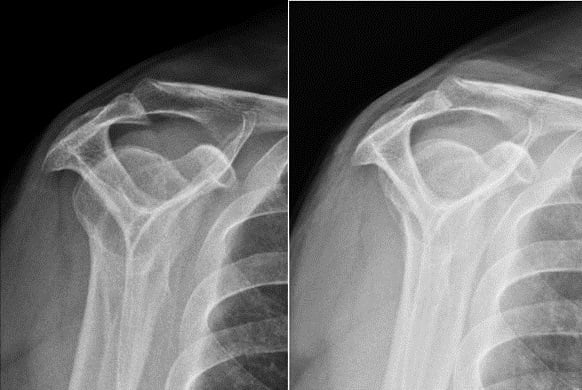
The film shows that the operation changes the anatomy. The trials asked whether changing the anatomy changes the pain, and the answer was no. The traditional selection criteria are a positive injection test, a structural acromial abnormality and failure of injection-based conservative care. Each has now been tested to some degree:
| Traditional selection criterion | What the placebo-controlled trials did |
|---|---|
| Failed exercise therapy and steroid injection | Required for entry to CSAW (exercise plus at least one injection) and to FIMPACT |
| Positive subacromial injection test | Required for entry to FIMPACT (temporary relief from lidocaine) |
| Hooked acromion or spur | FIMPACT pre-specified a subgroup analysis by acromial anatomy; it did not change the result |
| Long or severe symptoms | FIMPACT subgroup analyses by duration and severity; no effect on the result |
The hedge matters. The FIMPACT authors describe their subgroup analyses as supportive and hypothesis-generating, at higher risk of bias than the main comparison, so they do not prove that acromial shape is irrelevant. What can be said is that the 10-year FIMPACT report states that no trial has identified a subgroup with benefit. The OrthoVellum operative guide to arthroscopic subacromial decompression puts the remaining defensible indication narrowly: true mechanical impingement with a Type III acromion and spur, after genuine failure of an exercise-led pathway, with shared decision-making that cites this evidence. That is a judgement, not a trial result, and the patient should hear it as one.
The examination still matters, but its job has changed. Neer and Hawkins-Kennedy are moderately sensitive provocation tests (pooled sensitivity about 72–79%, specificity about 60%), not structural diagnoses; the shoulder exam accuracy post covers how to read them. The clinical exam guide to subacromial pain and the clavicular joints frames the examination as triage: find the cuff tear, the acromioclavicular joint, the scapular and cervical contributors, and the large group in between who need exercise and time.
What do the guidelines say now?
| Source | Position |
|---|---|
| BMJ Rapid Recommendation, 2019 | Strong recommendation against decompression for atraumatic subacromial pain syndrome of more than 3 months. Surgery gave no important improvement in pain, function or quality of life over placebo surgery or other options; frozen shoulder may be more common with surgery. The panel judged that almost all informed patients would choose to avoid it, and noted substantial uncertainty about which alternative is best. |
| Cochrane review, 2019 (8 trials, 1,062 participants) | High-certainty evidence that decompression gives no improvement over placebo in pain, function or quality of life up to one year. Adverse events about 3% across groups; serious adverse events likely under 1%. |
| NHS England Evidence-Based Interventions | Offer decompression for pure subacromial impingement only in appropriate cases; consider surgery for persistent or progressive symptoms despite adequate non-operative treatment, with the evidence discussed and a shared decision reached. |
| Hohmann et al., Arthroscopy 2020 (Level V clinical guideline) | After at least 6 weeks of non-operative treatment, decompression is a viable option for impingement with an intact cuff; not alone for chronic calcific tendinitis, workers' compensation cases or partial-thickness tears. |
The two ends of the table are not equal evidence. The BMJ and Cochrane positions rest on the two placebo-controlled trials; the 2020 guideline is labelled by its own authors as Level V expert opinion, and argues that studies not supporting decompression suffer from crossover and loss to follow-up. NHS England's Evidence-Based Interventions guidance (opens in a new tab) sits between them: it restricts the operation rather than removing it. It also defines "pure" subacromial impingement as pain not caused by a cuff tear, acromioclavicular joint pain or calcific tendinopathy, which is the population CSAW studied.
So is there still an indication?
Separate the question into three, because "subacromial decompression" names a step in several operations.
Isolated decompression for atraumatic subacromial pain with an intact cuff. This is exactly what CSAW and FIMPACT tested, with patients who had failed injections and physiotherapy. The evidence does not support it. A surgeon who still offers it is working within the NHS England EBI framework only if non-operative care has been adequate and the patient has been told that, in two placebo-controlled trials, the decompression itself added nothing. The supervised exercise programme in Ketola's earlier trial matched acromioplasty plus exercise at 2 and 5 years, which is the same message from an unblinded design.
Decompression added to another operation. Both trials excluded full-thickness cuff tears, so they say nothing about acromioplasty at rotator cuff repair. A 2012 meta-analysis of four randomised trials found no difference in shoulder scores or reoperation with or without acromioplasty at intermediate follow-up. The routine add-on has no better evidence than the stand-alone operation.
A different diagnosis wearing the impingement label. Acromioclavicular joint pain, calcific tendinopathy, frozen shoulder and instability all produce positive impingement signs and all have their own treatment. The internal impingement of the overhead athlete is the clearest example: acromioplasty does not treat it and can make a thrower worse. If a patient has failed months of rehabilitation, the first question is whether the diagnosis is right, not whether to decompress.
What to tell patients. On average, patients in every arm of both trials improved, including those who had no surgery. Decompression was no better than placebo surgery at any time point out to 10 years. The harms are small but real: frozen shoulder occurred in every arm of CSAW, and FIMPACT recorded it in three decompression, one placebo and two exercise patients. Frozen shoulder is covered on the adhesive capsulitis topic page. CSAW is one of the UK surgical trials examiners expect you to know, alongside PROFHER; the PROFHER post and the landmark trials page cover the rest.
In the exam
Frequently asked questions
What did the CSAW trial show?
CSAW randomised 313 UK patients with persistent subacromial pain and an intact cuff to arthroscopic decompression, arthroscopy only (placebo surgery) or no treatment. At 6 months the Oxford Shoulder Score did not differ between decompression and arthroscopy only. Both surgical groups did slightly better than no treatment, but the differences were below the trial's 4.5-point target and judged not clinically important. Removing bone and soft tissue conferred no clear added benefit.
Is subacromial decompression still recommended?
Not as a routine operation for subacromial pain. A 2019 BMJ Rapid Recommendation makes a strong recommendation against it, and a 2019 Cochrane review found high-certainty evidence of no important benefit over placebo up to one year. NHS England's Evidence-Based Interventions guidance still allows it for pure subacromial impingement when symptoms persist after adequate non-operative treatment, with the evidence discussed in a shared decision.
What is the difference between CSAW and FIMPACT?
Both compared decompression with diagnostic arthroscopy as a placebo. CSAW (UK, 313 patients) used no treatment as its third arm, the Oxford Shoulder Score as its outcome, and followed patients to one year. FIMPACT (Finland, 210 patients) used supervised exercise therapy as its third arm and pain scores as its outcomes, and has reported at 2, 5 and 10 years. Neither found decompression better than placebo surgery.
Does a hooked (Type III) acromion make decompression worthwhile?
That is the usual argument, but it has little support. FIMPACT pre-specified a subgroup analysis by acromial anatomy, and acromial shape did not change the finding that decompression was no better than placebo arthroscopy. The authors stress that subgroup analyses are exploratory and at higher risk of bias, so the result does not prove a hooked acromion is irrelevant. It does mean no trial has shown it predicts benefit.
Should an acromioplasty be added to rotator cuff repair?
Probably not routinely. CSAW and FIMPACT excluded full-thickness cuff tears, so they do not answer the question. A 2012 meta-analysis of four randomised trials (373 patients) found no statistically significant difference in shoulder scores or reoperation rate after arthroscopic cuff repair with or without acromioplasty at intermediate follow-up.
References
- Beard DJ, Rees JL, Cook JA, et al. Arthroscopic subacromial decompression for subacromial shoulder pain (CSAW): a multicentre, pragmatic, parallel group, placebo-controlled, three-group, randomised surgical trial. Lancet 2018;391(10118):329-338. DOI (opens in a new tab)
- Paavola M, Malmivaara A, Taimela S, et al. Subacromial decompression versus diagnostic arthroscopy for shoulder impingement: randomised, placebo surgery controlled clinical trial. BMJ 2018;362:k2860. DOI (opens in a new tab)
- Paavola M, Kanto K, Ranstam J, et al. Subacromial decompression versus diagnostic arthroscopy for shoulder impingement: a 5-year follow-up of a randomised, placebo surgery controlled clinical trial. Br J Sports Med 2021;55(2):99-107. DOI (opens in a new tab)
- Kanto K, Bäck M, Ibounig T, et al. Arthroscopic subacromial decompression versus placebo surgery for subacromial pain syndrome: 10 year follow-up of the FIMPACT randomised, placebo surgery controlled trial. BMJ 2025;391:e086201. DOI (opens in a new tab)
- Bäck M, Paavola M, Aronen P, et al. Return to work after subacromial decompression, diagnostic arthroscopy, or exercise therapy for shoulder impingement: a randomised, placebo-surgery controlled FIMPACT clinical trial with five-year follow-up. BMC Musculoskelet Disord 2021;22(1):889. DOI (opens in a new tab)
- Vandvik PO, Lähdeoja T, Ardern C, et al. Subacromial decompression surgery for adults with shoulder pain: a clinical practice guideline. BMJ 2019;364:l294. DOI (opens in a new tab)
- Karjalainen TV, Jain NB, Page CM, et al. Subacromial decompression surgery for rotator cuff disease. Cochrane Database Syst Rev 2019;1(1):CD005619. DOI (opens in a new tab)
- Ketola S, Lehtinen J, Arnala I, et al. Does arthroscopic acromioplasty provide any additional value in the treatment of shoulder impingement syndrome? A two-year randomised controlled trial. J Bone Joint Surg Br 2009;91(10):1326-1334. DOI (opens in a new tab)
- Ketola S, Lehtinen J, Rousi T, et al. No evidence of long-term benefits of arthroscopic acromioplasty in the treatment of shoulder impingement syndrome: five-year results of a randomised controlled trial. Bone Joint Res 2013;2(7):132-139. DOI (opens in a new tab)
- Hohmann E, Shea K, Scheiderer B, Millett P, Imhoff A. Indications for arthroscopic subacromial decompression. A level V evidence clinical guideline. Arthroscopy 2020;36(3):913-922. DOI (opens in a new tab)
- Chahal J, Mall N, MacDonald PB, et al. The role of subacromial decompression in patients undergoing arthroscopic repair of full-thickness tears of the rotator cuff: a systematic review and meta-analysis. Arthroscopy 2012;28(5):720-727. DOI (opens in a new tab)
Study the full topic
Included in Pro
Go deeper with Pro
- Operative guide: arthroscopic subacromial decompression
- Clinical exam: subacromial pain and the clavicular joints
Share this article
Cite this article
OrthoVellum Editorial Team. The CSAW Trial and Subacromial Decompression: Is There Still an Indication? [Internet]. OrthoVellum; 2026 Nov 11 [cited 2026 Nov 11]. Available from: https://www.orthovellum.com/blog/csaw-trial-subacromial-decompression
About this content
Prepared by the OrthoVellum Editorial Team from cited sources, under our editorial policy.
For education and exam preparation; not medical advice or a substitute for clinical judgement and local guidance.
Spotted an error? Tell us; every report is read.
Get new articles by email
New clinical explainers, landmark-trial summaries and exam guidance from the OrthoVellum blog. No account needed; unsubscribe from any email.