PROFHER Explained: What the Trial Really Says About Proximal Humerus Fractures
The PROFHER trial found surgery no better than a sling for displaced surgical-neck proximal humerus fractures. Who it covers, 5-year data and the exam answer.
By OrthoVellum Editorial TeamPublished 12 min read
Educational content for clinicians, not medical advice. Editorial policy

Key points
- In 250 adults with a displaced fracture involving the surgical neck, surgery gave no better Oxford Shoulder Score than sling treatment over two years (difference 0.75 points, 95% CI −1.33 to 2.84).
- The whole confidence interval lies below the 5-point minimal clinically important difference the trial was powered for, so this is a negative trial, not an underpowered one.
- The five-year follow-up found no difference at three, four or five years, and secondary shoulder surgery stayed at 11 patients in each arm.
- Fracture-dislocations, open fractures and clear surgical indications were excluded, and no patient had a primary reverse shoulder arthroplasty.
- PROFHER argues against routine surgery for these fractures. It does not show that no proximal humerus fracture benefits from an operation.
On this page11 sections
Should a displaced proximal humerus fracture be fixed? Most clinicians answer with the PROFHER trial, the UK randomised trial published in JAMA in 2015, and many quote it for fractures it never studied. This post sets out what PROFHER randomised, what it measured, what the five-year follow-up added and where its conclusions stop. It builds on our proximal humerus fractures topic page. The short answer: for adults with a displaced fracture involving the surgical neck, surgery as practised in the trial gave no better Oxford Shoulder Score than a sling and physiotherapy at two or five years, and it cost more.
What question did PROFHER ask?
PROFHER (PROximal Fracture of the Humerus: Evaluation by Randomisation) was set up to test a trend. Surgery for these fractures was increasing, partly because locking plates had become available, but there was little reliable trial evidence that it helped. The question was whether surgery improved patient-reported outcome compared with non-surgical treatment in adults with a displaced fracture of the proximal humerus involving the surgical neck.
It was a pragmatic, multicentre, parallel-group randomised trial funded by the NIHR Health Technology Assessment programme. The word pragmatic matters. PROFHER tested a treatment policy as delivered in ordinary NHS hospitals, not one operation performed by one expert. It sits with DRAFFT, FLOW and the other trials on our landmark trials page.
Who was in the trial?
250 patients were recruited from 32 NHS hospitals between September 2008 and April 2011, all within three weeks of injury. Mean age was 66 years (range 24 to 92), 192 (77%) were women and 249 (99.6%) were white. 108 patients (43%) were under 65, so this was not a trial of the frail elderly alone. Three-quarters of the injuries (186 of 250) were falls from standing height or less.
| Included | Excluded |
|---|---|
| Adults aged 16 or over | Associated dislocation of the shoulder |
| Presenting within 3 weeks of injury | Open fracture |
| Radiographically confirmed displaced fracture involving the surgical neck | Unable to understand the trial or follow rehabilitation |
| Neer two-part surgical-neck, three-part and four-part fractures | Comorbidity precluding surgery or anaesthesia |
| Surgical-neck fractures short of Neer thresholds, if the surgeon was uncertain how to treat them | Clear indication for surgery, such as severe soft-tissue compromise or nerve injury |
| Same-limb fractures or other upper-limb fractures | |
| Pathological fracture (other than osteoporotic) or terminal illness | |
| Living outside the hospital catchment area |
Head-splitting fractures were not on the exclusion list, but the investigators expected that these rare injuries would not be judged eligible.
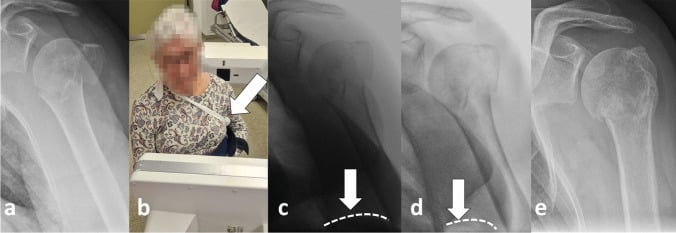
What the fractures looked like. Two shoulder surgeons independently classified the baseline radiographs using Neer's displacement thresholds (more than 1 cm of translation or 45° of angulation). They found 18 one-part, 128 two-part and 104 three- or four-part fractures. The one-part fractures were surgical-neck fractures that fell short of the Neer thresholds but that the treating surgeon still considered for surgery. Neer is only moderately reliable between observers, with interobserver kappa of 0.48 to 0.52 in Sidor's study, so treat these counts as approximate.
The selection funnel. Of 1,250 patients identified with a suitable fracture, 563 were eligible and 250 consented. Another 117 otherwise eligible patients were not approached because their surgeon had a firm treatment preference. PROFHER therefore describes fractures where the treating surgeon was genuinely uncertain, which is most of them but not all.
What did each arm actually receive?
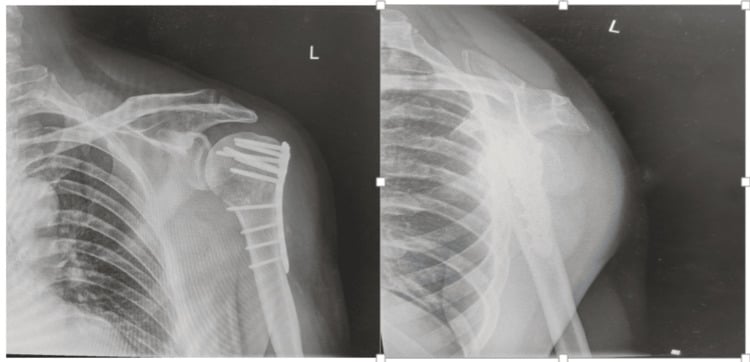
Surgery was left to the treating surgeon, who had to use a technique they were experienced with. Of the 125 patients allocated to surgery, 109 had an operation and 16 were treated non-surgically: 8 changed their minds, 6 became unfit for surgery and in 2 the surgeon's opinion differed. A plate and screws were used in 82.6% of operations (a PHILOS plate in 66) and a hemiarthroplasty in 10 (9.2%). Surgery took place a median of 9 days after injury. A reverse shoulder arthroplasty was used only once in the main trial, as secondary surgery for malunion.
Non-surgical care was a sling or collar and cuff, followed by active rehabilitation; 123 of 125 patients received it. Both arms were given the same information leaflet on sling care and the same physiotherapy protocol. In effect the trial compared surgery plus rehabilitation with rehabilitation alone.
What did PROFHER find?
The primary outcome was the Oxford Shoulder Score (OSS), scored 0 to 48 with higher scores better, collected at 6, 12 and 24 months and analysed over the two years. The sample size was based on a minimal clinically important difference of 5 points.
| Outcome | Surgery | Non-surgery | Result |
|---|---|---|---|
| OSS averaged over 2 years | 39.07 | 38.32 | Difference 0.75 (95% CI −1.33 to 2.84), P = 0.48 |
| OSS at 6 months | 37.84 | 35.59 | Difference 2.25 (95% CI −0.07 to 4.57), P = 0.058 |
| SF-12 physical component | 1.77 points higher with surgery (95% CI −0.84 to 4.39), P = 0.18 | ||
| Surgical or fracture-related complications | 30 patients | 23 patients | P = 0.28 |
| Secondary shoulder surgery | 11 | 11 | No difference |
| Increased or new shoulder therapy | 7 | 4 | P = 0.58 |
| Deaths | 9 | 5 | P = 0.27 |
| Medical complications in hospital | 10 | 0 | All in the surgical group |
Neither prespecified subgroup changed the answer. The investigators expected surgery to help more in patients under 65 and in fractures involving one or both tuberosities, but neither interaction was significant (P = 0.27 for age, P = 0.95 for tuberosity involvement). Surgery cost on average £1,780.73 more per patient at two years and had only a 5% probability of being cost-effective at £20,000 per quality-adjusted life-year.
Is PROFHER a negative trial or just underpowered?
Examiners often test this distinction. A non-significant P value alone does not prove that two treatments are equivalent, because a small trial can miss a real effect. PROFHER's case rests on the confidence interval. The upper limit for the two-year difference, 2.84 points, sits below the 5-point threshold the trial was designed to detect, and every 95% CI excluded that prespecified difference. The data rule out a clinically important average benefit from surgery in this population. With 215 patients complete at two years against a target of about 200, the trial reached its planned power. Our statistical power and sample size page covers the reasoning.
What the interval does not rule out is a smaller benefit, or a benefit confined to a subgroup too small to detect. The six-month result hints that surgery may speed early recovery a little, but even that interval stopped short of 5 points, and the gap had gone by one year. If the confidence-interval logic is unfamiliar, read statistics for the surgeon before the viva.
Did the result hold at five years?
The extended follow-up, reported by Handoll and colleagues in 2017, sent postal questionnaires at three, four and five years to the 176 participants who consented. OSS data were available for 164, 155 and 149 of them. There was no statistically or clinically significant difference at any point. At five years the adjusted difference was −1.09 points (95% CI −3.41 to 1.23, P = 0.36), nominally favouring non-surgical care. Nobody had secondary shoulder surgery for a new complication, so secondary surgery stayed at 11 patients in each arm, and EQ-5D quality of life did not differ.
Two caveats apply. The extended study fell 11 patients short of its target of 160, so it did not reach its revised power, although the authors argue the balanced losses and narrow intervals make this unlikely to matter. More further fractures were reported in the non-surgical arm (50 against 31). The authors considered it unsafe to attribute this to treatment and suggested it was mainly chance, with more smokers in that group. Do not quote it as a harm of non-operative care.
What PROFHER does not show
The trial answers one question well. Most misuse comes from carrying it into fractures and patients it did not include.
Fracture-dislocations and open fractures. Both were excluded by design, so PROFHER provides no evidence about them. Our shoulder fracture-dislocations page sets out how those injuries are managed.
Head-splitting and articular fractures. These were not formally excluded but were expected to be ineligible, and the trial offers no usable evidence for them. See humeral head fractures.
Isolated tuberosity fractures. Inclusion required surgical-neck involvement, so an isolated greater tuberosity fracture is outside the trial. The topic page gives its much tighter fixation threshold: more than 5 mm of displacement, or more than 3 mm in an overhead athlete or manual worker.
Patients with a clear surgical indication. Nerve injury, severe soft-tissue compromise and multiple upper-limb injuries were excluded, as were the 117 patients whose surgeon had already decided. PROFHER does not cover every displaced fracture seen in clinic, only those where a reasonable surgeon was unsure.
The young high-energy patient. Younger adults were included and the age-by-treatment interaction was not significant, but most injuries were low-energy falls. The 2022 Cochrane review states that evidence is absent or insufficient for people under 60 and for high-energy trauma.
A specific operation. The surgical arm was mostly locking plates with a few hemiarthroplasties, chosen by the surgeon. A null result for surgery as a policy is not a null result for each operation, and it says nothing about primary reverse shoulder arthroplasty, which was not used.
Other health systems. The cohort was 99.6% white, treated in the NHS with NHS rehabilitation pathways. Where structured physiotherapy is less available, the non-surgical arm may not perform the same way.
What are the main criticisms of PROFHER?
A 2017 survey of UK surgeons found that critics raised selection bias, the exclusion of complex fractures, the absence of reverse arthroplasty and the pragmatic design. Ten of 265 respondents (4%) were highly critical. The table puts each criticism next to what the trial reports.
| Criticism | What the trial reports | How far it lands |
|---|---|---|
| Surgeons kept the clear surgical cases out | 117 eligible patients excluded for surgeon preference; 250 randomised from 1,250 identified | Limits scope, not internal validity. It applies to fractures where treatment is uncertain |
| The surgeons were not experts | 109 operations by 66 surgeons (median 1 each, range 1 to 9); 82% performed by consultants, with a consultant operating, assisting or confirmed available in every case; only techniques the surgeon was experienced with | Low trial volume per surgeon is not proof of inexperience. The result reflects usual NHS practice, which is what a pragmatic trial measures |
| Old operations, no reverse arthroplasty | Plate and screws in 82.6%, hemiarthroplasty in 9.2%, no primary reverse | Valid. The reverse arthroplasty question is the subject of PROFHER-2 |
| Complex fractures under-represented | 104 of 250 were three- or four-part; Neer category did not change the result | Partly valid. The trial was not powered for that subgroup |
| Outcome assessment not blinded | Patient-reported score; blinding impossible for sling versus surgery | Unavoidable. Baseline treatment preference did not alter the result |
The investigators answered the reverse arthroplasty point in their report: reverse arthroplasty is more costly and more invasive, and its benefit for this population was unproven. In their view, the onus is on those who argue the results no longer apply to show the newer operations are better.
How did PROFHER change practice?
In the UK, the 2017 survey of 265 surgeons from the British Orthopaedic Association and the British Elbow and Shoulder Society found that 137 (about half) had changed practice to some extent because of PROFHER, by operating on fewer eligible fractures. A third of those who had not changed (43 of 128) were already treating these patients non-operatively.
In the wider evidence, the 2022 Cochrane review pooled 10 trials (717 participants) comparing surgery with non-surgical treatment for displaced fractures. It found high-certainty evidence of no clinically important difference in patient-reported shoulder function at one year (SMD 0.10, 95% CI −0.07 to 0.27) and two years. It also found low-certainty evidence of more additional surgery after operative treatment (RR 2.06, 95% CI 1.21 to 3.51), an illustrative 38 extra operations per 1,000 surgically treated patients.
In the United States, a database study of 2011 to 2019 found no significant change in the rate of operative treatment after 2015. Publishing a trial is not the same as changing practice.
What comes next. PROFHER-2, whose protocol was published in 2023, randomises adults over 65 with three- or four-part fractures, with or without dislocation, between reverse arthroplasty, hemiarthroplasty and non-surgical care, with a target of 380 patients and the OSS at 24 months as the primary outcome. Check whether it has reported before you quote it.
Who should still be considered for surgery?
PROFHER supports a default, not a rule. For the typical patient, an adult with a displaced surgical-neck fracture after a low-energy fall, the discussion should start with non-surgical care and present the trial results honestly. Outside that group, the topic page's algorithm still offers fixation with a plate or nail for a two-part surgical-neck fracture in a young or active patient. It also prefers reverse shoulder arthroplasty to hemiarthroplasty in many older patients with three- or four-part, head-split or unsalvageable fractures when surgery is chosen. Fracture-dislocations, open injuries, neurovascular injury and a displaced greater tuberosity fragment are decided on their own merits. When fixation is chosen, the locking plate operative guide covers the technique.
In the exam
Examiners want the population, the outcome and the limitation, not just the acronym. Our guide to structuring viva answers shows the general pattern.
Frequently asked questions
What did the PROFHER trial show?
PROFHER randomised 250 adults with a displaced proximal humerus fracture involving the surgical neck to surgery or sling treatment, both followed by the same rehabilitation. The Oxford Shoulder Score over two years was 39.07 with surgery and 38.32 without, a difference of 0.75 points (95% CI −1.33 to 2.84). Complications, secondary surgery and mortality did not differ significantly, surgery cost more, and the result was unchanged at five years.
Does PROFHER apply to three- and four-part fractures?
Partly. Independent Neer classification found 104 three- or four-part fractures among the 250, and adding Neer category to the analysis did not change the result. But the trial was not powered for that subgroup, fracture-dislocations were excluded, and surgery was mainly locking plates with some hemiarthroplasty. Reverse shoulder arthroplasty for these fractures is being tested in PROFHER-2.
Did PROFHER include reverse shoulder arthroplasty?
No patient had a primary reverse shoulder arthroplasty. Of the 109 operations, 82.6% used a plate and screws and 10 (9.2%) a hemiarthroplasty; a reverse prosthesis was used once in the main trial, as secondary surgery for malunion. A null result for surgery in PROFHER therefore cannot be read as evidence for or against reverse arthroplasty in fracture care.
What are the main criticisms of the PROFHER trial?
Surgeons could exclude patients they felt clearly needed surgery, so the trial covers fractures where treatment was genuinely uncertain. Complex patterns were a minority, reverse arthroplasty was not used, operations were spread across 66 surgeons, and outcome assessment could not be blinded. Most of these limit how widely the result applies rather than whether it is valid.
Was PROFHER only a trial in elderly patients?
No. Adults aged 16 or over were eligible; the mean age was 66 (range 24 to 92) and 108 of the 250 patients were under 65. A prespecified analysis found no interaction between age and treatment effect. Most injuries were falls from standing height, so the young adult with a high-energy fracture is still poorly represented.
References
- Rangan A, Handoll H, Brealey S, et al. Surgical vs nonsurgical treatment of adults with displaced fractures of the proximal humerus: the PROFHER randomized clinical trial. JAMA 2015;313(10):1037-1047. DOI (opens in a new tab)
- Handoll H, Brealey S, Rangan A, et al. The ProFHER trial: a pragmatic multicentre randomised controlled trial evaluating the clinical effectiveness and cost-effectiveness of surgical compared with non-surgical treatment for proximal fracture of the humerus in adults. Health Technol Assess 2015;19(24):1-280. DOI (opens in a new tab)
- Handoll HH, Keding A, Corbacho B, et al. Five-year follow-up results of the PROFHER trial comparing operative and non-operative treatment of adults with a displaced fracture of the proximal humerus. Bone Joint J 2017;99-B(3):383-392. DOI (opens in a new tab)
- Jefferson L, Brealey S, Handoll H, et al. Impact of the PROFHER trial findings on surgeons' clinical practice: an online questionnaire survey. Bone Joint Res 2017;6(10):590-599. DOI (opens in a new tab)
- Handoll HH, Elliott J, Thillemann TM, et al. Interventions for treating proximal humeral fractures in adults. Cochrane Database Syst Rev 2022;6:CD000434. DOI (opens in a new tab)
- Cheesman JS, Englert CH, Yang Q, et al. Impact of PROFHER on trends in proximal humerus fracture treatment in the United States. Shoulder Elbow 2026;18(3):476-484. DOI (opens in a new tab)
- Rangan A, Gwilym S, Keding A, et al. Reverse shoulder arthroplasty versus hemiarthroplasty versus non-surgical treatment for older adults with acute 3- or 4-part fractures of the proximal humerus: study protocol for a randomised controlled trial (PROFHER-2). Trials 2023;24(1):270. DOI (opens in a new tab)
- Sidor ML, Zuckerman JD, Lyon T, et al. The Neer classification system for proximal humeral fractures: an assessment of interobserver reliability and intraobserver reproducibility. J Bone Joint Surg Am 1993;75(12):1745-1750. PubMed (opens in a new tab)
Study the full topic
Included in Pro
Go deeper with Pro
- Operative guide: reverse shoulder arthroplasty for proximal humerus fracture
- Operative guide: proximal humerus ORIF with a locking plate
Share this article
Cite this article
OrthoVellum Editorial Team. PROFHER Explained: What the Trial Really Says About Proximal Humerus Fractures [Internet]. OrthoVellum; 2026 Oct 9 [cited 2026 Oct 9]. Available from: https://www.orthovellum.com/blog/profher-trial
About this content
Prepared by the OrthoVellum Editorial Team from cited sources, under our editorial policy.
For education and exam preparation; not medical advice or a substitute for clinical judgement and local guidance.
Spotted an error? Tell us; every report is read.
Get new articles by email
New clinical explainers, landmark-trial summaries and exam guidance from the OrthoVellum blog. No account needed; unsubscribe from any email.