Extensor Mechanism Injury
- Definition: Rupture of the quadriceps tendon at its insertion into the superior pole of the patella
- Definition: Usually occurs in older patients (over 40) compared to patellar tendon ruptures (under 40)
- Mechanism: Eccentric loading of a flexed knee (e.g., stumbling) or direct blow
- Management: Complete Rupture: Surgical Repair (Transosseous sutures or Suture Anchors) followed by hinged brace
- “X-ray (Patella Baja - low riding)
- “Ultrasound/MRI (Confirm site and retraction)
- “Good if repaired early
- “Chronic ruptures (greater than 6 weeks) have poor outcomes due to retraction and atrophy, often requiring reconstruction (V-Y plasty)
Quadriceps Tendon Rupture
Bilateral Quadriceps Rupture is a classic exam trap. It is usually misdiagnosed as strokes/neuro pathology because the patient simply "cannot walk" or stand up, but has no obvious fracture. Always palpate for a gap! Patella Baja (low riding) is seen in Quad rupture. Patella Alta (high riding) is seen in Patellar Tendon rupture.
Anatomy & Pathophysiology
Trilaminar structure — the quadriceps tendon is the confluence of four muscles in three layers:
- Superficial: rectus femoris (continues over the patella as the prepatellar fascia into the patellar tendon).
- Middle: vastus medialis (incl. VMO) and vastus lateralis.
- Deep: vastus intermedius (inserts directly onto the superior pole).
the tendon inserts on the superior pole of the patella. Most ruptures occur 1-2 cm proximal to the superior pole within a relative hypovascular watershed zone supplied by anastomoses of the genicular arteries (descending genicular and lateral/medial superior genicular). Pre-existing degenerative change (mucoid degeneration, calcific tendinopathy) in this zone usually precedes rupture, which is why ruptures cluster in older patients with metabolic disease rather than in healthy young athletes.
sudden eccentric contraction of the quadriceps against a flexed, planted knee (stumbling, missing a step) generating tension that exceeds the failure load of the degenerate tendon; less often a direct blow or laceration. The extensor mechanism normally fails at its weakest link — tibial tubercle avulsion in children, patellar tendon in patients under 40, patella fracture in mid-life, and quadriceps tendon over 40.
Clinical Presentation
sudden anterior knee pain and a "give-way" after eccentric loading; difficulty weight-bearing, climbing stairs or rising from a chair. Always ask about systemic risk factors (renal failure/dialysis, diabetes, gout, steroid use, fluoroquinolones) — especially if bilateral.
- Palpable suprapatellar gap (most specific sign; may be masked by haematoma — palpate carefully).
- Loss of active knee extension / extensor lag — cannot perform a straight-leg raise. An intact retinaculum can preserve weak partial extension, so a partial tear may still have some active extension.
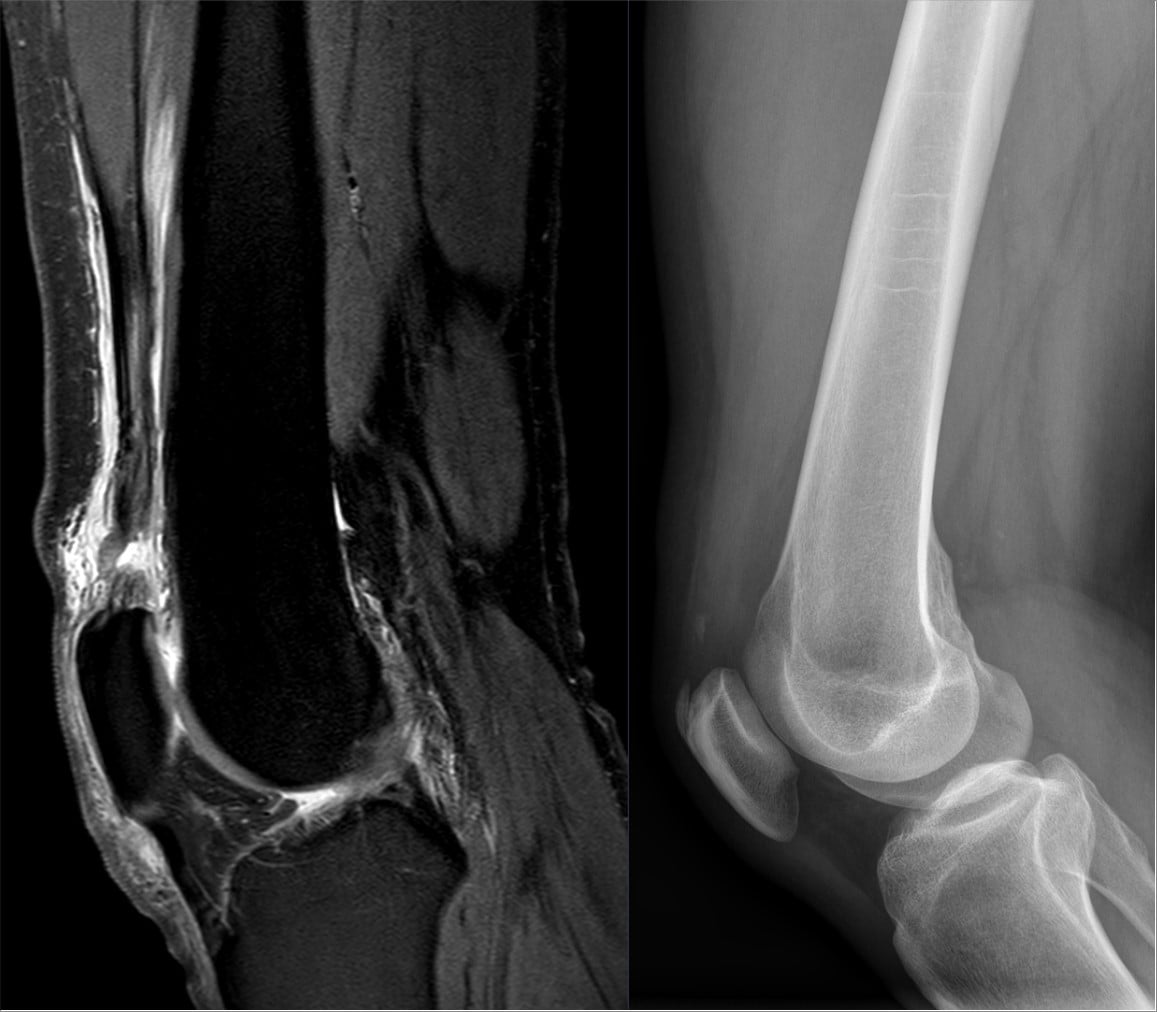
- Patella baja (low-riding patella) on lateral radiograph.
Investigations
- Radiographs (first line): lateral view shows patella baja; quantify with the Insall-Salvati ratio (patellar tendon length / patellar height; normal 0.8-1.2, less than 0.8 suggests baja). Exclude patella fracture.
- Ultrasound: fast, cheap, dynamic bedside confirmation of discontinuity and gap size; operator-dependent.
- MRI: gold standard for confirming complete vs partial tear, level and retraction, and tissue quality for surgical planning. Reserve for diagnostic doubt or partial tears.
- Bloods (if bilateral or atypical): renal function, calcium/phosphate, PTH, glucose/HbA1c, urate — to identify the systemic driver.
Differential Diagnosis
- Key Features
- Age over 40; suprapatellar gap; patella BAJA; failure 1-2cm above superior pole
- Key Features
- Age under 40; infrapatellar gap; patella ALTA; jumping athletes
- Key Features
- Mid-life; bony tenderness; transverse lucency on radiograph (not a gap)
- Key Features
- Adolescents (open apophysis); jumping injury; Ogden classification
- Key Features
- Strongly suggests systemic disease (about three-quarters of reported cases); mimics neurological 'cannot walk' presentation
Surgical Repair
- Acute (less than 3 weeks): Direct repair.
- Chronic: Reconstruction.
- Midline Incision.
- Transosseous Tunnels: Drill 3 longitudinal holes through patella. Pass #2 or #5 non-absorbable sutures (Krackow stitch) through tendon and pull through tunnels. Tie at distal pole.
- Suture Anchors: Alternative. Insert anchors into superior pole. Faster, but potentially less strong than bone tunnels.
- Reinforcement: Repair the retinaculum (medial/lateral) if torn.
- Hinged Knee Brace (Locked in extension 0-2 weeks).
- Gradual flexion (0-30° at 2 weeks, 0-60° at 4 weeks, 0-90° at 6 weeks).
- Full weight bearing in brace (locked) immediately.
Chronic Reconstruction
If tendon retracted and cannot be brought down:
- Codivilla V-Y Plasty: Lengthening the proximal tendon.
- Scuderi Turnover Flap: Folding down a flap from the rectus femoris.
- Allograft: Achilles or Whole Extensor Mechanism.
Transosseous tunnels vs suture anchors — biomechanics
- Cadaveric study (10 matched knees): transosseous tunnel repair had significantly higher ultimate tensile load than transosseous-equivalent double-row suture anchors (591 N vs 447 N, p=0.04)
- No significant difference in construct stiffness or gap formation between techniques
- All suture-anchor failures occurred at the suture eyelets; both constructs were judged sufficiently strong for repair
Clinical outcomes — transosseous vs suture anchor (systematic review)
- 8 studies, 210 knees (156 transosseous, 54 suture anchor)
- No significant difference in Lysholm score (92.6 vs 91.0); transosseous achieved slightly greater final ROM (132.5° vs 127.0°, p=0.02)
- Significantly more complications with suture anchors (9.3% vs 1.3%, p=0.013); re-rupture difference not significant (0% vs 3.7%)
Long-term outcomes after extensor mechanism repair
- 130 patients (93 quadriceps, 43 patellar tendon ruptures), mean follow-up ~10 years
- Good-to-excellent outcomes overall (mean KSS-Knee 93.1 for quadriceps ruptures); re-rupture rate 8% in the quadriceps group
- Re-rupture was associated with significantly worse functional scores
Epidemiology & risk of complications after repair
- Database cohort: 601 quadriceps and 1543 patellar tendon repairs (2010-2020); quadriceps repair patients were older on average
- 90-day complications in 39.2% of quadriceps repairs; reoperation rate 4.8%
- Female sex and Charlson comorbidity index were the strongest predictors of complications; older age, tobacco use and obesity were also independent predictors
Bilateral & simultaneous quadriceps rupture — systemic disease
- Review of 55 cases of simultaneous bilateral quadriceps tendon rupture; mean age 52, 82% male
- 76% had a predisposing systemic condition and 32% had multiple risk factors; 96% were treated surgically
- Age, multiple risk factors and renal/endocrine disease or diabetes correlated with poorer outcome
Fluoroquinolones & tendon rupture risk
- Population-based nested case-control study: current fluoroquinolone exposure raised the risk of any tendon rupture (adjusted IRR 1.61) and Achilles rupture (adjusted IRR 3.14), persisting ~60 days
- Risk rose with cumulative dose and was greatest when co-prescribed with oral corticosteroids (adjusted IRR 19.36 for Achilles rupture)
- Absolute risk was highest in patients aged 60 and over on concomitant corticosteroids
Why Systemic Disease Weakens the Tendon (REAL-Flu Mechanisms)
The REAL-Flu mnemonic, the bilateral-rupture card (Shah) and the fluoroquinolone card (Morales) all stress systemic risk factors, and a viva followUp asks how renal failure causes rupture - but the body never sets out WHY each systemic factor degrades the tendon. Rupture nearly always occurs through a pre-degenerate tendon, and these mechanisms explain the "over-40, comorbid, minimal-trauma, often bilateral" pattern.
- Renal failure / dialysis (the strongest driver). Secondary hyperparathyroidism (from phosphate retention and low active vitamin D) drives osteoclastic resorption at the bone-tendon (enthesis) junction, weakening the anchor; dialysis-related beta-2-microglobulin amyloid deposits within the tendon; and uraemic toxins impair collagen synthesis and cross-linking. This is why renal disease is the first thing to look for after a bilateral simultaneous rupture - though not the only one, since a quarter of collected cases had no identified predisposing condition.
- Diabetes. Non-enzymatic glycation forms advanced glycation end-products (AGEs) that stiffen and embrittle the collagen cross-links, while microvascular disease impairs the tendon's already-marginal blood supply and healing.
- Gout / crystal disease. Tophaceous urate infiltrates the tendon substance, replacing and disrupting collagen.
- Fluoroquinolones. They chelate magnesium (a cofactor for integrin-collagen binding), generate oxidative stress in tenocytes, and up-regulate matrix metalloproteinases that degrade collagen - the risk rises with cumulative dose and is dramatically amplified by concurrent corticosteroids (Morales: adjusted incidence-rate ratio up to about 19 for Achilles rupture on both).
- Corticosteroids (local or systemic). Suppress collagen synthesis and tenocyte proliferation and promote tenocyte apoptosis; a local peritendinous injection additionally weakens the tendon mechanically.
Q: Why do systemic diseases predispose to quadriceps tendon rupture? A: They degrade the tendon before it fails. Renal failure (secondary hyperparathyroidism resorbing the enthesis, beta-2-microglobulin amyloid, uraemic impairment of collagen) is the strongest, and why bilateral rupture signals renal disease; diabetes (AGE-crosslinked, embrittled collagen plus microvascular ischaemia); gout (tophaceous urate infiltration); fluoroquinolones (magnesium chelation, oxidative tenocyte damage and MMP up-regulation, hugely amplified by steroids); and corticosteroids (suppressed collagen synthesis, tenocyte apoptosis). Rupture then occurs through this degenerate tendon with minimal trauma in an over-40 patient.
The Krackow Locking Stitch
The repair technique and a viva followUp both name a "Krackow stitch" for grasping the tendon, but the stitch itself is never described.
- What it is. The Krackow is a locking core suture used to grip a tendon end securely before fixing it to bone. Each pass throws a self-locking loop that catches a longitudinal bundle of collagen fibres, so a series of locking loops is run down one side of the tendon and back up the other, exiting as two free suture limbs at the cut end.
- Why it is used. The interlocking loops resist pull-out and grip degenerate tissue far better than a simple whip-stitch, giving a high load-to-failure repair that tolerates early protected motion. In quadriceps repair a Krackow suture is placed in each side of the proximal tendon (typically 4-6 locking passes, about 4 cm of purchase) and the limbs are passed through the patellar bone tunnels (or tied to suture anchors) and tensioned to restore patellar height.
- The pitfalls. Loops placed too superficially cut out of friable degenerate tendon (hence deep, wide bites and augmentation in poor tissue), and over-tensioning the Krackow limbs creates a patella baja - so restore, do not shorten, the length.
Q: What is the Krackow locking stitch and why is it used for tendon repair? A: A locking core suture in which each pass throws a self-locking loop that grips a bundle of collagen fibres; locking loops run down one side of the tendon and back up the other, exiting as two limbs at the cut end. The interlocking loops resist pull-out and hold degenerate tissue, giving a strong repair that tolerates early protected motion - which is why it is the workhorse grasping stitch for quadriceps (and Achilles/patellar) tendon repair. Take deep wide bites in friable tissue and avoid over-tensioning (creates patella baja).
Management Overview
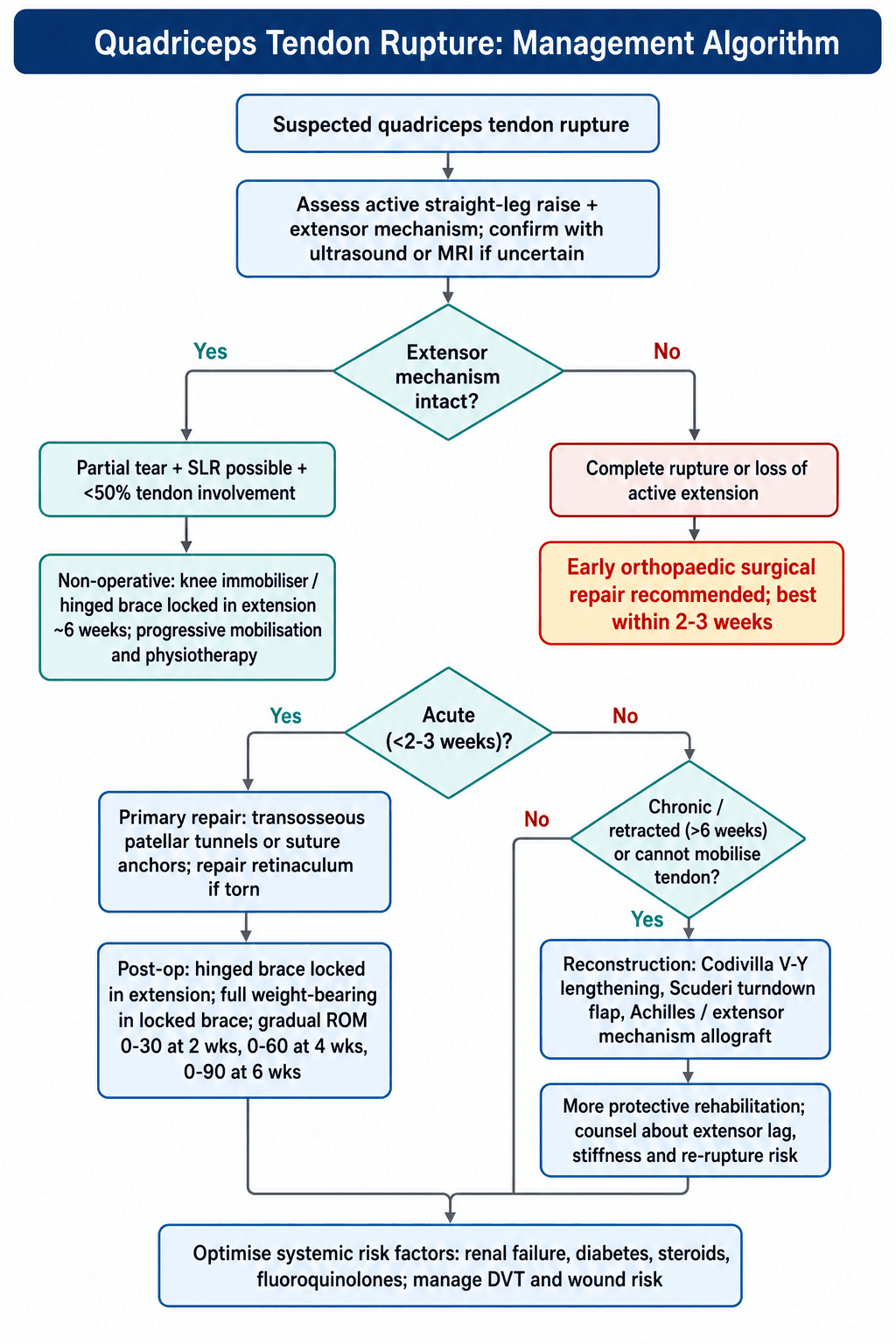
- Partial tear with intact extensor mechanism (can perform SLR, less than 50% tendon on imaging): non-operative — knee immobiliser/hinged brace in extension for ~6 weeks with progressive mobilisation.
- Complete rupture: surgical repair — there is no role for non-operative treatment as the patient loses active extension permanently. Repair early (within 2-3 weeks) gives the best outcomes.
- Acute (under 2-3 weeks): primary repair (transosseous tunnels or suture anchors).
- Chronic (over 6 weeks): retraction, scar and quadriceps contracture preclude simple repair — requires lengthening (Codivilla V-Y), turndown flap (Scuderi) or allograft reconstruction.
Management Algorithm
Complications
- Patient
- Older (over 40)
- X-ray
- Patella Baja
- Stiffness
- Common (adhesions)
- Patient
- Younger (under 40)
- X-ray
- Patella Alta
- Stiffness
- Very Common
Guidelines, Registries & Global Practice
Global epidemiology:
- Quadriceps tendon rupture is uncommon (estimated annual incidence ~1.3 per 100,000) and is the dominant extensor mechanism rupture in patients over 40, with a strong male predominance.
- Incidence is concentrated in populations with a high burden of metabolic disease — end-stage renal disease/dialysis, diabetes, gout and chronic corticosteroid or fluoroquinolone exposure — so case mix varies with regional dialysis prevalence.
- Bilateral simultaneous rupture is rare but clusters in dialysis and hyperparathyroid populations worldwide.
Side-by-side guidance (no single-country frame):
- Position on extensor mechanism repair
- Complete rupture is a surgical indication; early primary repair preferred; transosseous tunnels and suture anchors both acceptable.
- Position on extensor mechanism repair
- Acute extensor mechanism disruption warrants prompt diagnosis and timely operative repair; emphasis on not missing the injury in the "cannot straight-leg-raise" patient.
- Position on extensor mechanism repair
- Restore extensor continuity and patellar height; protect the repair with a graded, brace-controlled rehabilitation pathway.
- Position on extensor mechanism repair
- Acute primary repair for complete tears; reconstruction (V-Y, turndown, allograft) reserved for chronic/retracted tears.
unlike arthroplasty, extensor mechanism repair is not tracked in implant registries; the evidence base is biomechanical and observational (Level III-IV). Across series, transosseous tunnels and suture anchors give broadly equivalent functional outcomes (Mehta 2021), with re-rupture being the main driver of poor results (Negrin 2015).
- Well-resourced settings: routine MRI for planning, suture anchors/suture-tape augmentation, hinged braces, supervised physiotherapy, and allograft availability for chronic cases.
- Limited-resource settings: clinical diagnosis plus radiographs/ultrasound; transosseous tunnels with heavy non-absorbable suture (cheap, no implant cost); cylinder cast or simple immobiliser where hinged braces are unavailable; autograft (semitendinosus/turndown) rather than allograft for chronic reconstruction.
- Universal principles: complete ruptures need surgery; repair early; restore patellar height; protect the repair during early flexion.
Related pages: Extensor Mechanism Ruptures is the umbrella covering this injury and its patellar-tendon counterpart together, and is where the shared operative principles and the comparative epidemiology sit; Patellar Tendon Rupture is the same failure one bone distal, in a younger patient, with patella alta instead of baja - the pairing is the commonest exam discriminator on this topic; Patella Fractures for the bony equivalent that produces an identical inability to straight-leg-raise but a transverse lucency rather than a gap; Quadriceps Tendinitis for the degenerative tendinopathy that precedes most of these ruptures and explains why they happen with minimal trauma; Patellar Height Abnormalities for the Insall-Salvati and Blackburne-Peel measurements used to diagnose the injury and to judge the repair; and TKA Extensor Mechanism Failure for the same problem after arthroplasty, where the reconstruction options and the prognosis are quite different.
Controversies & Areas of Uncertainty
- Transosseous tunnels vs suture anchors: biomechanical studies disagree on which is stronger (Hart 2012 favoured tunnels; the pooled biomechanical meta-analysis found no significant difference, with a point estimate that ran the other way — Dankert 2022), and clinical outcomes are broadly equivalent (Mehta 2021). No high-level RCT exists; choice remains surgeon preference.
- Suture-tape / internal-brace augmentation: increasingly used in poor-quality tendon (diabetes, renal disease, revision) to permit earlier rehabilitation, but evidence is largely biomechanical and short-term; routine use is not established.
- Rehabilitation tempo: accelerated, early-motion protocols may reduce stiffness but risk gapping/elongation in degenerate tendon; the optimal balance and the safe threshold for early flexion are not defined by trial data.
- Partial tears: the imaging and clinical threshold for operative versus non-operative management of partial ruptures is not standardised.
- Chronic reconstruction: no consensus on the best technique (V-Y lengthening vs Scuderi turndown vs allograft); the systematic review evidence base is heterogeneous and low-level (Kim 2022 for the analogous patellar tendon literature).
MCQ Practice Points
Q: What is the classic clinical triad of quadriceps tendon rupture?
A: 1) Palpable suprapatellar gap, 2) Loss of active knee extension (inability to perform straight leg raise), 3) Patella baja on lateral X-ray. The gap is palpable at the superior pole of the patella. Unlike patellar tendon rupture (patella alta), quad rupture shows low-riding patella.
Q: What are the major risk factors for quadriceps tendon rupture?
A: Age over 40 (most common extensor mechanism rupture in this group), chronic renal failure (accumulation of β2-microglobulin), diabetes mellitus, hyperparathyroidism, steroid use (local or systemic), fluoroquinolone antibiotics, and gout. Bilateral simultaneous rupture strongly suggests systemic disease.
Q: What is the layered anatomy of the quadriceps tendon?
A: The quadriceps tendon has three layers: Superficial - rectus femoris, Middle - vastus lateralis and medialis converging, Deep - vastus intermedius. The rectus femoris continues over the patella as the prepatellar fascia. Most ruptures occur 0-2 cm above the superior pole of the patella in a relatively hypovascular zone.
Q: What is the treatment of choice for complete quadriceps tendon rupture?
A: Primary surgical repair through transosseous tunnels in the patella. Technique involves passing heavy non-absorbable sutures (Krackow or Bunnell pattern) through the tendon and through three longitudinal drill holes in the patella. Repair is augmented with medial and lateral retinacular repair. Must restore patella height (compare to contralateral).
Q: What is the Codivilla V-Y plasty used for in quadriceps tendon surgery?
A: Used for chronic ruptures with retraction where direct repair is not possible. The technique involves creating a V-shaped incision in the quadriceps muscle proximally, allowing distal mobilization of the tendon. The resulting proximal defect is closed in a Y configuration. Restores tendon length but may result in some extensor weakness.
At a Glance
Quadriceps tendon rupture typically occurs in patients older than 40 years (versus patellar tendon ruptures in younger patients), with rupture at the hypovascular zone 1-2cm proximal to the patella. The clinical triad is a palpable suprapatellar gap, inability to perform straight leg raise, and patella baja on lateral radiograph (compare to patella alta in patellar tendon rupture). Bilateral quadriceps rupture strongly suggests systemic disease (diabetes, renal failure, hyperparathyroidism, RA, fluoroquinolone use) - about three-quarters of reported cases have a predisposing condition, so treat it as a prompt to investigate rather than as proof - and is often misdiagnosed as neurological pathology. Complete ruptures require surgical repair within 3 weeks for best outcomes; chronic ruptures (greater than 6 weeks) require V-Y lengthening or reconstruction due to tendon retraction and atrophy.
REAL-FluRisk Factors for Tendon Rupture
Hook:REAL Flu makes tendons weak — Systemic causes
GLPDiagnostic Triad
Hook:Gap, Lag, Patella baja — The three findings that clinch the diagnosis
TPPQWhere the Extensor Mechanism Fails by Age
Hook:Tubercle, Patellar tendon, Patella, Quadriceps — youngest to oldest — Weakest link shifts distal-to-proximal with increasing age
Exam Viva Scenarios
Practise clinical reasoning and management decisions out loud
“A 55-year-old dialysis patient presents to the Emergency Department unable to walk. He says his legs 'gave way' when he tried to stand up from a chair. He denies any significant trauma - he simply felt both knees give way. He has been on haemodialysis for 8 years for end-stage renal disease due to polycystic kidney disease. His past medical history includes secondary hyperparathyroidism, diabetes mellitus, and he is on a renal transplant waiting list. On examination, he cannot perform a straight leg raise on either side. There is a palpable suprapatellar gap bilaterally. His knees have full passive range of motion but he has no active extension. Plain radiographs show low-riding patellas bilaterally (patella baja). The emergency medicine team initially suspected Guillain-Barré syndrome and requested a neurology consult, but you are called as the orthopaedic registrar. What is the diagnosis and how do you manage this patient?”
“A 52-year-old type 2 diabetic man presents to your clinic 5 days after injuring his knee. He was walking down stairs when he missed a step and his right knee 'gave out'. He fell to the ground and has been unable to fully extend his knee or perform a straight leg raise since. He went to his GP initially who gave him crutches and told him he had a 'knee sprain', but when symptoms persisted he self-referred to your clinic. His past medical history includes well-controlled type 2 diabetes (HbA1c 7.2%, on metformin), hypertension, and hyperlipidaemia. He is otherwise fit and active, working as a carpenter. On examination, there is a palpable suprapatellar gap on the right knee. He has full passive range of motion (0-135°) but cannot perform an active straight leg raise - when you ask him to extend against gravity, the knee extends to about 30° short of full extension with visible quadriceps effort but no further. When you support the leg, he can hold it extended passively but it drops immediately when you release. The left knee is normal with full active extension. Plain radiographs show patella baja on the right (Insall-Salvati ratio 0.7) compared to normal on the left (1.0). There is no fracture. You arrange an urgent MRI which confirms complete rupture of the quadriceps tendon 1.5cm proximal to the superior pole of the patella, with 2cm of retraction. The tear appears to involve all three layers (rectus femoris, vasti, intermedius). How do you counsel him and what is your surgical plan?”
“You are seeing a 60-year-old man in your reconstructive clinic who was referred from a rural area. He sustained a quadriceps tendon rupture 10 weeks ago when he fell on icy steps. He was seen at a local emergency department where X-rays were performed and showed no fracture, and he was told he had a 'severe knee contusion' and given crutches and analgesia. He was unable to walk properly or extend his knee, but because he lives alone on a farm and has limited mobility, he did not seek further medical attention. Over the past 10 weeks, he has been largely immobile, using crutches and a wheelchair, and has developed significant quadriceps atrophy. His daughter recently visited and insisted he see a specialist, which led to this referral. On examination, you note severe quadriceps wasting with the thigh circumference 8cm less than the contralateral side. There is a palpable suprapatellar depression. He cannot perform any active knee extension - when you ask him to try, you see quadriceps muscle contraction proximally but no movement at the knee. His passive range of motion is limited to 30-100° due to a fixed flexion contracture that has developed. The patella is palpable very high in the suprapatellar region. Plain radiographs show severe patella baja with Insall-Salvati ratio of 0.5 (compared to 1.1 on the contralateral side). MRI shows complete quadriceps tendon rupture with 6cm of retraction and scarring. The tendon stump is retracted and adherent to the distal femur. There is significant quadriceps muscle atrophy with fatty infiltration and contracture. The superior pole of the patella shows bone resorption. He is desperate to regain some function as he cannot manage his farm independently. How do you counsel him and what are the surgical options?”
Triad
- 1. Palpable Gap (Supra-patellar)
- 2. Loss of Active Extension (SLR)
- 3. Patella Baja (X-ray)
Risk Factors
- Age over 40
- Renal Failure
- Diabetes
- Fluoroquinolones
Treatment
- Complete: Repair (Transosseous)
- Partial: Splint 6w
References
- Hart ND, Wallace MK, Scovell JF, et al. Quadriceps tendon rupture: a biomechanical comparison of transosseous equivalent double-row suture anchor versus transosseous tunnel repair. J Knee Surg. 2012;25(4):335-9. PMID 23150161. doi:10.1055/s-0031-1299656
- Mehta AV, Wilson C, King TS, Gallo RA. Outcomes following quadriceps tendon repair using transosseous tunnels versus suture anchors: a systematic review. Injury. 2020;52(3):339-344. PMID 33041016. doi:10.1016/j.injury.2020.10.020
- Negrin LL, Nemecek E, Hajdu S. Extensor mechanism ruptures of the knee: differences in demographic data and long-term outcome after surgical treatment. Injury. 2015;46(10):1957-63. PMID 26190628. doi:10.1016/j.injury.2015.06.042
- Oeding JF, Alrabaa R, Wong SE, et al. Complications and re-operations after extensor mechanism repair surgery in a large cross-sectional cohort. Knee Surg Sports Traumatol Arthrosc. 2022;31(2):455-463. PMID 35841396. doi:10.1007/s00167-022-07061-9
- Shah MK. Outcomes in bilateral and simultaneous quadriceps tendon rupture. Orthopedics. 2003;26(8):797-8. PMID 12938944. doi:10.3928/0147-7447-20030801-18
- Morales DR, Slattery J, Pacurariu A, et al. Relative and absolute risk of tendon rupture with fluoroquinolone and concomitant fluoroquinolone/corticosteroid therapy. Clin Drug Investig. 2019;39(2):205-213. PMID 30465300. doi:10.1007/s40261-018-0729-y
- Dankert JF, Mehta DD, Remark LH, Leucht P. Transosseous tunnels versus suture anchors for the repair of acute quadriceps and patellar tendon ruptures: a systematic review and meta-analysis of biomechanical studies. J Orthop Sci. 2022;28(4):821-828. PMID 35490080. doi:10.1016/j.jos.2022.04.001