Direct Anterior vs Posterior Approach for THA: Dislocation, Nerve Injury and Recovery Evidence
Anterior vs posterior hip replacement on the evidence: dislocation, nerve injury, femoral complications and how much faster recovery really is after each.
By OrthoVellum Editorial TeamPublished 12 min read
Educational content for clinicians, not medical advice. Editorial policy

Key points
- The direct anterior approach (DAA) uses a true internervous interval between tensor fascia lata and sartorius, supine; the posterior approach splits gluteus maximus and divides the short external rotators and posterior capsule, which must then be repaired.
- Recovery is faster with the DAA for weeks, not years. Randomised trials show less early pain and earlier independence from walking aids; by 6 to 12 months, and at 5 years in one trial, outcomes converge.
- Dislocation is lower after the DAA in registries (Kaiser adjusted HR 0.44 against posterior), but posterior repair narrows the gap, and a meta-analysis of randomised trials found no significant difference.
- Each approach has its own nerve. The DAA carries a large excess of lateral femoral cutaneous nerve numbness and a higher femoral nerve palsy rate; the posterior approach puts the sciatic nerve at risk.
- The DAA's weak point is the femur. The Australian registry found more early revisions for periprosthetic fracture and femoral loosening, and in the Dutch registry revision risk was raised for a surgeon's first 50 cases and levelled off at about 100.
On this page8 sections
Patients now ask for "the anterior one" by name, and trainees are asked to defend their approach in the viva. The honest answer to anterior vs posterior hip replacement is that neither wins outright. The direct anterior approach (DAA) buys a faster first few weeks and, in registries, fewer dislocations at the price of thigh numbness, femoral nerve palsy and, early in a surgeon's experience, femoral fractures and loosening; the posterior approach is familiar and easily extended but depends on a good posterior repair. By a year, function is the same. This post sets the evidence side by side. Indications and the rest of the operation are on the total hip arthroplasty indications page.
How do the two approaches differ?
They reach the same joint from opposite sides, and almost every difference in outcome follows from what each one divides.
The direct anterior approach is done supine, often on a radiolucent table with an extension attachment and a C-arm. It uses the interval between tensor fascia lata (superior gluteal nerve) and sartorius (femoral nerve), a true internervous plane. Deep to it lie rectus femoris and the ascending branch of the lateral femoral circumflex artery, which must be controlled before the anterior capsule is opened. No muscle is detached, but to deliver the femur the leg must be extended, externally rotated and adducted off the side of the table, and the capsule released generously.
The posterior approach is done in the lateral decubitus position. Gluteus maximus is split in line with its fibres, both sides supplied by the inferior gluteal nerve, so there is no true internervous plane. The short external rotators and posterior capsule are released and then repaired. Exposure of the femur and acetabulum is broad and easily extended, which is why it is widely used for revision. The layer-by-layer anatomy is in our post on the posterior approach to the hip.
| Direct anterior | Posterior | |
|---|---|---|
| Position | Supine; fluoroscopy easy | Lateral decubitus |
| Plane | TFL (superior gluteal) / sartorius (femoral): internervous | Gluteus maximus split (inferior gluteal on both sides): not internervous |
| Divided | Anterior capsule; no muscle detached | Short external rotators and posterior capsule, then repaired |
| Nerves at risk | Lateral femoral cutaneous, femoral | Sciatic (peroneal division) |
| Vessels at risk | Ascending lateral femoral circumflex branches; femoral vessels medially | Superior and inferior gluteal vessels |
| Dislocation it favours | Anterior: extension and external rotation | Posterior: flexion, adduction and internal rotation |
| Hardest step | Femoral exposure and broaching | Sciatic protection and posterior repair |
The supine advantage. Lying the patient flat lets the surgeon compare leg lengths directly, check the cup with fluoroscopy, and operate on both hips at one sitting. In the meta-analysis of randomised trials by Yang and colleagues, more DAA cups landed inside the Lewinnek zone (RR 1.20, 95% CI 1.04–1.39), although mean inclination and anteversion did not differ.
Does the anterior approach really recover faster?
Yes, for weeks. The trials agree on the direction and on how quickly the difference disappears.
- Barrett (2013): a single-surgeon trial of 87 hips (43 DAA, 44 posterolateral). DAA patients had lower pain on day 1, more were climbing stairs normally and walking unlimited at 6 weeks, and HOOS symptom scores were higher at 3 months. There were no differences at 6 or 12 months, and the 5-year follow-up (opens in a new tab) found no difference in Harris Hip Score, UCLA activity, HOOS Jr or survivorship.
- Taunton (2014): 54 patients randomised to DAA or a mini-posterior approach. DAA patients gave up all walking aids at a mean of 22 days against 28 (p = 0.04). Little else differed.
- Yang (2020): 932 patients in randomised trials (467 DAA, 465 posterior). Pain was lower with the DAA (weighted mean difference −0.65 on the pain scale), and two trials reported earlier discontinuation of walking aids. Operating time, length of stay and blood loss did not differ.
- Meermans (2017): 42 studies, mostly of medium to low quality. Hip scores were better after the DAA for the first 6 weeks and the same thereafter; length of stay and gait analysis did not differ; operating time was usually longer, with a steep learning curve.
The fair summary is a real but short advantage, measured in days to a few weeks, from small trials, one of them a single surgeon's series. It is a reasonable thing to offer a patient who values the first month. It is not a reason to expect a better hip at a year.
Which approach dislocates less?
Posterior dislocation, in flexion, adduction and internal rotation, makes up 75–80% of all THA dislocations and is commonest after the posterior approach, because the approach divides the posterior capsule and rotators that resist it. Anterior dislocation, in extension and external rotation, is more common after anterior and anterolateral approaches. Commonly quoted ranges, which are teaching figures rather than one study's results, are 2–5% for the posterior approach and 0.5–2% for the DAA. The detail is on the THA dislocation page.
Registries favour the DAA. In the Kaiser Permanente registry (22,237 hips analysed for dislocation, median follow-up 3 years), the DAA had an adjusted hazard ratio of 0.44 (95% CI 0.22–0.87) for dislocation against the posterior approach, with no difference in aseptic or septic revision. The absolute event rate was low: 276 dislocations, about 1%. The Australian registry analysis of 122,345 primary THAs found more revisions for dislocation after the posterior approach than after either the anterior or lateral approach, in every time period studied.
Repair closes most of the gap. In Kwon's meta-analysis of five comparative studies, posterior dislocation was 0.49% with soft-tissue repair against 4.46% without (relative risk 8.21 for no repair). In a separate review of 11 studies, rates with repair were 1.01% posterior, 0.70% anterolateral and 0.43% direct lateral. These are older observational series with different heads, implants and rehabilitation, so treat the numbers as direction of effect.
Randomised trials are underpowered for it. In Yang's meta-analysis the dislocation relative risk was 0.47 for DAA against posterior, but the confidence interval ran from 0.11 to 2.05. Dislocation is too rare for trials of a few hundred patients to settle.
Approach is one part of stability. Head size, component version (the most important single factor), impingement, soft-tissue tension and spinopelvic stiffness all matter (see the hip-spine relationship in THA). A patient at high risk of instability may be better served by changing the bearing, for example to dual mobility, than by changing the approach alone.
Precautions. Practice varies after the DAA: some units set none, others restrict extension and external rotation for about 6 weeks. After the posterior approach, a review of 6,900 patients (opens in a new tab) found dislocation in 2.2% with precautions and 2.0% without, a difference that was not significant.
Which nerves are at risk with each approach?
Each approach has its own nerve, and the anterior one is injured far more often but matters far less.
Lateral femoral cutaneous nerve (DAA). This purely sensory nerve (L2–L3) emerges close to the anterior superior iliac spine, runs with sartorius and branches variably, so it lies near the proximal end of the incision. In Yang's meta-analysis, injury was much more common after the DAA (RR 38.97, 95% CI 7.89–192.57); the very wide confidence interval reflects small numbers of events. How common it is depends on how hard you look. Figures of 15–30% are often quoted, but when Goulding and colleagues gave questionnaires to 132 patients a year after anterior approach arthroplasty, 81% reported symptoms (67% after THA, 91% after resurfacing). SF-12, WOMAC and UCLA scores showed no functional limitation, and in a subset followed over time only 3 of 53 symptomatic patients (6%) had fully resolved.
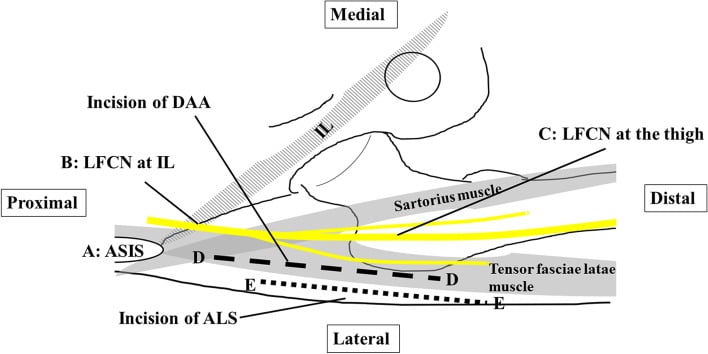
Prevention is anatomical: start the incision distal and lateral to the ASIS, open the TFL sheath rather than the sartorial fascia, and avoid heavy medial traction. Consent for numbness over the outer thigh before every DAA.
Femoral nerve (DAA). Femoral nerve palsy is rare but more frequent with anterior exposures. Among 17,350 primary THAs at one institution, Fleischman and colleagues found an overall rate of 0.21%, rising to 0.40% with the direct anterior and 0.64% with the anterolateral approach, a 14.8-fold higher incidence for anterior surgery. Recovery is slow: for most patients meaningful recovery did not begin until after 6 months, motor weakness had resolved in 75% by about 33 months, and sensory symptoms resolved completely in fewer than 20%. The mechanisms are anterior retractor compression and hip hyperextension, so retractors go on bone and are relaxed during the case.
Sciatic nerve (posterior). The sciatic nerve accounts for about 80% of nerve injuries after THA, its peroneal division more often than the tibial. In 27,004 primary THAs at the Mayo Clinic, Farrell found motor palsy in 0.17%; developmental dysplasia, post-traumatic arthritis, the posterior approach and lengthening of the limb were associated with it. Only 36% of complete palsies recovered fully. Approach is not the whole story: in a prospective series of 1,000 THAs, posterior and transtrochanteric approaches did not differ significantly, but that comparison rested on eight events. The detail is on the THA neurovascular injury page.
Is the femur the weak point of the anterior approach?
Yes, during the learning curve and possibly beyond it. Femoral preparation through the DAA needs the hip extended and externally rotated, a complete capsular release and offset instruments, and a femur that cannot be seen is a femur that can be fractured or under-sized.
- Australian registry (Hoskins 2020): 122,345 primary THAs for osteoarthritis, 32,086 of them anterior. Overall early revision did not differ by approach, but the anterior approach had a higher rate of major revision and, after adjustment, of revision for periprosthetic fracture and femoral loosening, and lower rates of revision for dislocation and infection than the posterior approach.
- Early femoral failure (Meneghini 2017): in 342 early revisions of cementless THAs at three academic centres, 57 of 112 early femoral failures (50.9%) followed the DAA, against 34.8% after the direct lateral and 14.3% after the posterior approach. The DAA remained a predictor after adjustment for age, sex, bone type, BMI and stem type. The study counted revisions, not the number of operations at risk, so it cannot give a rate.
- Learning curve (Peters 2022): in 15,875 DAA hips in the Dutch Arthroplasty Register, revision risk was raised for a surgeon's first 25 cases (HR 1.6) and cases 26–50 (HR 1.6), raised but not significantly for cases 51–100 (HR 1.3), and steady from about 100. Stem loosening was the commonest reason for revision (29%). Operative texts quote a 2–5% femoral fracture rate early in the curve, falling below 1% with experience.
One signal points the other way. A Mayo Clinic risk calculator (opens in a new tab) built on 16,696 THAs found a higher periprosthetic femoral fracture risk with approaches other than the DAA (posterior HR 1.9, lateral 2.9). Approach was chosen, not allocated, and the data span 1998 to 2018, so neither direction should be quoted as cause and effect. The safe statement is that femoral complications cluster where femoral exposure is difficult, whatever the approach. More on periprosthetic fractures after THA.
Wounds and obesity. In a Mayo series (opens in a new tab) of 716 DAA and 3,040 posterior THAs, wound complications were similar overall (1.7% against 1.9%), but obesity was a stronger risk factor after the DAA (HR 4.3) than after the posterior approach (HR 1.4).
Who suits which approach?
The approach is a technical choice, not a different operation. The question is which exposure lets this surgeon do the best reconstruction in this patient.
| Patient or setting | Leans towards | Why |
|---|---|---|
| Wants the fastest first month | DAA | Less early pain; walking aids dropped 6 days earlier in one trial |
| Bilateral disease | DAA | Supine position allows both hips at one sitting |
| High dislocation risk | DAA, or posterior with repair and a stability-focused bearing | Posterior restraints preserved; bearing choice matters as much |
| Obese, with an anterior pannus | Debated; some avoid the DAA | Higher wound-complication risk after DAA in obese patients |
| Severe proximal femoral deformity, retained hardware, fixed flexion contracture | Posterior or lateral | Femoral exposure through the DAA is difficult or impossible |
| Revision or likely need to extend | Posterior | Exposure extends easily |
| Surgeon in the first 50–100 DAA cases | Supervised DAA or familiar approach | Revision risk raised early in the curve |
Whichever is used, the surgeon should be able to convert. If the proximal femur cannot be seen after release and repositioning through the DAA, the operative guides advise extending or converting rather than forcing the broach. The step-by-step technique is in the direct anterior THA operative guide, and the posterior equivalent in the posterior approach operative guide.
Key numbers
| Number | What it means | Source and population |
|---|---|---|
| 22 vs 28 days | Time to stop all walking aids, DAA vs mini-posterior | Taunton RCT, 54 patients |
| HR 0.44 | Adjusted dislocation risk, DAA vs posterior | Kaiser registry, 22,237 hips |
| 0.49% vs 4.46% | Posterior dislocation with vs without soft-tissue repair | Kwon meta-analysis, 5 studies |
| RR 38.97 | Lateral femoral cutaneous nerve injury, DAA vs posterior | Yang meta-analysis of RCTs, 932 patients |
| 0.40% vs 0.21% | Femoral nerve palsy, DAA vs all THAs | Fleischman, 17,350 THAs |
| 0.17% | Motor nerve palsy after primary THA | Farrell, 27,004 THAs |
| ~100 cases | Point at which DAA revision risk levels off | Dutch Arthroplasty Register, 15,875 hips |
In the exam
Examiners are not looking for a favourite. They want the trade-offs named, with numbers, and an answer that puts the surgeon's own experience into the decision.
Frequently asked questions
Is anterior hip replacement better than posterior?
Neither approach is better overall. Randomised trials show the direct anterior approach gives less pain and quicker independence in the first weeks, with function the same by 6 to 12 months. It dislocates less often in registries but causes more thigh numbness and, early in a surgeon's experience, more femoral complications. The posterior approach dislocates more without careful repair. Surgeon experience with the chosen approach matters more than the label.
Does the anterior approach have a lower dislocation rate?
In large registries, yes. Kaiser Permanente data on 22,237 hips gave the direct anterior approach an adjusted hazard ratio for dislocation of 0.44 against posterior, and the Australian registry found more revisions for dislocation after the posterior approach. A meta-analysis of randomised trials did not show a significant difference, and posterior capsular and rotator repair brings the posterior rate down to about 1%.
Why is my thigh numb after anterior hip replacement?
The lateral femoral cutaneous nerve, a purely sensory nerve, runs close to the direct anterior incision and is easily stretched or cut. It produces numbness or burning over the outer thigh. In a meta-analysis of randomised trials it was far more common than after the posterior approach. It rarely limits function, but symptoms often improve only partly, so it belongs in the consent conversation.
Do you need hip precautions after anterior hip replacement?
Practice varies. Many surgeons using the direct anterior approach set no movement restrictions because the posterior capsule and short external rotators are left intact; others restrict extension and external rotation for about 6 weeks. Even after the posterior approach, a review of 6,900 patients found dislocation rates of 2.2% with precautions and 2.0% without, so routine restrictions add little.
How long is the learning curve for the direct anterior approach?
Estimates run from about 30 to 100 cases. The largest data set, 15,875 direct anterior hips in the Dutch Arthroplasty Register, found revision risk raised by about 60% for a surgeon's first 50 cases, still raised but not significantly between 50 and 100, and steady from about 100 onwards. Stem loosening was the commonest reason for revision.
References
- Barrett WP, Turner SE, Leopold JP. Prospective randomized study of direct anterior vs postero-lateral approach for total hip arthroplasty. J Arthroplasty 2013;28(9):1634-1638. DOI (opens in a new tab)
- Taunton MJ, Mason JB, Odum SM, Springer BD. Direct anterior total hip arthroplasty yields more rapid voluntary cessation of all walking aids: a prospective, randomized clinical trial. J Arthroplasty 2014;29(9 Suppl):169-172. DOI (opens in a new tab)
- Yang XT, Huang HF, Sun L, Yang Z, Deng CY, Tian XB. Direct anterior approach versus posterolateral approach in total hip arthroplasty: a systematic review and meta-analysis of randomized controlled studies. Orthop Surg 2020;12(4):1065-1073. DOI (opens in a new tab)
- Meermans G, Konan S, Das R, Volpin A, Haddad FS. The direct anterior approach in total hip arthroplasty: a systematic review of the literature. Bone Joint J 2017;99-B(6):732-740. DOI (opens in a new tab)
- Sheth D, Cafri G, Inacio MC, Paxton EW, Namba RS. Anterior and anterolateral approaches for THA are associated with lower dislocation risk without higher revision risk. Clin Orthop Relat Res 2015;473(11):3401-3408. DOI (opens in a new tab)
- Kwon MS, Kuskowski M, Mulhall KJ, Macaulay W, Brown TE, Saleh KJ. Does surgical approach affect total hip arthroplasty dislocation rates? Clin Orthop Relat Res 2006;447:34-38. DOI (opens in a new tab)
- Hoskins W, Bingham R, Lorimer M, Hatton A, de Steiger RN. Early rate of revision of total hip arthroplasty related to surgical approach: an analysis of 122,345 primary total hip arthroplasties. J Bone Joint Surg Am 2020;102(21):1874-1882. DOI (opens in a new tab)
- Meneghini RM, Elston AS, Chen AF, Kheir MM, Fehring TK, Springer BD. Direct anterior approach: risk factor for early femoral failure of cementless total hip arthroplasty: a multicenter study. J Bone Joint Surg Am 2017;99(2):99-105. DOI (opens in a new tab)
- Peters RM, Ten Have BLEF, Rykov K, et al. The learning curve of the direct anterior approach is 100 cases: an analysis based on 15,875 total hip arthroplasties in the Dutch Arthroplasty Register. Acta Orthop 2022;93:775-782. DOI (opens in a new tab)
- Goulding K, Beaulé PE, Kim PR, Fazekas A. Incidence of lateral femoral cutaneous nerve neuropraxia after anterior approach hip arthroplasty. Clin Orthop Relat Res 2010;468(9):2397-2404. DOI (opens in a new tab)
- Fleischman AN, Rothman RH, Parvizi J. Femoral nerve palsy following total hip arthroplasty: incidence and course of recovery. J Arthroplasty 2018;33(4):1194-1199. DOI (opens in a new tab)
- Farrell CM, Springer BD, Haidukewych GJ, Morrey BF. Motor nerve palsy following primary total hip arthroplasty. J Bone Joint Surg Am 2005;87(12):2619-2625. DOI (opens in a new tab)
Study the full topic
Included in Pro
Go deeper with Pro
- Operative guide: total hip replacement through the direct anterior approach
- Operative guide: posterior approach to the hip (Moore/Southern)
Share this article
Cite this article
OrthoVellum Editorial Team. Direct Anterior vs Posterior Approach for THA: Dislocation, Nerve Injury and Recovery Evidence [Internet]. OrthoVellum; 2026 Oct 30 [cited 2026 Oct 30]. Available from: https://www.orthovellum.com/blog/anterior-vs-posterior-hip-replacement
About this content
Prepared by the OrthoVellum Editorial Team from cited sources, under our editorial policy.
For education and exam preparation; not medical advice or a substitute for clinical judgement and local guidance.
Spotted an error? Tell us; every report is read.
Get new articles by email
New clinical explainers, landmark-trial summaries and exam guidance from the OrthoVellum blog. No account needed; unsubscribe from any email.