Hemiarthroplasty vs Total Hip Replacement for Displaced Hip Fractures: HEALTH, WHiTE 5 and Who Gets What
Hemiarthroplasty vs total hip replacement for displaced hip fracture: what HEALTH and WHiTE 5 found, NICE's 2023 criteria, cement, dislocation and approach.
By OrthoVellum Editorial TeamPublished 12 min read
Educational content for clinicians, not medical advice. Editorial policy

Key points
- HEALTH randomised 1,495 independently walking patients aged 50 or over: a secondary hip procedure within 24 months followed 7.9% of total hip replacements and 8.3% of hemiarthroplasties, and the authors called the functional gain from total hip replacement clinically unimportant.
- Dislocation is the price. Instability or dislocation was 4.7% after total hip replacement against 2.4% after hemiarthroplasty in HEALTH, and the 2022 Cochrane review found the risk roughly doubled (RR 1.96).
- NICE's 2023 recommendation is to consider, not offer, total hip replacement: for people who walked independently out of doors with no more than a stick, have no condition that makes it unsuitable, and are expected to stay independent beyond 2 years. Cognitive impairment is no longer a listed exclusion.
- WHiTE 5 (1,225 patients aged 60 or over) found cemented hemiarthroplasty gave modestly better quality of life at 4 months and fewer periprosthetic fractures (0.5% vs 2.1%) than a modern uncemented stem.
- Cement carries a risk of bone cement implantation syndrome. The joint AAGBI, BOA and BGS guideline manages it by identifying high-risk patients, briefing the team and preparing the canal carefully, not by abandoning cement.
On this page9 sections
A displaced intracapsular hip fracture in an older patient is replaced, not fixed. The argument at the trauma meeting is which replacement: hemiarthroplasty vs total hip replacement, and whether the hemiarthroplasty should be cemented. Two trials settle most of it. HEALTH showed that in patients who walked independently, a total hip replacement gave a small functional gain, no fewer reoperations and about twice the dislocation rate. WHiTE 5 showed that a cemented hemiarthroplasty did better than a modern uncemented one. The answer in one sentence: a cemented hemiarthroplasty for most, and a total hip replacement considered for the independent patient expected to benefit beyond 2 years. The fracture itself is covered on the neck of femur fracture topic page.
What did the HEALTH trial find?
The HEALTH investigators randomised 1,495 patients aged 50 or over with a displaced femoral neck fracture, at 80 centres in 10 countries, to total hip arthroplasty or hemiarthroplasty. Every patient had been able to walk without the help of another person before the fracture. The primary endpoint was a secondary hip procedure within 24 months.
| Outcome over 24 months | Total hip arthroplasty | Hemiarthroplasty | Effect |
|---|---|---|---|
| Secondary hip procedure (primary endpoint) | 7.9% (57 of 718) | 8.3% (60 of 723) | HR 0.95, 95% CI 0.64–1.40; P = 0.79 |
| Hip instability or dislocation | 4.7% (34) | 2.4% (17) | HR 2.00, 99% CI 0.97–4.09 |
| Mortality | 14.3% | 13.1% | P = 0.48 |
| Serious adverse events | 41.8% (300) | 36.7% (265) | No P value given in the abstract |
| WOMAC function, pain and stiffness | Modestly better | — | Clinically unimportant, in the authors' words |
How to read it. The primary result is null: the honest summary is that reoperation was the same, not that either operation was superior. The WOMAC scores favoured total hip arthroplasty, but the authors concluded that it gave "a clinically unimportant improvement" in function and quality of life over 24 months. The dislocation difference is about twofold, but its 99% confidence interval crosses 1.
The 2022 Cochrane review of arthroplasty for hip fracture (Lewis and colleagues) pooled 17 studies with 3,232 participants comparing the two. Dislocation was higher after total hip arthroplasty (RR 1.96, 95% CI 1.17–3.27; 12 studies), the 12-month mortality estimate was RR 1.00 (95% CI 0.83–1.22), consistent with both benefit and harm, and the estimate for unplanned return to theatre (RR 0.63, 95% CI 0.37–1.07) was low-certainty and included both benefit and no effect. The authors' conclusion matches HEALTH: any benefit of total hip arthroplasty "is likely to be small and not clinically appreciable".
What HEALTH cannot tell you. It enrolled only people who walked without another person's help, so it says nothing about the frail, dependent or institutionalised patient who makes up much of a hip-fracture list. And 24 months is short. Acetabular erosion after hemiarthroplasty is a late problem, so the follow-up may underestimate the difference that matters to a patient who lives for another decade.
What does NICE now recommend?
NICE CG124 recommends replacement arthroplasty, total hip replacement or hemiarthroplasty, for a displaced intracapsular fracture (recommendation 1.6.2). The choice between them was rewritten in January 2023, and the new wording is softer than the version most candidates learnt.
| NICE 2011 | NICE 2023 (current, 1.6.3) | |
|---|---|---|
| Verb | Offer total hip replacement | Consider total hip replacement rather than hemiarthroplasty |
| Mobility | Walked independently out of doors with no more than a stick | Walked independently out of doors with no more than a stick |
| Cognition | Not cognitively impaired | Not listed as an exclusion |
| Fitness | Medically fit for anaesthesia and the procedure | No condition or comorbidity that makes the procedure unsuitable |
| Horizon | Not stated | Expected to carry out activities of daily living independently beyond 2 years |
The current text is on the NICE CG124 recommendations page (opens in a new tab); the 2011 wording is preserved in the Royal College of Physicians summary (opens in a new tab). The committee's reasoning, published alongside it, explains each change.
- Why "consider". Some studies showed greater benefit from total hip arthroplasty, but for most outcomes the difference was not clinically or statistically significant. The guideline's own health economic model suggested total hip arthroplasty may have some benefit and be more cost-effective beyond 2 years; the evidence was not strong enough to recommend it for everyone.
- Why the 2-year horizon. Older people may not live long enough to see the long-term benefit, and people who are not very mobile may be less troubled by the consequences of a hemiarthroplasty, such as wear on the acetabulum. The committee also noted that hemiarthroplasty is less complicated and could mean less dislocation and less blood loss.
- Why cognition was dropped. The committee recognised that some people with significant cognitive impairment may be at greater risk of dislocation, but judged the evidence too limited for a specific recommendation. It asks clinicians to weigh comorbidities by their effect on function, and expects the change to stop people with mild cognitive impairment being excluded from total hip replacement unnecessarily. The decision is normally made by a multidisciplinary team.
Much exam teaching still quotes the 2011 criteria and a life expectancy of more than about 4 years. Quote the current wording, and name the year.
Who gets what?
The fracture decides that the head is replaced. The patient decides whether the acetabulum is replaced as well.
| Patient | Usual operation | Reasoning |
|---|---|---|
| Walked independently outdoors with no more than a stick, fit for the procedure, expected to stay independent beyond 2 years | Consider a total hip replacement | NICE 1.6.3; a small functional gain and, in NICE's model, cost-effectiveness beyond 2 years |
| As above, with pre-existing arthritis of the hip | Total hip replacement | The acetabulum is already diseased; a hemiarthroplasty head would articulate against damaged cartilage |
| Frail, limited mobility, or dependent for daily activities | Cemented hemiarthroplasty | Shorter and simpler, with a lower dislocation risk; HEALTH did not test total hip replacement in this group |
| Mild cognitive impairment, otherwise independent | Decide in the multidisciplinary team | No longer an automatic exclusion under NICE 2023 |
| Severe cognitive impairment or dementia | Cemented hemiarthroplasty in most cases | Dementia is listed as a very high-risk factor for dislocation after hip replacement |
| Pathological fracture with acetabular metastases | Cemented total hip replacement, long-stem if the femur is involved below the neck | The acetabulum is involved, and fixation will not heal through diseased bone |
| Physiologically young, displaced fracture | Reduce and fix | Preserve the native head; see the Garden and Pauwels post |
The structured version of this decision, with the arguments for each side, is on the total hip arthroplasty indications page.
Cemented or uncemented: what WHiTE 5 showed
WHiTE 5 was a UK multicentre trial of 1,225 patients aged 60 or over with an intracapsular hip fracture, randomised to a cemented hemiarthroplasty (610) or a modern hydroxyapatite-coated uncemented hemiarthroplasty (615). The primary outcome was EQ-5D utility at 4 months.
- Quality of life: EQ-5D 0.371 cemented against 0.315 uncemented (adjusted difference 0.055, 95% CI 0.009–0.101; P = 0.02). The difference at 1 month was similar; at 12 months it was smaller.
- Periprosthetic fracture: 0.5% against 2.1% (odds ratio for uncemented 4.37, 95% CI 1.19–24.00).
- Mortality at 12 months: 23.9% against 27.8% (OR 0.80, 95% CI 0.62–1.05), not a significant difference.
- Other complications: similar in the two groups.
Two cautions belong with the headline. Follow-up data were available for only 71.6% of patients at 4 months. And the trial's own range for the minimal clinically important EQ-5D difference was 0.050 to 0.075, so 0.055 sits at its bottom edge; the authors' word is "modestly". The within-trial economic evaluation found cemented implants cost-saving (mean −£961, 95% CI −£2,292 to £370) with a small QALY gain (0.010), and a 95–97% probability of being cost-effective at the thresholds tested.
The wider evidence points the same way. The 2022 Cochrane review (17 studies, 3,644 participants) found moderate-certainty evidence that cement improved quality of life and reduced 12-month mortality (RR 0.86, 95% CI 0.78–0.96), with fewer intraoperative (RR 0.20) and postoperative (RR 0.29) periprosthetic fractures. It also found a higher risk of pulmonary embolus with cement (RR 3.56, 95% CI 1.26–10.11). The Norwegian Hip Fracture Register (7,539 uncemented and 22,639 cemented bipolar hemiarthroplasties) found 1.5 times the risk of reoperation for any reason after uncemented fixation, and 5.1 times the risk of reoperation for periprosthetic fracture.
NICE's position is direct: use cemented implants in people having arthroplasty (1.6.4), and hospitals should aim to use a single type of cemented femoral component for hemiarthroplasty as standard (1.6.5, 2023).
What about bone cement implantation syndrome?
Cement is not free. The joint safety guideline from the AAGBI, BOA and British Geriatrics Society (2015) reports adverse cardiovascular events in about 20% of hip fracture operations using a cemented prosthesis: grade 1 (saturation under 94% or a fall in systolic pressure over 20%) in about 20%, grade 2 in about 3%, and grade 3, needing cardiopulmonary resuscitation, in about 1%. The risk is higher with increasing age, male sex, significant cardiopulmonary disease and diuretic use.
The guideline's answer is a three-stage process, not avoiding cement:
- Identify the high-risk patient before the list.
- Prepare the team, with a multidisciplinary discussion where appropriate, a pre-list briefing and the WHO checklist time-out.
- Assign roles. The surgeon tells the anaesthetist before cementing, washes and dries the canal (pressurised lavage is recommended), inserts cement retrograde from a gun over a plug with a distal suction catheter, and avoids vigorous pressurisation in high-risk patients. The anaesthetist keeps the patient well filled, monitors blood pressure with an arterial line or non-invasive cuff on the "stat" setting, aims to keep systolic pressure within 20% of the pre-induction value, and has vasopressors ready.
The grading, mechanism and differential diagnosis of the syndrome are on the PMMA bone cement page. The hemiarthroplasty operative guide reserves an uncemented stem for patients with significant cardiopulmonary disease or pulmonary hypertension, a previous episode of the syndrome, or a canal where cementing is impractical.
Unipolar or bipolar hemiarthroplasty?
The evidence does not separate them. The 2022 Cochrane review pooled 13 studies with 1,499 participants and found little or no difference in early or 12-month mortality, with low-certainty or very low-certainty evidence on the other outcomes. Dislocation was uncommon, about 1.6%, with no evidence of a difference between designs. The authors concluded that there is "no evidence to suggest a bipolar HA is superior to a unipolar prosthesis". A bipolar head is a reasonable choice; it is not one you have to defend with outcome data.
Dislocation, approach and dual mobility
Dislocation is the main cost of choosing a total hip replacement for a fracture. The usual explanation is the soft tissues: a fractured hip lacks the capsular thickening and contracture of a chronically arthritic one, so a total hip replacement put in for a fracture is less stable than one put in for osteoarthritis. The THA dislocation page sets out the risk factors and the bearing choices.
Which approach for a hemiarthroplasty? NICE still says to consider an anterolateral approach in preference to a posterior one (1.6.8), a recommendation last reviewed in 2011. The trial evidence since is weak in both directions. Parker randomised 216 patients having a cemented hemiarthroplasty to a lateral or posterior approach and found no significant difference in mortality, residual pain or regain of walking at one year; surgeons found the lateral approach subjectively easier. The 2025 Cochrane review of approaches (27 studies, 3,369 participants) concluded there is insufficient evidence to say whether the anterior, lateral or posterior approach is better. The signals it did find were low-certainty: earlier independent walking with the anterior approach than the posterior (RR 1.64), and, in a single study, less Trendelenburg gait with the anterior approach than the lateral.
If you use the posterior approach, repair it. The hemiarthroplasty operative guide quotes enhanced repair of the capsule and short external rotators as reducing dislocation from 5–10% to 1–2%, and the dislocation topic gives the posterior approach two to three times the dislocation rate of the anterior and anterolateral approaches in total hip replacement.
Dual mobility. For the patient who needs a total hip replacement but is at high risk of dislocation, a dual-mobility cup is a common choice, but the evidence is observational. A 2020 meta-analysis of 23 studies (7,189 patients, mean age 77.8) found lower dislocation with dual mobility than with a conventional total hip replacement (OR 0.26) or a hemiarthroplasty (OR 0.27). An international registry meta-analysis in 2022 (15,024 dual-mobility and 97,200 conventional total hip replacements for fracture) found no reduction in all-cause revision (HR 0.96, 95% CI 0.86–1.06; cumulative revision at 5 years 4.7% vs 4.3%), with fewer revisions for dislocation but more for infection; in most of the registries the dual-mobility patients were older and had more comorbidities. Use it selectively. The concept is covered on the dual mobility page and in our post on dual mobility hips.
The late cost of a hemiarthroplasty
A hemiarthroplasty puts a metal head against native acetabular cartilage. Over time the head can erode the acetabulum and cause groin pain, and the remedy is conversion to a total hip replacement. NICE's committee noted that people who are not very mobile may be less concerned about wear on the acetabulum. The patient who will be walking for many years is the one most likely to meet it.
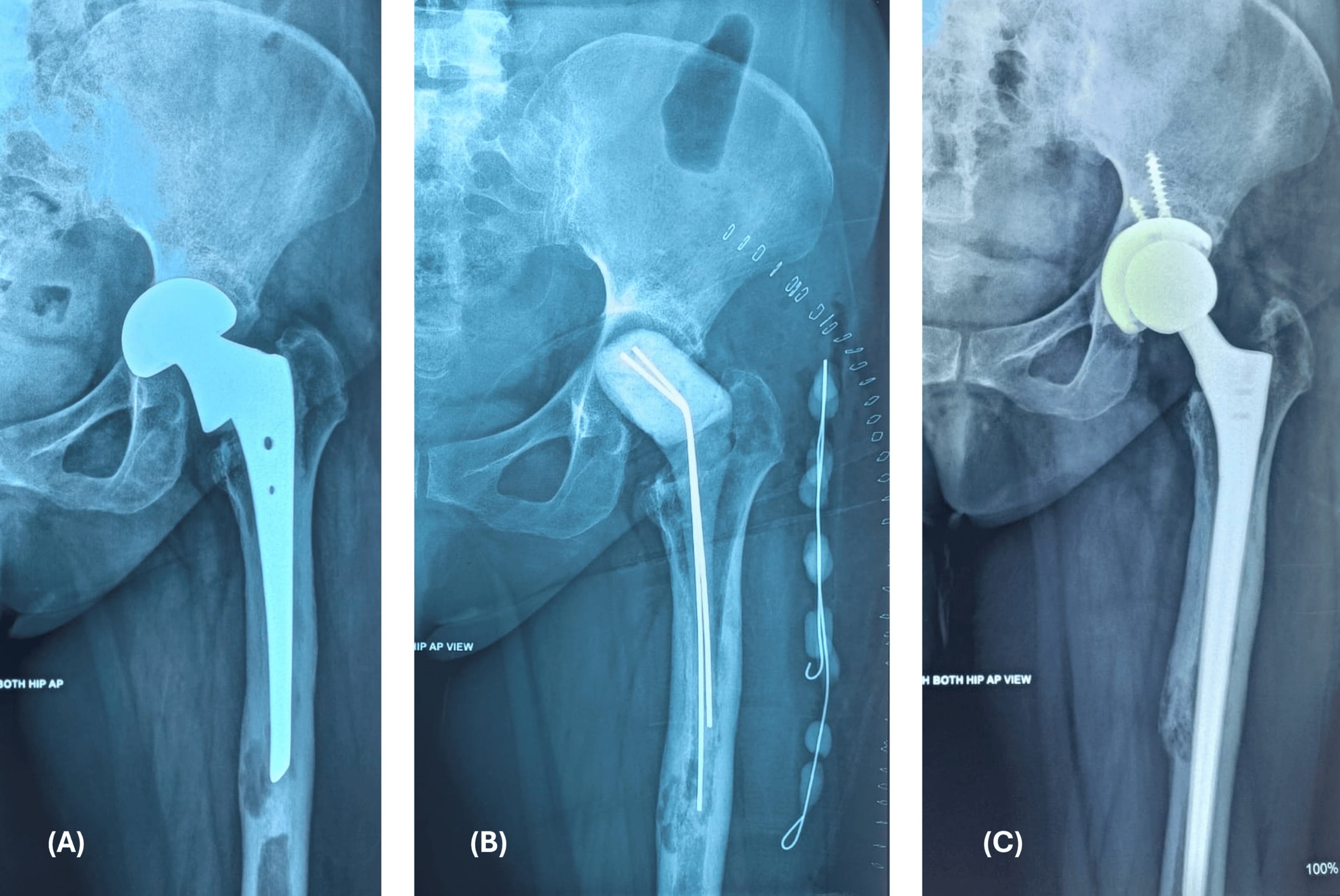
The technique of the salvage operation is in the conversion of a failed hemiarthroplasty guide.
In the exam
Examiners want the decision justified from the patient, the trials quoted with their limits, and NICE quoted in its current form.
Frequently asked questions
Is total hip replacement better than hemiarthroplasty for a displaced hip fracture?
Not by much, and not for everyone. In the HEALTH trial of 1,495 independently walking patients, reoperation at 24 months was the same (7.9% vs 8.3%), function favoured total hip replacement by an amount the authors called clinically unimportant, and dislocation was 4.7% against 2.4%. The 2022 Cochrane review reached the same conclusion: any benefit is likely to be small and not clinically appreciable.
What are the NICE criteria for total hip replacement after a hip fracture?
NICE CG124 (2023) says to consider total hip replacement rather than hemiarthroplasty for a displaced intracapsular fracture in people who were able to walk independently out of doors with no more than a stick, have no condition or comorbidity that makes the procedure unsuitable, and are expected to carry out activities of daily living independently beyond 2 years. The 2011 version said 'offer' and excluded cognitive impairment.
Should a hemiarthroplasty for hip fracture be cemented?
Yes, in most older patients. WHiTE 5 randomised 1,225 patients aged 60 or over and found cemented hemiarthroplasty gave better quality of life at 4 months (EQ-5D 0.371 vs 0.315) and fewer periprosthetic fractures (0.5% vs 2.1%) than a modern hydroxyapatite-coated uncemented stem, with no significant difference in 12-month mortality. NICE recommends cemented implants.
Does a total hip replacement dislocate more than a hemiarthroplasty after hip fracture?
Yes. In HEALTH, instability or dislocation occurred in 4.7% after total hip replacement and 2.4% after hemiarthroplasty, although the trial's 99% confidence interval for the difference crossed 1. Pooling 12 trials, the 2022 Cochrane review found a relative risk of 1.96 (95% CI 1.17 to 3.27). Larger heads, dual mobility and careful soft-tissue repair are used to reduce it.
Is a bipolar hemiarthroplasty better than a unipolar one?
There is no evidence that it is. The 2022 Cochrane review pooled 13 studies with 1,499 participants and found little or no difference in early or 12-month mortality, with dislocation low (about 1.6%) and no different between designs. The authors concluded that there is no evidence to suggest a bipolar hemiarthroplasty is superior to a unipolar prosthesis.
References
- HEALTH Investigators; Bhandari M, Einhorn TA, Guyatt G, et al. Total hip arthroplasty or hemiarthroplasty for hip fracture. N Engl J Med 2019;381(23):2199-2208. DOI (opens in a new tab)
- Fernandez MA, Achten J, Parsons N, et al; WHiTE 5 Investigators. Cemented or uncemented hemiarthroplasty for intracapsular hip fracture. N Engl J Med 2022;386(6):521-530. DOI (opens in a new tab)
- Png ME, Petrou S, Fernandez MA, et al. Cost-utility analysis of cemented hemiarthroplasty versus hydroxyapatite-coated uncemented hemiarthroplasty for the treatment of displaced intracapsular hip fractures: the WHiTE 5 trial. Bone Joint J 2022;104-B(8):922-928. DOI (opens in a new tab)
- Lewis SR, Macey R, Parker MJ, Cook JA, Griffin XL. Arthroplasties for hip fracture in adults. Cochrane Database Syst Rev 2022;2(2):CD013410. DOI (opens in a new tab)
- Kristensen TB, Dybvik E, Kristoffersen M, et al. Cemented or uncemented hemiarthroplasty for femoral neck fracture? Data from the Norwegian Hip Fracture Register. Clin Orthop Relat Res 2020;478(1):90-100. DOI (opens in a new tab)
- Griffiths R, White SM, Moppett IK, et al. Safety guideline: reducing the risk from cemented hemiarthroplasty for hip fracture 2015 (AAGBI, BOA, BGS). Anaesthesia 2015;70(5):623-626. DOI (opens in a new tab)
- Parker MJ. Lateral versus posterior approach for insertion of hemiarthroplasties for hip fractures: a randomised trial of 216 patients. Injury 2015;46(6):1023-1027. DOI (opens in a new tab)
- Morrell AT, Lindsay SE, Schabel K, Parker MJ, Griffin XL. Surgical approaches for inserting hemiarthroplasty of the hip in people with hip fractures. Cochrane Database Syst Rev 2025;6(6):CD016031. DOI (opens in a new tab)
- You D, Sepehri A, Kooner S, et al. Outcomes of total hip arthroplasty using dual mobility components in patients with a femoral neck fracture. Bone Joint J 2020;102-B(7):811-821. DOI (opens in a new tab)
- Farey JE, Masters J, Cuthbert AR, et al. Do dual-mobility cups reduce revision risk in femoral neck fractures compared with conventional THA designs? An international meta-analysis of arthroplasty registries. Clin Orthop Relat Res 2022;480(10):1912-1925. DOI (opens in a new tab)
Study the full topic
Included in Pro
Go deeper with Pro
- Operative guide: cemented hemiarthroplasty for femoral neck fracture
- Operative guide: primary total hip arthroplasty
Share this article
Cite this article
OrthoVellum Editorial Team. Hemiarthroplasty vs Total Hip Replacement for Displaced Hip Fractures: HEALTH, WHiTE 5 and Who Gets What [Internet]. OrthoVellum; 2026 Oct 16 [cited 2026 Oct 16]. Available from: https://www.orthovellum.com/blog/hemiarthroplasty-vs-total-hip-replacement
About this content
Prepared by the OrthoVellum Editorial Team from cited sources, under our editorial policy.
For education and exam preparation; not medical advice or a substitute for clinical judgement and local guidance.
Spotted an error? Tell us; every report is read.
Get new articles by email
New clinical explainers, landmark-trial summaries and exam guidance from the OrthoVellum blog. No account needed; unsubscribe from any email.