Rotator Cuff Tears: Repair, Rehab or Reverse? An Evidence-Based Decision Guide
Rotator cuff tear surgery vs physiotherapy: what trials show to 15 years, who should start with rehab, who needs early repair, and when a reverse is the answer.
By OrthoVellum Editorial TeamPublished 12 min read
Educational content for clinicians, not medical advice. Editorial policy
Key points
- For small, atraumatic supraspinatus tears in patients over 55, the Finnish trial found no difference between physiotherapy, acromioplasty and repair at 1, 2 and a mean of 6.2 years, and a 2019 Cochrane review found that repair may give little or no clinically important benefit at one year.
- The only trial followed to 15 years (Moosmayer, 103 tears up to 3 cm) favoured primary repair, by 11.8 Constant points, and the gap widened after year 5. Unrepaired tears in that trial roughly doubled in anteroposterior size.
- Physiotherapy works for most atraumatic tears: in the MOON cohort 27% had surgery within 10 years, more than half of them within 6 months, and scores did not decline in those who never had surgery.
- Healing falls with age and tear size. In UKUFF, 56% of repairs were intact at one year: 66–68% of small and medium tears, 47% of large and 27% of massive.
- Pseudoparalysis, cuff tear arthropathy or an irreparable tear in an older patient points to reverse arthroplasty; in a younger patient with an intact subscapularis, a tendon transfer or superior capsular reconstruction is weighed first.
On this page11 sections
A patient in their sixties has a painful shoulder and a full-thickness supraspinatus tear on ultrasound. Repair it, refer for physiotherapy or, if the cuff is beyond saving, plan a reverse? The trials of rotator cuff tear surgery vs physiotherapy answer more of this than their reputation suggests. For small atraumatic tears in patients over 55, structured physiotherapy matches repair for several years, but unrepaired tears often enlarge and the one trial followed to 15 years favours primary repair. Massive tears, pseudoparalysis and arthritis are a separate decision. This post sets out who goes where, and on what evidence. The clinical background is on the rotator cuff tears topic page.
Four questions that sort every tear
The decision is easier when the tear is placed before the trials are quoted. Four questions do most of the work:
- How did it start? An acute traumatic tear in an active patient is a different problem from an atraumatic, degenerative tear found in a 65-year-old.
- How big is it, and is the muscle still muscle? Size by Cofield (small under 1 cm, medium 1–3 cm, large 3–5 cm, massive over 5 cm or two complete tendons), retraction by Patte, and fatty infiltration by Goutallier.
- Can the patient lift the arm? Pseudoparalysis is active elevation under 90° with full passive range; it marks the shoulder whose cuff has stopped centring the head.
- Is the joint arthritic? Superior migration, acetabularisation of the acromion and glenohumeral narrowing (Hamada grades 3–5) make this cuff tear arthropathy.
The randomised trials answer only the first branch: repairable, mostly small, mostly atraumatic supraspinatus tears. Everything beyond that rests on cohort series and consensus, and should be presented to patients as such.
Does surgery beat physiotherapy for a degenerative cuff tear?
Four randomised trials compare repair with physiotherapy head to head.
| Trial | Patients | Comparison | Main result |
|---|---|---|---|
| Kukkonen (Finland) | 180 shoulders, over 55, non-traumatic supraspinatus tears (mean sagittal size 10 mm) | Physiotherapy vs acromioplasty + physiotherapy vs repair + acromioplasty + physiotherapy | No difference in Constant score at 1 and 2 years or at a mean of 6.2 years (mean change 18.5, 17.9 and 20.0; p = 0.84) |
| Lambers Heerspink (Netherlands) | 56, degenerative full-thickness tears | Repair vs conservative | Constant 81.9 vs 73.7 at 12 months (p = 0.08); pain and disability scores significantly lower after surgery |
| Moosmayer (Norway) | 103, tears up to 3 cm | Repair vs physiotherapy with optional secondary repair | Repair better at 1, 5, 10 and 15 years (small at 5 years); 11.8 Constant points at 15 years |
| Ranebo (Sweden) | 58, small acute traumatic tears | Repair vs physiotherapy | Median Constant 83 vs 78 at 12 months; difference 4.5 (95% CI −5 to 9; p = 0.68) |
A 2019 Cochrane review included nine trials (1,007 participants). In the main comparison, repair with decompression against exercise in three trials, surgery probably provides little or no improvement in pain at one year (0.87 points better on a 0–10 scale; moderate certainty), and function was 6 points better on a 0–100 scale (low certainty). The authors were uncertain whether repair gives clinically meaningful benefit, and noted the trials mostly enrolled small degenerative supraspinatus tears. Their conclusions may not apply to traumatic tears, large tears involving the subscapularis or young people.
The Finnish design carries a second lesson. Its middle arm added acromioplasty to physiotherapy and changed nothing, which is consistent with the placebo-controlled trials discussed in our post on the CSAW trial and subacromial decompression.
What does 15 years of follow-up add?
The Norwegian trial is the reason the debate is not closed. Moosmayer randomised 103 patients with tears no larger than 3 cm to primary repair or physiotherapy, with secondary repair allowed if physiotherapy failed, and kept a blinded assessor for 15 years.
- 1 year: 9 patients (18%) had already crossed over to surgery.
- 5 years: 12 of 51 had crossed over. Repair led by 5.3 Constant points (p = 0.05) and 9.0 ASES points, differences the authors judged small and possibly below clinical importance.
- 10 years: the gap had widened, to 9.6 Constant and 15.7 ASES points. The 14 patients who crossed over scored 10.0 Constant points below the primary repair group.
- 15 years: 83 of 103 (81%) attended and 15 of 51 had crossed over. Repair led by 11.8 Constant points, 13.9 ASES points and 1.8 cm on a 10 cm pain scale. The SF-36 showed no significant difference. The 12 crossover patients who attended now matched the primary repair group, a finding the authors interpret with caution.
Two cautions keep this in proportion. It is a single-centre trial of 103 patients, and the Finnish trial, in patients over 55 with small single-tendon tears, still showed no difference at six years. The crossover comparison is also outside the randomisation: the patients who failed physiotherapy were a selected group. What the trial does show is that, in this population, "physiotherapy first, repair later if needed" gave a worse result than primary repair for at least 10 years, and only at 15 years, in the few crossover patients still attending, did the gap close.
Will an unrepaired tear get bigger?
This is the strongest argument for repair in a younger patient, and the numbers are consistent across studies:
- Moosmayer: 37% of tears treated with physiotherapy alone enlarged by more than 5 mm on ultrasound over five years, and enlargement was associated with an inferior outcome. In the 26 tears never repaired, mean anteroposterior size rose from 16.2 to 31.6 mm by 15 years.
- Ranebo: 29.2% of unrepaired small traumatic tears enlarged by more than 5 mm within 12 months.
- Kukkonen: at two years the mean sagittal tear size was 4.2 mm after repair against 11.0 mm without it. At six years, though, repair had not protected against progression of glenohumeral arthritis or cuff tear arthropathy.
- Mall (asymptomatic tears): in 195 people followed with annual ultrasound, the 44 whose shoulders became painful had larger tears at enrolment. With the onset of pain, 18% of full-thickness tears had grown by more than 5 mm, and 40% of partial tears had become full-thickness.
Enlargement matters because what follows it is hard to reverse. In Goutallier's original CT series, infraspinatus fatty degeneration never regressed after a successful supraspinatus repair. A tear that is small and repairable at 55 may not be either at 65.
Who should start with physiotherapy?
Most patients with an atraumatic full-thickness tear. The MOON Shoulder Group enrolled 452 such patients in a standardised physiotherapy programme. Fewer than 25% chose surgery by two years, and those who did generally decided between 6 and 12 weeks. At 10 years, 115 (27.0%) had had an operation, 56.5% of them within six months of enrolment, and patient-reported scores had not declined in those who never had surgery.
The predictors are worth quoting to patients. Low expectations of physiotherapy predicted early surgery; workers' compensation status and activity level predicted later surgery. None of the three is a feature of the tear itself.
The programme on the topic page runs 6–12 weeks: periscapular strengthening for scapular control, deltoid strengthening to compensate for cuff weakness, stretching to keep passive range, and work on posterior capsular tightness. A corticosteroid injection can make the exercises tolerable but does not heal the tear. For an irreparable massive tear the equivalent is anterior deltoid re-education, and the counselling should be honest: Levy's 17 patients (mean age 80) gained elevation from 40° to 160°, but when Yian repeated the programme in 30 patients only 40% succeeded.
When is early repair the better call?
The site's guidance offers early repair to:
- Active patients with an acute traumatic tear, ideally within about three months, before the tendon retracts and the muscle atrophies
- Younger patients (under about 60–65) with a symptomatic full-thickness tear
- Patients whose weakness progresses despite physiotherapy, or whose function at work is significantly impaired
Two caveats belong with the first indication. The only randomised trial of acute traumatic tears, Ranebo's, studied small tears (median sagittal size 9.7 mm, mean age 59.7) and found no difference at 12 months, with a re-tear rate of 6.5% after repair. The case for urgent repair of a larger traumatic tear therefore rests on cohort evidence and consensus, not on a trial. The second caveat is that "acute on chronic" is common: a fall that unmasks a degenerative tear in a 70-year-old is not the same lesion as an avulsion in a 45-year-old labourer. Established fatty infiltration, which develops over the months after a complete tear, suggests the tear predates the fall.
Will the repair heal, and does it matter?
Less often than older case series suggest. In UKUFF, a UK multicentre trial of open against arthroscopic repair in patients aged 50 or over, 217 repairs were imaged at 12 months and 56% had healed: 66% of small tears, 68% of medium, 47% of large and 27% of massive. Mean age was 61 in healed repairs and 64 in those that failed, and age was the dominant risk factor after adjusting for size. Approach made no difference to the Oxford Shoulder Score.
Healing matters, but a re-tear is not a failed operation. In UKUFF the patients with healed repairs improved most, those with re-tears slightly less, and those whose tears could not be repaired least. In Lambers Heerspink's trial, patients whose repair stayed intact scored 88.5 on the Constant score against 73.7 after conservative care. At the far end, Galatz found recurrent tears in 17 of 18 large and massive arthroscopic repairs, yet ASES scores rose from 48.3 to 84.6 at a year, before falling to 79.9 at two years. Whether a second row of anchors changes healing is covered in our post on single- versus double-row rotator cuff repair.
When is a rotator cuff tear irreparable?
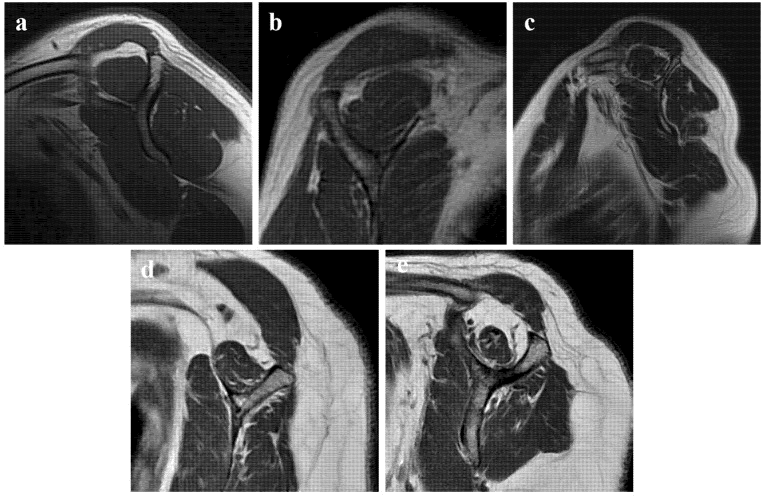
Repairability is judged on the MRI before it is tested in theatre. The massive rotator cuff tear page lists the signs:
- Goutallier grade 3–4 fatty infiltration (grade 3 borderline, grade 4 irreparable)
- Patte stage 3 retraction, to or beyond the glenoid
- A positive tangent sign: supraspinatus atrophy
- An acromiohumeral interval under 7 mm: static superior migration
An irreparable tear in a shoulder without arthritis still has options short of arthroplasty:
- Partial repair with margin convergence: closing what can be closed restores part of the transverse force couple.
- Latissimus dorsi transfer for posterosuperior tears: in Gerber's 69 shoulders the Subjective Shoulder Value rose from 28% to 66% of normal, but shoulders with poor subscapularis function did not improve. Lower trapezius transfer is an emerging alternative.
- Superior capsular reconstruction: in Mihata's original 24 shoulders with fascia lata autograft, 83% had no graft tear or re-tear, but this is a single-surgeon series without a control group.
- Debridement and biceps tenotomy: palliation for older, low-demand patients whose problem is pain. A biodegradable balloon spacer gives temporary improvement.
When is a reverse shoulder replacement the answer?
When the shoulder, not just the tendon, has failed. The cuff tear arthropathy page gives the indications: cuff tear arthropathy with pseudoparalysis, a massive irreparable tear, and failed previous arthroplasty. The massive tear page puts the usual patient at older than about 65–70. Non-operative care is tried first unless the head escapes anterosuperiorly from under the coracoacromial arch, which is functionally debilitating.
The results explain its place. In Sirveaux's multicentre series of 80 Grammont prostheses, the Constant score rose from 22.6 to 65.6 and active elevation from 73° to 138°, and teres minor integrity was essential for recovering external rotation. Wall's 240 reverses (mean age 72.7) improved from 23 to 60 points, with massive cuff tears and cuff tear arthropathy doing better than post-traumatic and revision cases. Sirveaux advised reserving the prosthesis for elderly patients, and Wall, given the age of his patients and the short follow-up, that it be used judiciously. How the implant substitutes the deltoid for the cuff is set out in our post on Grammont reverse shoulder biomechanics.
Under about 60, a reverse for the cuff-deficient shoulder remains contentious because of implant longevity and demand, and joint-preserving options are weighed first. The detail is on the reverse total shoulder arthroplasty page.
Repair, rehab or reverse: the decision at a glance
| Presentation | Start with | Escalate to |
|---|---|---|
| Atraumatic small or medium tear, over about 55–60, lower demand | Structured physiotherapy, review at 6–12 weeks | Repair if no better or weakness progresses |
| Atraumatic small or medium tear, younger or higher demand | Shared decision: trials support either start; the 15-year data favour primary repair | Repair |
| Acute traumatic tear, active patient, repairable muscle | Early repair, ideally within about 3 months | — |
| Large or massive tear, reducible, Goutallier 0–2, no arthritis | Repair, with honest counselling on healing | Partial repair ± augmentation |
| Irreparable tear, no arthritis, younger, subscapularis intact | Deltoid-focused physiotherapy | Tendon transfer or superior capsular reconstruction |
| Pseudoparalysis or cuff tear arthropathy, older patient | Physiotherapy trial unless anterosuperior escape | Reverse shoulder arthroplasty |
Examination drives every row: lag signs map which tendons are gone, and passive range separates pseudoparalysis from stiffness. The rotator cuff examination sequence is the place to rehearse it.
In the exam
Examiners want the tear classified, the evidence quoted with its limits, and a decision that follows from the patient.
Frequently asked questions
Is physiotherapy as good as surgery for a rotator cuff tear?
For small, atraumatic tears in older patients, mostly yes in the short and medium term. The Finnish trial in patients over 55 found no difference at a mean of 6.2 years, and a 2019 Cochrane review found repair may give little or no clinically important benefit at one year. The one trial followed to 15 years, of tears up to 3 cm, found primary repair better, with differences that grew over time.
Does a rotator cuff tear get bigger without surgery?
Often. In the Norwegian trial, 37% of tears treated with physiotherapy alone enlarged by more than 5 mm over five years, which was associated with a worse outcome, and by 15 years the mean anteroposterior size of unrepaired tears had risen from 16.2 to 31.6 mm. In a Swedish trial of small traumatic tears, 29.2% of unrepaired tears enlarged by more than 5 mm within a year.
Who should have early rotator cuff repair?
The usual candidates are active patients with an acute traumatic tear, younger patients with a symptomatic full-thickness tear, and anyone whose weakness progresses despite physiotherapy, provided the tear is reducible and the muscle is not heavily fatty. Early repair of traumatic tears, ideally within about three months, rests on consensus and cohort evidence: the one randomised trial of small traumatic tears found no difference at a year.
When is a reverse shoulder replacement used for a rotator cuff tear?
When the cuff cannot be repaired and the shoulder has failed: cuff tear arthropathy, pseudoparalysis (active elevation under 90° with full passive range) or a massive irreparable tear, usually in patients older than about 65–70. A reverse lets the deltoid elevate the arm without a cuff. In patients under about 60 it remains contentious because of implant longevity, so joint-preserving options are weighed first.
How long should physiotherapy be tried before rotator cuff surgery?
Usually 6–12 weeks of a structured programme, then review. In the MOON cohort most patients who went on to surgery decided between 6 and 12 weeks, and few changed course between 3 and 24 months. Over 10 years, 27% had surgery and 56.5% of those operations came within six months, so an early review identifies most of the patients physiotherapy will not help.
References
- Moosmayer S, Lund G, Seljom US, et al. Tendon repair compared with physiotherapy in the treatment of rotator cuff tears: a randomized controlled study in 103 cases with a five-year follow-up. J Bone Joint Surg Am 2014;96(18):1504-1514. DOI (opens in a new tab)
- Moosmayer S, Lund G, Seljom US, et al. At a 10-year follow-up, tendon repair is superior to physiotherapy in the treatment of small and medium-sized rotator cuff tears. J Bone Joint Surg Am 2019;101(12):1050-1060. DOI (opens in a new tab)
- Moosmayer S, Lund G, Seljom US, et al. Fifteen-year results of a comparative analysis of tendon repair versus physiotherapy for small-to-medium-sized rotator cuff tears: a concise follow-up of previous reports. J Bone Joint Surg Am 2024;106(19):1785-1796. DOI (opens in a new tab)
- Kukkonen J, Joukainen A, Lehtinen J, et al. Treatment of nontraumatic rotator cuff tears: a randomized controlled trial with two years of clinical and imaging follow-up. J Bone Joint Surg Am 2015;97(21):1729-1737. DOI (opens in a new tab)
- Kukkonen J, Ryösä A, Joukainen A, et al. Operative versus conservative treatment of small, nontraumatic supraspinatus tears in patients older than 55 years: over 5-year follow-up of a randomized controlled trial. J Shoulder Elbow Surg 2021;30(11):2455-2464. DOI (opens in a new tab)
- Lambers Heerspink FO, van Raay JJ, Koorevaar RC, et al. Comparing surgical repair with conservative treatment for degenerative rotator cuff tears: a randomized controlled trial. J Shoulder Elbow Surg 2015;24(8):1274-1281. DOI (opens in a new tab)
- Ranebo MC, Björnsson Hallgren HC, Holmgren T, Adolfsson LE. Surgery and physiotherapy were both successful in the treatment of small, acute, traumatic rotator cuff tears: a prospective randomized trial. J Shoulder Elbow Surg 2020;29(3):459-470. DOI (opens in a new tab)
- Karjalainen TV, Jain NB, Heikkinen J, et al. Surgery for rotator cuff tears. Cochrane Database Syst Rev 2019;12:CD013502. DOI (opens in a new tab)
- Mall NA, Kim HM, Keener JD, et al. Symptomatic progression of asymptomatic rotator cuff tears: a prospective study of clinical and sonographic variables. J Bone Joint Surg Am 2010;92(16):2623-2633. DOI (opens in a new tab)
- Kuhn JE, Dunn WR, Sanders R, et al. The predictors of surgery for symptomatic, atraumatic full-thickness rotator cuff tears change over time: ten-year outcomes of the MOON Shoulder Prospective Cohort. J Bone Joint Surg Am 2024;106(17):1563-1572. DOI (opens in a new tab)
- Carr AJ, Cooper CD, Campbell MK, et al. Clinical effectiveness and cost-effectiveness of open and arthroscopic rotator cuff repair [the UK Rotator Cuff Surgery (UKUFF) randomised trial]. Health Technol Assess 2015;19(80):1-218. DOI (opens in a new tab)
- Rashid MS, Cooper C, Cook J, et al. Increasing age and tear size reduce rotator cuff repair healing rate at 1 year. Acta Orthop 2017;88(6):606-611. DOI (opens in a new tab)
Study the full topic
Included in Pro
Go deeper with Pro
See what Pro includesShare this article
Cite this article
OrthoVellum Editorial Team. Rotator Cuff Tears: Repair, Rehab or Reverse? An Evidence-Based Decision Guide [Internet]. OrthoVellum; 2026 Nov 13 [cited 2026 Nov 13]. Available from: https://www.orthovellum.com/blog/rotator-cuff-tear-surgery-vs-physiotherapy
About this content
Prepared by the OrthoVellum Editorial Team from cited sources, under our editorial policy.
For education and exam preparation; not medical advice or a substitute for clinical judgement and local guidance.
Spotted an error? Tell us; every report is read.
Get new articles by email
New clinical explainers, landmark-trial summaries and exam guidance from the OrthoVellum blog. No account needed; unsubscribe from any email.