The Rarest Surface Osteosarcoma
- SURFACE (juxtacortical) OSTEOSARCOMAS arise on the bone SURFACE rather than within the medulla and comprise three entities of differing grade: PAROSTEAL (low-grade, commonest), PERIOSTEAL (intermediate-grade), and HIGH-GRADE SURFACE osteosarcoma (the rarest) - and they behave very differently from one another, so they must not be lumped together.
- HIGH-GRADE SURFACE OSTEOSARCOMA is a HIGH-grade malignancy that arises on the bone surface but behaves like CONVENTIONAL intramedullary osteosarcoma - it has the aggressive biological behaviour, metastatic potential and prognosis of a high-grade osteosarcoma, distinguishing it sharply from the indolent low-grade parosteal lesion.
- Histological GRADE is the single most important point to assess in surface osteosarcoma, because it determines both TREATMENT and PROGNOSIS: low-grade (parosteal) lesions are treated by WIDE RESECTION alone, whereas HIGH-grade lesions (high-grade surface, and dedifferentiated parosteal) require systemic CHEMOTHERAPY in addition to wide surgical resection.
- PUT THE NUMBERS AND THE DENOMINATOR TOGETHER - THEY ARE SMALL. The most-quoted series is 18 surface osteosarcomas from two Tunisian centres over 7 years: 11 parosteal (6 of them DEDIFFERENTIATED), 3 periosteal and only 4 HIGH-GRADE SURFACE. Mean age 25 years (16 to 55), 61 percent female, 11 femoral and 7 tibial. At a mean follow-up of 34.5 months, LOCAL RECURRENCE occurred in 6 of 18 (33.3 percent), LUNG METASTASES in 8 of 18 (44.4 percent) and DEATH in 6 of 18 (33.3 percent) at a mean of only 12 months - and every patient who died had a HIGH-GRADE lesion. That last point is the teaching, but it rests on 6 deaths in 18 patients.
- THE 'POOR CHEMOTHERAPY RESPONSE' CLAIM IS SMALLER THAN IT SOUNDS. Histological response was poor in all cases in that series - but only 6 of the 18 patients received neoadjuvant chemotherapy at all. So the honest statement is that response was poor in the six who were treated, not that surface osteosarcoma is established to be chemoresistant. No trial compares chemotherapy regimens in this entity.
- It must be DISTINGUISHED from its surface relatives - PAROSTEAL osteosarcoma (low-grade, classically a 'stuck-on' ossified mass on the posterior distal femur, best prognosis, can dedifferentiate) and PERIOSTEAL osteosarcoma (intermediate-grade, chondroblastic, diaphyseal) - and from benign surface lesions; correct grading on biopsy at a specialist centre is essential.
- PRESENTATION is of a surface bone mass (commonly the long bones - femur/tibia) with the imaging features of a surface lesion; STAGING (local MRI, chest CT) is required because of the metastatic potential of a high-grade tumour, and a properly planned BIOPSY (at the unit that will treat it) is mandatory before definitive surgery.
- MANAGEMENT mirrors that of conventional high-grade osteosarcoma: NEOADJUVANT and adjuvant CHEMOTHERAPY around WIDE (limb-salvage where feasible, or amputation) surgical RESECTION with clear margins, in a specialist sarcoma multidisciplinary unit - in contrast to low-grade parosteal osteosarcoma, where wide resection alone usually suffices.
- “Three SURFACE (juxtacortical) osteosarcomas: PAROSTEAL (low-grade, commonest, posterior distal femur, best prognosis) - PERIOSTEAL (intermediate, chondroblastic, diaphyseal) - HIGH-GRADE SURFACE (rarest, behaves like conventional OS).
- “GRADE drives treatment: low-grade parosteal → WIDE RESECTION alone; high-grade surface (and dedifferentiated parosteal) → CHEMOTHERAPY + wide resection.
- “Quote the outcome figures with their denominator: in the standard 18-patient series (11 parosteal - 6 dedifferentiated, 3 periosteal, 4 high-grade surface; mean age 25, 61% female), local recurrence 6/18, lung metastases 8/18 and death 6/18 at a mean of 12 months, EVERY death in a high-grade lesion. The 'poor chemotherapy response' finding covers only the 6 patients who received it.
- “Properly planned biopsy + grading at a sarcoma unit; stage (MRI + chest CT); manage like conventional high-grade osteosarcoma. Don't treat a high-grade surface OS like a benign or low-grade surface lesion.
Commonest surface OS; 'stuck-on' posterior distal femur; best prognosis; wide resection alone (chemo only if dedifferentiated).
Rarest; behaves like conventional osteosarcoma; needs chemotherapy + wide resection; worst prognosis of the three. Grade on biopsy at a sarcoma unit.
The Three Surface Osteosarcomas
Surface (juxtacortical) osteosarcomas arise on the bone surface: parosteal (low-grade, commonest - classically a 'stuck-on' ossified mass on the posterior distal femur, best prognosis, can dedifferentiate); periosteal (intermediate-grade, chondroblastic, diaphyseal); and high-grade surface osteosarcoma (rarest), a high-grade lesion that behaves like conventional intramedullary osteosarcoma. Histological grade is the key: it determines treatment and prognosis - low-grade lesions are resected, high-grade lesions need chemotherapy as well.
- Parosteal
- Low
- Periosteal
- Intermediate
- High-grade surface
- High
- Parosteal
- Commonest surface OS
- Periosteal
- Less common
- High-grade surface
- Rarest
- Parosteal
- Posterior distal femur (metaphysis)
- Periosteal
- Diaphysis (tibia/femur)
- High-grade surface
- Long bones (femur/tibia)
- Parosteal
- Indolent (worse if dedifferentiated)
- Periosteal
- Intermediate
- High-grade surface
- Like conventional OS (metastasises)
- Parosteal
- Wide resection alone
- Periosteal
- Wide resection +/- chemotherapy
- High-grade surface
- Chemotherapy + wide resection
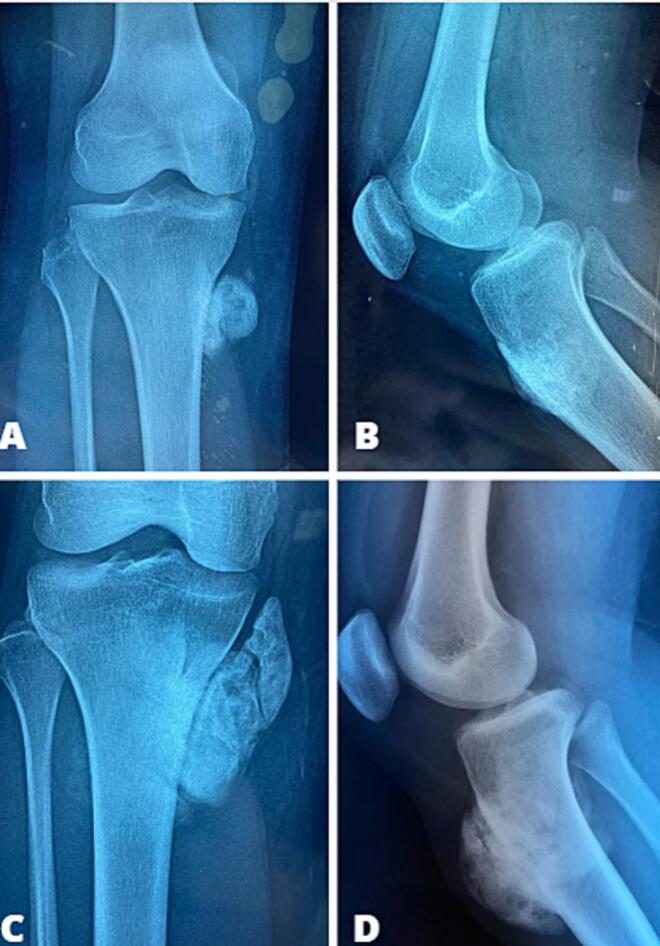
Presentation, Diagnosis & Management
- Presentation: a surface bone mass, commonly of the long bones (femur/tibia), with surface-lesion imaging features.
- Diagnosis: planned biopsy at the treating sarcoma unit; grading is decisive (high-grade surface OS vs low-grade parosteal vs intermediate periosteal).
- Staging: local MRI and chest CT (metastatic potential of a high-grade tumour).
- Management (high-grade surface OS): neoadjuvant + adjuvant chemotherapy around wide resection (limb-salvage where feasible, or amputation) with clear margins - as for conventional high-grade osteosarcoma.
- Contrast: low-grade parosteal OS is treated by wide resection alone - but examine the whole specimen, because 6 of 11 parosteal tumours in the standard series had dedifferentiated.
The lesions on either side of this diagnosis have their own pages. The intramedullary disease it behaves like is osteosarcoma; the soft-tissue counterpart with no bone attachment is extraskeletal osteosarcoma; and the malignant surface mimic with a chondroid matrix is periosteal chondrosarcoma, within the wider chondrosarcoma family. The two benign lesions that must not be confused with it are myositis ossificans, which matures from the periphery inwards, and osteochondroma, which shows cortico-medullary continuity. The rules that keep an unplanned excision from happening are in biopsy principles.
The danger with high-grade surface osteosarcoma is to mistake it for a benign surface lesion or for the indolent low-grade parosteal osteosarcoma, and thereby under-treat it. Although it sits on the bone surface, it is a high-grade malignancy that behaves like conventional intramedullary osteosarcoma, with the same metastatic potential and the need for systemic chemotherapy in addition to wide resection. The grade, established on a properly planned biopsy read at a specialist sarcoma centre, is the pivotal determinant: a low-grade parosteal lesion can be cured by wide resection alone, whereas a high-grade surface (or a dedifferentiated parosteal) lesion requires neoadjuvant and adjuvant chemotherapy around margin-negative resection, with full staging for metastatic disease. As with all bone sarcomas, an unplanned excision of an undiagnosed surface mass compromises subsequent limb salvage and outcome, so suspected surface osteosarcoma must be referred before any surgery.
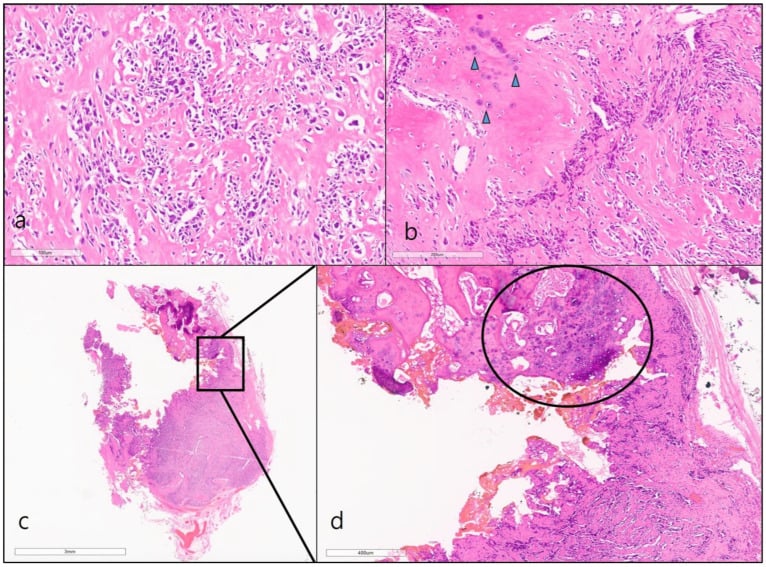
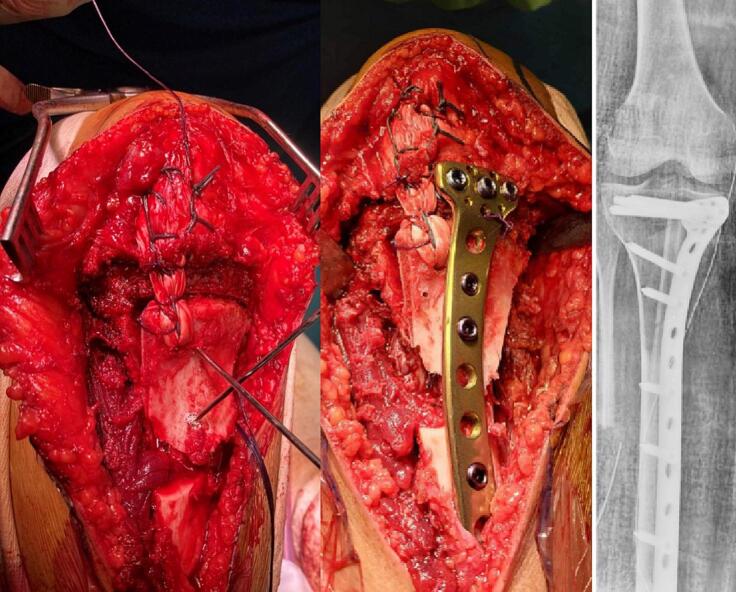
Imaging: Telling the Three Surface Osteosarcomas Apart
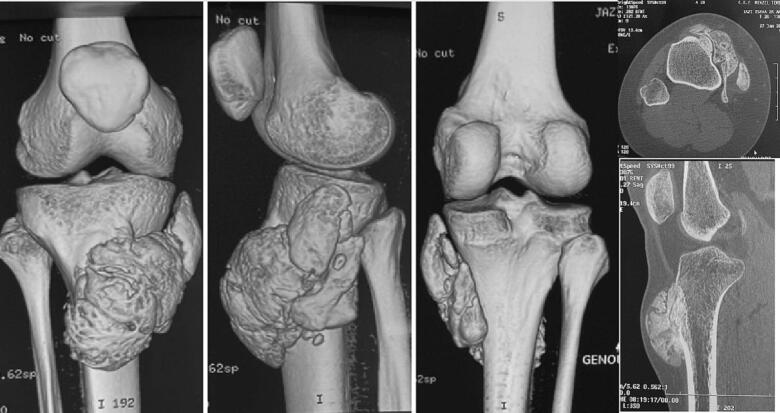
- Parosteal. A densely ossified, lobulated "stuck-on" mass on the posterior distal femur metaphysis, with a radiolucent cleft (the cleavage plane) between the mass and the cortex and mineralisation densest centrally; CT/MRI is used to look for medullary invasion, which worsens the prognosis.
- Periosteal. A diaphyseal, broad-based surface mass with perpendicular spiculated / "sunburst" periosteal reaction and a Codman triangle, cortical thickening/scalloping at the base, and a chondroblastic matrix (less dense mineralisation than parosteal).
- High-grade surface. A surface mass with a more aggressive, destructive appearance - cortical destruction, an associated soft-tissue mass and often medullary extension - with variable, patchy mineralisation, resembling a conventional osteosarcoma sitting on the surface.
Q: How do the three surface osteosarcomas differ on imaging?
A: Parosteal - a densely ossified "stuck-on" lobulated mass on the posterior distal femur with a radiolucent cleft from the cortex and central mineralisation (check CT/MRI for medullary invasion). Periosteal - a diaphyseal, broad-based mass with perpendicular "sunburst" periosteal reaction and a Codman triangle and a chondroblastic (less-mineralised) matrix. High-grade surface - a more aggressive, destructive surface mass with cortical destruction, a soft-tissue component and often medullary extension, resembling conventional OS.
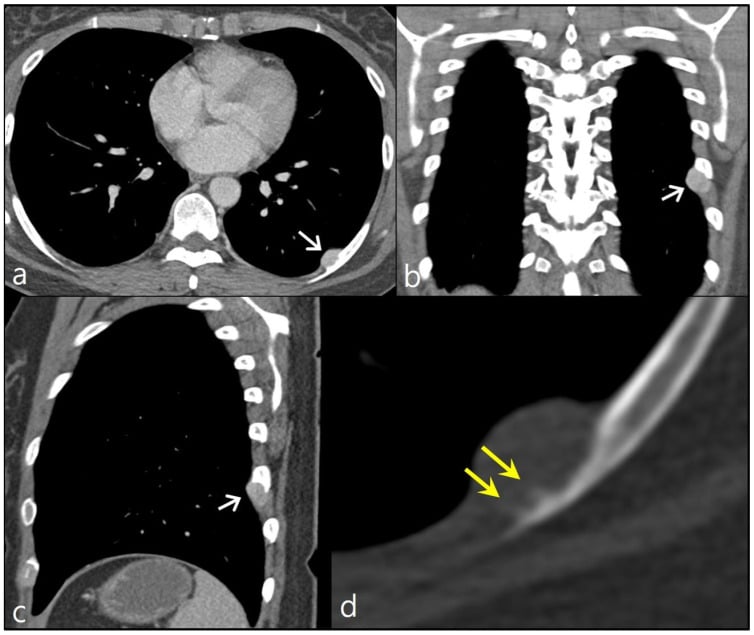
The Differential of a Surface Bone Lesion
- Myositis ossificans - the key benign mimic. It shows zonal maturation: a mature, ossified peripheral rim with a lucent centre (the reverse of parosteal OS, which is dense centrally), it is separated from the cortex by a cleft, and it matures/regresses over time - so a history of trauma, the peripheral-rim pattern and serial maturation favour it.
- Osteochondroma - shows cortical and medullary continuity with the parent bone (the pathognomonic feature) and a cartilage cap; a bony outgrowth, not a "stuck-on" mass.
- Other benign surface lesions - parosteal (juxtacortical) osteoma, surface (periosteal) chondroma, and florid reactive periostitis - benign, well-defined, without an aggressive soft-tissue mass.
- Malignant surface mimics - surface/periosteal chondrosarcoma (chondroid matrix) and dedifferentiated parosteal osteosarcoma (a low-grade parosteal that has developed a high-grade component - treated as high-grade).
- The rule. Any surface bone mass with aggressive features (cortical destruction, a soft-tissue component, medullary extension) or an atypical maturation pattern is biopsied at a sarcoma unit - not assumed benign.
Q: What is the differential of a surface bone lesion, and how do you tell benign from malignant?
A: The key benign mimic is myositis ossificans, which shows zonal maturation (mature peripheral rim, lucent centre - the reverse of parosteal OS's central density), is separated from the cortex and matures/regresses over time. Osteochondroma shows cortico-medullary continuity with the parent bone. Other benign lesions include parosteal osteoma, surface chondroma and florid reactive periostitis; malignant mimics include surface chondrosarcoma and dedifferentiated parosteal OS. Any surface mass with cortical destruction, a soft-tissue component, medullary extension or atypical maturation is biopsied at a sarcoma unit.
The Outcome Figures - and How Few Patients They Rest On
The teaching that grade determines everything in surface osteosarcoma comes largely from one retrospective bicentric series of 18 patients over seven years - 11 parosteal (6 of them dedifferentiated), 3 periosteal and only 4 high-grade surface. Mean age was 25 years and 61 percent were female, with 11 femoral and 7 tibial lesions. At a mean follow-up of 34.5 months, 6 of 18 (33.3 percent) recurred locally, 8 of 18 (44.4 percent) developed lung metastases, and 6 of 18 (33.3 percent) died at a mean of only 12 months - and every death was in a patient with a high-grade lesion. That is a genuinely important observation and it is the right thing to quote, but a candidate who adds "in a series of eighteen" is giving the better answer.
"Histological response to chemotherapy was poor in all cases" is repeated widely, but only 6 of those 18 patients received neoadjuvant chemotherapy. So the finding is poor response in six treated patients, not a demonstration that surface osteosarcoma is chemoresistant - and no trial compares regimens in this entity. It is a reason to temper expectation, not to withhold treatment from a high-grade lesion.
Six of the 11 parosteal tumours were dedifferentiated - a reminder that a low-grade label on a surface lesion is not durable and the whole specimen must be examined. And 3 of the 18 resections were intralesional, which is the margin failure that surface tumours invite when they are mistaken for something benign and shelled out.
Mnemonics & Memory Aids
SURFACE
Hook:SURFACE: Surface OS, Usually low-grade parosteal, inteRmediate periosteal, Full-OS high-grade surface, Assess grade, Chemo+resection, Evaluate at a sarcoma unit.
GRADEGrade Sets the Operation - GRADE
Hook:GRADE decides it: low-grade resected, high-grade gets chemo plus resection - and the dedifferentiated parosteal hides in the low-grade pile.
ZONALThe Benign Mimics - ZONAL
Hook:ZONAL maturation is the benign signature - peripheral rim, lucent centre, a cleft from the cortex; destruction or atypical maturation goes to biopsy.
Clinical Decision Scenarios
Practise clinical reasoning and management decisions out loud
“A surface bone lesion of the femur is reported as a surface osteosarcoma. Why does the grade matter, and how would you manage a high-grade surface variant?”
Surface osteosarcomas
- Parosteal: low-grade, commonest, posterior distal femur, best prognosis - but can dedifferentiate (6 of 11 in one series)
- Periosteal: intermediate-grade, chondroblastic, diaphyseal
- High-grade surface: rarest, behaves like conventional OS
Key principle
- Histological grade determines treatment and prognosis
- Grade on a planned biopsy at a sarcoma unit
- In the standard 18-patient series: recurrence 33 percent, lung metastases 44 percent, death 33 percent - all deaths high-grade
- 'Poor chemo response' derives from the 6 of 18 who actually received it
Management
- High-grade surface OS: like conventional OS - neoadjuvant/adjuvant chemo + wide resection
- Stage: local MRI + chest CT
- Low-grade parosteal: wide resection alone
Evidence & Key Studies
Surface osteosarcoma: clinical features and therapeutic implications
- Retrospective bicentric Tunisian series of 18 surface osteosarcomas treated between 2006 and 2013: 11 parosteal (6 of them dedifferentiated), 3 periosteal and 4 high-grade surface. Mean age 25 years (range 16 to 55), 61 percent female; 11 lesions in the femur and 7 in the tibia.
- All 18 were resected - margins wide in 15 and intralesional in 3 - but only 6 received neoadjuvant chemotherapy. Histological response to chemotherapy was poor in all of those 6, which is the basis of the widely repeated claim that these tumours respond poorly.
- At a mean follow-up of 34.5 months, 6 patients (33.3 percent) had a local recurrence, 8 (44.4 percent) developed lung metastases, and 6 (33.3 percent) died of disease at a mean of 12 months (range 6 to 30) - all of the deaths occurring in patients with high-grade lesions. The series is small, retrospective and from two centres, and its 4 high-grade surface cases cannot establish outcomes for that subtype on their own.
High grade surface osteosarcoma: a clinicopathologic study of 46 cases
- The largest series of the actual entity: 46 high-grade surface osteosarcomas (13 Mayo Clinic, 33 from the authors' files), comprising only 8.9% of surface osteosarcomas at the study institution.
- Definite male predominance; 70% of patients in the second and third decades; 44 of 46 in long bones, the mid-femur commonest; histology identical to conventional osteosarcoma.
- Five-year survival 46.1%; marginal excision independently increased local recurrence, and Broders grade 3 fared worse.
- The authors' conclusion: prognosis is SIMILAR TO CONVENTIONAL osteosarcoma, and wide excision plus effective systemic chemotherapy are associated with better outcomes.
Parosteal osteosarcoma: a clinicopathological study of 226 cases
- The reference parosteal series: 226 patients (67 managed at the Mayo Clinic, 159 from consultation files), defined as well-differentiated (grade 1-2) surface lesions with less than 25% medullary involvement.
- Dedifferentiation occurred in 16% - MORE common than previously reported - and carried a poor prognosis.
- Cross-sectional imaging showed medullary involvement in 22%, which is why CT/MRI assessment of the medulla matters before resection.
Periosteal osteosarcoma - a European review of outcome (EMSOS)
- European Musculo-Skeletal Oncology Society collaborative dataset of 119 periosteal osteosarcomas - the intermediate-grade member of the surface family; femur then tibia predominated.
- All but 2 patients had surgery (9 amputations, the rest limb salvage); 81 had chemotherapy, 50 of them neoadjuvant, all doxorubicin-based but with no standard regimen.
- Overall survival 89% at 5 years and 83% at 10 years - markedly better than conventional or high-grade surface osteosarcoma.
- The value of chemotherapy in periosteal osteosarcoma remained unresolved - the honest position between 'resection alone' and 'always add chemo'.
The classification of surface osteosarcomas into parosteal, periosteal and high-grade surface variants with differing behaviour, the central role of histological grade in determining treatment and prognosis, the poor chemotherapy response, and the worse outcome of high-grade lesions come from the cited Nouri series. The specific features of parosteal (low-grade, posterior distal femur, dedifferentiation) and periosteal (intermediate-grade, chondroblastic, diaphyseal) osteosarcoma, the staging/biopsy principles, and management of high-grade surface OS like conventional osteosarcoma are standard, well-established teaching. That series is retrospective, from two centres, and contains only 4 high-grade surface tumours and 6 patients who received chemotherapy, so its recurrence, metastasis and mortality proportions describe surface osteosarcoma as a whole rather than the high-grade subtype specifically. The subtype anchors are now cited: high-grade surface survival (46.1% at 5 years, marginal excision driving recurrence) from the Okada 46-case series, parosteal dedifferentiation (16%) and medullary involvement (22%) from the Okada 226-case series, and periosteal survival (89% at 5 years) from the EMSOS review. Beyond these there is no trial comparing chemotherapy regimens in surface disease, and no agreed proportion that each of the three subtypes contributes - the ordering parosteal, periosteal, high-grade surface by frequency is the conventional teaching rather than a figure from a defined population.