Popeye Deformity | Associated Rotator Cuff Pathology | Usually Non-operative
- Popeye deformity is the classic clinical sign (distal migration of muscle belly)
- Minimal functional loss in most patients (supinator strength preserved by short head)
- Associated pathology (rotator cuff tear, SLAP) is common and must be evaluated
- Completed rupture is usually observed; delayed tenodesis/reconstruction is reserved for carefully selected persistent symptoms or unacceptable deformity
- Tenotomy versus tenodesis trials study an intact diseased tendon, usually during cuff surgery, and do not directly establish treatment of an already ruptured tendon
- “Rupture often provides spontaneous pain relief from chronic biceps tendinitis ('autotenotomy')
- “Distal biceps rupture is a DIFFERENT pathology with significant weakness (needs repair)
- “Speed's and Yergason's tests usually positive prior to rupture, negative after
- “Always check the rotator cuff - isolated LHB rupture is rare in older adults
Overview and Epidemiology
Proximal biceps tendon rupture predominantly involves the long head of the biceps (LHB). It is frequently a degenerative process associated with chronic shoulder impingement and rotator cuff disease, and in most patients the tendon fails at the end of a predictable degenerative cascade rather than in a single traumatic event.
A sentinel for the cuff. In a patient over 40, treat a proximal biceps rupture as a marker of rotator cuff disease and examine the cuff thoroughly, because isolated rupture is rare in this age group. In younger patients (under 30) it may be isolated trauma from weightlifting or contact sport, but this is much less common.
Risk factors. Look for these when taking the history:
- Age over 40 (degenerative change)
- Previous rotator cuff tear (supraspinatus or subscapularis)
- Smoking
- Corticosteroid injection, which weakens collagen
- Overuse in overhead sport such as tennis, swimming and baseball
- Anabolic steroid use in younger weightlifters
Anatomy
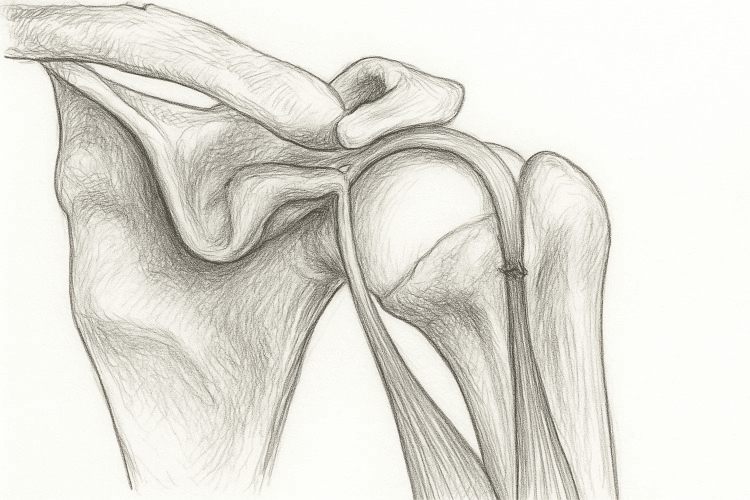
The long head's course. The LHB arises from the supraglenoid tubercle and the superior labrum (40-60% from the superior labrum), and its intra-articular origin leaves it susceptible to impingement. It leaves the joint through the rotator interval, turning 90 degrees to enter the bicipital groove (intertubercular sulcus) between the greater and lesser tuberosities. That turn is a site of high stress and degeneration, the pulley lesion.
The groove and the short head. The transverse humeral ligament, a continuation of the subscapularis tendon, holds the long head in the groove. The short head arises from the coracoid process and remains intact in a long-head rupture, and the two heads insert through a common tendon on the radial tuberosity.
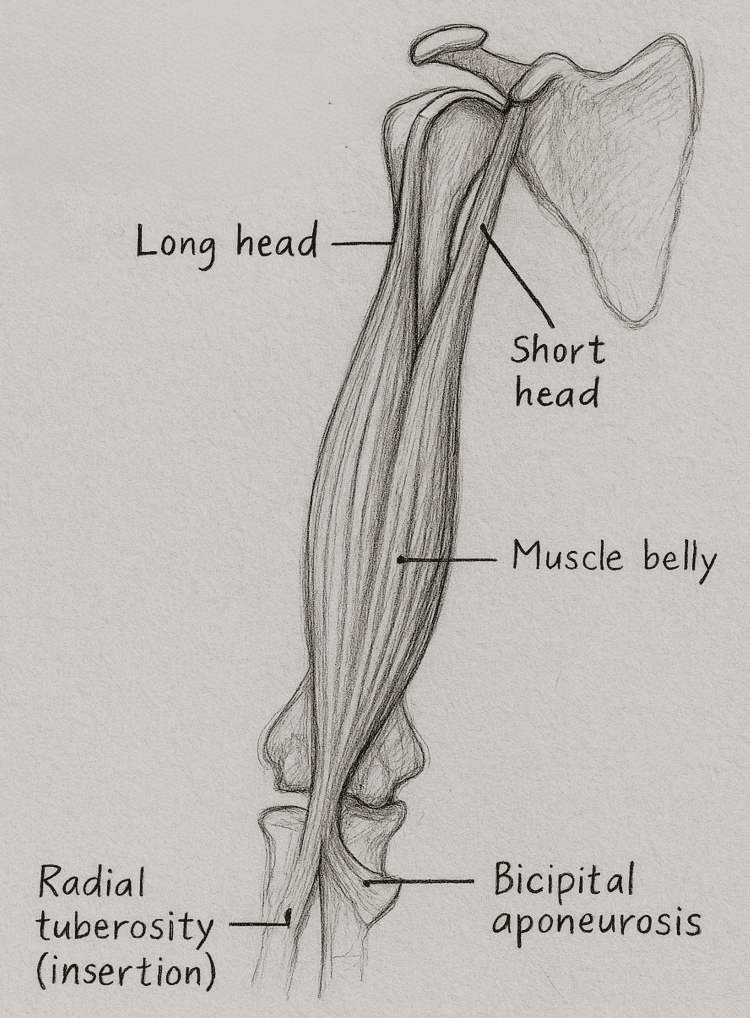
Blood supply. Branches of the anterior circumflex humeral artery supply the tendon. The proximal intra-articular zone is relatively hypovascular, a watershed.
Function. Biceps is the primary supinator of the forearm, working with the supinator muscle. At the elbow it is a flexor secondary to brachialis, the primary elbow flexor, which acts irrespective of forearm rotation. At the shoulder it has a minor role in depressing the humeral head and acts as an anterior stabiliser.
Pathophysiology
Where the tendon is vulnerable. The near-90-degree turn at the rotator interval is a chronic shear and friction point, the pulley zone. The same proximal intra-articular segment lies in a relatively hypovascular watershed, which limits healing and predisposes to attritional degeneration.
The degenerative cascade. Tenosynovitis (tendinitis) progresses to tendinosis with collagen disorganisation, then to partial and finally complete rupture, typically near the supraglenoid tubercle or at the entrance to the groove. Subacromial impingement and rotator cuff disease accelerate the degeneration, which is why proximal rupture is a sentinel of cuff pathology over the age of 40.
Autotenotomy. Once the tendon ruptures, the inflamed intra-articular pain generator is no longer under tension within the joint and groove. The deep anterior shoulder pain of chronic biceps tendinitis therefore often improves after the rupture. The weakness and deformity that remain must be weighed against the risks of surgical reconstruction.
Classification
By aetiology. Two patterns, separated by mechanism, age and the injuries that come with them.
- Mechanism
- Chronic wear/impingement
- Demographics
- Older (over 50)
- Associated Injuries
- Rotator cuff tears, Impingement
- Mechanism
- Sudden eccentric load
- Demographics
- Younger (under 40)
- Associated Injuries
- SLAP lesions, Labral tears
By location. This is not a formal classification, but where the pathology lies guides treatment:
- Intra-articular - tendinitis, fraying, SLAP lesions
- Junction or pulley - instability and subluxation out of the groove, often with subscapularis tears
- Bicipital groove - stenosis, tenosynovitis
- Distal to the groove - the musculotendinous junction, typically spared in proximal rupture; the tendon usually fails proximally
The Biceps Pulley and Medial Instability
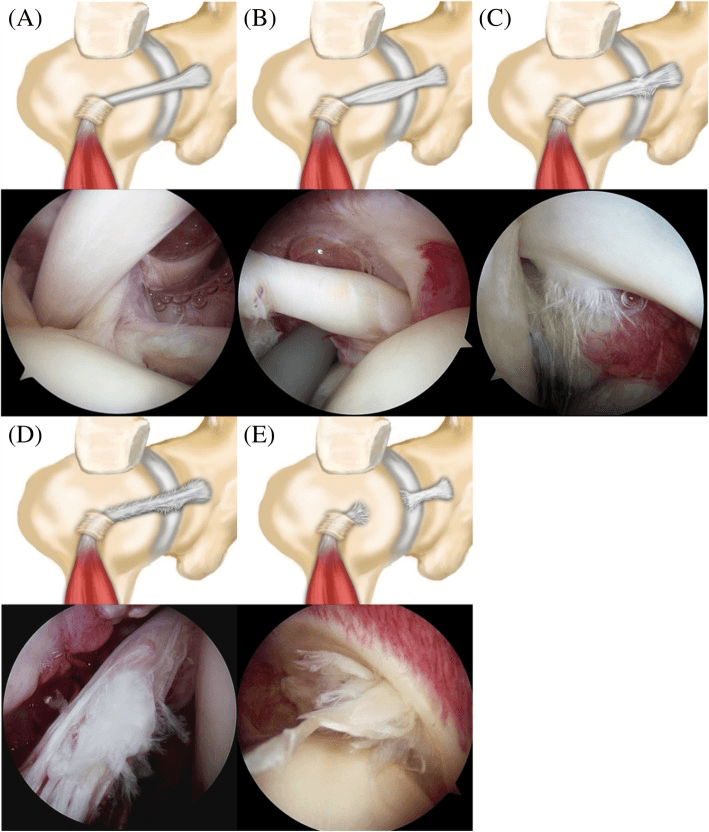
The reflection pulley. At the rotator interval the LHB is held at its turn into the groove by a fibrous sling, the biceps reflection pulley, formed by the superior glenohumeral ligament (SGHL) and the coracohumeral ligament (CHL). Fibres of subscapularis reinforce it anteriorly and supraspinatus posteriorly.
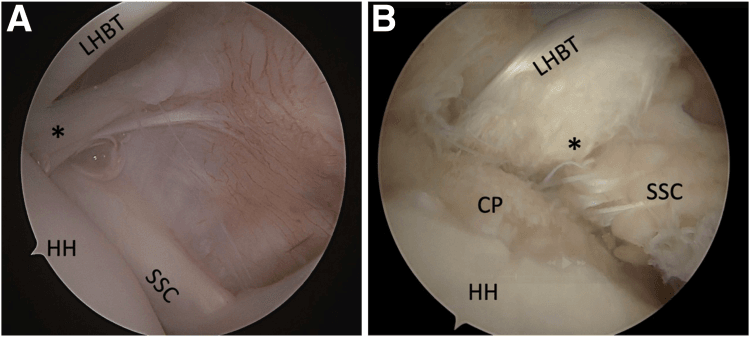
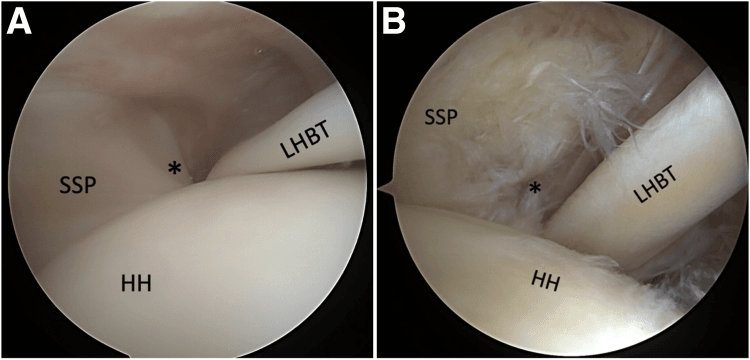
Why instability is almost always medial. The anterior wall of the pulley and groove is reinforced by subscapularis, and the transverse humeral ligament is formed by its fibres. A tear of subscapularis (with the SGHL) therefore lets the LHB sublux or dislocate medially, riding over or under the torn tendon, often before the tendon frankly ruptures. Medial dislocation is a strong indirect sign of a subscapularis tear and a red flag for an occult one.
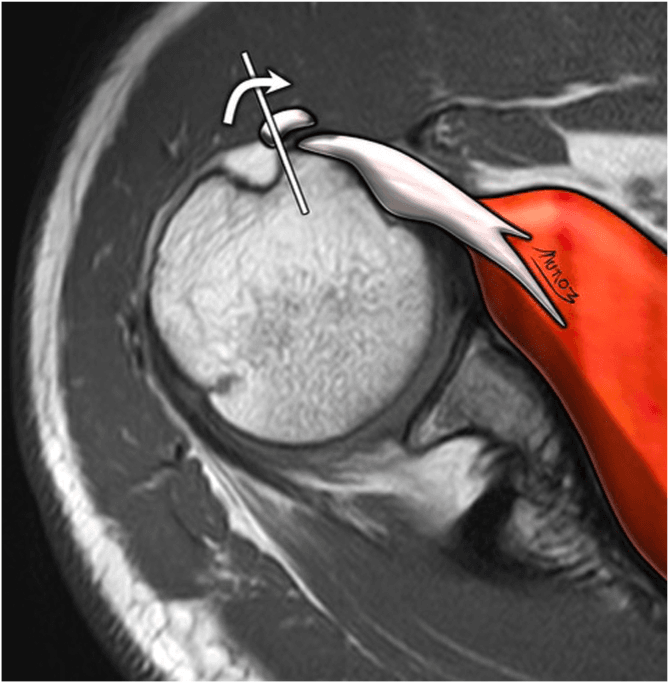
Grading. Pulley lesions are commonly graded by the Habermeyer classification, types I to IV, according to which structures are involved: isolated SGHL, SGHL plus the supraspinatus side, SGHL plus the subscapularis side, or both. The type predicts the pattern of biceps instability.
Treating it. Address the unstable biceps by tenodesis or tenotomy and repair the subscapularis and anterior pulley. Leaving the pulley or subscapularis lesion untreated allows persistent pain and re-subluxation. Subscapularis repair is developed in the subscapularis-tears topic.
Clinical Assessment
History. A pop or snap, sharp initial pain that settles to an ache, and bruising down the arm, against a history of prodromal shoulder pain. Patients often report that the chronic pain improved after the rupture, the autotenotomy described above.
Inspection. Compare with the uninjured side. In the Popeye deformity the muscle belly has retracted distally, and ecchymosis tracks down the medial arm with gravity.
Proximal or distal. Distal biceps rupture is a completely different injury, requiring surgical repair in most active patients because of significant supination strength loss. Do not conflate the two management algorithms.
Special tests. These examine the tendon before rupture, or the contralateral side, and are often negative after a complete rupture.
- Speed's test - pain on resisted forward flexion with the elbow extended and the forearm supinated
- Yergason's test - pain on resisted supination with the elbow at 90 degrees; specific for groove pathology
- Ludington's test - hands on the head, flex the biceps and palpate for absence of the tendon; specific for rupture
Investigations
Radiographs. AP, scapular Y and axillary lateral views. They are usually normal for the biceps but rule out underlying osteoarthritis and fractures, and a high-riding humeral head marks a chronic massive rotator cuff tear.
Ultrasound. Excellent for tendons: it shows the empty groove and can assess dynamic subluxation, but it is operator dependent.
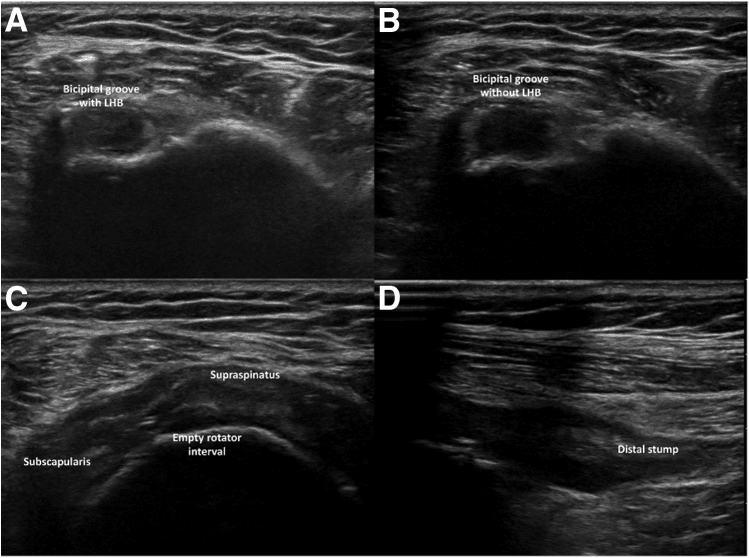
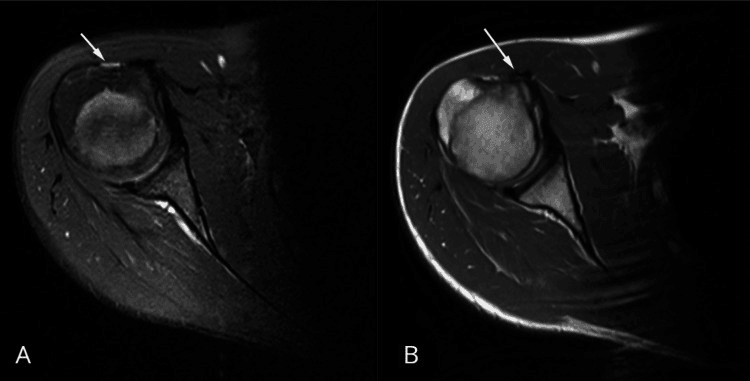
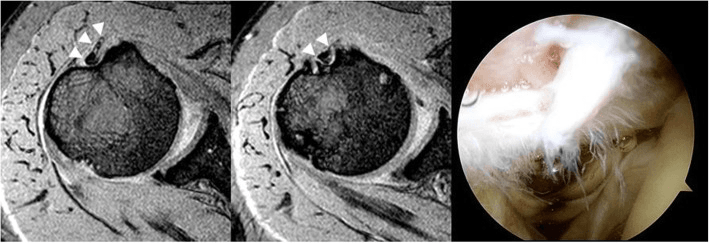
MRI. The gold standard for associated pathology. It confirms the empty groove and evaluates the integrity of the rotator cuff, which is crucial for management, and the labrum for a SLAP lesion.
On axial MRI slices the LHB tendon should sit within the bicipital groove. An empty groove indicates rupture or dislocation, so follow the tendon medially and inspect the subscapularis and pulley before calling it a rupture.
Differential Diagnosis
The "Popeye" arm and acute anterior shoulder pain have a short but exam-relevant differential. The single most important distinction is proximal vs distal biceps rupture, because their management algorithms are opposite.
- Key Distinguishing Feature
- Older patient, mild pain, intact supination, sentinel for cuff disease
- Deformity Direction
- Belly migrates DISTALLY (low Popeye)
- Default Management
- Usually non-operative
- Key Distinguishing Feature
- Reverse Popeye, weak supination, positive hook test
- Deformity Direction
- Belly migrates PROXIMALLY (high bulge)
- Default Management
- Surgical repair in active patients
- Key Distinguishing Feature
- Tendon still present, groove tenderness, positive Speed/Yergason
- Deformity Direction
- No deformity
- Default Management
- Conservative, then tenodesis if refractory
- Key Distinguishing Feature
- Weak abduction/external rotation, positive lag signs
- Deformity Direction
- No biceps deformity (may coexist)
- Default Management
- Address cuff per tear pattern
- Key Distinguishing Feature
- Younger overhead athlete, deep clicking, positive O'Brien
- Deformity Direction
- No deformity
- Default Management
- Rehab; debridement/repair/tenodesis
The hook test differentiates distal biceps rupture: with the elbow flexed to 90 degrees and the forearm supinated, the examiner cannot hook a finger under an intact distal biceps tendon from the lateral side if it is ruptured. This is the bedside test that protects against missing a distal rupture, which needs surgery.
Management Algorithm
Initial treatment of a completed rupture. Confirm that the injury is proximal rather than distal, and assess the rotator cuff, subscapularis and labrum. Treatment is then symptom-led:
- Acute phase - rest, ice and NSAIDs, a brief sling for comfort (a few days) if needed, and early shoulder and elbow range of motion, with pendulums for the shoulder
- Rehabilitation phase - progressive strengthening of the scapular stabilisers and rotator cuff, with elbow flexion and supination as tolerated, aiming to regain full range of motion
What to tell the patient. Outcomes of non-operative care are usually excellent. Strength loss is variable and depends on baseline muscle, activity and associated cuff disease; the intact short head and brachialis compensate and preserve substantial elbow flexion. Do not promise a fixed percentage or assume the deformity predicts disability. Counsel that the contour does not improve with time and usually persists, while strength and endurance outcomes vary.
When to consider reconstruction. Delayed tenodesis or reconstruction, in a specialist setting, is considered only when:
- Persistent pain or cramping remains function-limiting after rehabilitation
- The deformity is unacceptable after informed discussion
- Imaging shows a retrievable tendon stump and the expected benefit justifies the surgical morbidity
Discuss it honestly. Define the stump's location, its chronicity and the patient's expectations first. The stump may be scarred or retracted, the operation is technically harder than treating an intact tendon and high-level rupture-specific evidence is limited.
Tenotomy and tenodesis trials concern an intact pathological LHB encountered during shoulder surgery. After a completed proximal rupture, the operative question is whether a retracted stump can and should be reconstructed or tenodesed.
- Priority
- Confirm proximal rather than distal injury and assess the cuff
- Treatment
- Analgesia, early motion and progressive rehabilitation
- Rationale
- Most patients retain useful elbow function
- Priority
- Define stump location, chronicity and expectations
- Treatment
- Consider delayed tenodesis/reconstruction in a specialist setting
- Rationale
- Technically harder than treating an intact tendon; evidence is limited
- Priority
- Treat the cuff pathology that drives symptoms
- Treatment
- Address only residual diseased or unstable biceps tissue if present
- Rationale
- A completed rupture leaves no intact proximal tendon to tenotomise
- Priority
- Urgent distal-biceps assessment
- Treatment
- Separate repair pathway for active patients
- Rationale
- Distal rupture causes a much larger supination deficit
Surgical Technique
Tenodesis can be used for a retrievable chronic rupture stump or for an intact diseased tendon treated during shoulder surgery. Tenotomy applies only to an intact tendon; it is not a treatment for a completed rupture.
Choosing tenodesis. The indications are:
- Strength - high-demand labourers or athletes needing maximal supination
- Cosmesis - concern about the Popeye deformity
- Associated pathology - the rotator cuff tear is being repaired anyway
- Refractory pain or cramping that has failed conservative care
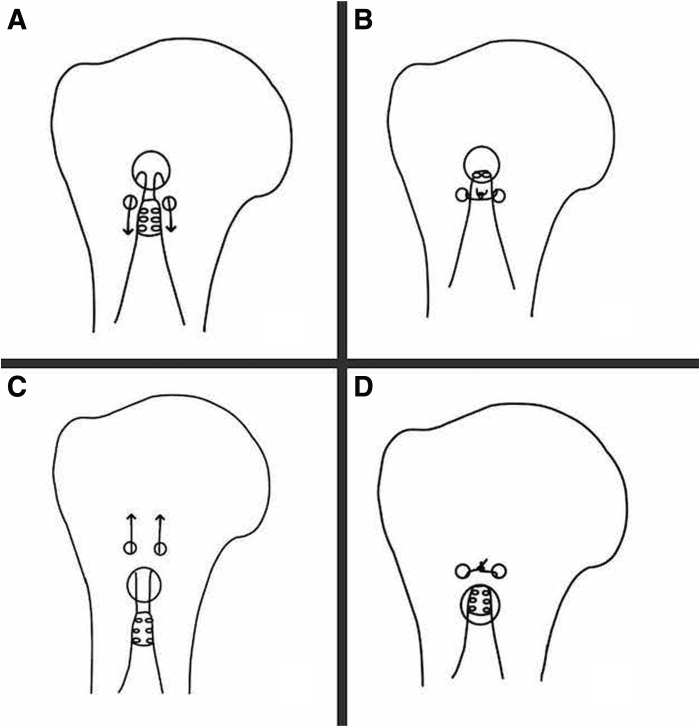
Where to fix it. Suprapectoral tenodesis is arthroscopic or open and sits high in the groove. Subpectoral tenodesis is open, through a mini-incision, distal to the groove. Moving the tendon out of the groove eliminates groove pain and gives strong fixation; the price is a risk of humeral fracture in torsion and neurovascular risk to the musculocutaneous nerve.
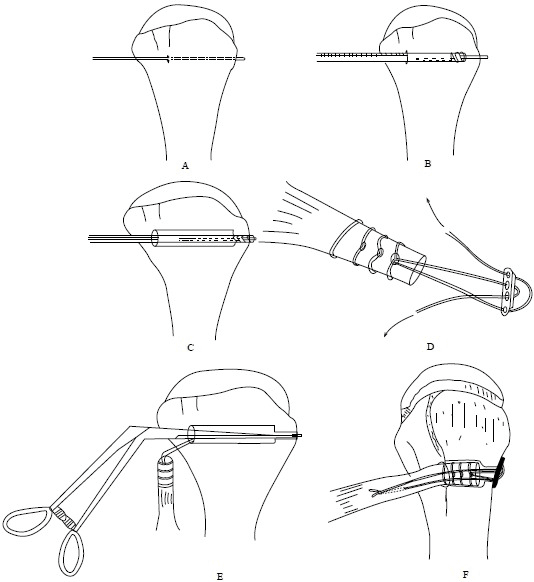
Subpectoral technique. The tendon is found, prepared and fixed in seven steps:
- Position the patient in the beach chair
- Make a small incision in the axillary fold, medial to the pectoralis major tendon
- Locate the tendon, which is often retracted, and retrieve it
- Whipstitch its distal end
- Drill the humerus, centred, unicortical or bicortical depending on the fixation device
- Fix it with an interference screw, suture anchor or cortical button
- Restore physiological tension with the elbow at 90 degrees and the forearm supinated
- Tenotomy
- Release of an intact pathological tendon
- Tenodesis
- Fixation of an intact tendon or reconstructable stump
- Tenotomy
- Higher Popeye risk
- Tenodesis
- Lower Popeye risk in intact-tendon trials
- Tenotomy
- Similar patient-reported outcomes in RCTs
- Tenodesis
- Similar patient-reported outcomes in RCTs
- Tenotomy
- Usually immediate motion
- Tenodesis
- Protect fixation during tendon-bone healing
- Tenotomy
- Deformity; cramping is not consistently higher
- Tenodesis
- Fixation failure, humeral fracture, residual groove pain
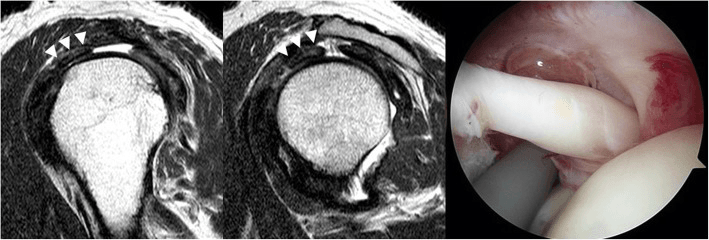
The Hourglass Biceps: A Mechanical Block to Elevation
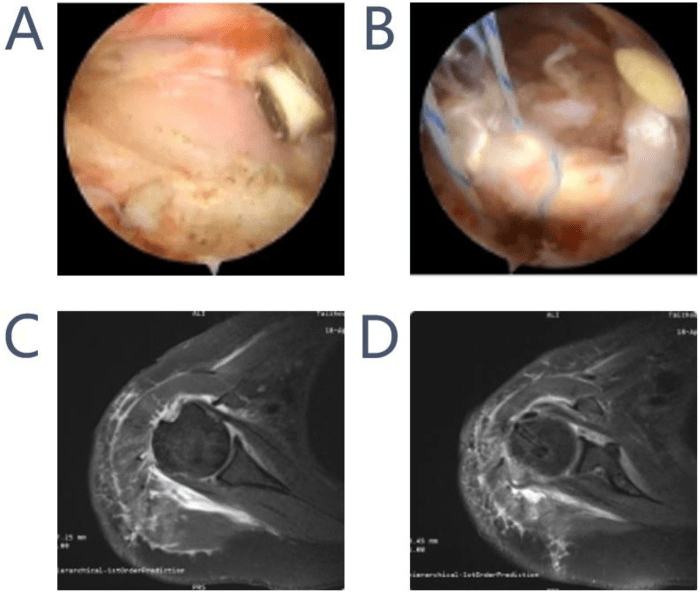
What it is. A hypertrophic intra-articular segment of the long head that has become too bulky to slide down into the groove when the arm is elevated. On elevation the tendon buckles and is squeezed (incarcerated) between the humeral head and the glenoid, an intra-articular mechanical block that Boileau likened to a bucket-handle meniscal tear locking the knee.
How it presents. Anterior shoulder pain with a 10-20 degree loss of active and passive elevation, a true mechanical block rather than weakness, usually with coexisting rotator cuff disease. It is confirmed at operation by the hourglass test: forward elevation with the elbow extended reproduces the buckling and incarceration of the tendon within the joint.
Why it changes the operation. Simple tenotomy at the origin does not relieve the block, because the hypertrophic intra-articular portion is still incarcerated. That segment must be excised, by a "bipolar" tenotomy or as part of a tenodesis. Recognising the lesion converts an unexplained stiff, painful shoulder into a treatable mechanical one.
Complications
- Risk Factor
- Tenotomy
- Management
- Accept or Tenodesis if symptomatic
- Risk Factor
- Occurs after BOTH procedures at similar rates
- Management
- Physio, stretching; late tenodesis will not reliably fix it
- Risk Factor
- Tenodesis (Screw)
- Management
- ORIF
- Risk Factor
- Retractor placement
- Management
- Explore/Repair
- Risk Factor
- Poor bone quality
- Management
- Revision or Conversion to Tenotomy
- Risk Factor
- Prolonged immobilisation
- Management
- Physio/MUA
In sub-pectoral tenodesis, vigorous medial retraction can injure the musculocutaneous nerve. The nerve enters the coracobrachialis medial to the operative field.
Postoperative Care
After tenotomy, immediate active range of motion is allowed as tolerated, with no specific restriction other than pain. After tenodesis the fixation is protected while the tendon heals to bone:
Rehab Protocol (Tenodesis)
- Sling for comfort (wean earlier than after rotator cuff repair)
- Passive elbow flexion
- No active elbow flexion against resistance
- Passive shoulder range of motion
- Active assisted range of motion
- Begin light active flexion
- No lifting heavier than 1-2 lb
- Full active range of motion
- Progressive resistance training (biceps curls)
- Gradual return to activities
- Unrestricted activity
- Return to sport
Outcomes and Prognosis
The consolidated picture from Level I RCTs and meta-analyses of the intact diseased tendon:
Function is equivalent. ASES, WORC and Constant-Murley scores do not differ between tenotomy and tenodesis in pooled Level I data. Most RCTs show no difference in elbow flexion or supination strength; only isolated trials show marginally higher supination strength after tenodesis, and its clinical relevance is debated.
Deformity is the one reproducible difference. The Popeye deformity follows roughly 23-33% of tenotomies and 7-10% of tenodeses.
Cramping. Cramping, a muscle spasm in the distal arm, was historically attributed to tenotomy, but high-level RCTs found similar cramping rates in both groups, so it is not a reason to choose one procedure over the other.
The trade. Tenotomy is faster, with simpler rehabilitation. Tenodesis better preserves cosmesis at the cost of operative time, implant cost and its specific risks: fixation failure, humeral fracture and residual groove pain.
Guidelines, Registries & Global Practice
Global epidemiology
- Long head of biceps (LHB) pathology is found in a high proportion of rotator cuff tears at surgery; isolated LHB rupture in patients over 40 is widely regarded as a sentinel sign of cuff disease.
- Peak incidence is the 5th-6th decade, predominantly in men and manual or overhead workers.
- Distal ruptures are far rarer than proximal and occur in younger, often muscular men with sudden eccentric load.
Side-by-side guidance
- Imaging stance
- MRI/US to define associated cuff and labral pathology, not for an obvious clinical Popeye
- Treatment emphasis
- Shared decision-making; tenotomy and tenodesis both acceptable
- Imaging stance
- Reserve advanced imaging for surgical planning or diagnostic doubt
- Treatment emphasis
- Non-operative default in low-demand; tenodesis for cosmesis/strength concerns
- Imaging stance
- Focus on concomitant cuff/instability rather than the LHB in isolation
- Treatment emphasis
- Address the LHB at the time of cuff or instability surgery
- Imaging stance
- US first-line in many centres (cheaper, dynamic), MRI for full work-up
- Treatment emphasis
- Procedure choice driven by patient demand and deformity tolerance
Practice variation by resource setting
- High-resource settings: ready MRI access, arthroscopic suprapectoral or open subpectoral tenodesis with implants, formal physiotherapy pathways.
- Limited-resource settings: ultrasound or clinical diagnosis predominate; non-operative management and, when surgery is indicated, arthroscopic tenotomy (no implant cost, immediate rehab) are favoured. The functional equivalence shown in RCTs makes tenotomy a defensible, cost-effective default where implants are scarce.
Related pages: Biceps Tendon Pathology is the umbrella covering tendinopathy, instability and the pre-rupture tendon - this page picks up where that one ends, at the completed tear; Rotator Cuff Tears is the finding that actually decides management here, since a proximal biceps rupture in this age group is usually a marker of cuff disease and twenty of Boileau's twenty-one hourglass patients had a cuff tear repaired at the same sitting; Massive Rotator Cuff Tears for the shoulder in which the ruptured biceps was the last restraint; SLAP Tears for the labral end of the same tendon and the other indication for tenodesis in this literature - most of the trials pooled by Belk mixed both populations; Distal Biceps Rupture for the injury this must never be confused with, where the deformity points the other way and surgery is the default rather than the exception; and Rotator Cuff Arthropathy for the endpoint of the untreated cuff-deficient shoulder.
Controversies & Areas of Uncertainty
Level I RCTs agree function is equivalent; the only consistent difference is Popeye deformity. The unresolved question is whether the small supination-strength and cramping signals are clinically meaningful. Most surgeons reserve tenodesis for younger, leaner, high-demand or cosmesis-conscious patients.
Older series attributed disabling cramping to tenotomy, but blinded RCTs (MacDonald 2020) found no difference in cramping between groups. Cramping may be less procedure-specific than classically taught.
No clear functional winner. Subpectoral fixation moves the tenodesis distal to the groove (theoretically eliminating residual groove pain) but adds a second incision and neurovascular exposure. Suprapectoral arthroscopic fixation is associated with more postoperative stiffness in some series (Werner, Arthroscopy 2014).
Interference screws create a torsional stress riser - cadaveric torsion testing fractured 100% of screw-tunnel specimens (Frank 2019). Suture anchors and the smallest adequate screw reduce this risk, but no high-level clinical trial proves one construct superior in vivo.
MCQ Practice Points
Q: Which nerve is most at risk during open sub-pectoral biceps tenodesis? A: The Musculocutaneous Nerve. It enters the coracobrachialis muscle medial to the operative field and is vulnerable to vigorous medial retraction.
Q: What is the expected functional deficit after non-operative management of a proximal biceps rupture? A: Approximately 10-20% loss of supination strength and endurance. Elbow flexion strength is largely preserved due to the intact brachialis.
Q: What does a positive Yergason's test indicate? A: It indicates pathology of the LHB in the bicipital groove or instability of the transverse humeral ligament. It is performed by resisting supination with the elbow at 90 degrees.
Q: A patient presents with a 'Popeye' deformity. Where has the tendon likely ruptured? A: Proximal Long Head of Biceps. The muscle belly retracts distally, creating a prominent bulge in the lower arm. Distal biceps ruptures cause the muscle to retract proximally.
Q: What is the most appropriate imaging to rule out associated pathology in a 60-year-old? A: MRI of the Shoulder. This is the gold standard to evaluate the rotator cuff (supraspinatus/subscapularis), which is torn in a high percentage of elderly patients with biceps rupture ("Sentinel Sign").
Exam Viva Scenarios
Practise clinical reasoning and management decisions out loud
“A 72-year-old male presents with sudden arm pain and bruising 2 weeks ago while gardening. Now pain has settled, but he notices a bulge in his arm. He has full range of motion. Examination reveals a Popeye deformity. How do you manage him?”
“A 28-year-old bodybuilder feels a snap doing heavy deadlifts. Acute pain anterior shoulder. MRI shows complete LHB rupture and superior labral tear. He is worried about appearance and strength.”
“You performed a rotator cuff repair and biceps tenotomy on a 55-year-old carpenter 6 months ago. He is happy with the shoulder, but complains of painful cramping in the biceps muscle belly after repetitive hammering. It is affecting his work.”
“A 35-year-old weightlifter had a subpectoral biceps tenodesis 6 weeks ago. While doing a heavy eccentric curl against advice, he felt a painful 'pop' and noticed the muscle belly retract distally again. He is distraught about the appearance. What happened and how do you manage it?”
Key Anatomy
- Origin: Supraglenoid tubercle
- Groove: Intertubercular sulcus
- Function: Supinator dominant vs Flexor
- Nerve: Musculocutaneous (C5-6)
Clinical Signs
- Popeye Deformity (distal bunching)
- Ecchymosis (medial arm)
- Ludington's test positive
- Usually painless after acute phase
Management Rules
- Elderly/Low Demand to Non-operative
- Young/High Demand to Tenodesis
- Cuff Repair to Tenotomy or Tenodesis
- Cosmetic concern to Tenodesis
Tenotomy vs Tenodesis
- Tenotomy: Fast, easy, safe, but deformity/cramps
- Tenodesis: Strong, cosmetic, but longer rehab/risks
- Evidence: Equal functional scores
- Rehab: Immediate (Tenotomy) vs Protected (Tenodesis)
Surgical Risks
- Deformity (Tenotomy)
- Cramping (Tenotomy)
- Humerus Fracture (Tenodesis)
- Musculocutaneous Nerve Injury
Key Exam Pearls
- Always check Rotator Cuff - sentinel sign of cuff disease
- Distal rupture DIFFERENT - needs surgical repair
- Minimal functional loss - short head compensates
- Cosmesis main concern - counsel pre-op
Evidence Base
MacDonald et al. Double-Blind RCT: Tenodesis vs Tenotomy
- Prospective double-blind RCT, 114 patients (mean age 57.7), LHB lesions at arthroscopy.
- ASES and WORC scores improved equally; no difference between groups at 24 months.
- Popeye deformity 33% (tenotomy) vs 10% (tenodesis); relative risk 3.5 (95% CI 1.26-9.70).
- No difference in elbow flexion or supination strength; cramping equivalent; all tenodeses intact on 1-year MRI.
Belk et al. Meta-analysis of Level I RCTs
- Systematic review of 5 Level I RCTs: 236 tenodesis vs 232 tenotomy patients, mean follow-up 23 months.
- Cosmetic deformity 6.8% (tenodesis) vs 23.3% (tenotomy), P less than 0.001.
- No difference in ASES, VAS pain, or Constant-Murley scores; only one RCT showed greater supination strength after tenodesis.
- No difference in overall complication rates at latest follow-up.
Ge, Zhang et al. Tenotomy or Tenodesis Meta-analysis
- Meta-analysis of 7 studies, 622 subjects.
- Tenodesis: higher Constant score (P=0.02), lower Popeye rate (P less than 0.001), less cramp pain (P=0.04).
- Tenotomy: shorter surgical time (P less than 0.001).
- Overall complication rate lower with tenodesis in this cohort.
Slenker et al. Clinical Outcomes Systematic Review
- Systematic review of 16 studies (Level II-IV): 433 tenodesis and 699 tenotomy procedures.
- Excellent/good outcome 74% (tenodesis) vs 77% (tenotomy) - clinically comparable.
- Cosmetic deformity 8% (tenodesis) vs 43% (tenotomy).
- Postoperative bicipital pain 24% (tenodesis) vs 19% (tenotomy).