Humeral Head Resurfacing Arthroplasty
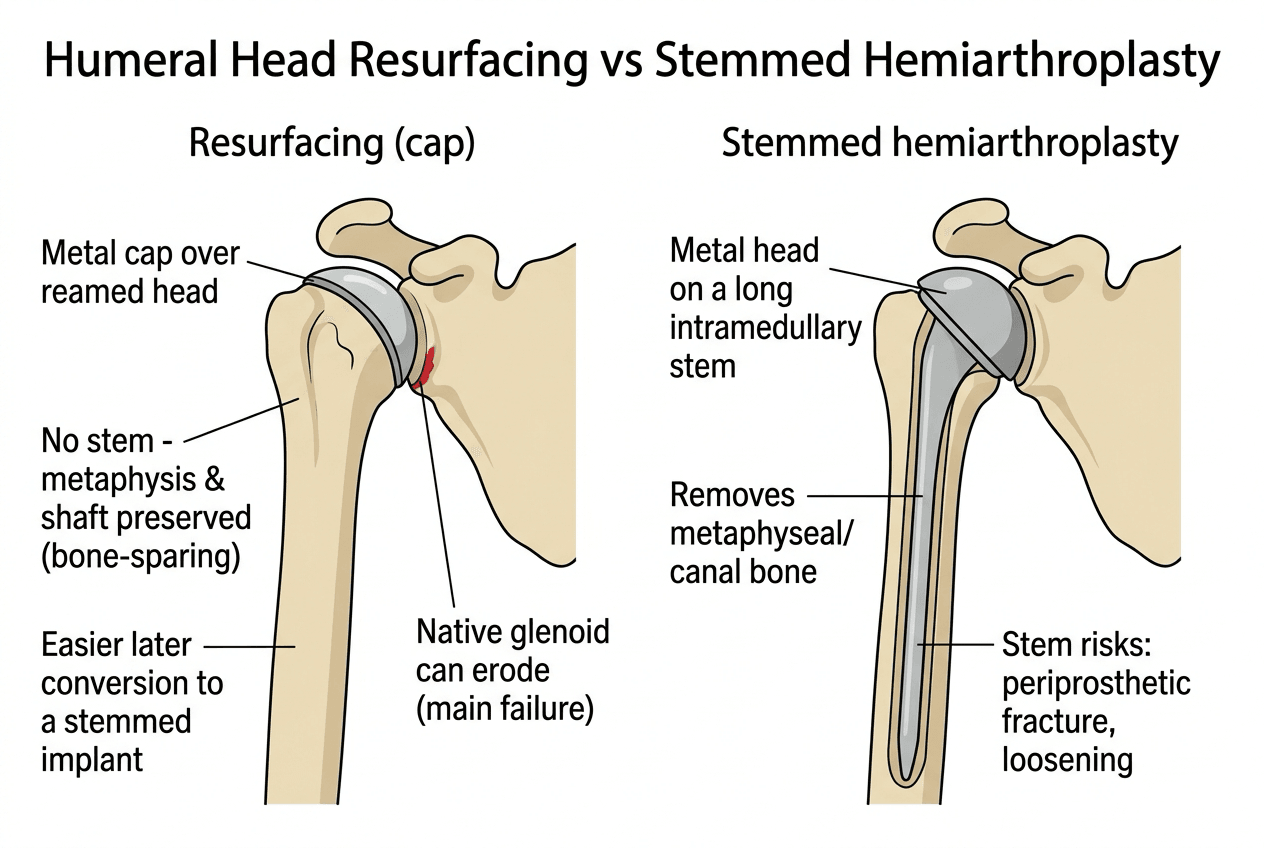
- Humeral head resurfacing arthroplasty is a BONE-PRESERVING procedure in which a metallic (or pyrocarbon) CAP is fitted over the reamed humeral head WITHOUT a long intramedullary stem - the metaphysis and shaft remain native bone - which avoids stem-related complications (periprosthetic fracture, stem loosening, difficult stem removal) and preserves humeral bone stock, making later revision to a stemmed implant relatively straightforward.
- It is typically chosen for a YOUNGER patient with glenohumeral arthritis who has PRESERVED humeral-head bone stock and acceptable head geometry; the appeal is preserving bone and avoiding both the humeral stem and (in hemi-resurfacing) a glenoid component, while restoring the joint surface.
- The dominant failure mode is GLENOID EROSION and pain that occurs when a metal resurfaced head articulates with the NATIVE GLENOID - this is why registry and comparative studies have NOT shown a survivorship advantage for metal resurfacing over stemmed hemiarthroplasty at mid-term, and why glenoid-side pathology must be considered before choosing a hemi-resurfacing.
- The classic TECHNICAL PITFALLS are getting the head size and position wrong: OVERSIZING the cap ('overstuffing' the joint) and creating excessive LATERAL OFFSET (or varus malposition) increase the load on the glenoid and ACCELERATE GLENOID WEAR - so matching the patient's native head size and offset (and down-sizing rather than up-sizing in resurfacing) is important.
- PYROCARBON (pyrolytic carbon) resurfacing has been proposed to reduce glenoid erosion because of markedly lower wear rates, and registry data (AOANJRR) in patients under 55 show a LOWER revision rate for pyrocarbon hemi-resurfacing (around 8.9% at 6 years) than for metal hemi-resurfacing (around 17.1%) or metal stemmed hemiarthroplasty (around 17.5%), with no pyrocarbon cases revised for glenoid erosion; pain, prosthesis fracture and infection were the main revision reasons.
- SEPARATE RADIOGRAPHIC GLENOID WEAR FROM SYMPTOMATIC FAILURE - conflating them overstates the risk and generates unnecessary revisions. Pooling 20 studies and 1,117 pyrocarbon patients, radiographic wear was reported in anywhere from 6% to 100% of series and progressed in 6% to 39% where tracked, yet revision for PAINFUL erosion occurred in only FOUR patients. Follow up on symptoms and function, not on the appearance of the glenoid, and do not revise a comfortable patient because the film has changed.
- THE CONSTRUCT MATTERS AS MUCH AS THE BEARING: in the same pooled data, implant survival was 98% for STEMMED pyrocarbon hemiarthroplasty, 96% for pyrocarbon RESURFACING and 87% for INTERPOSITION, with revision rates of 3%, 5% and 12% - so choosing pyrocarbon does not by itself make a resurfacing perform like a stemmed implant, and the reviewers concluded survivorship was inferior for the resurfacing and interposition forms.
- RESURFACING AND STEMLESS ARE NOT INTERCHANGEABLE bone-preserving options, and the difference is the humeral head. Resurfacing RETAINS the head, which is precisely why GLENOID EXPOSURE IS MARKEDLY HARDER - the head cannot be displaced out of the way - so most resurfacings are performed as a HEMI against the native glenoid, which is where the failure mode lives. A stemless component RESECTS the head, so glenoid exposure is normal and a GLENOID COMPONENT IS AVAILABLE, while the metaphysis and shaft are still preserved. Where the glenoid is driving the problem, the bone-preserving answer is stemless or a stemmed anatomic total shoulder, not resurfacing.
- A major practical advantage is that, because bone stock and humeral geometry are preserved, a failed resurfacing can usually be CONVERTED relatively straightforwardly to a stemmed anatomic or reverse arthroplasty - so resurfacing can be viewed as a bone-conserving first step in a young patient, provided the surgeon avoids overstuffing and considers the glenoid.
- “Humeral head resurfacing = bone-preserving stemless CAP (native shaft kept) → avoids stem complications, eases later revision; for younger patients with preserved head bone stock.
- “Dominant failure = GLENOID erosion/pain (metal on native glenoid); no survivorship advantage over stemmed hemi at mid-term; OVERSTUFFING / lateral offset accelerate wear.
- “Pyrocarbon resurfacing lowers wear/revision (AOANJRR ~8.9% vs ~17% at 6y); conversion to stemmed implant is straightforward.
- “RADIOGRAPHIC wear (6-100% of series) is NOT failure: only 4 of 1,117 pyrocarbon patients were revised for painful erosion. Follow symptoms, not the film.
- “Construct beats bearing: pooled pyrocarbon survival 98% stemmed hemi / 96% resurfacing / 87% interposition (revision 3/5/12%).
- “Resurfacing RETAINS the head so the glenoid cannot be reached (hence hemi on native glenoid); stemless RESECTS it so a glenoid component is available. Glenoid problem → stemless or anatomic TSA, not resurfacing.
A stemless cap preserves the metaphysis and shaft - no stem complications, and a failed resurfacing converts easily to a stemmed implant. Good for younger patients.
Glenoid erosion/pain (metal on native glenoid) is the main failure; don't overstuff or over-lateralise the head. Pyrocarbon reduces wear.
Concept, Indications & Failure
Humeral head resurfacing fits a metallic (or pyrocarbon) cap over the reamed humeral head without a stem, preserving the metaphysis and shaft. The benefits are bone preservation and avoidance of stem-related complications (periprosthetic fracture, stem loosening, hard stem removal), and a failed resurfacing converts relatively easily to a stemmed implant - which makes it attractive in a younger patient with preserved head bone stock. The caveat is the glenoid: when a metal cap articulates with the native glenoid, glenoid erosion and pain are the dominant failure mode, and at mid-term resurfacing has not out-survived stemmed hemiarthroplasty. The classic technical errors - oversizing/overstuffing and excessive lateral offset - increase glenoid load and accelerate wear; pyrocarbon bearings reduce it.
Indications and Contraindications
- Indications. Glenohumeral arthritis in a young, active patient with preserved humeral-head bone stock and acceptable geometry: primary osteoarthritis, post-traumatic arthritis, avascular necrosis with a still-supportable head (a classic indication where enough subchondral bone remains - the osteonecrosis disease itself is covered in Avascular Necrosis of the Shoulder), selected inflammatory arthritis with adequate bone, and instability/dysplastic arthropathy; focal/partial resurfacing implants exist for a contained osteochondral/AVN lesion.
- Contraindications. Significant glenoid erosion/bone loss or a biconcave glenoid (drives the wear failure - address the glenoid instead); deficient humeral-head bone stock (extensive AVN collapse, large cysts, severe osteoporosis) that cannot support the cap; active infection; and a deficient rotator cuff / cuff-tear arthropathy, where a reverse replacement is the right operation (see Rotator Cuff Arthropathy and Reverse Total Shoulder Arthroplasty).
Ideal candidate: young, active, OA or AVN, with a well-preserved head and a reasonable glenoid. Rule it out for glenoid erosion/bone loss, an unsupportable head, infection, or a deficient cuff (then reverse). AVN with a supportable head is a classic indication; AVN with collapse/large cysts is a contraindication.
Glenoid Wear on the Radiograph Is Not the Same as Failure
The Distinction That Changes Follow-up
Glenoid erosion is the dominant failure mode, but "erosion" is used for two different things, and conflating them makes the operation look worse than it is and generates unnecessary revisions. In a systematic review and meta-analysis of 20 studies and 1,117 patients receiving pyrocarbon humeral implants:
- Radiographic glenoid wear is common and its reported frequency is wildly variable - between 6% and 100% across series of pyrocarbon hemiarthroplasty, and 3% to 90% for pyrocarbon interposition. Where progression was tracked over time, erosion advanced in 6% to 39%.
- Revision for symptomatic, painful erosion was rare - only 4 patients in the entire pooled cohort.
So a resurfaced shoulder that develops radiographic glenoid wear has not failed. What matters is whether the patient has pain, and follow-up should be driven by symptoms and function rather than by the appearance of the glenoid on a plain film. The corollary is that a comfortable patient with radiographic wear does not need revising, and quoting radiographic wear rates as though they were failure rates badly overstates the risk.
Pyrocarbon Helps - But Not Every Pyrocarbon Construct Equally
Pyrocarbon is used in three different constructs, and the same meta-analysis separates them - which matters, because their results are not alike:
- Implant survival
- 98%
- Revision rate
- 3%
- Implant survival
- 96%
- Revision rate
- 5%
- Implant survival
- 87%
- Revision rate
- 12%
- Implant survival
- 96% (95% CI 94-98%)
- Revision rate
- 5%
Pooled survival across all pyrocarbon constructs was 96% (95% CI 94-98%), but with substantial heterogeneity, and the subgroups did not perform alike: the stemmed pyrocarbon hemiarthroplasty performed best and the interposition construct clearly worst, with resurfacing between them. In other words the bearing material and the construct are separate questions - choosing pyrocarbon does not by itself make resurfacing the equal of a stemmed implant, and the reviewers' own conclusion was that survivorship has been inferior when pyrocarbon is used for resurfacing or interposition compared with a stemmed pyrocarbon hemiarthroplasty.
Separate radiographic glenoid wear from symptomatic failure: wear appears in anything from 6% to 100% of pyrocarbon series, yet only 4 of 1,117 patients were revised for painful erosion. Follow up on symptoms, not on the film. And note the construct matters as much as the material - pooled survival was 98% stemmed pyrocarbon hemi, 96% pyrocarbon resurfacing, 87% interposition.
Resurfacing Versus Stemless: Two Different Bone-Preserving Answers
Both resurfacing and a stemless humeral component are marketed on bone preservation and on easy conversion at revision, and a candidate should be able to say why they are not interchangeable. The difference is what happens to the humeral head.
- Resurfacing
- RETAINED and reamed - only the articular surface is removed
- Stemless
- RESECTED at the anatomical neck; fixation is in the metaphysis
- Resurfacing
- MARKEDLY HARDER - the retained head cannot be displaced out of the way
- Stemless
- Normal, as for any stemmed implant - the head has been removed
- Resurfacing
- In practice usually not, so most are hemi-resurfacing on a native glenoid
- Stemless
- Yes - a standard anatomic total shoulder is possible
- Resurfacing
- Metal or pyrocarbon articulates with native glenoid, which is where the failure mode lives
- Stemless
- The glenoid can be resurfaced, removing that failure mode entirely
- Resurfacing
- Most - head, metaphysis and shaft all native
- Stemless
- Metaphysis and shaft; head resected
- Resurfacing
- Adequate head bone stock and geometry
- Stemless
- Adequate metaphyseal bone quality
This is why the glenoid-exposure limitation is not merely a technical inconvenience. It is the reason resurfacing is usually performed as a hemiarthroplasty, and therefore the reason the native glenoid is left to articulate against the implant at all. A stemless component keeps most of the bone-preservation and easy-conversion advantages while restoring normal glenoid access, so where the glenoid is the problem, stemless or stemmed anatomic total shoulder arthroplasty addresses it and resurfacing does not.
Resurfacing keeps the head, which is exactly why the glenoid cannot be reached - hence hemi-resurfacing against a native glenoid, hence the failure mode. Stemless resects the head, so glenoid exposure is normal and a glenoid component is available, while still preserving the metaphysis and shaft. If the glenoid is driving the problem, the bone-preserving answer is stemless, not resurfacing.
Operative Technique (and the Glenoid-Exposure Problem)
- Approach. Standard deltopectoral approach; the subscapularis is taken down (tenotomy/peel or a lesser-tuberosity osteotomy) for access and repaired at closure.
- Surface preparation. A central guide pin is placed down the axis of the anatomical neck and the articular surface is shaped with a cannulated reamer - only the worn surface is removed, reproducing the native head-neck inclination, version and offset. The cap (with a short central peg/keel for fixation) is impacted to sit flush, deliberately NOT proud, to avoid overstuffing or over-lateralising.
- The glenoid-exposure problem. Because the head is retained (not resected), you cannot displace the proximal humerus out of the way as you can after a humeral neck cut, so glenoid exposure is markedly harder - this is a real technical limitation and one reason hemi-resurfacing (leaving the glenoid alone) is common; if the glenoid genuinely needs resurfacing, a stemmed/total construct gives far better access.
- Sizing rule. Choose the cap to match or slightly under-size the native head; building up size/offset is the error that loads the glenoid.
Ream only the surface over a central guide pin, reproduce the native head-neck offset/version, and seat the cap flush (under-size rather than over-size). The catch the examiner wants: with the head retained, glenoid exposure is difficult, so you cannot easily resurface the glenoid - which both explains why hemi-resurfacing predominates and why a glenoid-driven problem favours a stemmed/total implant.
Mnemonics & Memory Aids
RESURFACE
Hook:RESURFACE: no stem, Erosion is the enemy, Size to native, Under-55, Revision easy, no Fracture, Avoid offset, Carbon helps, Evaluate glenoid.
Clinical Decision Scenarios
Practise clinical reasoning and management decisions out loud
“What is humeral head resurfacing arthroplasty and when would you consider it?”
“A young patient's metal hemi-resurfacing has failed with glenoid pain. Why did it fail and what are the revision options?”
Concept & indication
- Bone-preserving metallic/pyrocarbon cap over the humeral head, NO stem
- Avoids stem complications; preserves bone; eases later revision
- Younger patient with preserved head bone stock and geometry
Failure mode
- Glenoid erosion + pain (metal on native glenoid) - dominant failure
- No survivorship advantage over stemmed hemiarthroplasty at mid-term
- Pain, prosthesis fracture, infection also cause revision
- RADIOGRAPHIC wear (6-100%) is NOT failure - only 4 of 1,117 revised for painful erosion
- Follow up on symptoms and function, not on the appearance of the glenoid
Versus stemless
- Resurfacing RETAINS the head → glenoid exposure markedly harder → usually hemi
- Stemless RESECTS the head → normal glenoid access → glenoid component available
- Glenoid-driven problem: choose stemless or anatomic TSA, not resurfacing
- Pyrocarbon by construct: stemmed hemi 98% / resurfacing 96% / interposition 87% survival
Technical pearls
- Match native head size/offset; AVOID oversizing (overstuffing)
- Avoid excess lateral offset/varus (accelerates glenoid wear)
- Assess the glenoid; consider pyrocarbon to reduce wear
Revision
- Preserved bone → straightforward conversion to stemmed implant
- Cuff intact + adequate glenoid → anatomic TSA
- Cuff-deficient/worn glenoid → reverse TSA
Technique Pearls & Evidence-based Practice
- Match native head size and offset. Reproduce the patient's anatomy; avoid oversizing ('overstuffing') and excessive lateral offset or varus malposition, which increase glenoid load and wear (down-size rather than up-size in resurfacing).
- Assess the glenoid. Glenoid erosion/pain drives failure of hemi-resurfacing - consider glenoid wear, version and bone stock when choosing hemi-resurfacing versus a glenoid-resurfacing or stemmed/total option.
- Consider the bearing. Pyrocarbon resurfacing reduces wear and, in registry data, revision rates - particularly for the goal of avoiding glenoid erosion.
- Plan for the future. Counsel that resurfacing is bone-conserving and convertible to a stemmed anatomic or reverse arthroplasty if it fails - a genuine advantage in a young patient.
The recurring lesson of humeral head resurfacing is that the GLENOID, not the humeral cap, usually decides the outcome: because the dominant failure mode is glenoid erosion and pain when metal articulates with native glenoid, and because resurfacing has not out-survived stemmed hemiarthroplasty at mid-term, the glenoid must be assessed and the head must NOT be overstuffed or over-lateralised - both of which load the glenoid further. Use resurfacing for its real strengths - bone preservation and easy conversion in a young patient - and consider a pyrocarbon bearing or a glenoid-side solution where glenoid wear is the concern, rather than expecting a metal-on-native-glenoid hemi-resurfacing to be durable in every patient.
Evidence & Key Studies
Pyrocarbon vs metal humeral resurfacing and metal stemmed hemiarthroplasty in young patients (AOANJRR)
- In registry patients under 55 with osteoarthritis, the cumulative revision at 6 years was 8.9% for pyrocarbon hemi-resurfacing, 17.1% for metal hemi-resurfacing and 17.5% for metal stemmed hemiarthroplasty.
- Pyrocarbon hemi-resurfacing had a significantly lower revision rate than other hemi-resurfacing prostheses; pain, prosthesis fracture and infection were the key reasons for revision.
- No pyrocarbon hemi-resurfacing case was revised for glenoid erosion - the failure mode that limits metal-on-native-glenoid resurfacing.
Stemmed hemiarthroplasty versus resurfacing in primary shoulder osteoarthritis
- Functional scores were similar between resurfacing and 3rd-generation stemmed hemiarthroplasty, but revision-free survival was significantly lower with resurfacing (4 revisions for glenoid wear, 9.8%, versus none).
- Resurfacing showed greater varus positioning and lateral offset of the humeral head than stemmed hemiarthroplasty.
- Greater humeral-head size may increase lateral offset and accelerate glenoid wear; down-sizing the head in resurfacing may limit these complications.
Pyrocarbon implants in shoulder arthroplasty: a systematic review and meta-analysis
- Twenty studies and 1,117 patients (mean age about 50) receiving pyrocarbon hemiarthroplasty or interposition; pooled implant survival 96% (95% CI 94-98%) with substantial heterogeneity, and an overall revision rate of 5%.
- The construct mattered: survival was 98% for stemmed pyrocarbon hemiarthroplasty, 96% for pyrocarbon resurfacing and 87% for interposition, with revision rates of 3%, 5% and 12% respectively.
- Radiographic glenoid wear was reported in 6% to 100% of hemiarthroplasty series and progressed in 6% to 39% where tracked - yet revision for symptomatic painful erosion occurred in only 4 patients across the whole cohort.
The registry survivorship figures (pyrocarbon vs metal hemi-resurfacing vs metal stemmed hemiarthroplasty), the reasons for revision and the absence of glenoid-erosion revisions with pyrocarbon come from the cited McBride AOANJRR study; the similar function but poorer revision-free survival of resurfacing (driven by glenoid wear) and the link between greater head size/lateral offset and glenoid wear (favouring down-sizing) from the cited Lebon study. The separation of radiographic glenoid wear from symptomatic failure, the wide 6-100% range of reported wear, the 4 revisions for painful erosion among 1,117 patients, and the survival and revision figures broken down by pyrocarbon construct come from the cited Aguilar-Gonzalez meta-analysis - which is also the basis for the caution that choosing pyrocarbon does not by itself make a resurfacing perform like a stemmed implant.
The comparison with stemless components is a structural one rather than a numerical one: the difference in glenoid exposure follows from whether the humeral head is retained or resected, and no comparative survivorship figure for resurfacing versus stemless is quoted because a direct comparison was not identified. The stemless side is developed in Stemless / Short-Stem Shoulder Arthroplasty. The bone-preserving rationale, stem-avoidance and ease of conversion to a stemmed implant are standard, well-established teaching. (See also Total Shoulder Arthroplasty and Shoulder Osteoarthritis.)