Paprosky classification drives fixation strategy: where can I still achieve reliable fixation — metaphysis, diaphysis, or neither?
- The classification is a fixation-zone algorithm: Type I proximal fixation possible; Types II-IIIA diaphyseal fixation with cylindrical or tapered stems; IIIB tapered fluted titanium; IV bypass or replace the femur.
- Fluted tapered titanium stems gain axial stability from the taper and rotational stability from the flutes — they need only 2 to 3 cm of diaphyseal contact, which is why they work in IIIB where 6-inch cylindrical stems do not.
- Extensively porous-coated cobalt-chrome cylindrical stems need 4 to 6 cm of scratch-fit; failure rates rise sharply in IIIB (classically up to 20 percent or more) and stress shielding is common with stems 16.5 mm and larger.
- Varus remodelling of the proximal femur mandates consideration of an extended trochanteric osteotomy to allow neutral reaming and avoid distal-lateral cortical perforation.
- The deficient calcar is managed by bypassing it — modern revision stems do not rely on calcar support; the modular proximal body restores offset, version and length independently of distal fixation.
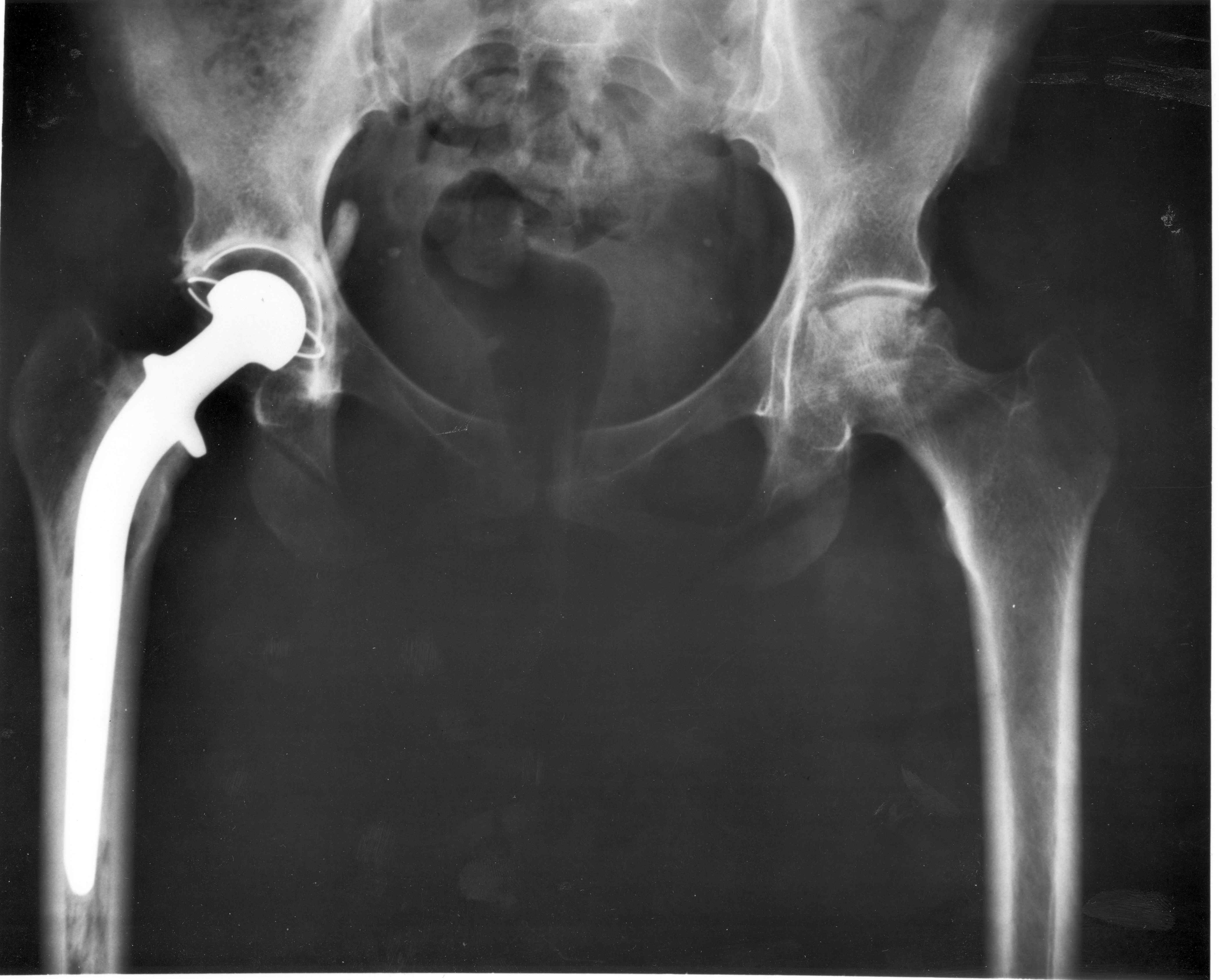
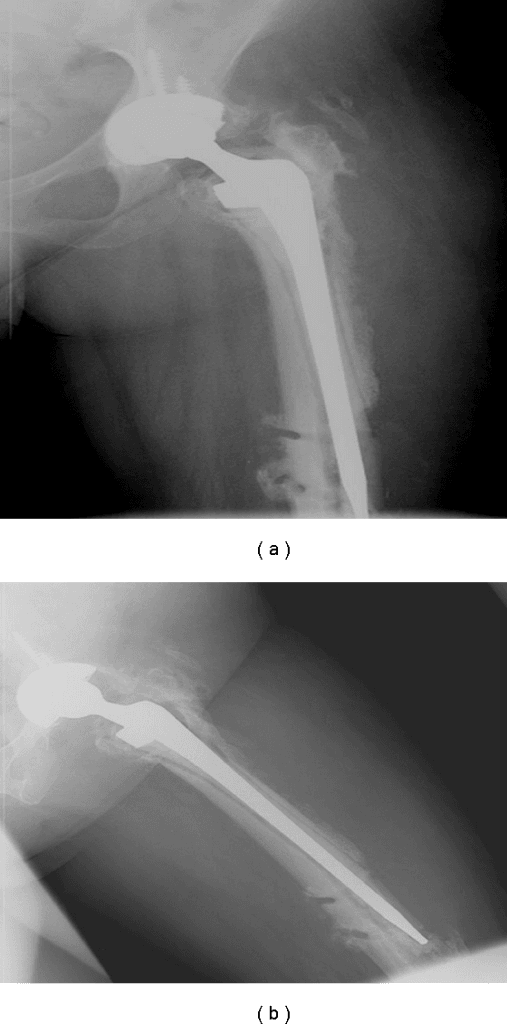
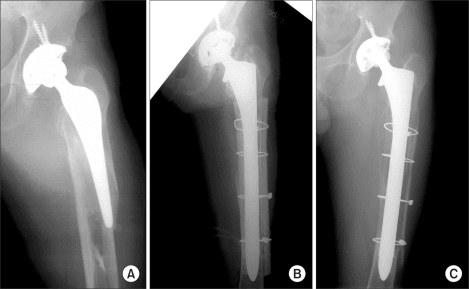
- “Ask for the full-length femur film: isthmus quality, cortical thickness (aim for cortices at least 2 mm thick over the fixation zone), canal diameter, varus remodelling, stem tip position and any distal pedestal.
- “In IIIB and IV, an extensively coated cylindrical stem is the classic wrong answer — the exam wants a fluted tapered modular stem or, for Type IV, impaction grafting, APC or proximal femoral replacement.
- “Cemented long stems retain a role in the elderly, low-demand or irradiated femur where bone ingrowth cannot be expected.
IIIA versus IIIB hinges on whether greater than 4 cm of intact diaphysis is available for scratch-fit. This single measurement changes the implant: cylindrical stems are acceptable in IIIA but have unacceptable failure rates in IIIB, where the fluted tapered stem is the answer.
Large-diameter extensively coated cobalt-chrome monoblocks (16.5 mm and above) cause marked proximal stress shielding and load the stem tip — risk of thigh pain, periprosthetic fracture at the tip, and difficult future revision of a well-ingrown stem.
Modular fluted tapered stems can subside (undersizing, line-to-line reaming errors) and carry a small but real risk of modular junction fracture and fretting corrosion, especially with a large patient, small junction, and unsupported proximal body.
A femur remodelled into varus reamed with a straight stem will perforate the lateral cortex anterolaterally. Recognise it on the AP femur preoperatively and plan an extended trochanteric osteotomy to redirect the reamer down the true canal.
Principles: Where Is the Fixation Zone?
- 1Start
Loose or failed femoral stem — ask one question: what bone remains that can support an implant?
Fixation zone defined as metaphyseal, diaphyseal, or neither
- 2Metaphysis supportive (Type I)
Proximal metaphyseal cancellous bone intact, canal not widened
Fixation stays in the metaphysis; simplest reconstruction
- 3Metaphysis gone, diaphysis intact (Type II and IIIA)
Proximal support lost but greater than 4 cm of intact diaphyseal isthmus remains
Scratch-fit in the isthmus carries the load; either design reliable when isthmus is generous
- 4Diaphysis compromised (Type IIIB)
Less than 4 cm of usable isthmus — short, often capacious distal segment
Cylindrical stems fail here; the 4 cm isthmus rule is the pivotal measurement
- 5No isthmus (Type IV)
Widened, thin-walled femur that cannot grip an uncemented stem
Reconstruction ladder chosen by bone stock, host biology and demand
- 6Universal rule 1
Cortical perforations, stress risers and old screw holes are fracture initiators
Reduced periprosthetic fracture risk
- 7Universal rule 2
A perfectly fixed stem with a detached trochanter is a failed hip
Restored abductor mechanism, stable and functional hip
Revision femoral surgery is a problem of achieving durable fixation in compromised bone. Every decision follows from a single question: what bone remains that can support an implant?
- Metaphysis intact (Type I) — primary-type fixation still possible.
- Metaphysis gone, diaphysis intact (Type II, IIIA) — move fixation distally into the diaphysis.
- Diaphysis compromised (IIIB) — fixation must be achieved in a short, often capacious segment: only a tapered fluted design can do this reliably.
- No isthmus (Type IV) — the femur cannot grip an uncemented stem. Options: rebuild the tube (impaction grafting), cement into what remains (elderly), replace the proximal femur with allograft plus stem (APC), or replace it with metal (proximal femoral replacement).
Two further principles:
- Bypass defects by at least two cortical diameters of intact bone (relevant for cortical perforations, stress risers, and old screw holes) to reduce periprosthetic fracture risk.
- Restore the abductor mechanism — a perfectly fixed stem with a detached trochanter is a failed hip. Trochanteric fixation and soft-tissue strategy is part of the plan, not an afterthought.
Radiographic Assessment
Obtain AP pelvis, AP and lateral full-length femur including the knee (rules out distal deformity, old hardware, and defines total canal length). CT adds value for cortical thickness mapping, version, and occult lysis.
Read the femur systematically:
- Fixation status of the existing stem — for cemented stems, Barrack cementation grade and Harris loosening criteria; for cementless, Engh criteria (spot welds, absence of reactive lines around the coated portion, calcar rounding, pedestal).
- Level of bone loss — is cancellous metaphyseal bone present? Is the calcar intact, thinned, or absent? Where does structurally supportive cortex begin?
- Isthmus quality — measure the length of diaphysis with parallel, intact inner cortices distal to the defect. Greater than 4 cm supports a cylindrical or tapered stem (IIIA); less than 4 cm mandates a tapered design (IIIB).
- Cortical thickness — cortices thinned to less than 2 mm over the intended fixation zone will not hold a press-fit stem and are at high risk of intraoperative fracture; consider prophylactic cabling or a different strategy.
- Canal diameter — a canal wider than roughly 18 to 19 mm with thin cortices ("stovepipe") predicts poor scratch-fit; ectatic canals push towards Type IV solutions.
- Remodelling into varus — draw the proximal and distal canal axes; angulation with a lateralised greater trochanter means straight reamers will exit laterally. Plan an ETO.
- Stress risers — old screw holes, cement mantle defects, previous perforations; plan stem length to bypass by two cortical diameters.
An extended trochanteric osteotomy sacrifices proximal bone to gain access. If a IIIA femur has only 5 cm of isthmus and the ETO consumes part of it, you have created a IIIB — so choose the stem for the femur as it will be after the osteotomy, not as it is on the preoperative film.
Paprosky Classification in Detail
- Metaphysis
- Minimal cancellous loss, calcar largely intact
- Diaphysis
- Intact
- Typical scenario
- Failed resurfacing, early cementless failure
- Preferred reconstruction
- Primary-type cementless stem (fully coated or tapered wedge) or extensively coated stem
- Key discriminator
- Metaphyseal cancellous bone still supportive
- Metaphysis
- Extensive cancellous loss, calcar deficient
- Diaphysis
- Intact
- Typical scenario
- Loose cemented stem with proximal lysis
- Preferred reconstruction
- Diaphyseal fixation: extensively coated cylindrical or fluted tapered stem
- Key discriminator
- I versus II: is the metaphyseal cancellous bone supportive
- Metaphysis
- Non-supportive
- Diaphysis
- Greater than 4 cm of scratch-fit available
- Typical scenario
- Long-standing loose stem with moderate lysis
- Preferred reconstruction
- Extensively coated cylindrical stem (canal less than about 19 mm) or modular fluted tapered stem
- Key discriminator
- II versus III: loss extends into the metadiaphysis
- Metaphysis
- Non-supportive
- Diaphysis
- Less than 4 cm of scratch-fit
- Typical scenario
- Extensive lysis to and beyond the isthmus
- Preferred reconstruction
- Modular fluted tapered titanium stem — cylindrical stems fail here
- Key discriminator
- IIIA versus IIIB: greater or less than 4 cm of diaphyseal scratch-fit
- Metaphysis
- Non-supportive
- Diaphysis
- No reliable isthmus, ectatic canal
- Typical scenario
- Multiply revised femur, massive osteolysis, periprosthetic fracture nonunion
- Preferred reconstruction
- Impaction grafting (young), cemented long stem (elderly or irradiated), allograft-prosthetic composite, or proximal femoral replacement
- Key discriminator
- III versus IV: is there any isthmus capable of gripping a stem at all
- Metaphysis
- Minimal cancellous loss, calcar largely intact
- Diaphysis
- Intact
- Typical scenario
- Failed resurfacing, early cementless failure
- Preferred reconstruction
- Primary-type cementless (fully coated or tapered wedge) or extensively coated stem
- Metaphysis
- Extensive cancellous loss, calcar deficient
- Diaphysis
- Intact
- Typical scenario
- Loose cemented stem with proximal lysis
- Preferred reconstruction
- Diaphyseal fixation: extensively coated cylindrical or fluted tapered stem
- Metaphysis
- Non-supportive
- Diaphysis
- Greater than 4 cm scratch-fit available
- Typical scenario
- Long-standing loose stem, moderate lysis
- Preferred reconstruction
- Extensively coated cylindrical (canal less than about 19 mm) or modular fluted tapered
- Metaphysis
- Non-supportive
- Diaphysis
- Less than 4 cm scratch-fit
- Typical scenario
- Extensive lysis to and beyond isthmus
- Preferred reconstruction
- Modular fluted tapered titanium stem — cylindrical stems fail
- Metaphysis
- Non-supportive
- Diaphysis
- No reliable isthmus, ectatic canal
- Typical scenario
- Multiply revised femur, massive osteolysis, periprosthetic fracture nonunion
- Preferred reconstruction
- Impaction grafting (young), cemented long stem (elderly/irradiated), APC, or proximal femoral replacement
Key discriminators to state in the exam:
- I versus II: is the metaphyseal cancellous bone supportive?
- II versus III: does the bone loss extend into the metadiaphysis?
- IIIA versus IIIB: greater or less than 4 cm of diaphyseal scratch-fit.
- III versus IV: is there any isthmus capable of gripping a stem at all?
Revision Stem Options: Design Rationale
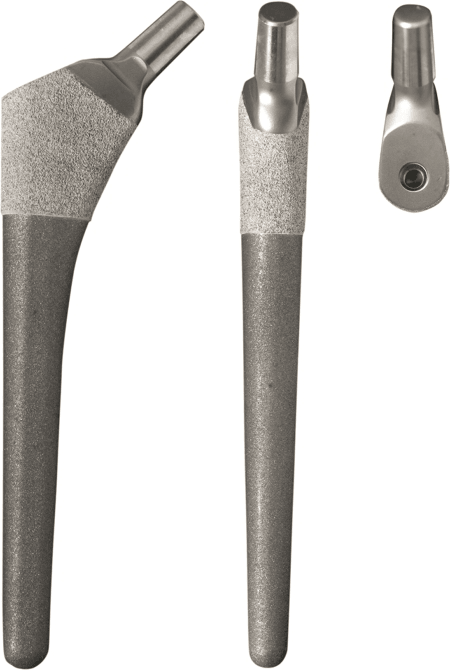
- Extensively coated CoCr cylindrical monoblock
- Fully porous-coated cylindrical stem popularised by Engh and Paprosky; historic workhorse
- Modular fluted tapered titanium
- Wagner conical taper concept evolved into modular systems; current workhorse
- Extensively coated CoCr cylindrical monoblock
- Cylindrical distal geometry gives cortical 'scratch-fit' with bone ingrowth wherever bone contacts the coating
- Modular fluted tapered titanium
- Conical taper wedges to resist axial subsidence; longitudinal flutes cut endosteal cortex to resist rotation
- Extensively coated CoCr cylindrical monoblock
- Needs 4 to 6 cm of intact diaphyseal isthmus
- Modular fluted tapered titanium
- Reliable with only 2 to 3 cm of diaphyseal contact — the key advantage in Type IIIB
- Extensively coated CoCr cylindrical monoblock
- Types I, II and IIIA with canal diameter below roughly 18 to 19 mm and reasonable cortical thickness
- Modular fluted tapered titanium
- Types II, IIIA and IIIB; selected Type IV where a partial grip plus cerclage is achievable; Vancouver B2 and B3 periprosthetic fractures
- Extensively coated CoCr cylindrical monoblock
- Ream 0.5 mm under stem diameter per system; stems longer than about 200 mm must be bowed or risk anterior cortical perforation; confirm axial and rotational stability on trialling
- Modular fluted tapered titanium
- Conical ream to firm cortical chatter; implant the distal taper first for fixation, then select proximal body for length, offset and version; intraoperative axial load test; prophylactic cerclage below stress risers
- Extensively coated CoCr cylindrical monoblock
- Stiff cobalt-chrome — stress shielding worse at diameters 16.5 mm and above, with proximal resorption complicating future revision
- Modular fluted tapered titanium
- Lower-modulus grit-blasted titanium reduces stress shielding and frequently shows proximal bone restoration (the 'Wagner phenomenon')
- Extensively coated CoCr cylindrical monoblock
- Monoblock fixes version and offset at the moment of impaction — limited fine-tuning, but no junction to fail
- Modular fluted tapered titanium
- Fixation decoupled from reconstruction; proximal body chosen independently for length, offset and version
- Extensively coated CoCr cylindrical monoblock
- 95 to 97 percent survivorship in Types II and IIIA at 10 to 15 years in classic series
- Modular fluted tapered titanium
- Broad applicability across defect grades including IIIB where cylindrical stems fail
- Extensively coated CoCr cylindrical monoblock
- Failure in IIIB from inadequate scratch-fit length (historic failure around 20 percent or worse); distal tip loading fracture in osteopenic femora; extraction of a well-fixed stem demands ETO plus trephines
- Modular fluted tapered titanium
- Subsidence (usually within the first weeks — less than 5 mm generally stabilises, greater than 10 mm threatens stability, limb length and dislocation); taper junction fatigue fracture in heavy patients with an unsupported proximal body cantilevered over a defect; fretting corrosion; intraoperative fracture on impaction
- Extensively coated CoCr cylindrical monoblock
- Restrict to canals with adequate isthmic length and diameter; use bowed stems beyond 200 mm
- Modular fluted tapered titanium
- Correct sizing, support the junction with bone or graft, avoid small junction diameters in large patients, consider a monoblock tapered stem where modular versatility is not needed, protect with prophylactic cables
- Fixation principle
- 4-6 cm diaphyseal scratch-fit, ingrowth
- Best for
- II, IIIA with canal less than about 19 mm
- Key weakness
- Stress shielding, IIIB failure, distal fracture, hard to extract
- Fixation principle
- Taper = axial stability; flutes = rotational; needs 2-3 cm contact
- Best for
- II, IIIA, IIIB, B2/B3 fractures — current workhorse
- Key weakness
- Subsidence if undersized; modular junction fracture/corrosion
- Fixation principle
- Cement interlock
- Best for
- Elderly, irradiated, staged infection
- Key weakness
- Poor interlock in sclerotic canals
- Fixation principle
- Cemented polished taper in impacted allograft
- Best for
- Young Type IV — restores bone stock
- Key weakness
- Fracture, subsidence, technically demanding
- Fixation principle
- Stem cemented in bulk allograft, united to host
- Best for
- Young Type IV with abductor reconstruction need
- Key weakness
- Nonunion, resorption, infection
- Fixation principle
- Endoprosthesis, distal fixation
- Best for
- Elderly low-demand Type IV, salvage
- Key weakness
- Instability (use dual mobility), loosening
Operative Strategy: Fluted Tapered Stem via Posterior Approach with ETO (PIPADRAW)
- Position: lateral decubitus on a radiolucent table, well-padded supports, whole limb draped free including knee.
- Imaging and equipment: full-length calibrated femur films; image intensifier available; company-specific extraction kit, high-speed burr, flexible osteotomes, trephines, cement removal instruments (or ultrasonic), cerclage cables, revision stem system with trials, allograft available, dual mobility or constrained options on the shelf.
- Preparation: exclude infection preoperatively (inflammatory markers, aspiration for culture and synovial white cell count); send at least 5 intraoperative tissue samples with separate instruments; tranexamic acid, cross-match, cell salvage.
- Approach: posterior approach with extended proximal and distal exposure; identify and protect the sciatic nerve.
- Dissection / removal: dislocate, remove head; attempt stem extraction in situ; if fixed stem or long cement column, perform an extended trochanteric osteotomy — length templated to reach the stem tip or cement plug while preserving 4 to 5 cm of distal diaphysis; osteotomise one third of the canal circumference laterally, hinge on vastus lateralis and anterior soft tissues; prophylactic cerclage cable distal to the osteotomy before reaming.
- Reconstruction: sequential conical reaming by hand down the true canal axis to firm endosteal cortical engagement over 2 to 3 cm minimum; insert the fluted taper to templated depth with reproducible advancement per blow ceasing to advance; test axial (impactor load) and rotational stability; trial proximal bodies for length, offset, version; trial reduction with stability testing through full arc; commit proximal body, engage taper cleanly and dry.
- At-risk structures: sciatic nerve (posterior retraction, lengthening greater than about 4 cm), femoral cortex (perforation with straight reamers in a varus femur — this is the ETO indication), lateral cortex at ETO hinge, medial femoral circumflex remnants.
- Fixation of osteotomy / closure: reduce the ETO fragment around the proximal body; two or three cerclage cables; consider trochanteric claw-cable device if the fragment is fractured or the abductors avulsed; repair posterior capsule and short external rotators; layered closure over a drain if preferred.
- Aftercare: check radiograph as the subsidence baseline; toe-touch to partial weight bearing 6 weeks (protects ETO and permits taper settling), then progressive loading; posterior precautions; radiographs at 6 weeks, 3 months, 1 year measuring subsidence against the baseline.
- Pitfalls and salvage: subsidence greater than 10 mm with instability — re-revise with a larger taper or longer stem; ETO nonunion (uncommon with cables, most unite) — revision fixation with grafting; intraoperative fracture — cables plus longer bypass; irreducible instability — dual mobility or constrained liner.
Straight rigid reamers introduced through a varus proximal femur are directed into the anterolateral cortex. Cortical perforation converts a IIIA reconstruction into a IIIB or fracture scenario. Recognise varus remodelling on the AP femur and plan the ETO from the outset — it also makes safe stem and cement extraction dramatically easier and protects the abductor attachment.
Managing the Deficient Calcar and the Trochanter
The calcar:
- Modern revision philosophy bypasses the calcar rather than reconstructing it — no modern revision stem depends on calcar support. Calcar-replacing proximal bodies restore soft-tissue tension and version, not load transfer.
- Residual proximal shell bone should be preserved and closed around the stem — even non-structural proximal bone contributes to soft-tissue attachment, vascularity and future revisions, and Wagner-type remodelling can partially restore it.
- Strut allograft with cables can reinforce a severely thinned medial or lateral cortex or an ETO in poor bone.
The trochanter and abductors:
- ETO fragment: cerclage cables (usually two or three); avoid overtightening on a thin fragment.
- Trochanteric escape or fracture: claw-plate or grip-cable device; accept fibrous union with reasonable function in the low-demand patient — repeated fixation attempts in avascular bone often fail.
- Absent abductors (multiply revised, PFR): highest dislocation risk of any hip scenario — use dual mobility or constrained liners, consider abductor reconstruction to the implant or trochanteric slide, and counsel the patient about limp and lifelong precautions.
Outcomes by Paprosky Class and Complications
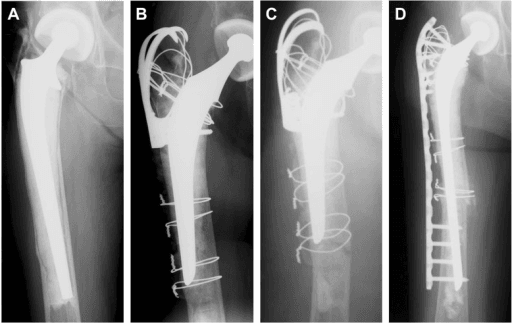
- Where
- Proximal-lateral diaphysis, at the isthmus or a bowed canal
- Mechanism
- Straight reamer or straight stem driven down a bowed or remodelled femur; eccentric reaming after cement or membrane removal
- Avoid by
- Adequate lateral entry and trochanteric bone removal, flexible reamers, extended trochanteric osteotomy for controlled access, image intensifier check, hand-feel of cortical chatter
- If it happens
- Bypass the defect by at least two cortical diameters with a longer stem, cerclage above and below, bone graft the window
- Where
- Proximal femur around a large stiff stem
- Mechanism
- Stiff large-diameter cobalt-chrome cylindrical stems carry load distally and unload the metaphysis; worse in capacious canals
- Avoid by
- Favour titanium fluted tapered stems in capacious canals, avoid oversized cylindrical cobalt-chrome, keep diameter to what fixation demands
- If it happens
- Usually radiographic only and observed; matters at re-revision as it worsens proximal bone stock — plan for a longer distal-fixing construct
- Where
- Tapered stems on the diaphyseal cone
- Mechanism
- Insufficient conical contact length, under-reaming error or soft cancellous diaphysis; taper seats further under load
- Avoid by
- At least 4 cm of scratch-fit or conical engagement, ream to the taper, trial for axial stability, restore leg length on the trial not the definitive
- If it happens
- Early subsidence less than 5 mm is typically self-limiting — protect weight bearing and observe; progressive or greater subsidence with pain means revision to a larger or longer stem
- Where
- Body-stem taper of modular fluted tapered stems
- Mechanism
- Fretting and corrosion, then fatigue fracture where the junction is unsupported by bone and cantilevered
- Avoid by
- Support the junction with bone or place it distal to the deficient segment, size the body appropriately, avoid excessive offset and length at a thin junction
- If it happens
- Fractured junction requires extraction of both components — plan trephines and extraction tooling; consider a monoblock fluted taper at re-revision
- Where
- Intraoperative during impaction, reaming or extraction; late at the stem tip
- Mechanism
- Osteopenic thin cortex, notching, stress riser where a stiff stem ends at a defect or old screw hole
- Avoid by
- Prophylactic cerclage before broaching or impaction, bypass all defects and holes by two cortical diameters, gentle sequential reaming, controlled extended trochanteric osteotomy rather than uncontrolled split
- If it happens
- Cerclage or plate the fracture and lengthen the stem past it; unstable distal fractures may need a stem-plate construct or distal femoral replacement
- Where
- Greater trochanter or extended trochanteric osteotomy fragment
- Mechanism
- Non-union or proximal migration of the osteotomy fragment; abductor-deficient hip then dislocates
- Avoid by
- Preserve fragment vascularity and soft-tissue sleeve, at least 4 cm of diaphysis distal to the osteotomy for stem fixation, two or more cerclage cables, protected weight bearing
- If it happens
- Cable or claw plate revision with grafting; accept abductor deficiency and use dual mobility or a constrained liner, as dislocation is the commonest complication of revision hip arthroplasty
- Types I-II: excellent — survivorship of diaphyseal-fixing stems above 95 percent at 10 years in classic series.
- IIIA: extensively coated cylindrical stems 96 to 97 percent survivorship in Paprosky's own series; fluted tapered stems comparable at mid-term.
- IIIB: cylindrical stems historically failed in roughly one in five or worse; fluted tapered stems restored survivorship to around 90 to 95 percent at mid-term — this outcome differential is the single most examinable fact in the topic.
- IV: all options carry higher complication rates. Impaction grafting gives durable results in experienced centres with the polished taper technique but with meaningful fracture and subsidence rates; PFR survivorship is limited more by instability and infection than fixation.
Complications across revision femoral surgery:
- Dislocation — the commonest complication of revision hip arthroplasty overall; mitigate with restored offset and version (modularity), soft-tissue repair, and liberal use of dual mobility in abductor-deficient hips.
- Periprosthetic fracture — intraoperative (impaction, reaming, extraction) and late tip fractures; prophylactic cerclage and two-cortical-diameter bypass are the preventive levers.
- Subsidence — tapered stems, and it is mostly normal behaviour: 79 per cent settle within the first month, a mean of 2.9 mm, then stop. The concerning pattern is subsidence that CONTINUES past a year. 12 per cent exceed 1 cm, and the modifiable predictor is canal fill, not stem design (Baldwin 2024).
- Infection — always exclude before aseptic revision; multiple samples intraoperatively.
- Stress shielding — stiff large-diameter cobalt-chrome stems; favour titanium tapers in capacious canals.
- Modular junction failure — fracture and fretting; support the junction, size appropriately.
Minimum 10-Year Results of Extensively Porous-Coated Stems in Revision Hip Arthroplasty
- 170 patients with extensively coated cementless revision stems, followed 10 to 16 years (mean 13.2), with survivorship greater than 95 per cent.
- Fixation at latest review: 82 per cent bone-ingrown, 13.9 per cent STABLE FIBROUS, 4 per cent unstable. Overall mechanical failure 4.1 per cent.
- Postel-D'Aubigne pain and walking score improved from 5.4 to 10.8.
- STRESS SHIELDING WAS GREATEST IN STEMS LARGER THAN 16.5 mm AND IN OSTEOPOROTIC (DORR TYPE C) BONE - the numeric boundary of this implant's comfort zone.
- Thigh pain in 9 per cent, and it included EVERY patient with an unstable stem.
Managing Femoral Bone Loss in Revision THR - Fluted Tapered Modular Stems
- Names the four situations that favour a modular tapered stem: altered lesser trochanter anatomy, periprosthetic fracture, and Paprosky type IIIB or type IV bone loss.
- The mechanism is split by component: the TAPER gives axial stability and the SPLINES give rotational control, improving fit where the diaphysis is deficient.
- 'In general, TWO CENTIMETRES of diaphyseal contact is all that is needed to gain stability with modular tapered stems' - the figure that separates this implant from a cylindrical stem needing 4 to 6 cm.
- Modularity earns its place at trial reduction: the proximal body rotates on an already-fixed distal segment, so version is set after fixation rather than dictated by it, reducing dislocation risk.
- The authors' own caution: modular stems should NOT be used for all femoral revisions, because implant fracture and corrosion at the modular junction still occur.
Incidence and Predictors of Subsidence Using Modular, Tapered, Fluted Titanium Femoral Stems
- 102 modular tapered fluted titanium stems across 4 designs in aseptic revision, measured radiographically from the immediate post-operative film.
- MOST SUBSIDENCE IS EARLY AND SMALL: 79 per cent of stems subsided by 1 month, a mean of 2.9 mm (range 0.1 to 12 mm). Beyond 1 month subsidence was minimal in at least 77 per cent.
- 12 per cent subsided more than 1 cm; subsidence was minimal (under 3 mm) in at least 64 per cent.
- On multivariate analysis, female sex and LESS FEMORAL CANAL FILL predicted greater subsidence (P at most 0.034). Stem DESIGN did not (P = 0.816).
- THERE WERE NO MODULAR JUNCTION FRACTURES in the series.
- Maximising canal fill reduced subsidence WITHOUT increasing femoral fracture rates.
Nonmodular Tapered Fluted Titanium Stems Osseointegrate Reliably at Short Term in Revision THA
- 104 Wagner SL nonmodular tapered stems, 53 per cent of that unit's 198 femoral revisions, median follow-up 32 months.
- States the design trade-off explicitly: cylindrical nonmodular stems are associated with STRESS SHIELDING, and tapered fluted MODULAR stems with JUNCTIONAL FRACTURES - the nonmodular taper is chosen to avoid both.
- Paprosky distribution: I 10, II 26, IIIA 52, IIIB 9, IV 2.
- Oxford Hip Score 39 to 87 and WOMAC 44 to 87 (both p less than 0.001).
- Restoration of proximal femoral bone stock in 45 of 103 hips (44 per cent).
- Subsidence of 10 to 15 mm in 6 hips (6 per cent); in the other 94 per cent the mean was 2 mm. One revision, for loosening associated with infection.
- Concluded it is viable for Paprosky II and III, and that Type IV is 'most easily addressed with other techniques such as a proximal femoral replacement'.
Impacted Cancellous Allografts and Cement for Revision Total Hip Arthroplasty
- The founding Exeter description: morselised impacted cancellous allograft with cement for femoral fixation when bone stock has been lost.
- 56 hips reviewed at 18 to 49 months, with few complications and a majority of satisfactory results.
- Radiographic evidence of incorporation of the graft.
- The authors' own conclusion is deliberately tentative: 'Further study and review are necessary, but the use of the method appears to be justified.'
MDDNPaprosky Femoral Fixation Ladder
Hook:Walk down the femur: metaphysis, long diaphysis, short diaphysis, nothing — the fixation ladder descends as the bone loss ascends.
TAFRFluted Taper Stability
Hook:Taper stops it sinking, flutes stop it spinning — and it needs only 2 to 3 cm of bone to do both.
Guidelines, Registries & Global Practice
- Registry evidence: the NJR (England and Wales), AOANJRR (Australia), SHAR (Sweden) and AJRR (United States) consistently report aseptic loosening, infection, dislocation and periprosthetic fracture as the leading reasons for femoral re-revision; registry data show the international migration from cylindrical cobalt-chrome to fluted tapered titanium stems for major bone loss over the last two decades, and steadily rising use of dual mobility in revision.
- AAOS and NICE address hip arthroplasty broadly; neither prescribes a stem for a given Paprosky class — implant choice remains a principles-based surgical decision, which is exactly how examiners frame it.
- BOA/BHS revision network guidance (United Kingdom) supports concentrating complex (Type IIIB and IV) revisions in higher-volume revision units with allograft access and multidisciplinary infection services — a model echoed in several European systems.
- Resource-limited settings: modular revision systems, bone banks and megaprostheses may be unavailable. Pragmatic alternatives include long cemented stems, monoblock Wagner-type tapers (cheaper, no junction), and cement-in-cement techniques; the classification and its fixation logic remain universally applicable even where the implant menu is narrow.
- Fresh-frozen allograft availability (impaction grafting, APC) varies enormously worldwide with regulatory and tissue-banking infrastructure — this drives genuine regional variation in Type IV management, with PFR used earlier where allograft is unavailable.
Controversies & Areas of Uncertainty
- Modular versus monoblock tapered stems: modularity aids intraoperative flexibility but introduces junction fracture and corrosion risk; comparative series show similar survivorship, and several units have returned to monoblock tapers for straightforward IIIA/IIIB femurs, reserving modularity for complex version or length problems.
- How short can the fixation segment be? The 2 to 3 cm figure for tapered stems is empirical; distal fixation into a short supracondylar segment blurs into "total femoral" territory and the failure threshold is not precisely defined.
- Impaction grafting versus tapered stems in Type IV: bone-stock restoration versus reproducibility; impaction grafting results are strongly centre-dependent, and many surgeons now attempt a tapered stem with cables even in near-Type IV femurs.
- PFR versus APC in the younger Type IV patient: APC restores bone but risks nonunion and resorption; PFR is reliable early but mortgages the future. No randomised data exist and practice follows unit expertise.
- Routine dual mobility in revision: increasingly adopted given dislocation dominance in registries, but with unresolved questions about intraprosthetic dislocation and long-term wear in younger patients.
MCQ Practice Points
Q: What distinguishes Paprosky IIIA from IIIB femoral bone loss?
A: Both have non-supportive metadiaphyseal bone; IIIA retains greater than 4 cm of intact diaphysis available for scratch-fit, IIIB has less than 4 cm.
Q: Which stem is preferred for a Paprosky IIIB femur, and why?
A: A fluted tapered titanium stem — the conical taper achieves axial stability and the flutes rotational stability. Cross and Paprosky put the requirement at about 2 cm of diaphyseal contact, against the 4 to 6 cm a cylindrical extensively coated stem needs, which is exactly why the cylinder runs out of bone in a IIIB femur and the taper does not.
Q: Which revision stem characteristic most predisposes to proximal stress shielding?
A: A large-diameter extensively porous-coated cobalt-chrome stem — high stiffness transfers load distally and resorbs proximal bone. Paprosky's own 10-year series puts a number on it: stress shielding was greatest in stems larger than 16.5 mm and in osteoporotic Dorr type C bone.
Q: A revision femur shows remodelling into varus. What technical step prevents cortical perforation?
A: An extended trochanteric osteotomy — it allows removal of the implant and neutral reaming down the true distal canal axis, avoiding anterolateral cortical perforation by straight reamers.
Q: What is the best bone-stock-restoring option for a 55-year-old with a Paprosky IV femur?
A: Femoral impaction grafting with morselised allograft and a cemented polished tapered stem, or an allograft-prosthetic composite where abductor reconstruction is also needed; proximal femoral replacement is reserved for elderly, low-demand patients or salvage. Say the caveat too: Gie's founding series ran to a maximum of 49 months, which is far too short to see the subsidence and periprosthetic fracture that limit the technique.
Q: A fluted tapered stem has subsided 4 mm at 6 weeks. What is the management?
A: Observe. Early subsidence is the normal behaviour of this implant rather than a complication — in Baldwin's 102 modular tapered stems, 79 per cent subsided within the first month by a mean of 2.9 mm and then stopped, and beyond one month subsidence was minimal in at least 77 per cent. What matters is the trajectory, not the presence: subsidence still progressing after a year, or exceeding 1 cm (12 per cent of that series), warrants review for instability and leg-length change.
Exam Viva Scenarios
Practise clinical reasoning and management decisions out loud
“A 72-year-old presents with start-up thigh pain 18 years after a cemented total hip. Radiographs show a loose stem with complete radiolucency, extensive metaphyseal cancellous loss, an absent calcar, but an intact diaphysis with good cortices. How do you assess and manage this femur?”
“A 68-year-old has a multiply revised hip with a loose long cementless stem. Films show metadiaphyseal bone loss extending to the isthmus, with only about 3 cm of intact diaphysis distally before the canal widens. The proximal femur is a thin shell remodelled into varus. Talk me through classification, implant choice and technique.”
“A 79-year-old low-demand woman has a loose revision stem within an ectatic femur: the canal measures 24 mm with paper-thin cortices and no identifiable isthmus. Separately, how would your answer differ for a fit 52-year-old with the same femur?”
Classification
- Type I: minimal metaphyseal loss — primary-type or extensively coated stem
- Type II: extensive metaphyseal loss, intact diaphysis — diaphyseal fixation
- IIIA: metadiaphyseal loss, greater than 4 cm scratch-fit — cylindrical or tapered
- IIIB: less than 4 cm scratch-fit — fluted tapered titanium only
- Type IV: no isthmus — impaction grafting, cemented long stem, APC, or PFR
Radiographic assessment
- Full-length AP and lateral femur including knee
- Isthmus length and quality; cortical thickness at least 2 mm over fixation zone
- Canal diameter — above about 19 mm favours tapered over cylindrical
- Varus remodelling — plan ETO to avoid anterolateral perforation
- Bypass stress risers by two cortical diameters
Stem rationale
- Extensively coated CoCr cylindrical: 4-6 cm scratch-fit; stress shielding above 16.5 mm; fails in IIIB
- Fluted tapered titanium: taper = axial, flutes = rotational; needs 2-3 cm; watch subsidence and junction fracture
- Cemented long stem: elderly, irradiated, staged infection; cement-in-cement where mantle intact
- Impaction grafting: young Type IV, restores bone stock, fracture risk
- APC: bone stock plus abductor attachment; nonunion risk
- PFR: elderly/salvage; instability dominant — dual mobility
Technique and complications
- Exclude infection; multiple intraoperative samples
- ETO for fixed stems, long cement columns, varus remodelling; cable before reaming
- Subsidence below 5 mm usually settles; beyond 10 mm threatens failure
- Calcar is bypassed, not reconstructed; proximal body restores offset and version
- Dislocation is the commonest revision complication — dual mobility in abductor deficiency
- IIIB outcomes: cylindrical stems roughly one in five failure; tapered stems 90-95 percent survivorship