Total Wrist Arthroplasty vs Arthrodesis
- End-stage wrist arthritis - from rheumatoid arthritis, primary osteoarthritis, or post-traumatic causes (SLAC/SNAC wrist, malunited distal radius fracture, scaphoid nonunion, scapholunate dissociation, Kienbock's disease) - that has failed non-operative management may need reconstruction, and the two principal options are total wrist ARTHRODESIS (fusion) and total wrist ARTHROPLASTY.
- Total wrist ARTHRODESIS is the durable, reliable option and the historical gold standard: it gives excellent, predictable PAIN RELIEF and long-term durability and is preferred for HIGH-DEMAND patients and manual workers, younger active patients, those with poor bone stock or soft tissues, infection, and as a SALVAGE procedure; the cost is loss of wrist motion, but function is usually well preserved provided the contralateral wrist and the other ipsilateral joints (fingers, forearm rotation) move.
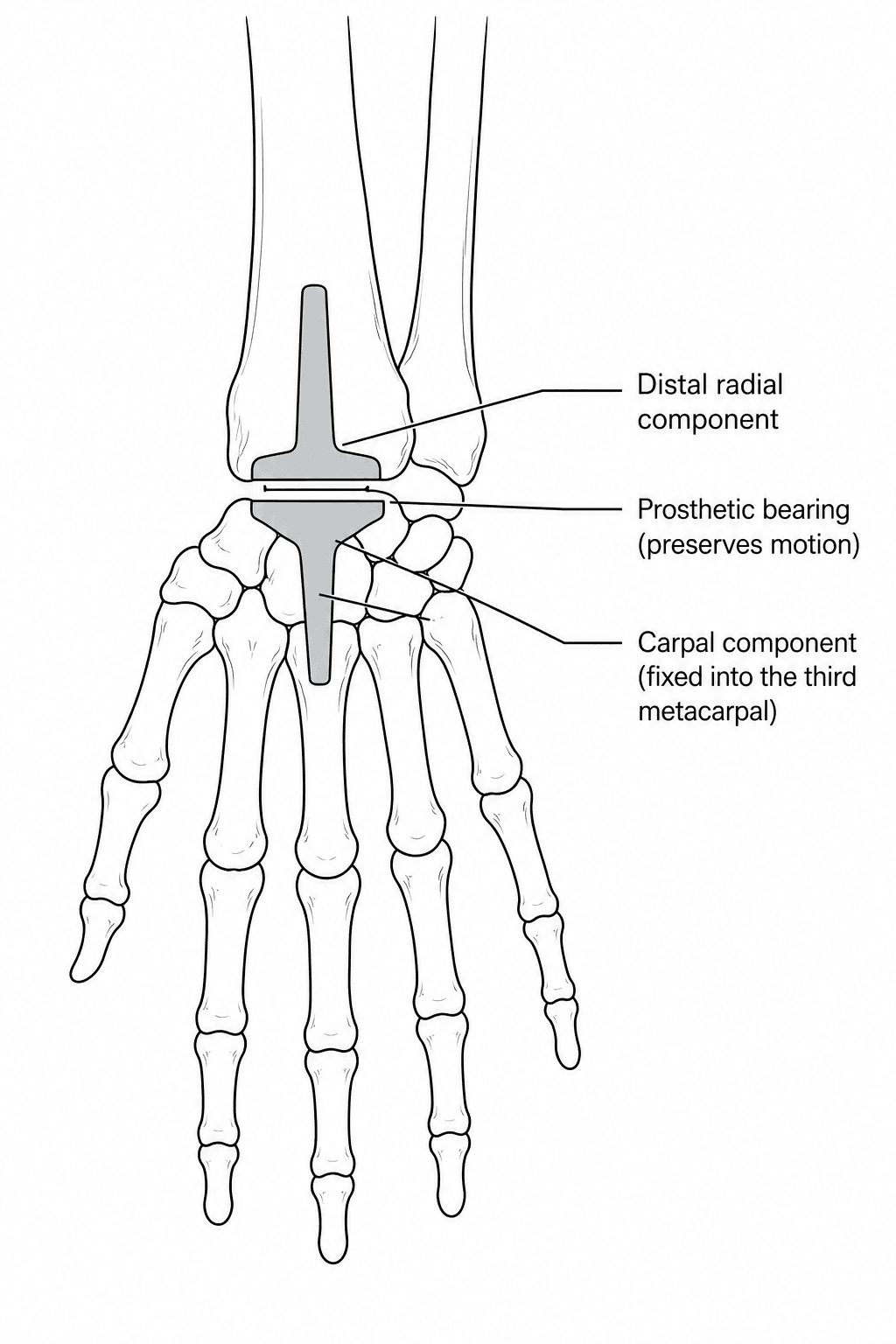
- Total wrist ARTHROPLASTY preserves wrist MOTION, which matters for activities of daily living and personal care; design has historically been difficult because of the complex wrist anatomy, with many early failures, but FOURTH-GENERATION implants have improved durability - a single-implant series of 26 wrists reported 81% survival at a mean 11 years with 92% satisfaction, while national registry data on 189 replacements give 78% at 5 years and 71% at 10, with design-specific survival ranging from 57% to 85% at 5 years - and it is best suited to LOWER-DEMAND patients who value motion.
- The CHOICE is driven by PATIENT FACTORS more than the diagnosis: arthroplasty is favoured in lower-demand patients who want to retain motion, particularly with BILATERAL wrist disease or rheumatoid arthritis with multiple affected joints (where preserving some wrist motion helps), and especially if the contralateral wrist is already fused; arthrodesis is favoured in HIGH-DEMAND/manual workers, young active patients, those with inadequate bone/soft tissue, infection, or as salvage.
- COMPLICATIONS of total wrist arthroplasty include component (especially DISTAL/carpal component) LOOSENING, instability/dislocation, periprosthetic fracture, and synovitis; it is generally CONTRAINDICATED for heavy manual labour and high-impact loading, which accelerate loosening, so adherence to activity limits is part of patient selection.
- A key advantage in the algorithm is that a FAILED total wrist arthroplasty can be CONVERTED to a total wrist ARTHRODESIS (often with bone graft to fill the defect) as a reliable salvage - so arthroplasty does not 'burn bridges' in the way that might be feared, although the conversion involves bone loss; conversely, a fusion cannot be turned back into a moving joint, so the motion-preserving option, when appropriate, should be considered first in the right patient.
- “End-stage wrist arthritis (RA, OA, post-traumatic SLAC/SNAC, Kienbock): choose ARTHRODESIS (durable, reliable, high-demand/salvage - loses motion) vs ARTHROPLASTY (motion-preserving; registry survival 78% at 5y / 71% at 10y, 57-85% depending on design - loosening/instability risks).
- “Choice driven by PATIENT FACTORS: arthroplasty for lower-demand wanting motion / bilateral disease / RA / contralateral fusion; arthrodesis for high-demand/manual workers, young active, poor bone, infection, salvage.
- “TWA NOT for heavy manual labour (loosening). Failed arthroplasty CONVERTS to arthrodesis (with graft); fusion is not reversible.
Durable, reliable pain relief - the gold standard for high-demand/manual workers, young active patients, poor bone/infection, and salvage. Cost: loses wrist motion.
Preserves motion (registry survival 78% at 5y, 71% at 10y) - for lower-demand patients wanting motion, bilateral disease/RA, or a contralateral fusion. Risks: loosening/instability; not for heavy labour.
The Decision: Arthrodesis vs Arthroplasty
End-stage wrist arthritis (RA, primary OA, or post-traumatic - SLAC/SNAC, malunited distal radius, scaphoid nonunion, Kienbock's) failing non-operative care needs reconstruction. Total wrist ARTHRODESIS is the durable, reliable historical gold standard, giving predictable pain relief and best suited to high-demand/ manual workers, young active patients, poor bone/soft tissue, infection and salvage - the cost is loss of wrist motion (usually well tolerated if the other wrist and joints move). Total wrist ARTHROPLASTY preserves motion; registry survival is 78% at 5 years and 71% at 10 (one 26-wrist fourth-generation series reached 81% at 11 years), and it suits lower-demand patients who value motion, bilateral disease, RA with multiple joints, or a contralateral fusion. The choice is driven by patient factors (demand, bilaterality, bone stock) more than the diagnosis. TWA risks loosening (especially the distal/carpal component) and instability and is not for heavy labour; a failed TWA converts to arthrodesis.
- Arthrodesis (fusion)
- Lost (fused)
- Arthroplasty (TWA)
- Preserved
- Arthrodesis (fusion)
- More reliable pain relief in the head-to-head systematic review
- Arthroplasty (TWA)
- Registry survival 78% at 5y, 71% at 10y (57-85% by design); higher complication and revision rates
- Arthrodesis (fusion)
- High-demand/manual, young active, poor bone, infection, salvage
- Arthroplasty (TWA)
- Lower-demand wanting motion, bilateral disease, RA, contralateral fusion
- Arthrodesis (fusion)
- Loss of motion
- Arthroplasty (TWA)
- Component (distal) loosening, instability, periprosthetic fracture
- Arthrodesis (fusion)
- Tolerated
- Arthroplasty (TWA)
- Contraindicated (accelerates loosening)
- Arthrodesis (fusion)
- Definitive (not reversible)
- Arthroplasty (TWA)
- Failed TWA converts to arthrodesis (with graft)
Selection, Outcomes & Salvage
- Favour arthrodesis in high-demand/manual workers, young active patients, poor bone stock or soft tissues, infection, and as salvage - for durable, predictable pain relief.
- Favour arthroplasty in lower-demand patients who value motion, bilateral wrist disease, RA with multiple affected joints, or where the contralateral wrist is already fused (retaining some motion on one side helps daily function/personal care).
- Counsel on TWA limits: no heavy manual labour/high-impact loading (accelerates loosening); the main failure is distal/carpal component loosening, with instability and periprosthetic fracture also seen.
- Salvage: a failed total wrist arthroplasty converts to a total wrist arthrodesis (often with bone graft); a fusion is definitive and cannot be reversed - so consider the motion-preserving option first in the right patient.
The wrist-reconstruction decision should be driven by the patient - their demand, occupation, bilaterality of disease and bone quality - rather than the radiographic diagnosis alone, because the two operations make opposite trade-offs. Arthrodesis gives the most durable, reliable pain relief and is the right choice for a high-demand manual worker, a young active patient, poor bone or infection, and as salvage, but it permanently removes wrist motion. Arthroplasty preserves motion and has improved markedly with modern implants, but it must not be offered to a heavy manual labourer and carries a real rate of distal-component loosening and instability. Crucially, a failed arthroplasty can be salvaged by conversion to a fusion, whereas a fusion cannot be turned back into a moving joint - so in an appropriate lower-demand patient who values motion, the motion-preserving option deserves first consideration, with the patient counselled on the activity limits and the conversion pathway if it fails.
The Reconstruction Ladder: Motion-Sparing Salvage Before Total Replacement
Before choosing between total arthrodesis and total arthroplasty for SLAC/SNAC wrist, scaphoid nonunion or Kienbock's, there is a limited, motion-sparing salvage ladder that comes first - because the arthritis is initially confined to part of the wrist:
- Wrist denervation (posterior and anterior interosseous neurectomy) - a simple, motion-preserving option for pain in a patient who accepts ongoing degeneration.
- Proximal row carpectomy (PRC) - excise the proximal carpal row to articulate the capitate on the lunate fossa; suits SLAC/SNAC with a preserved capitate head and lunate fossa.
- Scaphoidectomy + four-corner fusion (4CF) - for SLAC/SNAC where the capitate head is worn; fuses the capitate-lunate-hamate-triquetrum and removes the scaphoid.
- Radioscapholunate fusion - a partial fusion for isolated radiocarpal arthritis (e.g. an intra-articular distal radius malunion) that preserves midcarpal motion.
Only when the disease is pan-carpal (involving both the radiocarpal AND midcarpal joints), or these limited options have failed, do the total procedures apply - and the same demand/bilaterality logic then chooses between total arthrodesis and total arthroplasty. The limited salvages are developed in proximal row carpectomy, four-corner fusion, SLAC wrist, SNAC wrist and Kienbock's disease.
Don't jump to a total procedure: for SLAC/SNAC the motion-sparing ladder is denervation → PRC → scaphoidectomy + four-corner fusion → radioscapholunate fusion, chosen by which joints are spared. Total arthrodesis or arthroplasty is for pan-carpal disease (radiocarpal AND midcarpal) or failed limited salvage.
The Functional Arc of Wrist Motion & the Position of Fusion
Fusion loses motion, though function is preserved if the other joints move, and the motion an arthroplasty preserves matters for ADL and personal care - so it is worth quantifying exactly how much motion matters:
- The functional arc. Most activities of daily living are achievable within a relatively small arc - classically described as around 40 degrees of extension, 40 degrees of flexion and a combined 40 degrees of radioulnar deviation (Ryu), and an even smaller "functional" arc of roughly 5 degrees of flexion to 30 degrees of extension (Palmer) for everyday tasks. This is why losing wrist motion to a fusion is often well tolerated.
- The position of arthrodesis. A total wrist fusion is set in the position that optimises grip and function - around 10 to 15 degrees of extension with slight ulnar deviation (neutral or slight extension); this is the strongest position for power grip.
- What arthroplasty actually preserves. A total wrist arthroplasty typically gives a functional but reduced arc (often in the region of a 50 to 70 degree flexion-extension arc), enough for the tasks that a fused wrist makes awkward.
- The personal-care / bilateral argument. The tasks a fused wrist most compromises are those needing wrist flexion - perineal/toileting care and reaching into tight spaces - so a patient with bilateral disease (or an already-fused contralateral wrist) gains the most from preserving motion on at least one side, which is exactly why arthroplasty is favoured there. Fusion position and technique are detailed in wrist arthrodesis, and the implant designs, generations and technique of replacement in wrist arthroplasty.
Quantify it: the functional arc is small (around 40 degrees extension / 40 degrees flexion, or even 5 degrees flexion to 30 degrees extension), which is why a fusion - set in about 10 to 15 degrees of extension for grip - is well tolerated unilaterally. The motion a fused wrist most lacks is flexion for perineal/personal care, so bilateral disease is the strongest argument for keeping one side mobile with arthroplasty.
Mnemonics & Memory Aids
WRIST
Hook:WRIST: Which patient (demand), Rheumatoid/bilateral → arthroplasty, Industrial/manual → arthrodesis, Survival 78%/71% at 5 and 10 years (loosening), Transfer back impossible (fusion definitive).
Clinical Decision Scenarios
Practise clinical reasoning and management decisions out loud
“How do you decide between total wrist arthrodesis and arthroplasty for end-stage wrist arthritis?”
“What are the complications and salvage options for total wrist arthroplasty?”
The problem
- End-stage wrist arthritis: RA, primary OA, post-traumatic (SLAC/SNAC, malunion, scaphoid nonunion, Kienbock)
- Failed non-operative care → reconstruction
- Two options: arthrodesis (fusion) vs arthroplasty
Arthrodesis (fusion)
- Durable, reliable, predictable pain relief (historical gold standard)
- High-demand/manual, young active, poor bone, infection, salvage
- Cost: loss of wrist motion (usually well tolerated); definitive/irreversible
Arthroplasty (TWA)
- Motion-preserving; registry survival 78% at 5y, 71% at 10y (57-85% by design); 81% at 11y in a 26-wrist series
- Head-to-head (RA): fusion more reliable pain relief, fewer complications/revisions; only 3 of 14 studies had a mean arc in the functional range
- Lower-demand wanting motion, bilateral disease, RA, contralateral fusion
- Not for heavy manual labour; main failure = distal/carpal component loosening (also instability, periprosthetic fracture)
Decision & salvage
- Driven by patient demand/bilaterality/bone, not diagnosis alone
- Failed TWA converts to arthrodesis (with graft)
- Fusion cannot be reversed - consider motion-preserving option first in the right patient
What the Comparative Evidence Actually Shows
A recommendation to choose between two operations is only as good as the head-to-head data behind it, and the figure most often quoted for modern arthroplasty rests on a smaller base than its confident repetition suggests.
The widely quoted 81 percent survival at a mean of 11 years comes from a single retrospective series of 25 patients (26 wrists) with one implant - and the surviving wrists had only moderate function scores (PRWHE 44, QuickDASH 41), even though 92 percent said they were satisfied. National registry data on 189 primary wrist replacements are more sobering and more generalisable: 78 percent survival at 5 years (95 percent CI 70 to 85) and 71 percent at 10 years (CI 59 to 80), with large differences between designs
- 85 percent at 5 years for one prosthesis against 57 percent for another. Quote a range and name the implant, not a single flattering number.
The most-cited systematic review compared 18 arthroplasty studies (about 500 procedures) with 20 fusion studies (over 800 procedures) in rheumatoid wrists and found that fusion gave more reliable pain relief, with higher complication and revision rates for arthroplasty; satisfaction was high in both. Its sharpest finding is easy to miss: of 14 studies reporting motion, only three showed a mean active arc within the functional range - so the motion an arthroplasty preserves is not reliably the motion that makes a difference. The authors concluded the data did not support widespread arthroplasty for the rheumatoid wrist.
The registry looked for the very factors this decision is normally taught on and did not find them. There was no statistically significant influence of age, diagnosis or year of operation on the risk of revision - so "young patient, therefore fuse" is a reasonable inference from demand and expected implant lifetime, but it is not something that registry revision data demonstrated. What the registry did find was that women had a higher revision rate than men (relative risk 3, 95 percent CI 1 to 7) - a confidence interval whose lower bound touches 1, so it is a weak signal rather than a rule, and one a registry cannot separate from differences in diagnosis, implant era or demand. Neither finding should be turned into permission to implant a young manual worker; the argument against that remains mechanical loading and the length of life the construct must survive, which is exactly the argument to make out loud rather than citing a survival curve.
Carry the range: 78 percent at 5 years and 71 percent at 10 across a national registry, with design-specific survival from 57 to 85 percent at 5 years; 81 percent at 11 years in a 26-wrist single-implant series. Fusion gave more reliable pain relief with fewer complications and revisions in the rheumatoid head-to-head, where only 3 of 14 arthroplasty studies achieved a mean arc within the functional range.
Evidence & Key Studies
Long-term results of a fourth-generation total wrist arthroplasty (Universal 2)
- The Universal 2 total wrist implant had 81% implant survival at a mean 11-year follow-up, with 92% of patients (very) satisfied.
- Five implants failed and were converted to total wrist arthrodesis (distal component loosening in 3, recurrent luxation in 1, recurrent synovitis in 1) at a mean of 9.2 years.
- Distal component loosening was the main failure mode, and conversion to arthrodesis was the salvage.
Total wrist arthroplasty - indications and state of the art
- Total wrist arthroplasty was historically accompanied by many failures (and rejected by most surgeons) because of the complex wrist anatomy, but newer concepts have established it as more than an individual-case option, with expanded, standardised indications.
- In 162 patients (41% rheumatoid arthritis, the rest osteoarthritis/post-traumatic causes), QuickDASH and pain improved and grip increased; range of motion decreased in rheumatoid patients but increased in others, with an average complication rate of 3.7% and no implant removals requiring secondary arthrodesis.
- Modern total wrist arthroplasty can be an equivalent treatment option in appropriately selected patients.
Arthroplasty versus arthrodesis in the rheumatoid wrist - the most-cited systematic review
- Systematic review screening 1,750 citations: 18 total wrist arthroplasty studies (about 500 procedures) against 20 total wrist fusion studies (over 800 procedures), in rheumatoid arthritis only; silicone arthroplasty excluded.
- Total wrist fusion provided MORE RELIABLE pain relief than arthroplasty, and complication and revision rates were HIGHER for arthroplasty. Satisfaction was high in both groups.
- Of 14 studies reporting motion, only THREE showed a mean active arc within the functional range - motion preserved is not necessarily motion that is useful.
- The authors concluded that existing data did not support widespread application of arthroplasty for the rheumatoid wrist.
- Restricted to rheumatoid patients and to literature available in 2008, so it predates fourth-generation implants and does not address primary or post-traumatic osteoarthritis.
Norwegian Arthroplasty Register: 189 wrist replacements over 16 years
- 189 primary wrist replacements (90 Biax, 23 Elos, 76 Gibbon) registered 1994 to 2009 and analysed by Cox regression.
- Survival was 78 percent at 5 years (95 percent CI 70 to 85) and 71 percent at 10 years (CI 59 to 80).
- Design mattered more than anything else measured: 85 percent at 5 years for the Biax against 57 percent for the Elos.
- NO statistically significant influence of age, diagnosis or year of operation on revision risk; women had a higher revision rate than men (relative risk 3, 95 percent CI 1 to 7 - a wide interval touching unity).
- Survival was inferior to hip and knee arthroplasty, but the authors note a failed wrist arthroplasty still leaves the option of a well-functioning arthrodesis.
- Registry data capture revision, not function or demand, and the implants studied are largely earlier-generation designs.
The long-term survival (81% at 11 years) and high satisfaction of a fourth-generation total wrist implant, with distal-component loosening as the main failure mode and conversion to arthrodesis as salvage, come from the cited Zijlker series; the historical difficulty and failure of total wrist arthroplasty, its improvement with newer concepts, and the outcomes across rheumatoid and osteoarthritic/post-traumatic patients (improved function/grip, ROM decreased in RA but increased in others) from the cited Nicoloff study. The head-to-head comparison in rheumatoid wrists, the higher complication and revision rates for arthroplasty and the finding that only 3 of 14 studies achieved a functional mean arc come from the cited Cavaliere and Chung systematic review, which is restricted to rheumatoid patients and predates fourth-generation implants; the survival figures, the design-specific range and the absence of an age or diagnosis effect on revision from the cited Krukhaug registry report, whose implants are largely earlier-generation and which records revision rather than function. Those two sources are taken in substance from our wrist arthroplasty topic and re-verified independently. The arthrodesis-versus-arthroplasty indications (demand, bilaterality, bone, RA vs OA), the motion-versus-durability trade-off, and the irreversibility of fusion are standard, well-established teaching. No randomised trial comparing total wrist arthrodesis with arthroplasty was retrieved, and no agreed demand threshold or occupational cut-off defining who may safely receive an implant exists, so none is quoted. See also wrist arthrodesis, SLAC wrist, SNAC wrist and rheumatoid arthritis of the hand.