Socket Design | Suspension Systems | Knee Units | Prosthetic Feet | Upper Limb Prosthetics
- Socket types: PTB (patellar tendon bearing) vs TSB (total surface bearing) for transtibial; quadrilateral vs ischial containment for transfemoral
- Suspension systems: Pin lock (mechanical), suction (seal-in liner), vacuum (active pump), sleeve (neoprene/gel)
- Knee units: Single-axis (simple, durable), polycentric (stability), hydraulic/pneumatic (cadence responsive), microprocessor (C-Leg, Genium)
- Prosthetic feet: SACH (solid ankle cushion heel), single/multi-axis, dynamic response (energy storing/returning)
- K-levels (K0-K4) determine component prescription - match complexity to functional capacity
- “TSB socket distributes load over entire residual limb vs PTB which concentrates on patellar tendon
- “Ischial containment socket provides better coronal femoral control than the older quadrilateral design
- “Microprocessor knees significantly reduce stumbles and uncontrolled falls vs mechanical knees (RCT and systematic-review evidence)
- “Energy-storing (dynamic response) feet improve gait efficiency, most measurably at faster walking and running speeds
Overview and Prosthetic Fundamentals
Prosthetic limb components are the elements that make up an artificial limb. Orthopaedic surgeons involved in amputation surgery and post-operative rehabilitation planning need to understand them.
Principles of prescription. Five principles guide the prescription:
- Match components to functional level, using the K-level classification to guide selection
- Socket fit is paramount: the socket is the interface between residual limb and prosthesis
- Suspension must be reliable, because it prevents pistoning and skin breakdown
- Knee and foot selection affects gait efficiency, and higher function warrants more advanced components
- Involve the prosthetist early, ideally before the operation, for optimal stump planning
Prescribe to the K-level. Components run from none for prosthetic ambulation at K0, through basic components for limited household use (K1), intermediate components for limited community ambulation (K2) and advanced components for unlimited community ambulation at variable cadence (K3), to high-activity components for athletes (K4). Over-prescribing wastes resources; under-prescribing limits function.
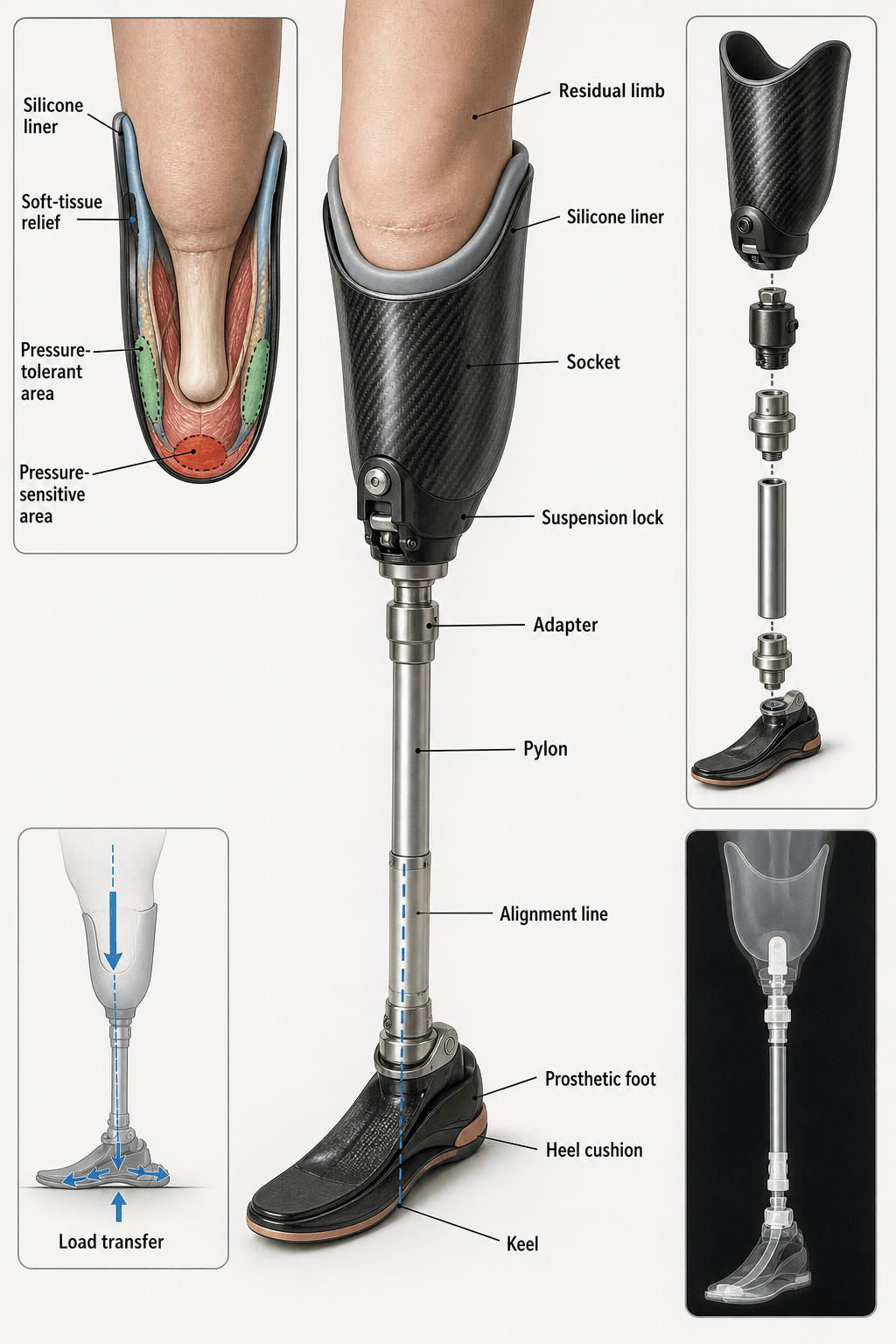
The lower limb prosthesis. It has six parts:
- Socket, the interface with the residual limb
- Liner, a cushioning layer between skin and socket
- Suspension system, which keeps the prosthesis attached
- Pylon or shank, connecting socket to foot (or knee to foot)
- Knee unit (transfemoral), controlling swing and stance
- Prosthetic foot, for ground contact and energy return
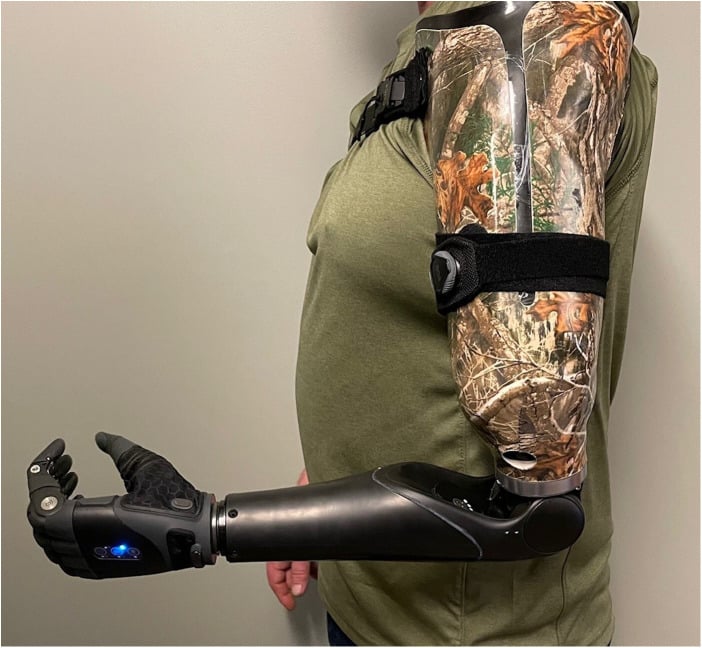
The upper limb prosthesis. The same logic with different parts:
- Socket, the interface with the residual limb
- Suspension, by harness or suction
- Elbow unit (transhumeral), controlling flexion and extension
- Wrist unit, allowing pronation and supination, with a quick disconnect
- Terminal device, a hook or hand for function or cosmesis
- Control system, body-powered cables or myoelectric
Socket Design Principles
The socket. It is the interface between the residual limb and the artificial limb, and the most critical component of any prosthesis. Poor socket fit leads to skin breakdown, pain and prosthetic rejection.
What a socket must do. A socket has five design goals:
- Distribute weight comfortably: pressure on tolerant areas, relief over sensitive areas
- Give stable suspension, preventing pistoning and rotation
- Provide proprioceptive feedback, so the patient can control the prosthesis
- Look acceptable
- Withstand daily use
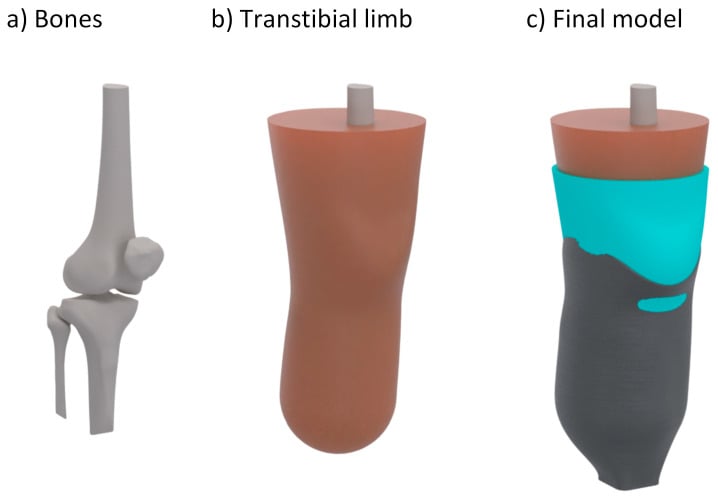
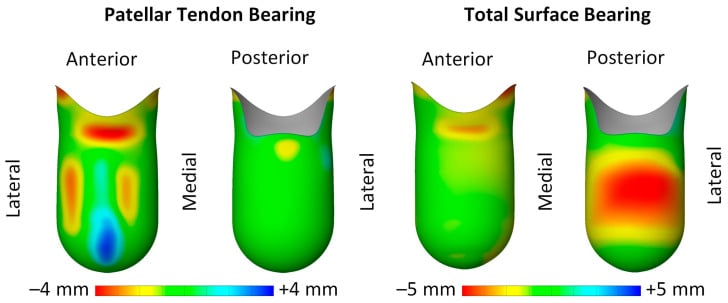
PTB socket. The patellar tendon bearing socket is the traditional design, developed in the 1950s and still widely used. It concentrates weight-bearing on the patellar tendon, with the medial tibial flare and popliteal area as the other pressure-tolerant areas, and relieves the pressure-sensitive fibular head, tibial crest and distal tibia.
TSB socket. The total surface bearing socket is the modern design and has no specific weight-bearing focus. A gel liner distributes pressure uniformly on the hydrostatic principle, equal pressure throughout, so there is less point loading, and many patients find it more comfortable. It is often combined with suction or vacuum suspension, the liner creating the seal, or with a pin.
Total contact. Both designs keep the entire residual limb in contact with the socket, to prevent distal oedema.
PTB variations. Three variations on the PTB socket:
- PTB-SC (supracondylar): extended medial and lateral walls for rotational control
- PTB-SCSP (supracondylar suprapatellar): a higher anterior trim for suspension
- KBM (Kondylen Bettung Munster): intimate medial-lateral contouring
Suspension Systems
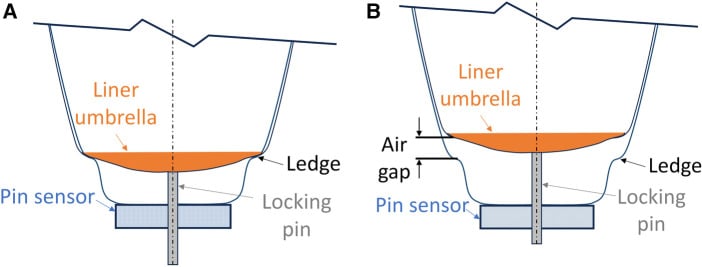
Suspension keeps the prosthesis securely attached to the residual limb, and every system requires a well-fitting socket. Inadequate suspension leads to pistoning, reduced control and skin problems.
- Mechanism
- Pin on liner engages lock in socket
- Advantages
- Simple, secure, easy don/doff
- Disadvantages
- Pistoning possible, milking effect on tissues
- Best For
- K1-K2, limited dexterity
- Mechanism
- Sealing lip on liner creates vacuum
- Advantages
- Intimate fit, good suspension
- Disadvantages
- Difficult don/doff, requires intact liner
- Best For
- K2-K3, good hand function
- Mechanism
- Active pump maintains negative pressure
- Advantages
- Excellent suspension, volume management
- Disadvantages
- Expensive, battery dependent, complex
- Best For
- K3-K4, volume fluctuation issues
- Mechanism
- Neoprene or gel sleeve over socket rim and thigh
- Advantages
- Simple, inexpensive, adds stability
- Disadvantages
- Hot, may irritate skin, stretches over time
- Best For
- Additional suspension, K1-K2
- Mechanism
- Socket contour locks over bony prominences
- Advantages
- No additional hardware needed
- Disadvantages
- Requires specific residual limb anatomy
- Best For
- Knee disarticulation, Syme
Active patients (K3-K4). Suction or vacuum suspension is preferred. The intimate fit maximises control and is worth the complexity for high-activity users, and elevated vacuum is worth considering for variable activity.
Less active patients (K1-K2). A pin lock is often the most practical choice: it is easy to don and doff, simple to understand and relies less on hand dexterity. A sleeve can be added as an adjunct.
Elevated vacuum. An active pump maintains consistent negative pressure, which keeps the fit. It reduces the effects of volume fluctuation, decreases pistoning significantly, improves proprioceptive feedback and may improve residual limb health. That makes it ideal for active amputees with volume management problems, at greater cost and complexity than passive systems.
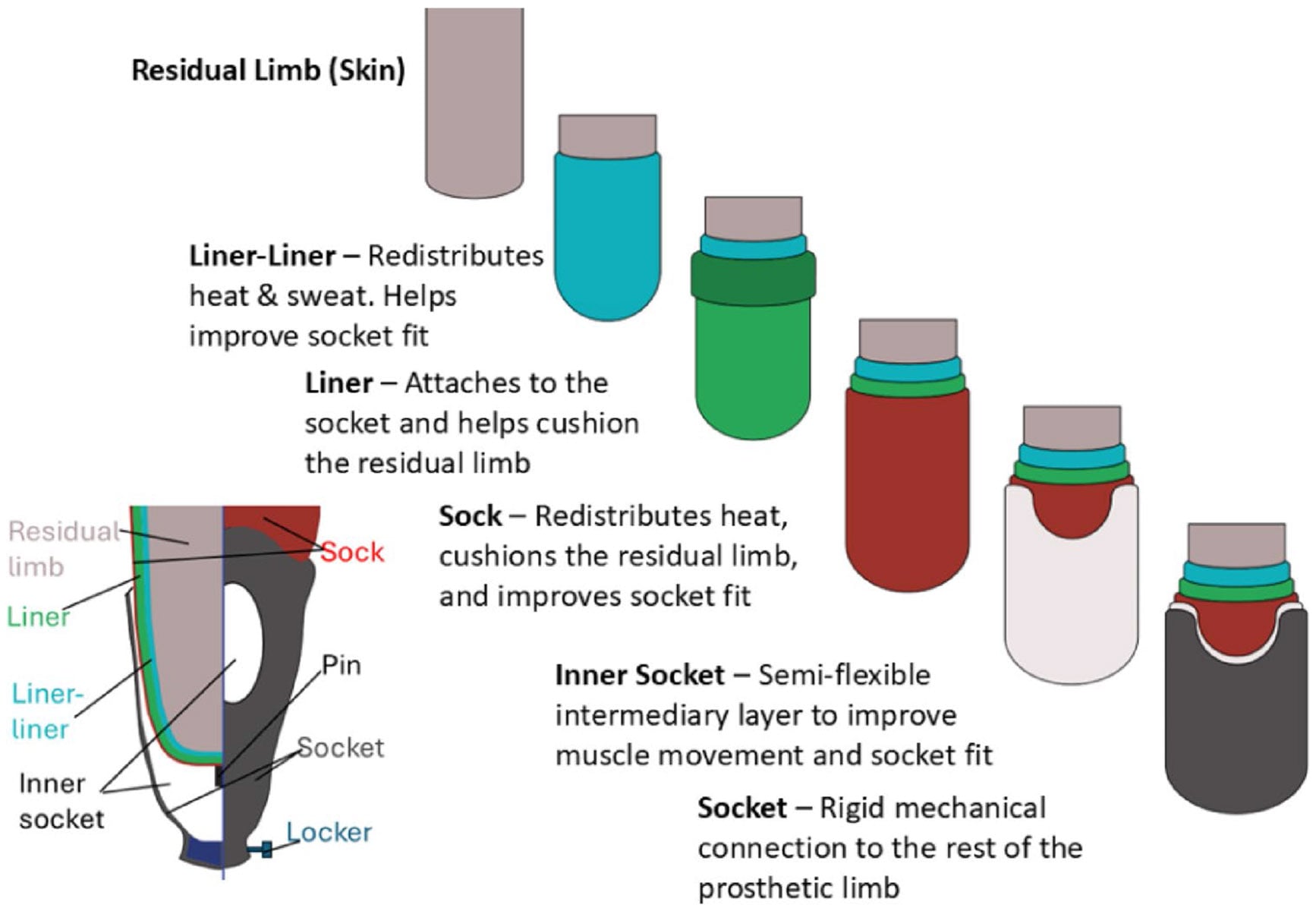
Prosthetic Knee Units
Transfemoral, knee disarticulation and hip disarticulation amputees need a knee unit. It must provide stability in stance and controlled motion in swing.
At K1-K2 the choice is a mechanical knee, single-axis or polycentric.
Single-axis knee. The simplest design: a single pivot, with friction or a manual lock controlling motion, and weight-activated stance control in some models. It is durable, low-maintenance and inexpensive, but it has no cadence response, giving a single walking speed.
Polycentric knee. Multiple pivot points, typically a four-bar linkage, make the instantaneous centre of rotation move during flexion. In stance that centre lies posterior to the weight line, giving inherent geometric stability, so the knee is more stable than a single-axis design. It shortens functionally in swing, improving toe clearance, and its posterior displacement gives a cosmetic sitting position. It is good for longer residual limbs and ideal for knee disarticulation or nervous ambulators needing stability.
Manual locking knee. Locked in full extension during stance and unlocked by hand for sitting, it gives maximum stability for weak or nervous ambulators at the price of a stiff-legged gait. It is limited to K0-K1 function.
- Mechanism
- Simple hinge with friction control
- Best For (K-Level)
- K1-K2 (limited ambulators)
- Advantages
- Durable, low maintenance, inexpensive
- Disadvantages
- No cadence response, manual lock often needed
- Mechanism
- Multiple pivot points, shortens in swing
- Best For (K-Level)
- K2-K3 (stability needed)
- Advantages
- Inherent stance stability, toe clearance in swing
- Disadvantages
- Heavier, more complex mechanism
- Mechanism
- Fluid resistance varies with speed
- Best For (K-Level)
- K3 (variable cadence)
- Advantages
- Cadence-responsive, smooth gait at all speeds
- Disadvantages
- Heavier, requires maintenance, more expensive
- Mechanism
- Air resistance varies with speed
- Best For (K-Level)
- K3 (lighter option)
- Advantages
- Lighter than hydraulic, cadence-responsive
- Disadvantages
- Less resistance range than hydraulic
- Mechanism
- Sensors detect gait phase, adjust resistance
- Best For (K-Level)
- K3-K4 or falls risk
- Advantages
- Stumble recovery, stairs descent, reduced falls
- Disadvantages
- Expensive, battery dependent, requires training
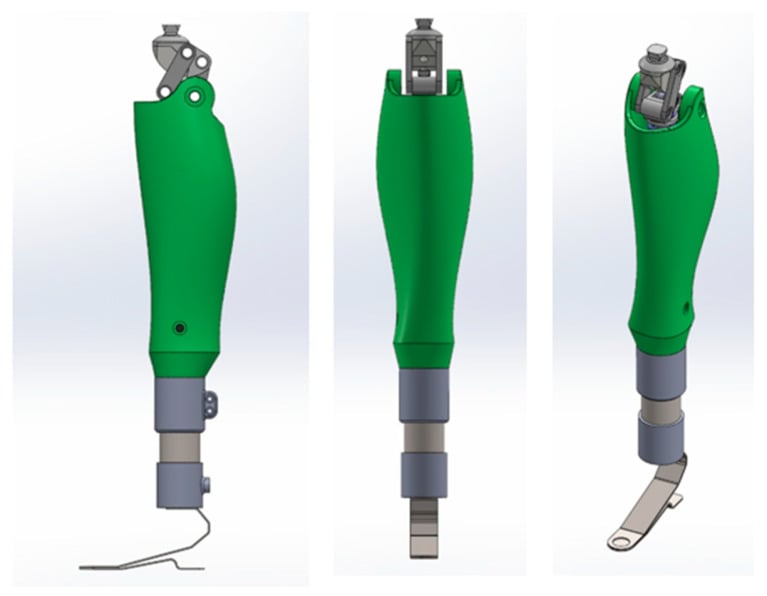
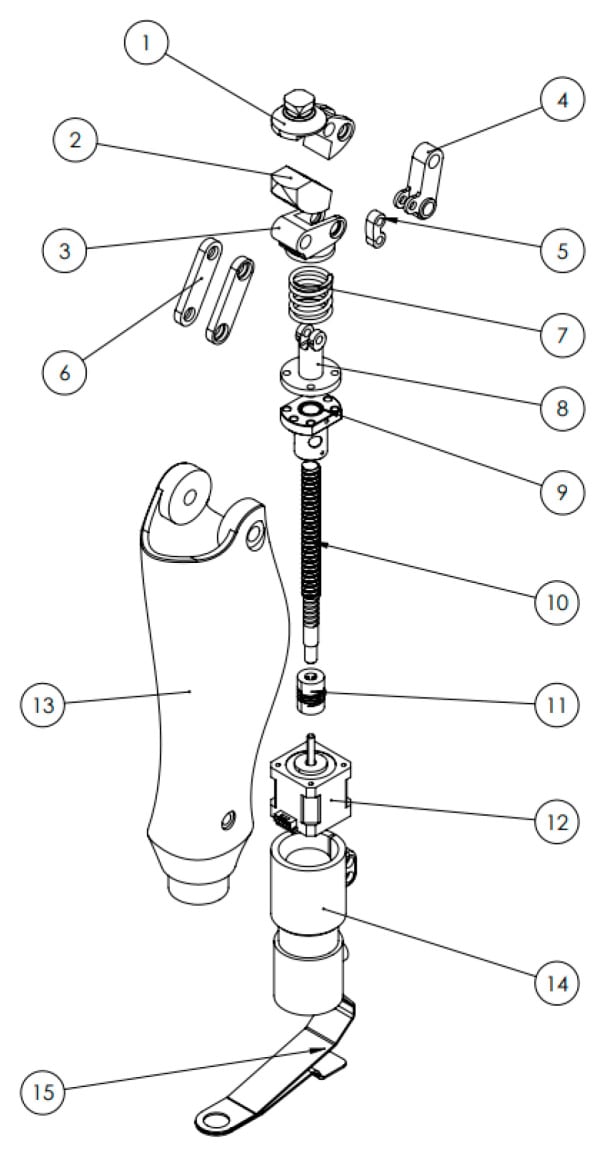
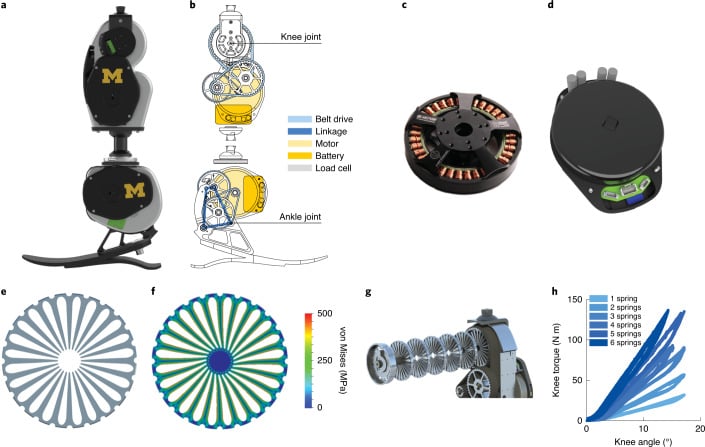
Prosthetic Feet
The prosthetic foot provides ground contact, shock absorption and energy return during gait. Selection depends on activity level, terrain requirements and the patient's goals.
SACH foot. The solid ankle cushion heel foot is the simplest design: solid construction with no ankle joint and no moving parts. Ankle motion is simulated through the gait cycle:
- Heel strike: the compressible foam heel cushion compresses, simulating plantarflexion and absorbing impact
- Midstance: the rigid structure provides stability
- Push-off: the stiff forefoot keel provides the lever for propulsion
It is durable, waterproof, low-maintenance and inexpensive, but gives no energy return, and suits K1 limited ambulators.
Heel durometer. The hardness of the heel is selected for body weight: softer for lighter or less active patients, firmer for heavier or more active ones.
SAFE foot. The stationary ankle flexible endoskeleton is a SACH variant with a flexible keel. It still has no moving parts, but allows some forefoot flexibility and a smoother rollover than the rigid SACH.
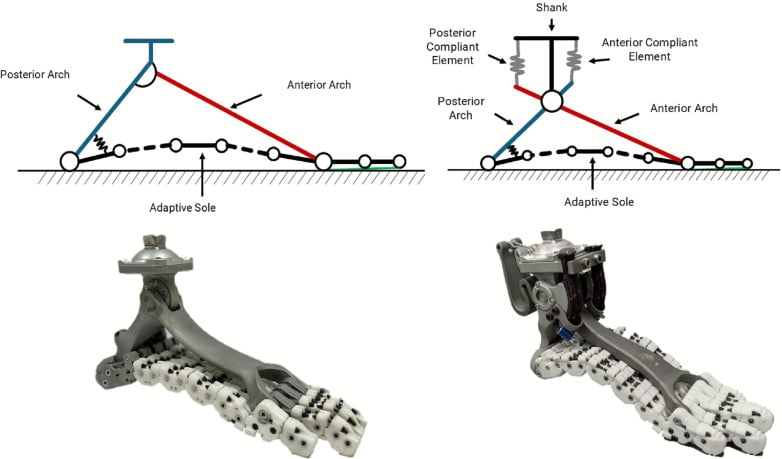
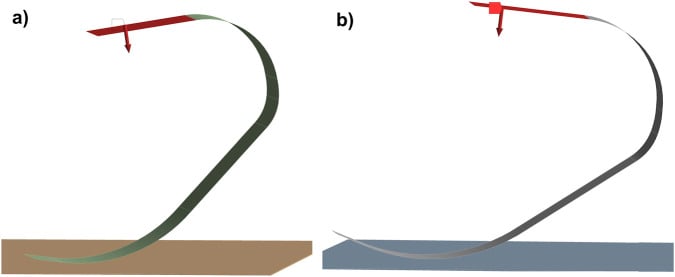
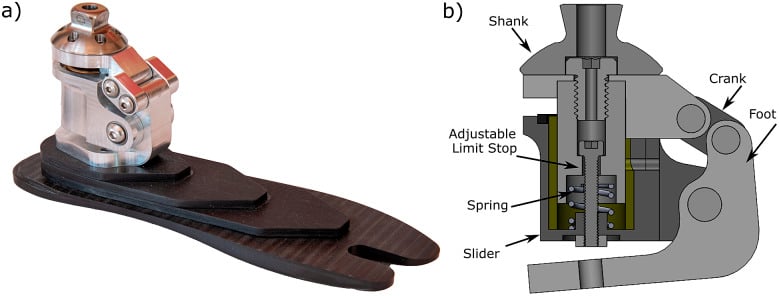
Upper Limb Prosthetics
Upper limb prosthetics present unique challenges compared with the lower limb. The hand's complexity (27 bones, 18 degrees of freedom) cannot be replicated, so prosthetic options provide partial function or cosmesis.
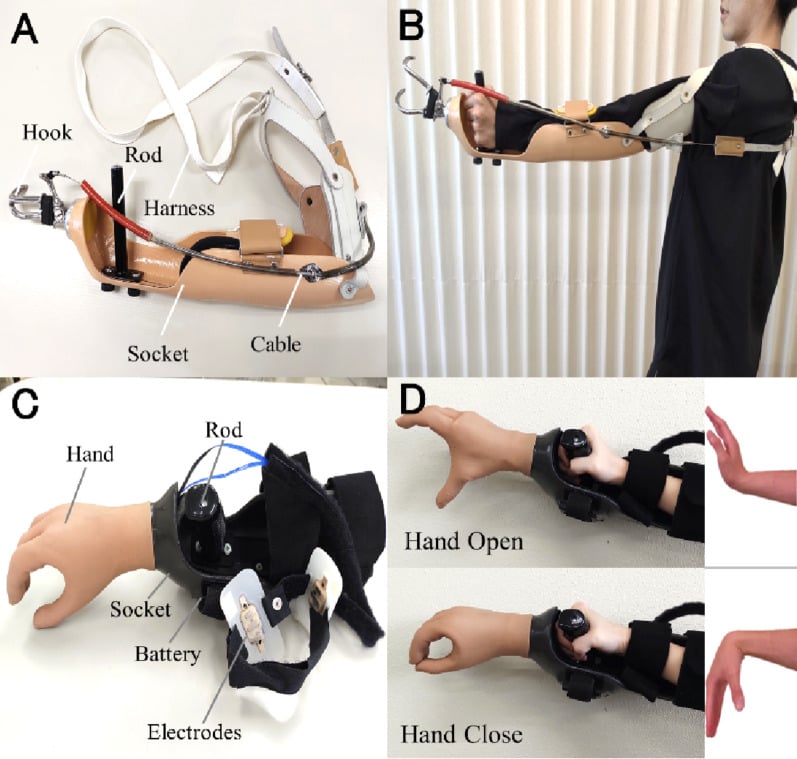
How it works. A cable and harness system captures movement of the opposite shoulder or trunk (scapular abduction, humeral flexion or chest expansion), and a Bowden cable transmits it to the terminal device. The components:
- Figure-of-8 harness: standard for transradial
- Figure-of-9 harness: for transhumeral, adding elbow control
- Wrist unit: quick disconnect for terminal devices
- Terminal device: hook or voluntary-opening hand
Feedback. Cable tension provides proprioceptive feedback: the user feels how hard they are gripping, which matters for delicate tasks. Many long-term users prefer body-powered prostheses for this feedback.
Trade-offs. Body-powered limbs are durable and reliable, cost less than myoelectric ones, come in waterproof options and work in any environment. Against that, they require body motion (harness effort), grip strength is limited (typically 20-25 lbs), the harness is visible and it can be hot and uncomfortable.
Upper Limb Prosthetic Rejection
Rates. Upper limb prostheses are rejected more often than lower limb prostheses, and rejection rises with more proximal amputation: 20-30% at transradial level and 30-50% at transhumeral level.
Reasons for rejection. They include:
- Insufficient function compared with remaining abilities
- Discomfort with socket and harness
- Weight of the prosthesis
- Appearance concerns
- Lack of sensory feedback
- Difficulty learning myoelectric control
The keys to successful upper limb prosthetic use:
- Early fitting (within 30 days if possible)
- Comprehensive training programme
- Realistic expectations counselling
- Multiple device options for different activities
- Ongoing prosthetist and therapy support
Delay beyond 6 months significantly reduces acceptance rates.
K-Level Classification and Functional Outcomes
The K-level (functional classification, K0-K4) originated in the US Medicare system but is now used internationally as a shorthand for matching prosthetic component complexity to a patient's ambulation potential. Most funding bodies worldwide (UK NHS limb-fitting services, European social-insurance schemes and private insurers) use the same functional concept even where the K0-K4 label is not the formal billing term.
- Functional Description
- Non-ambulatory, cannot use prosthesis
- Prosthetic Components
- Cosmetic prosthesis only, wheelchair
- Expected Outcomes
- No prosthetic ambulation expected
- Functional Description
- Household ambulator, transfers
- Prosthetic Components
- SACH foot, single-axis knee, pin suspension
- Expected Outcomes
- Limited indoor walking, standing
- Functional Description
- Limited community ambulator
- Prosthetic Components
- Multi-axis foot, polycentric knee
- Expected Outcomes
- Community distances, low obstacles
- Functional Description
- Unlimited community ambulator, variable cadence
- Prosthetic Components
- Dynamic response foot, hydraulic knee, vacuum suspension
- Expected Outcomes
- Variable speed, terrain adaptation
- Functional Description
- Active athlete, high-impact activities
- Prosthetic Components
- Carbon fibre foot, microprocessor knee, specialised sport components
- Expected Outcomes
- Running, sports, exceeds basic ambulation
The components in the table are typical of each level rather than confined to it: the knee section gives microprocessor knees for K3-K4 and for selected K2 patients.
Functional assessment tools. Four measure mobility potential or performance:
- Amputee Mobility Predictor (AMP/AMPnoPRO): a validated 21-item tool predicting prosthetic mobility potential, with a version performed without the prosthesis. Scores correlate with K-level, and it is used preoperatively and during rehabilitation.
- Timed Up and Go (TUG): the standard mobility measure. The patient rises from a chair, walks 3 m, returns and sits; greater than 19 seconds suggests falls risk.
- 6-minute walk test: an endurance assessment whose distance correlates with community ambulation; greater than 200 m suggests community ambulatory potential.
- L-test: a modified TUG with turns, more challenging than the TUG and a better predictor of community mobility.
Determining the K-level. Five things decide it:
- Prior functional level (pre-amputation)
- Current physical examination
- Comorbidities and healing
- Cognitive ability
- Motivation and goals
K-level can change, so reassess it at follow-up. A K2 patient may progress to K3 with training, and deteriorating health may reduce the K-level.
Endoskeletal versus Exoskeletal Construction
Prosthetic construction determines which structure carries load and whether alignment can be adjusted after assembly.
Exoskeletal ('crustacean'). The load is carried by a rigid outer shell shaped to the limb, laminated or wood. It is durable, robust and waterproof, good for heavy or harsh use, but heavy; its alignment is fixed once built, and its cosmesis is the shell shape itself.
Endoskeletal ('modular'), the modern standard. The load is carried by an internal pylon or tube (metal or carbon) connecting socket to knee or foot, covered by a soft, shaped foam cosmetic cover. It is lighter and modular, with components and alignment couplings that swap and adjust easily, and gives better cosmesis, at the cost of the cover and slightly less brute durability.
Why it matters. Almost all modern limbs are endoskeletal because adjustable alignment couplings permit static and dynamic correction. Exoskeletal designs persist mainly where ruggedness and waterproofing outweigh adjustability. Do not swap the two in the exam: the outer shell bears load in an exoskeletal limb, the internal pylon in an endoskeletal one.
Prosthetic Alignment
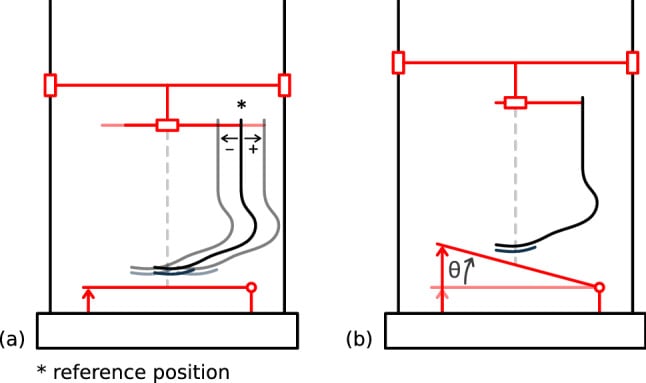
Prosthetic alignment is the spatial relationship, the angles and positions, of the socket, knee and foot. It is established in three stages:
- Bench alignment: the initial workshop setup, in which the prosthetist assembles the components to standard skeletal reference positions (built-in socket flexion and adduction, the foot under the load line, correct height) before the patient stands
- Static alignment: with the patient standing and weight-bearing, the prosthetist checks the load (plumb) line, socket position, foot-flat and height, adjusting angles and translations for a stable, comfortable stance
- Dynamic alignment: with the patient walking, the prosthetist fine-tunes to eliminate gait deviations and optimise stability, energy cost and cosmesis
Malalignment causes gait deviations, socket pressure and instability, and is only correctable on an endoskeletal limb with adjustable couplings.
Differential Diagnosis: The Painful or Failing Prosthesis
A common viva and clinic scenario is the amputee who "cannot use the leg". Distinguish socket/component problems from residual-limb pathology and central pain.
- Typical Features
- Diffuse pain, pistoning, sock-ply changes through day
- Key Discriminator
- Symptoms vary with limb volume and time of day
- Management
- Sock ply adjustment, reline/recast socket, vacuum suspension
- Typical Features
- Sharp/electric focal pain, positive Tinel over a nodule
- Key Discriminator
- Reproducible point tenderness; pain on socket pressure
- Management
- Offload, desensitisation; targeted muscle reinnervation or excision if refractory
- Typical Features
- Localised distal pain, palpable hard prominence
- Key Discriminator
- Confirmed on plain radiograph
- Management
- Socket relief; surgical revision if persistent
- Typical Features
- Pain perceived in the missing limb
- Key Discriminator
- Pain in absent body part, not the residuum
- Management
- Graded motor imagery, mirror therapy, neuropathic agents
- Typical Features
- Erythema, ulcer, discharge at pressure points
- Key Discriminator
- Visible skin lesion; folliculitis with poor hygiene
- Management
- Wound care, hygiene, socket modification, treat infection
- Typical Features
- Rest pain, poor healing, cool dysvascular stump
- Key Discriminator
- Vascular history; reduced perfusion
- Management
- Vascular review; may need proximal revision
Guidelines, Registries & Global Practice
Global Epidemiology
- Dysvascular disease (with diabetes) is the dominant cause of major limb amputation worldwide; trauma predominates in younger cohorts and in many low- and middle-income countries.
- Prevalence is rising and ageing - US modelling projects a doubling of people living with limb loss by 2050 (Ziegler-Graham). Diabetes-related amputation rates vary several-fold between and within countries, reflecting screening, foot-care and revascularisation access.
- Knee preservation (transtibial over transfemoral) is the single biggest determinant of prosthetic walking energy cost and long-term function (Waters).
Guidelines & Component-Selection Frameworks (Side by Side)
- Framework
- K0-K4 functional levels tie components to ambulation potential
- Microprocessor Knee Stance
- Funded for K3-K4; emerging evidence supports selected K2
- Framework
- Functional assessment + multidisciplinary limb-fitting centres
- Microprocessor Knee Stance
- Available via specialist centres; business-case/clinical justification
- Framework
- Evidence-based CPGs (e.g. knee selection CPG, Stevens 2018)
- Microprocessor Knee Stance
- Recommended to reduce falls and cognitive load in active users
- Framework
- Standards for prosthetics services incl. limited-resource settings
- Microprocessor Knee Stance
- Prioritises durable, maintainable components where service support is scarce
Registry & Outcome Data
- Amputation/prosthetic care is less registry-driven than arthroplasty; outcomes come from limb-loss cohorts, rehabilitation databases and device-specific trials rather than national implant registries.
- Osseointegration outcomes are tracked in specialist-centre prospective series (Brånemark): high 2-year implant survival with a substantial but mostly minor stoma-infection rate.
- Validated mobility tools (AMP/AMPnoPRO, TUG, 6-minute walk, L-test) provide standardised, internationally comparable functional outcomes.
High- vs Limited-Resource Practice
- Typical practice
- Microprocessor knees, vacuum suspension, carbon-fibre dynamic feet, osseointegration in selected centres
- Drivers
- Funding, prosthetist availability, device servicing
- Typical practice
- Durable mechanical knees, SACH feet, simple pin-lock/suspension, locally manufactured sockets
- Drivers
- Cost, maintenance capacity, supply chain, ISPO appropriate-technology principles
The same functional (K-level) logic applies everywhere - match component complexity to the patient's realistic ambulation potential and to the local capacity to fit, train and maintain the device.
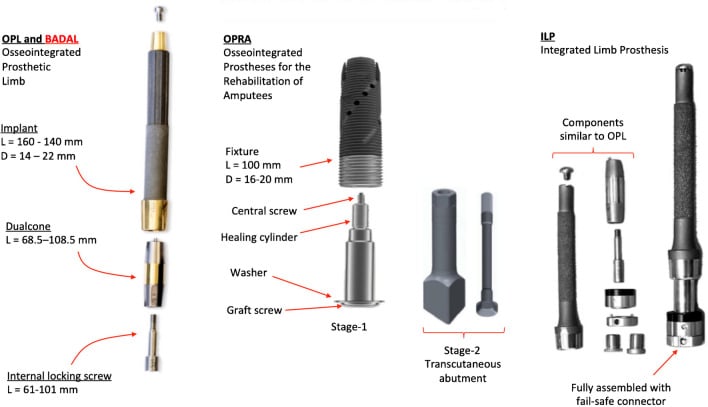
Related pages: Osseointegration is the alternative to everything on this page - it removes the socket, which is the component that fails most often, and takes on a permanent skin-penetration problem in exchange. Mangled Extremity and Limb Salvage Decision-Making and Limb Salvage Surgery Principles are the decisions taken before any of this, and the level chosen there sets the energy cost the patient pays for the rest of their life. Hip Disarticulation and Forequarter Amputation is the proximal extreme where prosthetic function becomes marginal, and Paediatric Amputee Management is where the abandonment data on this page are worst and growth changes the prescription. Phantom Limb Pain and Neuroma Management cover the two causes of a painful residual limb that no socket adjustment will fix, and Heterotopic Ossification is the one that a socket modification sometimes can. Diabetic Foot Ulcers and Diabetic Foot Infections describe the disease that produces most of the amputees actually being fitted - the population the component trials on this page largely do not study. Gait Cycle Analysis supplies the vocabulary for prosthetic alignment and for naming the deviation you are trying to correct.
Controversies & Areas of Uncertainty
Long held to be reserved for K3-K4, but a systematic review (Kannenberg) found large fall reductions and speed gains in selected K2 limited community ambulators. Funders increasingly accept trial fitting to identify responders, blurring the rigid K-level cutoff.
IRC sockets give reliable coronal control but are often uncomfortable. RCT crossover data (Kahle and Highsmith) show brimless / sub-ischial designs can match skeletal control with lower medial pressure and better comfort - the "high wall is essential" dogma is being questioned.
Marketing claims of large "70-80% energy return" overstate clinical effect. Controlled data (Hsu) show single-digit to low-double-digit efficiency gains, mainly at higher speeds, and no consistent advantage of every carbon foot over SACH at slow walking.
Osseointegration removes socket problems and improves mobility/QoL but carries a high (mostly superficial) stoma-infection rate and lifelong skin-penetration risk. Patient selection, long-term implant survival and infection management remain unsettled.
Clinical Decision Scenarios
Practise clinical reasoning and management decisions out loud
“A 45-year-old active male has undergone transtibial amputation for trauma 3 months ago. He is a construction worker who wants to return to work. What prosthetic components would you recommend for him?”
“A 72-year-old woman with diabetes and peripheral vascular disease has had a transfemoral amputation. She was previously mobile with a walking frame indoors only. What knee unit and foot would you recommend?”
“A 35-year-old transfemoral amputee reports multiple falls over the past 6 months, including one resulting in a hip fracture. He is currently using a mechanical hydraulic knee. What would you recommend?”
K-Level Classification
- K0: Non-ambulatory - cosmetic prosthesis only
- K1: Household ambulator - SACH foot, single-axis or manual lock knee
- K2: Limited community - multi-axis foot, polycentric knee
- K3: Unlimited community - dynamic response foot, hydraulic/microprocessor knee
- K4: Active athlete - specialized high-activity components
Socket Types
- Transtibial: PTB (patellar tendon bearing) vs TSB (total surface bearing)
- PTB focuses weight on patellar tendon, TSB distributes evenly
- Transfemoral: Quadrilateral (old) vs Ischial Containment (modern standard)
- Ischial containment provides better femoral control and gait
- All sockets should have total contact to prevent distal edema
Suspension Systems
- Pin lock: Simple, reliable, easy don/doff (K1-K2)
- Suction: Intimate fit, good for active (K2-K3)
- Vacuum (elevated): Best volume management, complex (K3-K4)
- Sleeve: Simple adjunct, can cause sweating
- Poor suspension causes pistoning and skin breakdown
Knee Units
- Single-axis: Simple, durable, no cadence response (K1-K2)
- Polycentric (4-bar): Inherent stability, shortens in swing (K2-K3)
- Hydraulic: Cadence-responsive, smooth gait (K3)
- Microprocessor (C-Leg/Genium): significant fall reduction, stumble recovery (K3-K4)
- Match knee to K-level - dont overprescribe or underprescribe
Prosthetic Feet
- SACH: Simple, no moving parts, compressible heel (K1)
- Single-axis: Plantarflexion for knee stability (K1-K2)
- Multi-axis: Terrain adaptation, inversion/eversion (K2-K3)
- Dynamic response: Carbon fiber; 70-80% is bench spring return, metabolic gain ~5% (K3-K4)
- Microprocessor feet: Active ankle control, stair/slope adaptation (K4)
Upper Limb Prosthetics
- Body-powered: Cable control, proprioceptive feedback, durable
- Myoelectric: EMG control, higher grip, no feedback, expensive
- Terminal devices: Hooks (functional) vs Hands (cosmetic)
- Rejection rates 20-30% for transradial, higher proximal
- Early fitting (less than 30 days) improves acceptance
Socket Problems
- Volume fluctuation: Most common - sock ply adjustment needed
- Pistoning: Socket loose or suspension inadequate
- Skin breakdown: Check fit, bony prominences, hygiene
- All problems require prosthetist review
- Socket is the most critical component - fit determines success
Evidence Base and Key Studies
Microprocessor (C-Leg) vs Mechanical Knee: Function, Performance and Preference
- A-B-A-B reversal crossover of 21 unilateral transfemoral amputees, mechanical vs Otto Bock C-Leg microprocessor knee
- Significant improvement in stair-descent score and hill-descent time with the C-Leg (P less than .01)
- Significant reduction in self-reported frequency of stumbles and falls and frustration with falling (P less than .05)
- Reduced reported difficulty multitasking while walking
- Subject satisfaction significantly greater with the C-Leg than the mechanical knee (P less than .001)
Energy Cost of Walking by Level of Amputation (Landmark Study)
- Compared gait and energy cost in 70 unilateral traumatic and vascular amputees vs 40 normal controls
- Performance was significantly better the more distal the amputation (Syme greater than below-knee greater than above-knee)
- Energy cost rises sharply moving from transtibial to transfemoral level
- Amputees self-select a slower comfortable walking speed to limit metabolic cost
- Conclusion: when preserving function, amputate at the lowest feasible level
Physiological Cost of Walking/Running with Different Prosthetic Feet
- Repeated-measures trial in 5 active unilateral transtibial amputees across treadmill walking and running speeds
- Compared SACH foot, Flex-Foot, and Re-Flex Vertical Shock Pylon (VSP)
- Re-Flex VSP improved energy cost vs SACH/Flex-Foot: ~5% walking, ~11% running
- Gait efficiency improved ~6% walking and ~9% running with the VSP
- No significant difference between Flex-Foot and SACH in this cohort